ExenatideResearch guide
The first-in-class GLP-1 receptor agonist, derived from Gila monster venom and now largely superseded by newer agents
Half-life
~2.4 hours (Byetta); once-weekly extended-release (Bydureon)
Typical Dose
Byetta: 5-10mcg twice daily before meals. Bydureon: 2mg SC once weekly.
Format
Injectable
Purity
Pharmaceutical grade (prescription drug)
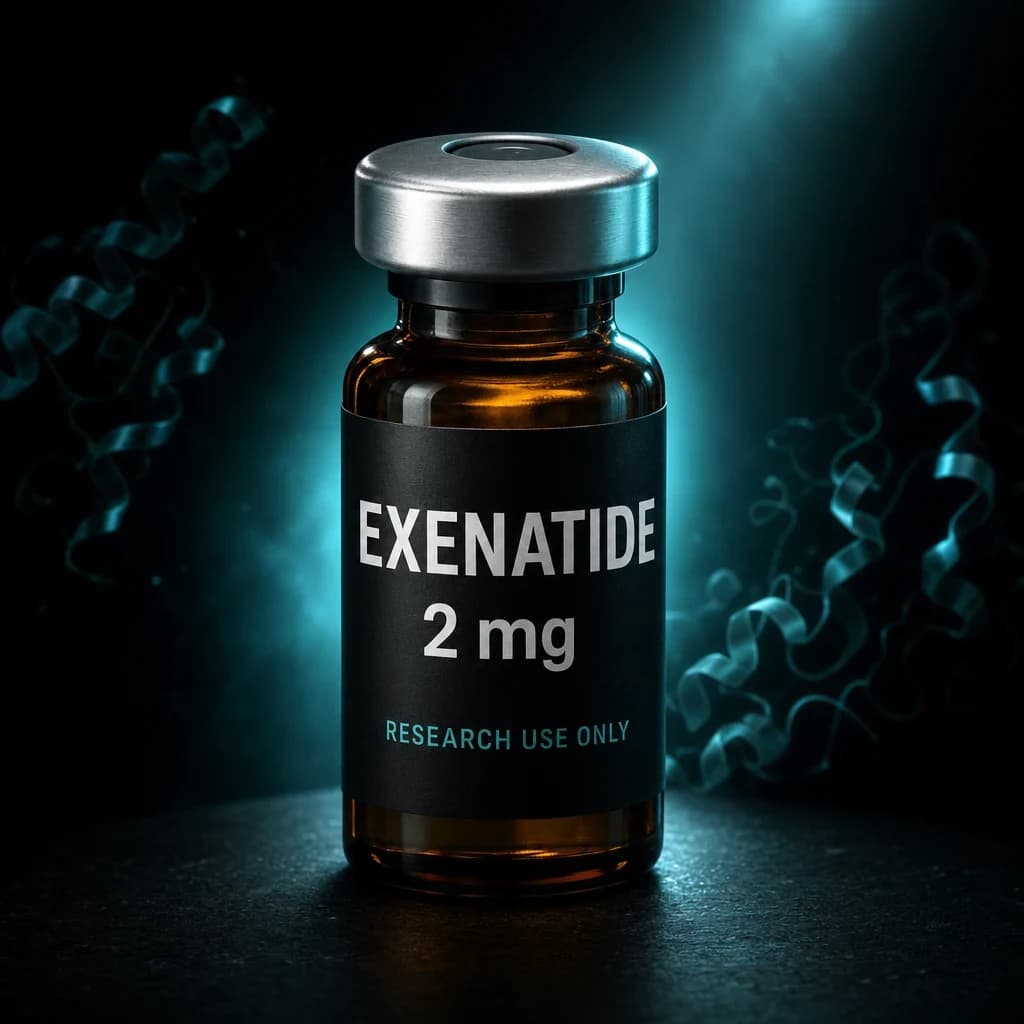
Overview
Exenatide is a synthetic copy of exendin-4, a 39-amino-acid peptide first isolated from the venom of the Gila monster (Heloderma suspectum) [1]. Approved by the FDA in 2005 as Byetta, it was the first GLP-1 receptor agonist ever brought to market. The twice-daily Byetta pen was later joined by Bydureon, an extended-release formulation dosed once weekly [5]. Across its registration trials, adding exenatide to metformin, a sulfonylurea, or both lowered HbA1c by roughly 0.8% and produced about 2.8 kg of weight loss over 30 weeks [2,3,4]. It works, but it is no longer front line. The once-weekly version was inferior to liraglutide on glycemic control in DURATION-6 [6], and the large EXSCEL cardiovascular outcomes trial found no significant reduction in major cardiovascular events [7]. Newer agents such as semaglutide and tirzepatide now deliver larger weight and glucose effects with simpler dosing, so exenatide is rarely a first choice today.
Mechanism
Exenatide is a GLP-1 receptor agonist. Its parent molecule, exendin-4, shares roughly half its sequence with human GLP-1 but resists breakdown by the DPP-4 enzyme, so it keeps activating the receptor far longer than the native hormone [1]. Receptor activation triggers glucose-dependent insulin secretion, suppresses glucagon, slows gastric emptying, and increases satiety. Because that insulin release only happens when glucose is elevated, the risk of hypoglycemia on its own stays low. Byetta's short half-life of about 2.4 hours requires twice-daily injections before meals, while Bydureon encapsulates exenatide in biodegradable microspheres that release it slowly for once-weekly dosing [5].
Researched benefits
- First FDA-approved GLP-1 receptor agonist (2005), backed by two decades of clinical data
- Glucose-dependent insulin release keeps standalone hypoglycemia risk low
- Modest weight reduction of roughly 2-3 kg alongside HbA1c improvement
- Once-weekly Bydureon option for people who want fewer injections
- Resists DPP-4 degradation, extending receptor activation beyond native GLP-1
Frequently asked
Byetta vs Bydureon: what's the difference?
Both are exenatide, but the delivery differs. Byetta is immediate-release and injected twice daily within 60 minutes before the morning and evening meals. Bydureon packages the same peptide into slow-dissolving microspheres, so a single 2mg injection lasts a full week. DURATION-1 found the once-weekly version produced slightly greater HbA1c reduction than twice-daily dosing, with fewer injections.
Exenatide vs semaglutide: which is stronger?
Semaglutide is substantially more effective. Exenatide produces around 2-3 kg of weight loss and modest HbA1c reduction, while semaglutide delivers roughly 15% body weight reduction in the STEP trials plus larger glucose improvements. Semaglutide's ~7-day half-life also allows once-weekly dosing without the microsphere technology Bydureon relies on. For most people, exenatide has been eclipsed by semaglutide and tirzepatide.
Does exenatide really come from Gila monster venom?
Yes. Exendin-4, the peptide exenatide is copied from, was isolated in 1992 from the venom of the Gila monster, a venomous lizard native to the southwestern United States and Mexico [1]. Researchers noticed the reptile could go long stretches between meals, and the peptide in its venom turned out to activate the human GLP-1 receptor while resisting the enzyme that rapidly degrades native GLP-1. The commercial drug is fully synthetic. No lizards are involved in manufacturing.
What is the half-life of exenatide?
Byetta has a short half-life of about 2.4 hours, which is why it needs twice-daily injections timed to meals. Bydureon sidesteps this with an extended-release microsphere formulation that steadily releases exenatide over a week, allowing once-weekly dosing despite using the same underlying peptide.
Is exenatide still FDA approved and prescribed?
Exenatide is an FDA-approved prescription medication, first cleared in 2005. It is a legitimate diabetes drug, not a research chemical. That said, it is prescribed far less often now that semaglutide, tirzepatide, and dulaglutide offer greater efficacy with once-weekly dosing, and its manufacturer has wound down some formulations. Treat it as a historically important first-in-class agent rather than a current go-to.
How is exenatide injected and dosed?
Both forms are subcutaneous injections into the abdomen, thigh, or upper arm. Byetta starts at 5mcg twice daily for the first month, then increases to 10mcg twice daily, each dose given within 60 minutes before a meal. Bydureon is a fixed 2mg dose once weekly on the same day each week. Neither is meant for intravenous or intramuscular use.
Scientific Literature
References
- [1]
Eng J, Kleinman WA, Singh L, et al. (1992). Isolation and characterization of exendin-4, an exendin-3 analogue, from Heloderma suspectum venom.
Journal of Biological Chemistry · PubMed: 1313797
- [2]
DeFronzo RA, Ratner RE, Han J, et al. (2005). Effects of exenatide (exendin-4) on glycemic control and weight over 30 weeks in metformin-treated patients with type 2 diabetes.
Diabetes Care · PubMed: 15855572
- [3]
Buse JB, Henry RR, Han J, et al. (2004). Effects of exenatide (exendin-4) on glycemic control over 30 weeks in sulfonylurea-treated patients with type 2 diabetes.
Diabetes Care · PubMed: 15504997
- [4]
Kendall DM, Riddle MC, Rosenstock J, et al. (2005). Effects of exenatide (exendin-4) on glycemic control over 30 weeks in patients with type 2 diabetes treated with metformin and a sulfonylurea.
Diabetes Care · PubMed: 15855571
- [5]
Drucker DJ, Buse JB, Taylor K, et al. (2008). Exenatide once weekly versus twice daily for the treatment of type 2 diabetes (DURATION-1).
The Lancet · PubMed: 18782641
- [6]
Buse JB, Nauck M, Forst T, et al. (2013). Exenatide once weekly versus liraglutide once daily in patients with type 2 diabetes (DURATION-6).
The Lancet · PubMed: 23141817
- [7]
Holman RR, Bethel MA, Mentz RJ, et al. (2017). Effects of Once-Weekly Exenatide on Cardiovascular Outcomes in Type 2 Diabetes (EXSCEL).
New England Journal of Medicine · PubMed: 28910237
Citations are provided for educational purposes. Always verify primary sources before drawing research conclusions.
Keep researching
Next steps for Exenatide
The compound page is the overview. Charts, certificates, and the vendor audit sit one click away.
Vendor
Ascension Peptides review
The COA audit and the ENHANCED 50% code for injectable research peptides.
Read the reviewArticle
GLP-1s for Chronic Migraine: What the Braca Liraglutide Pilot and IIH Read-Across Show
A deeper read that sits next to the Exenatide guide.
Read articleTool
Reconstitution calculator
Convert vial size and bacteriostatic water into syringe units.
Open calculatorReady to start your research
Get Exenatide from Ascension Peptides
COA-verified, US-based, discreet shipping. Use code ENHANCED for 50% off your entire order.
Buy Exenatide now