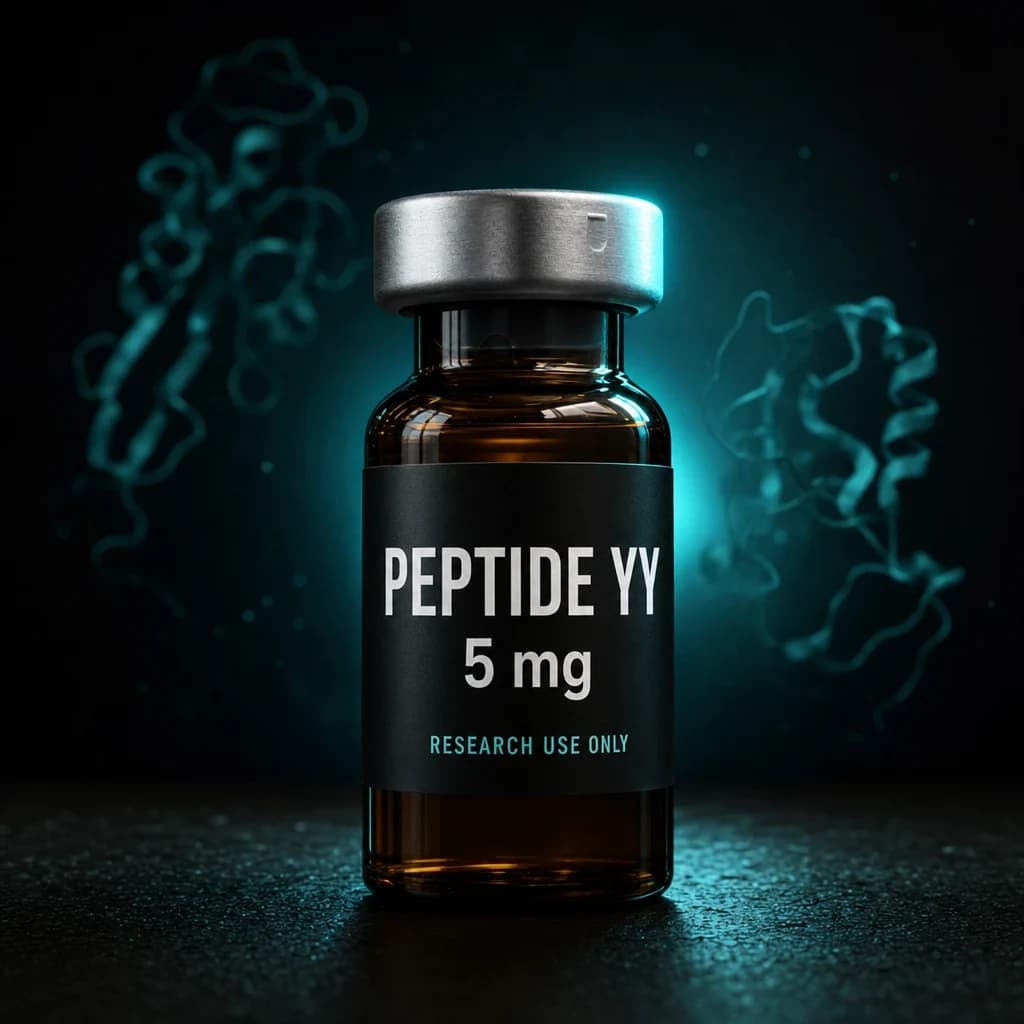
Peptide YYResearch guide
Gut satiety hormone (PYY 3-36) and Y2 receptor agonist studied for appetite suppression
Half-life
~8-30 minutes (short circulating half-life of PYY 3-36)
Typical Dose
Research context: human trials used ~0.8pmol/kg/min IV infusion
Format
Injectable
Purity
≥98%
Overview
Peptide YY (PYY) is a 36-amino-acid gut hormone released from intestinal L-cells after a meal, co-secreted with GLP-1 in proportion to the calories eaten [1]. Its active form, PYY 3-36, is a Y2 receptor agonist that suppresses appetite: a physiological infusion reduced food intake by 33% over 24 hours in lean volunteers [1], and by roughly 30% in obese subjects, showing that obesity is not a PYY-resistant state [2]. PYY is one of the main satiety signals that climbs after Roux-en-Y gastric bypass, which helps explain the sharp appetite drop that follows bariatric surgery [4,5]. As a standalone drug it has struggled. A short circulating half-life and dose-limiting nausea stalled the early obesity programs, so PYY today is studied mainly as a satiety hormone and as a partner to GLP-1 rather than as an approved weight-loss medicine [3].
Mechanism
PYY is secreted as PYY 1-36 and rapidly cleaved by DPP-4 into PYY 3-36, the Y2 receptor-selective form [1]. PYY 3-36 acts on presynaptic Y2 receptors on hypothalamic arcuate NPY/AgRP neurons, lowering orexigenic drive and shifting the balance toward the anorexigenic POMC pathway [1]. This makes it a physiological counterweight to ghrelin, the hunger hormone: ghrelin rises before meals to trigger eating, while PYY rises after meals to signal fullness. Because PYY and GLP-1 are co-released from the same L-cells and inhibit food intake additively, dual PYY plus GLP-1 approaches remain an active area of obesity research [3].
Researched benefits
- Postprandial satiety signal: cut 24-hour food intake ~33% at physiological doses [1]
- Appetite suppression preserved in obese subjects (~30% intake reduction) [2]
- Additive with GLP-1 on food intake, supporting co-agonist research [3]
- Key mediator of reduced appetite after gastric bypass surgery [4,5]
- Y2 receptor selectivity, a mechanism distinct from GLP-1 based approaches [1]
Frequently asked
What is Peptide YY?
Peptide YY is a 36-amino-acid hormone released from L-cells in the lower gut after eating. Circulating levels rise in proportion to meal calories, and it acts as a satiety signal that tells the brain you are full. It is a research compound and physiological hormone, not an approved weight-loss drug.
How is PYY different from ghrelin?
They are opposites. Ghrelin is the hunger hormone that peaks before meals to drive you to eat, while PYY is a fullness hormone that rises after meals to reduce appetite. In appetite research the two are often studied together as a push-pull system regulating food intake.
What is PYY 3-36?
PYY is secreted as PYY 1-36, then the enzyme DPP-4 trims it to PYY 3-36. That shorter form is selective for the Y2 receptor and is the fragment responsible for suppressing appetite. In Batterham's 2002 Nature study, infusing PYY 3-36 to normal post-meal levels reduced food intake by about 33% over 24 hours.
Why hasn't PYY become a weight-loss drug?
Two problems. The native peptide clears from the blood in minutes, so effects are brief, and the doses needed to curb appetite tend to cause nausea. Early obesity programs stalled on these limits, which is why interest has shifted toward longer-acting, better-tolerated analogues rather than native PYY.
Can PYY be combined with GLP-1?
Yes, and this is the most active line of research. PYY and GLP-1 are co-released from the same gut cells, and Neary's 2005 study found they inhibit food intake additively, with about a 27% reduction in energy intake when given together in humans. That additive effect is the rationale behind PYY plus GLP-1 co-agonist development.
How is PYY linked to bariatric surgery?
Roux-en-Y gastric bypass sharply raises post-meal PYY and GLP-1, favoring an anorectic, low-appetite state. le Roux's work identified this gut-hormone surge as a key reason bypass patients eat less and keep weight off, whereas patients losing similar weight through gastric banding do not show the same rise.
Scientific Literature
References
- [1]
Batterham RL, Cowley MA, Small CJ, et al. (2002). Gut hormone PYY(3-36) physiologically inhibits food intake.
Nature · PubMed: 12167864
- [2]
Batterham RL, Cohen MA, Ellis SM, et al. (2003). Inhibition of food intake in obese subjects by peptide YY3-36.
New England Journal of Medicine · PubMed: 12954742
- [3]
Neary NM, Small CJ, Druce MR, et al. (2005). Peptide YY3-36 and glucagon-like peptide-1(7-36) inhibit food intake additively.
Endocrinology · PubMed: 16150917
- [4]
le Roux CW, Aylwin SJB, Batterham RL, et al. (2006). Gut hormone profiles following bariatric surgery favor an anorectic state, facilitate weight loss, and improve metabolic parameters.
Annals of Surgery · PubMed: 16371744
- [5]
le Roux CW, Welbourn R, Werling M, et al. (2007). Gut hormones as mediators of appetite and weight loss after Roux-en-Y gastric bypass.
Annals of Surgery · PubMed: 17968169
Citations are provided for educational purposes. Always verify primary sources before drawing research conclusions.
Keep researching
Next steps for Peptide YY
The compound page is the overview. Charts, certificates, and the vendor audit sit one click away.
Vendor
Ascension Peptides review
The COA audit and the ENHANCED 50% code for injectable research peptides.
Read the reviewTool
Reconstitution calculator
Convert vial size and bacteriostatic water into syringe units.
Open calculatorReady to start your research
Get Peptide YY from Ascension Peptides
COA-verified, US-based, discreet shipping. Use code ENHANCED for 50% off your entire order.
Buy Peptide YY now