At a glance
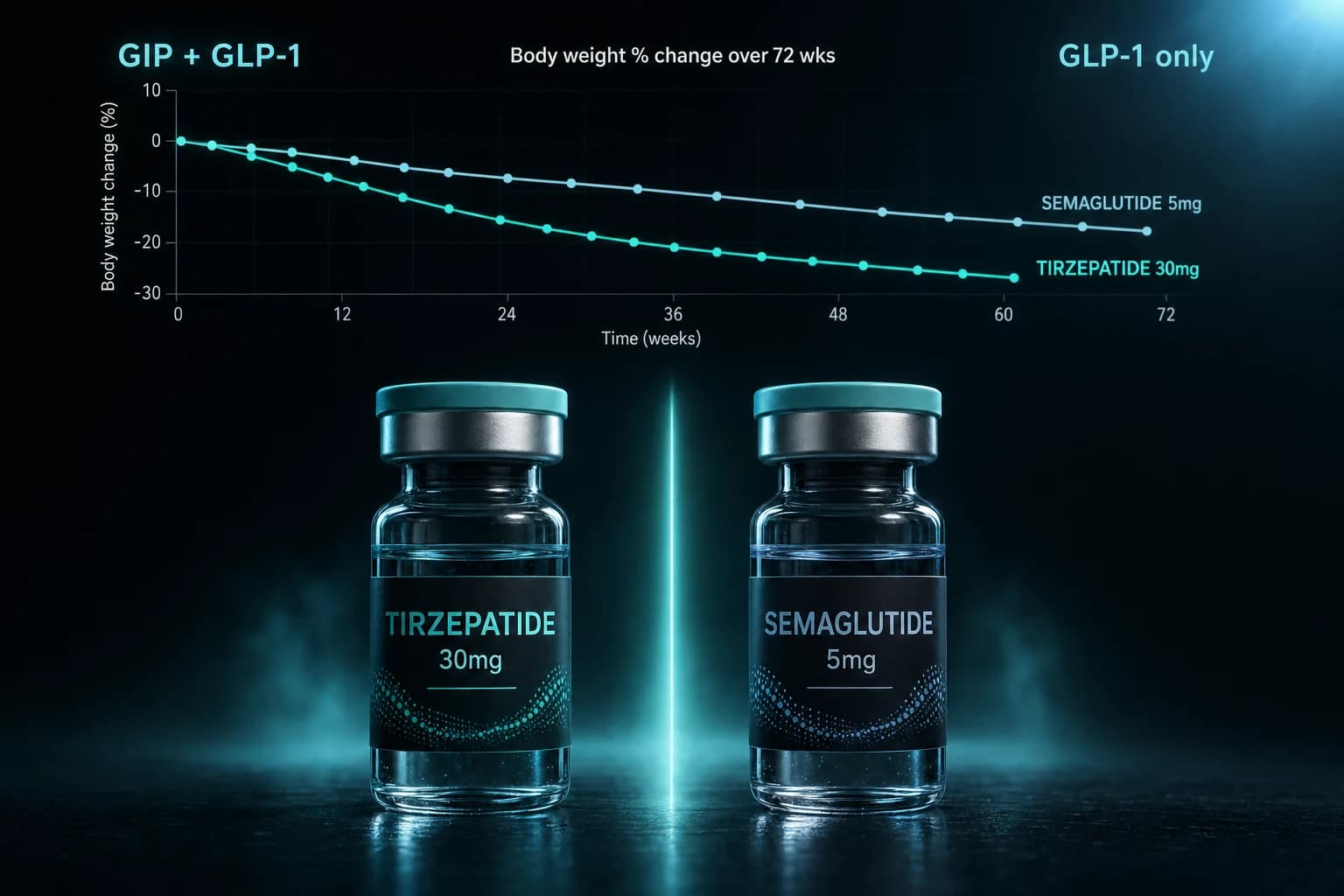
- Tirzepatide produced 47% greater weight loss than semaglutide in SURMOUNT-5
- Semaglutide has the only placebo-controlled MACE data (20% reduction in SELECT)
- GI discontinuation was lower with tirzepatide (2.7% vs 5.6%) at max dose
- Tirzepatide is dual GLP-1/GIP; semaglutide is GLP-1 only
- Oral semaglutide (Wegovy) approved Dec 2025; no oral tirzepatide exists
The headline
If you're comparing Tirzepatide and Semaglutide for weight management research, the short answer is: Tirzepatide produces greater weight reduction in every head-to-head trial to date, while Semaglutide has the longer clinical track record and the landmark SELECT cardiovascular outcomes data.
We now have two direct comparisons. The first, SURPASS-2, tested patients with type 2 diabetes. The second, SURMOUNT-5, tested patients with obesity and no diabetes. Both pointed the same direction.
SURPASS-2: the diabetes head-to-head
SURPASS-2 (NEJM, 2021; n = 1,879) randomized adults with type 2 diabetes (mean baseline HbA1c 8.28%, mean weight 93.7 kg) to Tirzepatide 5/10/15 mg or Semaglutide 1 mg weekly for 40 weeks.
Weight loss:
- Tirzepatide 15 mg: -11.2 kg (treatment difference vs. semaglutide: -6.2 kg)
- Tirzepatide 10 mg: -9.3 kg (difference: -4.1 kg)
- Tirzepatide 5 mg: -7.6 kg (difference: -1.7 kg)
- Semaglutide 1 mg: -5.7 kg
HbA1c reduction: -2.30, -2.24, and -2.01 percentage points for tirzepatide 15/10/5 mg versus -1.86 for semaglutide (p < 0.001 for the two higher doses). All three tirzepatide arms were statistically noninferior and superior to semaglutide on both glycemic control and weight.
SURMOUNT-5: the obesity rematch
SURMOUNT-5 (NEJM, 2025; n = 751) directly compared maximum tolerated doses in adults with obesity but without diabetes over 72 weeks:
- Tirzepatide (10-15 mg): -20.2% body weight (-22.8 kg)
- Semaglutide (1.7-2.4 mg): -13.7% body weight (-15.0 kg)
Tirzepatide delivered 47% greater relative weight loss. Waist circumference shrank by 18.4 cm vs. 13.0 cm. At the 25% weight-loss threshold, 31.6% of tirzepatide patients qualified compared to 16.1% on semaglutide. GI-related discontinuation was actually lower with tirzepatide (2.7% vs. 5.6%).
SURMOUNT-1: the placebo baseline
For context, SURMOUNT-1 (NEJM, 2022; n = 2,539; 72 weeks) tested tirzepatide against placebo in adults with obesity. Mean weight reductions were 16.0% (5 mg), 21.4% (10 mg), and 22.5% (15 mg) versus 2.4% for placebo. At the highest dose, 57% of participants lost at least 20% of body weight and nearly 40% lost 25% or more.
Mechanism difference
Semaglutide is a selective GLP-1 receptor agonist. It mimics the incretin hormone GLP-1, reducing appetite, slowing gastric emptying, and increasing glucose-dependent insulin secretion.
Tirzepatide is a dual GIP/GLP-1 receptor agonist, a 39-amino-acid synthetic peptide with a C20 fatty di-acid moiety that enables once-weekly dosing. Structurally, its engagement is imbalanced: it binds the GIP receptor with affinity similar to native GIP, while at the GLP-1 receptor it shows biased agonism favoring cAMP signaling over beta-arrestin recruitment (JCI Insight, 2020). That biased signaling may improve GLP-1 receptor trafficking and amplify the cellular response compared to a balanced agonist.
The practical consequence: co-activation of GIP and GLP-1 produces a synergistic insulin response and glucagonostatic effect that exceeds either hormone alone. Insulin sensitivity improvements with tirzepatide also appear partly independent of weight loss, suggesting dual agonism confers distinct metabolic mechanisms beyond what GLP-1 alone provides.
Think of it this way: Semaglutide pulls one lever (appetite suppression + insulin). Tirzepatide pulls two (appetite + insulin + metabolic rate).
Half-life and dosing
| | Tirzepatide | Semaglutide | | Half-life | ~5 days | ~7 days | | Dose frequency | Once weekly | Once weekly | | Typical dose range | 2.5-15 mg | 0.25-2.4 mg | | Titration period | 20 weeks to max | 16-20 weeks to max | | Vial size | 5-15 mg | 2-5 mg |
Both use weekly subcutaneous dosing. The longer half-life of Semaglutide means steadier plasma levels; Tirzepatide has slightly more peak-trough variation but still reaches steady state by week 4-5.
You can model this yourself in the half-life visualizer.
Side effects
Both compounds share the GLP-1 class side effects: nausea (most common), diarrhea, vomiting, constipation. These usually peak in the first 2-4 weeks after a dose increase and resolve with continued use.
In SURPASS-2 (the only trial that tested identical populations on both drugs), side effect rates were closely matched:
- Nausea: tirzepatide 17-22% across doses vs. semaglutide 18%
- Diarrhea: tirzepatide 13-16% vs. semaglutide 12%
- Vomiting: tirzepatide 6-10% vs. semaglutide 8%
At equivalent efficacy doses, the rates are essentially comparable. However, when semaglutide is pushed to the higher 2.4 mg weight-management dose (as in the STEP trials), nausea incidence climbs to approximately 44%. Tirzepatide at its maximum 15 mg dose stays in the 22% range, meaning it achieves greater weight loss with a meaningfully lower nausea burden at top dose.
SURMOUNT-5 reinforced this: GI adverse events leading to permanent discontinuation were 2.7% for tirzepatide vs. 5.6% for semaglutide. The GIP component appears to add efficacy without proportionally increasing tolerability costs.
Cardiovascular outcomes
This is where semaglutide held a clear lead until late 2025.
SELECT (NEJM, 2023): This landmark trial enrolled 17,604 adults (BMI >= 27, established CVD, no diabetes) across 41 countries with a mean follow-up of 39.8 months. Semaglutide 2.4 mg reduced three-point MACE (CV death, nonfatal MI, nonfatal stroke) by 20% versus placebo (HR 0.80; 95% CI 0.72-0.90; p < 0.001). MACE occurred in 6.5% of the semaglutide group versus 8.0% on placebo. This made Wegovy the first weight-management compound with a primary CV benefit indication.
SURPASS-CVOT (NEJM, December 2025): The gap has narrowed. This trial (n > 13,000; median follow-up 4 years) compared tirzepatide to dulaglutide (not placebo) in patients with T2D and atherosclerotic CVD. Tirzepatide reduced three-point MACE by 8% versus dulaglutide (HR 0.92; 95.3% CI 0.83-1.01), meeting noninferiority. All-cause mortality was 16% lower with tirzepatide. The FDA is reviewing Mounjaro for a MACE-reduction indication in T2D, with a decision expected in 2026.
Semaglutide still has the only placebo-controlled MACE data in obesity without diabetes, but tirzepatide's CV profile is no longer an open question.
2025-2026 regulatory updates
The approval picture has shifted substantially:
- Semaglutide (Jan 2025): FDA expanded Ozempic's label to cover reduction of kidney disease worsening and kidney failure in adults with T2D and CKD.
- Semaglutide (Dec 2025): FDA approved oral Wegovy (once-daily semaglutide tablet) for chronic weight management, the first oral GLP-1 approved for that indication.
- Semaglutide (2026): Higher-dose injectable Wegovy HD (7.2 mg) approved under the FDA's National Priority Voucher pilot.
- Tirzepatide (late 2024): Zepbound became the first GLP-1-class medication approved for obstructive sleep apnea.
- Tirzepatide (2026): Mounjaro MACE-reduction indication in T2D under FDA review, decision expected mid-2026. No oral tirzepatide formulation has been approved.
Which should you research?
Choose Tirzepatide if:
- Weight reduction magnitude is the primary endpoint
- You're studying metabolic rate effects or dual incretin signaling
- You want the current best-in-class efficacy with favorable GI tolerability at top dose
Choose Semaglutide if:
- Cardiovascular outcomes in obesity (without diabetes) are relevant
- You need the most extensive safety database and longest follow-up
- You want oral dosing options (Rybelsus, oral Wegovy)
- You're modeling kidney or liver (MASH) endpoints
Ready to start?
Both Tirzepatide and Semaglutide are available from Ascension Peptides with 50% off using code ENHANCED. Cross-check lot purity in the lab-tests library before you order.