At a glance
- 25-40% of weight lost on GLP-1 drugs is lean mass across STEP 1 and SURMOUNT-1
- The ratio tracks caloric restriction, but the absolute losses are larger
- Resistance training + 1.2-1.6 g/kg protein preserves most lean mass
- Bimagrumab + semaglutide cut lean mass loss from 7.4% to 2.9% in BELIEVE
- No peptide has a published RCT for muscle preservation during GLP-1 therapy
The short answer
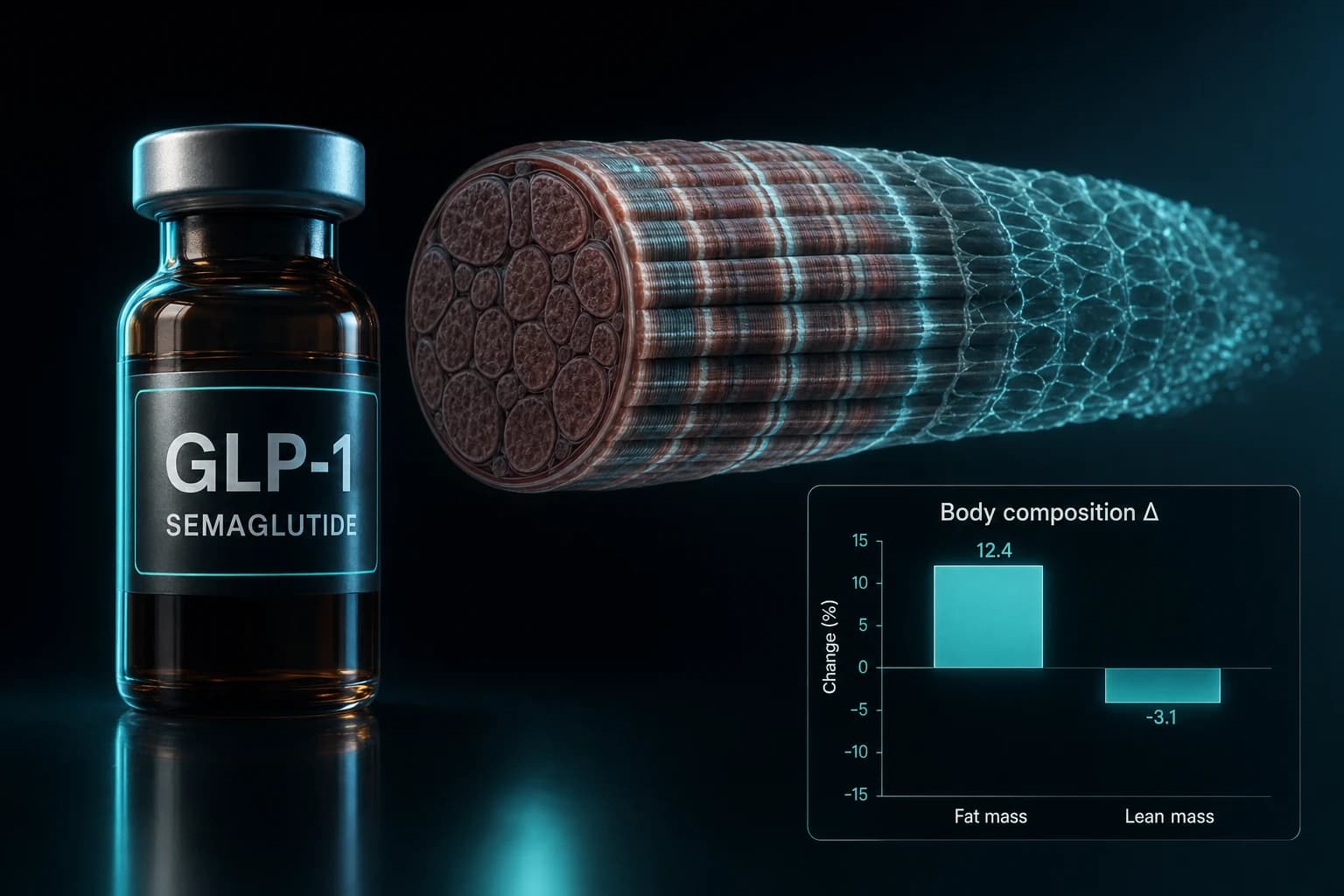
About a quarter of the weight lost on semaglutide or tirzepatide is lean mass. The 2024 network meta-analysis of 22 randomized trials put the pooled contribution at roughly 25% of total weight loss across the GLP-1 class, close to the ratio you see with plain caloric restriction (Zhang et al., Metabolism 2024). Because GLP-1 therapy produces bigger absolute weight losses than most non-surgical interventions, the absolute drop in lean mass is also bigger.
Whether that matters depends on who you started as, what you are trying to protect, and what you plan to do once you hit your goal weight. The research on preserving lean mass during GLP-1 therapy has moved fast since 2023. Here is what actually changed.
How much lean mass people lose on GLP-1 therapy
Body composition data across the major phase 3 obesity trials converges on a relatively consistent pattern. The proportion of lean mass loss sits between about 25% and 40% of total weight lost, depending on the drug, the dose, the duration, and the sub-study population.
| Trial | Drug + dose | Weight change | Fat mass change | Lean mass change | % of weight loss that was lean |
|---|---|---|---|---|---|
| STEP 1 (DEXA substudy, n=140) | Semaglutide 2.4 mg | −15.0% | −19.3% | −9.7% | ~30% |
| SURMOUNT-1 (DEXA substudy, n=160) | Tirzepatide (pooled) | −21.3% | −33.9% | −10.9% | ~25% |
| SEMALEAN (prospective, n=115) | Semaglutide 2.4 mg | −13% at 12 mo | −18% | −3 kg (stable after mo 7) | ~23% |
| BELIEVE | Semaglutide 2.4 mg arm | −15.7% | 71.8% of loss was fat | −7.4% lean mass | ~28% |
| BELIEVE | Bimagrumab + semaglutide | −22.1% | 92.8% of loss was fat | −2.9% lean mass | ~7% |
STEP 1's 140-participant body composition arm showed semaglutide producing a 19.3% drop in total fat mass, a 27.4% drop in visceral fat, and a 9.7% drop in total lean mass over 68 weeks (Wilding et al., NEJM 2021).
SURMOUNT-1's substudy showed tirzepatide driving about three times more fat mass loss than lean mass loss, with roughly 75% of body weight lost coming from fat and 25% from lean tissue (Look et al., Diabetes Obesity Metabolism 2025; main trial Jastreboff et al., NEJM 2022).
The SEMALEAN prospective cohort (n=115) showed lean mass dropping about 3 kg at 7 months and then stabilizing through month 12, with handgrip strength actually improving by 4.5 kg and the prevalence of sarcopenic obesity falling from 49% at baseline to 33% at month 12 (Alissou et al., Diabetes Obesity Metabolism 2026).
Those numbers do not tell the same story at first glance. Resolving the discrepancy is the next question.
Why the trial numbers disagree
Headline ratios depend on three things that vary across studies.
Who they enrolled. Participants starting with higher fat mass have more room to lose fat preferentially, which pulls the lean mass ratio down. Younger participants preserve more muscle than older ones at the same weight loss rate. Populations with higher baseline sarcopenia can look like they are losing more lean mass because their starting lean mass was already lower in absolute terms.
How fast they dropped weight. Faster weight loss tilts composition toward more lean mass loss. GLP-1 drugs that produce deeper weight loss (tirzepatide, retatrutide) drive bigger total losses, but the percentage of lean mass tends to hold roughly constant once you adjust for the rate.
What they measured. DEXA is the standard method in these trials, but DEXA-derived lean mass includes water, organs, connective tissue, and skeletal muscle together. Some of the early lean mass drop on GLP-1 therapy reflects water shifts and reduced glycogen storage rather than contractile tissue loss. Reviews that apply a correction for the non-muscle component of fat-free mass often end up closer to 10 to 15% skeletal muscle contribution than the headline 25 to 40% lean mass figure (Neeland et al., Diabetes Obesity Metabolism 2024).
Note: Lean mass and muscle mass are not synonyms. Lean mass includes water, organs, bone, and connective tissue. Published estimates of skeletal muscle loss on GLP-1 therapy are consistently lower than the lean mass estimates that make the headlines.
Is GLP-1 lean mass loss different from caloric restriction?
For the most part, no. The ratio of lean to fat loss on GLP-1 drugs looks close to what you see with diet-induced weight loss at the same magnitude (Prado et al., Lancet Diabetes Endocrinol 2024). A 15% weight loss from diet alone typically gives you something in the range of 25 to 30% lean tissue loss. A 15% weight loss on semaglutide gives you close to the same number.
Where GLP-1 therapy differs is at the extremes. Tirzepatide at 15 mg and retatrutide in phase 2 produce weight losses that diet alone almost never achieves outside of hospital-based protocols. The ratio stays similar, but the absolute numbers add up faster. A person on tirzepatide for 72 weeks losing 21% of body weight and ending up 10 to 11% lighter on lean mass is losing roughly twice the absolute lean mass of a typical dieter who drops 8 to 10%.
This matters most for two groups. Older adults starting from a sarcopenic-obese baseline are the first, because they have less lean mass reserve to give up. High-functioning athletes or heavily muscular individuals considering GLP-1 therapy for fat loss are the second, because their body composition goals usually depend on protecting muscle specifically rather than just dropping weight.
What resistance training does during GLP-1 weight loss
The evidence on exercise during weight loss is much larger than the specific GLP-1 literature, and it points in one direction. Structured resistance training (two to three sessions per week, progressive overload, compound movements) consistently attenuates lean mass loss during any form of caloric deficit.
The direct data inside GLP-1 trials is still emerging, but the broader meta-analytic base is strong. Pooled analyses of weight-loss interventions show participants performing resistance training preserve significantly more fat-free mass than those doing aerobic work or no structured exercise. One representative trial reported that 85% of resistance training participants gained fat-free mass during the intervention while only 50% of aerobic-plus-resistance participants even held steady.
For researchers designing GLP-1 protocols, the practical read is:
- Minimum dose: 2 sessions per week, whole-body, 3 to 5 compound lifts, 6 to 12 reps in the working range.
- Better: 3 sessions per week, push-pull-legs or upper-lower split, progressive overload tracked.
- Timing: Sessions earlier in the day are usually easier. GLP-1-induced appetite suppression can blunt post-workout refeeding, which is a real constraint during the nausea phase.
- Rebound window: The biggest lean mass losses tend to cluster in the first 3 to 4 months. Starting resistance training before initiating GLP-1 therapy (or at the same time, not after) tracks with better outcomes in the early weight loss phase.
Protein intake: what the meta-analyses show
Protein intake is the second evidence-backed lever.
The Nunes meta-analysis in Journal of Cachexia, Sarcopenia and Muscle pooled 49 studies and found that protein supplementation significantly amplified resistance training-induced gains in strength and fat-free mass, with the benefit plateauing above roughly 1.6 g/kg/day (Nunes et al., J Cachexia Sarcopenia Muscle 2022). Below 1.0 g/kg, participants were more likely to lose lean mass even at neutral energy balance.
Clinical guidance for GLP-1 patients has converged on roughly the same window:
| Protein target | What the data supports |
|---|---|
| Below 1.0 g/kg/day | Associated with faster lean mass loss. Avoid. |
| 1.0 to 1.2 g/kg | Minimum acceptable for preservation during weight loss. |
| 1.2 to 1.6 g/kg | Standard target used in most current guidelines for patients on GLP-1 therapy. |
| 1.6 to 2.0 g/kg | Appropriate for adults with resistance training, higher muscle mass goals, or advanced age. |
| Above 2.0 g/kg | No added fat-free mass benefit in most meta-analyses. |
GLP-1 therapy makes hitting these targets harder in practice because appetite suppression reduces total intake and protein is the macronutrient most people cut first when nauseated. Strategies that help include front-loading protein earlier in the day before nausea peaks, shifting to lower-volume high-density sources such as whey isolate or lean meats to reduce gastric volume per gram of protein delivered, and splitting intake across four to five smaller eating windows rather than two or three large meals.
Bottom line: Resistance training plus 1.2 to 1.6 g/kg protein remains the most directly evidence-backed muscle preservation strategy during GLP-1 weight loss. Nothing pharmacological has beaten it in head-to-head data yet.
Bimagrumab and the BELIEVE trial
The first pharmacological agent to demonstrate meaningful lean mass preservation on top of GLP-1 therapy is bimagrumab, a monoclonal antibody that blocks type II activin receptors and relieves myostatin-pathway suppression of muscle growth.
The phase 2b BELIEVE trial published in Nature Medicine in 2026 randomized 507 adults with obesity across nine arms, including bimagrumab monotherapy, semaglutide monotherapy, and various combinations, for 72 weeks (Heymsfield et al., Nature Medicine 2026). The composition data was striking:
- Semaglutide 2.4 mg alone: −15.7% body weight, 71.8% of loss as fat, 7.4% reduction in lean mass.
- Bimagrumab alone: −10.8% body weight, 100% of loss as fat, 2.5% gain in lean mass.
- Bimagrumab + semaglutide 2.4 mg: −22.1% body weight, 92.8% of loss as fat, 2.9% reduction in lean mass.
The combination produced nearly half again as much weight loss as semaglutide alone while cutting the lean mass penalty from 7.4% to 2.9%. That is the first published trial in which a drug has kept lean mass meaningfully intact while a GLP-1 produced its usual weight loss curve.
Bimagrumab is not commercially available for obesity. It has a complicated clinical history, including a failed inclusion body myositis trial, and adverse events including muscle spasms, acne, and pancreatic enzyme elevations were prominent in BELIEVE. Whether it gets a phase 3 obesity program depends on how the safety profile holds up at scale.
Where peptides fit in the conversation
This is where most peptide content on the internet overclaims, so it is worth being precise.
No peptide currently available has a published RCT showing muscle preservation during GLP-1-induced weight loss. Not BPC-157. Not TB-500. Not CJC-1295 or Ipamorelin. Not MK-677. Not tesamorelin or sermorelin. The mechanistic rationale for several of these compounds as muscle-supportive agents is defensible. The clinical evidence in the GLP-1-specific context is not.
What does exist as background data:
- MK-677 (ibutamoren) is an oral ghrelin mimetic. A 12-month RCT in older adults showed fat-free mass increased by roughly 1.1 kg on 25 mg daily, with worsened insulin sensitivity and fluid retention (Nass et al., Annals of Internal Medicine 2008). No published data on MK-677 as an adjunct to GLP-1 therapy.
- CJC-1295 + Ipamorelin raises pulsatile GH and IGF-1, which matters mechanistically for muscle protein synthesis. Body composition trials in healthy adults are thin, and none have tested the combination as an adjunct to GLP-1 therapy.
- Tesamorelin is FDA-approved for HIV-associated lipodystrophy and has human data showing visceral fat reduction with modest lean mass preservation (Falutz et al., NEJM 2007). It has not been tested in the GLP-1 context.
- BPC-157 has no peer-reviewed human RCTs at all. Mechanistic animal data on angiogenesis and wound healing does not translate into a muscle preservation claim.
The honest read is that peptides remain speculative as muscle preservation tools during GLP-1 weight loss. If someone offers a published human study showing otherwise, read it carefully before acting on it. Mechanistic plausibility is not the same as clinical evidence.
A practical decision framework
Here is a working framework for researchers thinking about lean mass during GLP-1-based weight loss.
| Situation | What the evidence supports |
|---|---|
| Baseline lean mass normal, young adult, goal is fat loss only | Resistance training 2-3x/week + 1.4 g/kg protein. Most trials show this prevents the majority of lean mass loss. |
| Older adult, at risk for sarcopenic obesity | Higher protein target (1.6-2.0 g/kg), resistance + impact training, slower titration on GLP-1, DEXA tracking if available. |
| High-functioning athlete with body recomposition goal | GLP-1 therapy is a poor first choice. Consider moderate calorie restriction with heavy resistance work first. If using GLP-1, keep dose modest and prioritize muscle work. |
| Post-weight-loss maintenance phase | Keep protein at 1.2-1.6 g/kg indefinitely. Lean mass regain after cessation is possible but requires training, not just reintroducing calories. |
| Interested in pharmacological muscle preservation | Bimagrumab is in development, not available. Peptide options lack direct GLP-1-context trials. Resistance training remains the intervention with the most evidence. |
The common theme: what works best is the intervention with the least hype attached to it. Progressive resistance training plus adequate protein consistently beats everything else on published data, and it is also the cheapest intervention available.
Monitoring during a GLP-1 research protocol
For researchers running structured protocols and tracking body composition:
- DEXA every 12 to 16 weeks is the reference-standard approach if available. Bioelectrical impedance is a reasonable substitute if calibrated to a DEXA baseline.
- Grip strength with a hand dynamometer is the cheapest functional marker and correlates with broader muscle health. SEMALEAN used it as a primary functional endpoint.
- Lean mass plateaus matter. The SEMALEAN pattern (drop at 7 months, stable at 12 months) suggests the first half of a GLP-1 course produces most of the lean mass change. Protocols that allow time for stabilization before further dose escalation tend to show better functional outcomes.
- Track training volume. Lean mass preservation correlates more tightly with training adherence than with any supplement or peptide intervention in the published literature.
For those stacking growth hormone secretagogues into research protocols, the CJC-1295 + Ipamorelin stack guide covers what the compound-specific evidence says. For reconstitution math, the reconstitution calculator handles dose-to-volume conversions.
Where to source the compounds discussed
Injectable peptides including CJC-1295, Ipamorelin, Tesamorelin, and Sermorelin are available from Ascension Peptides with 50% off using code ENHANCED. Oral compounds such as MK-677 are available from Limitless Biotech with code ENHANCED. Source quality matters more than most peptide content acknowledges. Independent COAs confirming identity and purity at 98% or higher are the minimum standard worth accepting.
None of these compounds have published RCT data for muscle preservation during GLP-1 therapy, and anyone selling them on that specific claim is overstepping the evidence. The research-backed stack is still resistance training, protein, and patience.
The bottom line
GLP-1 therapy drops about a quarter of total weight as lean mass, which is similar to the ratio you see with caloric restriction at matched weight loss. The absolute numbers are larger because the total losses are larger. The research-backed preservation strategies are resistance training and a protein target in the 1.2 to 1.6 g/kg/day window, which together preserve most lean mass across most trial populations. Bimagrumab is the first drug to show meaningful pharmacological preservation on top of GLP-1 therapy in a published RCT, but it is not commercially available. Peptide compounds marketed for muscle preservation during GLP-1 therapy do not yet have RCT evidence to support that specific claim.
The practical read for anyone running or considering a GLP-1 research protocol: focus on the interventions with the strongest data, track body composition, and treat pharmacological preservation as an emerging area rather than a solved problem.
Further reading
- Tirzepatide vs Semaglutide: The 2026 Head-to-Head
- Retatrutide vs Tirzepatide vs Semaglutide
- 12-Week Retatrutide Titration Protocol
- Retatrutide: Where to Buy in 2026
- CJC-1295 + Ipamorelin Stack Protocol
- MK-677 (Ibutamoren) Oral GH Secretagogue Guide
- Reconstitution Calculator
This article is for educational and research purposes only. None of the compounds discussed are approved by the FDA for muscle preservation during weight loss therapy. All dosing information is derived from published clinical research and is intended for research purposes only. Consult a qualified healthcare professional before making any decisions about peptide research, obesity pharmacotherapy, or any change in medical treatment.