AdipotideResearch guide
Experimental prohibitin-targeting peptidomimetic (FTPP) that ablates the blood vessels feeding white fat. No human trials.
Half-life
Short; rapid plasma clearance, not characterized in humans
Typical Dose
No validated human dose (experimental research compound)
Format
Injectable
Purity
≥98%
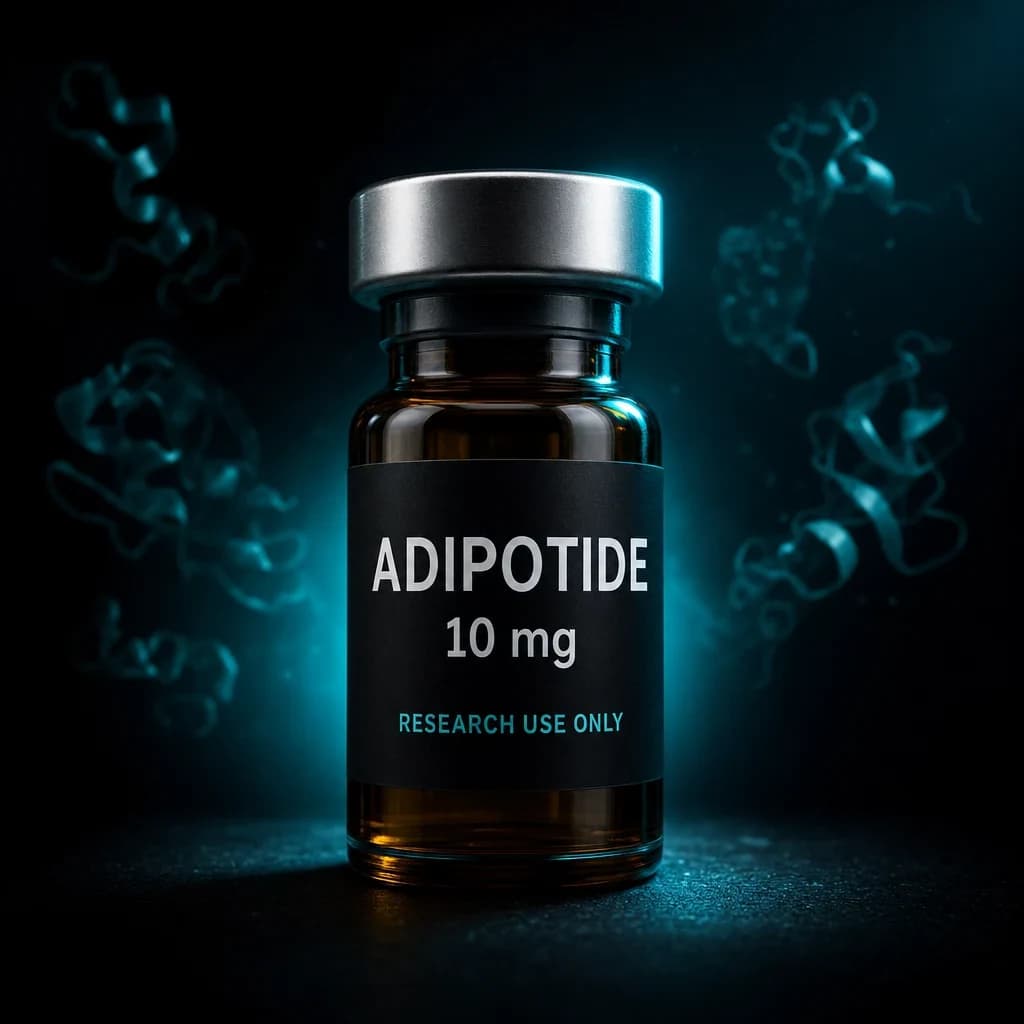
Overview
Adipotide (also called FTPP, or by its sequence CKGGRAKDC-GG-D(KLAKLAK)2) is an experimental peptidomimetic developed by the Kolonin, Arap, and Pasqualini groups using in vivo phage display [1]. Unlike GLP-1 drugs, it does not act on appetite or metabolism. Instead it homes to prohibitin on the blood vessels that supply white adipose tissue and delivers a pro-apoptotic payload that kills that vasculature, cutting off the fat tissue's blood supply [1,2]. In obese rhesus monkeys it produced roughly 11% body weight loss over 28 days plus improved insulin sensitivity, but the same study flagged dose-dependent kidney toxicity [2]. There are no human efficacy or safety trials, no established human dose, and the compound never advanced to approved clinical use. Treat it strictly as a research chemical, not a proven or safe fat-loss agent.
Mechanism
Adipotide is a fusion peptidomimetic: a homing sequence (CKGGRAKDC) that binds prohibitin, a receptor enriched on the luminal endothelium of blood vessels feeding white adipose tissue, linked to a pro-apoptotic domain, D(KLAKLAK)2, that disrupts mitochondrial membranes once internalized [1,4]. By concentrating the cytotoxic payload in the fat-tissue vasculature, it triggers apoptosis of those blood vessels, so the adipocytes lose their blood supply, shrink, and are resorbed [1]. The approach is vascular-ablative rather than metabolic, which is why it does not depend on appetite signaling [3]. The kidney's proximal tubules reabsorb the peptide, which is the proposed basis for the renal toxicity seen at higher doses in primates [2].
Researched benefits
- Targets the vasculature of white fat rather than appetite or satiety pathways
- Reversed diet-induced obesity in mouse models [1]
- Produced roughly 11% body weight loss over 28 days in obese rhesus monkeys [2]
- Reduced abdominal fat on imaging and improved insulin sensitivity in primates [2]
- Mechanism is independent of caloric restriction or gastric emptying
Frequently asked
How does Adipotide actually target fat?
It is a two-part molecule. One end (CKGGRAKDC) binds prohibitin, a protein concentrated on the inner lining of the blood vessels that feed white fat. The other end, D(KLAKLAK)2, is a pro-apoptotic peptide that ruptures mitochondrial membranes once inside the cell. So instead of shrinking fat cells metabolically, it kills the vasculature supplying them, and the starved fat tissue is then resorbed.
What did the obese monkey study show?
Barnhart et al. (2011, Science Translational Medicine) treated obese rhesus monkeys with adipotide and saw roughly 11% body weight loss over 28 days, reduced abdominal fat on MRI, and improved insulin sensitivity. Importantly, the same study reported dose-dependent, largely reversible kidney toxicity (rising serum creatinine and proximal tubule changes), which is a serious caveat, not a footnote.
Is there any human evidence for Adipotide?
No. Every published efficacy result comes from mice (Kolonin 2004) and non-human primates (Barnhart 2011). There are no completed human efficacy or safety trials, no dose-finding data in people, and no regulatory approval. Any claim about human weight loss is extrapolation from animal data.
What are the safety concerns?
The headline concern is renal toxicity. In the primate study the kidney's proximal tubules reabsorbed the peptide and showed dose-dependent injury, with elevated creatinine. Because the mechanism deliberately destroys blood vessels, off-target vascular effects are a theoretical risk too. With no human safety data at all, the actual risk profile in people is unknown.
How is Adipotide different from GLP-1 drugs or AOD-9604?
Semaglutide and tirzepatide work centrally on appetite and insulin signaling, and AOD-9604 mobilizes fat lipolytically without killing cells. Adipotide is categorically different: it is cytotoxic and vascular-targeted, physically destroying the blood supply to fat tissue. That is a far more aggressive and less reversible mechanism, and it has none of the human safety track record those other compounds have.
Scientific Literature
References
- [1]
Kolonin MG, Saha PK, Chan L, Pasqualini R, Arap W. (2004). Reversal of obesity by targeted ablation of adipose tissue.
Nature Medicine · PubMed: 15133506
- [2]
Barnhart KF, Christianson DR, Hanley PW, et al. (2011). A peptidomimetic targeting white fat causes weight loss and improved insulin resistance in obese monkeys.
Science Translational Medicine · PubMed: 22072637
- [3]
Daquinag AC, Zhang Y, Kolonin MG. (2011). Vascular targeting of adipose tissue as an anti-obesity approach.
Trends in Pharmacological Sciences · PubMed: 21349592
- [4]
Salameh A, Daquinag AC, Staquicini DI, et al. (2016). Prohibitin/annexin 2 interaction regulates fatty acid transport in adipose tissue.
JCI Insight · PubMed: 27468426
Citations are provided for educational purposes. Always verify primary sources before drawing research conclusions.
Keep researching
Next steps for Adipotide
The compound page is the overview. Charts, certificates, and the vendor audit sit one click away.
Vendor
Ascension Peptides review
The COA audit and the ENHANCED 50% code for injectable research peptides.
Read the reviewTool
Reconstitution calculator
Convert vial size and bacteriostatic water into syringe units.
Open calculatorReady to start your research
Get Adipotide from Ascension Peptides
COA-verified, US-based, discreet shipping. Use code ENHANCED for 50% off your entire order.
Buy Adipotide now