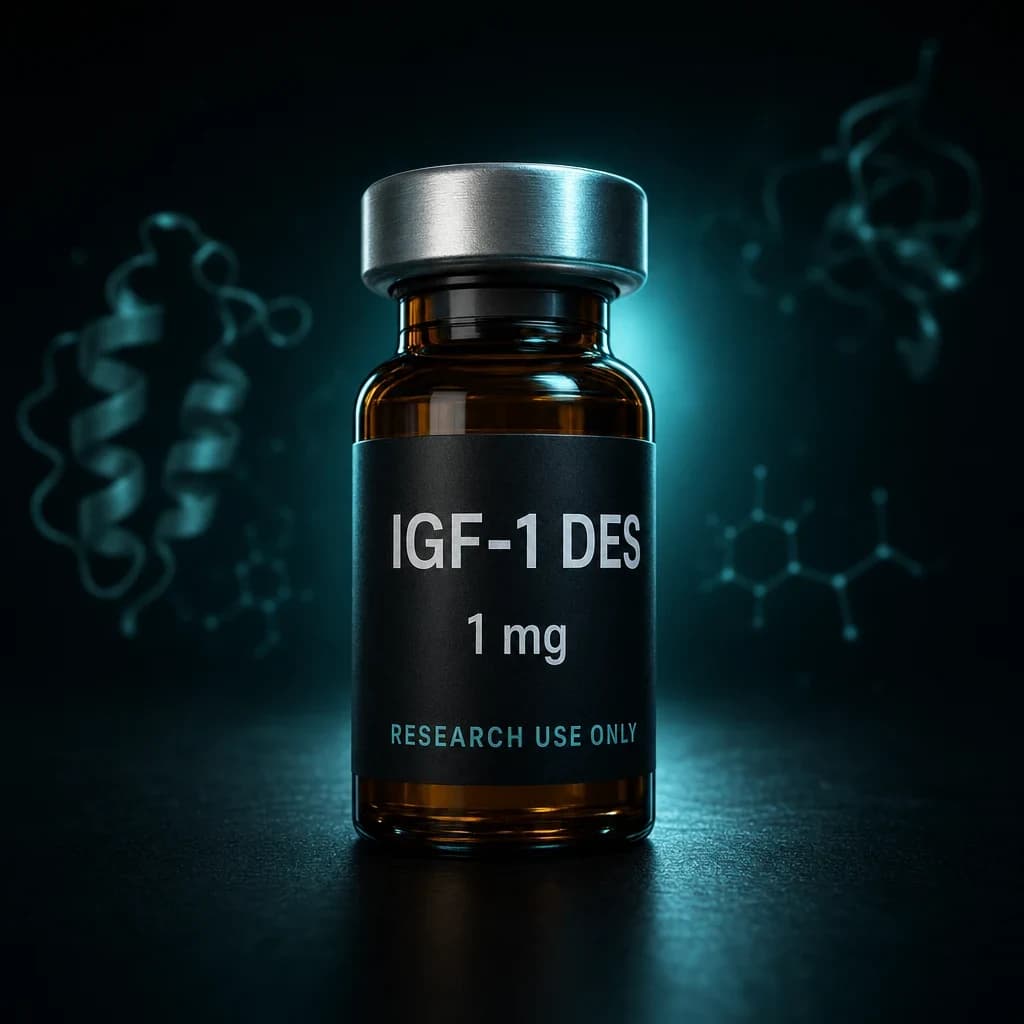
IGF-1 DESResearch guide
Truncated, IGFBP-evading IGF-1 analogue with high local potency and a very short half-life
Half-life
~20-30 min
Typical Dose
20-100mcg per injection, 1-2x on training days (empirical)
Format
Injectable
Purity
≥98%
Overview
IGF-1 DES, short for des(1-3)IGF-1, is a naturally occurring truncated form of insulin-like growth factor 1 that is missing the first three N-terminal amino acids (Gly-Pro-Glu), leaving 67 residues instead of 70 [1]. It is not a lab novelty. The body produces it by acid protease cleavage of circulating IGF-1, and it has been isolated from bovine colostrum, human brain, and porcine uterus [6]. Losing those three residues (specifically the glutamate at position 3) cuts binding to the IGF binding proteins by roughly 70-fold, so the peptide stays free to reach the type 1 IGF receptor instead of being held in circulation [1,2]. In cultured cells it runs about 10-fold more potent than native IGF-1 [1].
Mechanism
IGF-1 DES activates the type 1 IGF receptor much like native IGF-1, but its defining trait is what it does not do: it binds the IGF binding proteins (IGFBP-1 through 6) very poorly, roughly 25-fold weaker at IGFBP-3, because the N-terminal glutamate that anchors that binding is gone [1,2]. Native IGF-1 spends most of its circulating life bound to these proteins and must dissociate before it can signal, whereas IGF-1 DES skips that step, so a larger fraction is immediately bioactive at the receptor [2,3]. In whole animals the potency advantage narrows but persists: des(1-3)IGF-1 stimulated growth in gut-resected rats [4] and lowered plasma glucose 2 to 3 times more potently than IGF-1 in pigs and marmoset monkeys [5]. Paired with a very short plasma half-life, this pharmacology is the basis for the site-specific muscle-growth hypothesis, which remains unproven in humans [1,5].
Researched benefits
- Roughly 10x the in-vitro potency of native IGF-1
- Very low IGFBP binding, so most of the peptide stays receptor-active
- Short half-life limits prolonged systemic exposure
- Direct type 1 IGF receptor activation
- Studied for anabolic and tissue-repair signaling in animal models
Frequently asked
What's the difference between IGF-1 DES and IGF-1 LR3?
Both are IGFBP-evading IGF-1 analogues, but they sit at opposite ends of the duration scale. IGF-1 DES has a plasma half-life around 20-30 minutes, while IGF-1 LR3 lasts roughly 20-30 hours thanks to its 13-residue N-terminal extension and an Arg3 substitution that keep it in circulation far longer. Researchers reach for DES when they want a brief, concentrated pulse, and for LR3 when they want sustained systemic exposure.
Why is the half-life so short?
IGF-1 DES clears in about 20-30 minutes because, unlike native IGF-1, it barely binds the IGF binding proteins that normally act as a circulating reservoir and stretch out IGF-1's residence time. With almost nothing holding it in the bloodstream, it is cleared and degraded quickly. The short duration is the intended feature of the molecule in research protocols, not a defect.
Does IGF-1 DES cause localized, site-specific muscle growth?
This is the popular claim, and it is largely a bodybuilding hypothesis rather than a proven human effect. The logic is that a 20-30 minute half-life keeps the peptide near the injection site before it clears, so local tissue sees most of the dose. It is a reasonable idea on paper, but no controlled human trial has shown site-specific hypertrophy from local IGF-1 DES injection. Treat it as unverified.
What's the typical research dose?
Empirical protocols commonly use 20-100mcg per injection, once or twice daily, usually only on training days and often shortly after exercise. These figures come from user-reported practice, not dose-response trials. No human clinical dosing standard exists for IGF-1 DES.
How is IGF-1 DES reconstituted?
Bacteriostatic water is the standard diluent. For a 1mg vial, 1mL of BAC water yields 1000mcg/mL, so 0.1mL delivers 100mcg. Add the water slowly down the vial wall, swirl gently, and never shake. Refrigerate after reconstitution and protect from light.
Why is IGF-1 DES more potent than regular IGF-1?
The missing N-terminal glutamate slashes its affinity for the IGF binding proteins by about 70-fold. Native IGF-1 is mostly protein-bound and inactive at any given moment, whereas IGF-1 DES stays free and can engage the receptor directly, which is why it runs roughly 10-fold more potent in cultured cells. In living animals that advantage shrinks to about 2 to 3 times for effects like glucose lowering, since binding proteins are only one part of the system.
Scientific Literature
References
- [1]
Ballard FJ, Wallace JC, Francis GL, Read LC, Tomas FM. (1996). Des(1-3)IGF-I: a truncated form of insulin-like growth factor-I.
International Journal of Biochemistry & Cell Biology · PubMed: 8930132
- [2]
Francis GL, Ross M, Ballard FJ, et al. (1992). Novel recombinant fusion protein analogues of insulin-like growth factor (IGF)-I indicate the relative importance of IGF-binding protein and receptor binding for enhanced biological potency.
Journal of Molecular Endocrinology · PubMed: 1378742
- [3]
Simes JM, Wallace JC, Walton PE. (1991). The effects of insulin-like growth factor-I (IGF-I), IGF-II and des(1-3)IGF-I, a potent IGF analogue, on growth hormone and IGF-binding protein secretion from cultured rat anterior pituitary cells.
Journal of Endocrinology · PubMed: 1715381
- [4]
Lemmey AB, Martin AA, Read LC, et al. (1991). IGF-I and the truncated analogue des-(1-3)IGF-I enhance growth in rats after gut resection.
American Journal of Physiology · PubMed: 1996625
- [5]
Tomas FM, Walton PE, Dunshea FR, Ballard FJ. (1997). IGF-I variants which bind poorly to IGF-binding proteins show more potent and prolonged hypoglycaemic action than native IGF-I in pigs and marmoset monkeys.
Journal of Endocrinology · PubMed: 9415072
- [6]
Yamamoto H, Murphy LJ. (1994). Generation of des-(1-3) insulin-like growth factor-I in serum by an acid protease.
Endocrinology · PubMed: 7988428
Citations are provided for educational purposes. Always verify primary sources before drawing research conclusions.
Keep researching
Next steps for IGF-1 DES
The compound page is the overview. Charts, certificates, and the vendor audit sit one click away.
Vendor
Ascension Peptides review
The COA audit and the ENHANCED 50% code for injectable research peptides.
Read the reviewArticle
IGF-1 LR3 vs IGF-1 DES: Duration vs Local Potency
A deeper read that sits next to the IGF-1 DES guide.
Read articleTool
Reconstitution calculator
Convert vial size and bacteriostatic water into syringe units.
Open calculatorReady to start your research
Get IGF-1 DES from Ascension Peptides
COA-verified, US-based, discreet shipping. Use code ENHANCED for 50% off your entire order.
Buy IGF-1 DES now