LixisenatideResearch guide
Short-acting once-daily prandial GLP-1 receptor agonist for post-meal glucose control
Half-life
~3 hours
Typical Dose
10-20mcg once daily
Format
Injectable
Purity
Pharmaceutical grade (prescription drug)
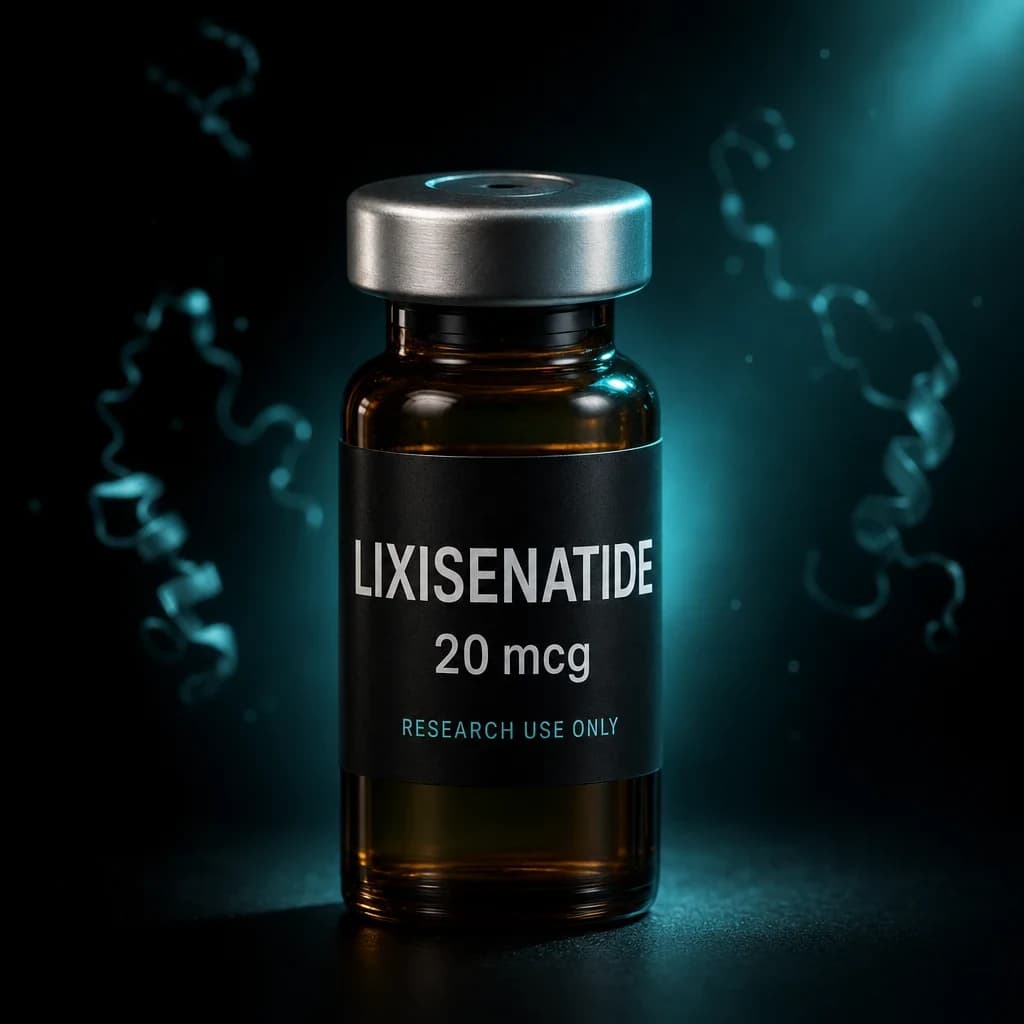
Overview
Lixisenatide is a short-acting, once-daily GLP-1 receptor agonist approved for type 2 diabetes, sold as Adlyxin in the US and Lyxumia in Europe and bundled with insulin glargine in the fixed-ratio combination Soliqua/Suliqua (iGlarLixi) [3]. It is built on exendin-4, the lizard-derived peptide behind exenatide, with six added lysine residues at the C-terminus that shape its pharmacology [6]. Its short half-life of roughly 3 hours makes it a prandial agent: it strongly slows gastric emptying to blunt post-meal glucose spikes rather than lowering fasting glucose [3,5]. The ELIXA trial confirmed cardiovascular safety in patients with a recent acute coronary syndrome [1], and GetGoal-X showed non-inferior HbA1c control versus twice-daily exenatide with better GI tolerability [2]. Be honest about its place: it is a minor player next to semaglutide and tirzepatide, with only modest weight effects, and Sanofi discontinued Adlyxin in the US market in 2023 for commercial reasons (not safety). A notable second life comes from the LixiPark trial, which found a modest slowing of motor decline in early Parkinson's disease [4].
Mechanism
Lixisenatide is a synthetic exendin-4 analogue with high affinity for the GLP-1 receptor [6]. It stimulates glucose-dependent insulin secretion and suppresses glucagon, but its defining action is a pronounced delay of gastric emptying that flattens post-meal glucose excursions [3]. Because its half-life is only about 3 hours, receptor activation is transient and tied to the daily pre-meal injection, which is why it lowers postprandial rather than fasting glucose and is classed as a prandial GLP-1 agonist [5]. The same central GLP-1 pathways that drive satiety are engaged, though the short exposure limits appetite and weight effects relative to weekly agonists.
Researched benefits
- Once-daily prefilled pen, no reconstitution required
- Strong reduction of post-meal glucose spikes via delayed gastric emptying
- Cardiovascular safety established in the ELIXA outcomes trial
- Better GI tolerability than twice-daily exenatide (GetGoal-X)
- Modest weight reduction alongside glycemic control
Frequently asked
What is Lixisenatide?
Lixisenatide is a short-acting GLP-1 receptor agonist approved for type 2 diabetes, sold as Adlyxin in the US and Lyxumia in Europe and included in the fixed-ratio insulin combination Soliqua/Suliqua (iGlarLixi). It is a synthetic analogue of exendin-4, the same lizard-derived peptide behind exenatide, modified with six lysine residues at the C-terminus. It is an FDA-approved prescription drug, not a research chemical.
How does it compare to Semaglutide and Tirzepatide?
It is a minor player. Semaglutide and tirzepatide are long-acting, once-weekly agonists that drive roughly 15-21% weight reduction, while lixisenatide is once-daily, short-acting, and produces only modest weight change (about 2-3 kg). Its niche is blunting post-meal glucose spikes rather than sustained appetite suppression. Sanofi discontinued Adlyxin in the US market in 2023 for commercial reasons (not safety), and it has been largely sidelined by the weekly incretins.
Why is it called a prandial or short-acting GLP-1 agonist?
Its half-life is only about 3 hours, so plasma levels rise and fall around a single daily injection taken before a meal. This produces a pronounced, transient slowing of gastric emptying that flattens the post-meal glucose curve, with comparatively little effect on fasting glucose. Long-acting agents like semaglutide instead maintain steady receptor activation and lower fasting glucose more strongly.
What did the ELIXA cardiovascular trial show?
ELIXA (Pfeffer et al., 2015) enrolled 6,068 people with type 2 diabetes and a recent acute coronary syndrome and found that lixisenatide neither increased nor decreased major cardiovascular events versus placebo. It was the first completed cardiovascular outcomes trial for any GLP-1 receptor agonist and established cardiovascular safety, though without the risk reduction later seen with semaglutide.
What is the Parkinson's disease research angle?
The LixiPark phase 2 trial (Meissner et al., 2024) randomized 156 people with early Parkinson's to daily lixisenatide or placebo for 12 months. Motor scores stayed roughly stable on lixisenatide but worsened on placebo, suggesting a modest slowing of motor progression. Nausea (46%) and vomiting (13%) were common. It is an early signal, not an approved use, and larger trials are needed to confirm it.
How is it dosed and stored?
Dosing starts at 10mcg once daily for 14 days, then increases to the 20mcg maintenance dose, injected within one hour before the first meal of the day. It ships as a ready-to-use prefilled pen with no reconstitution. Keep it refrigerated at 2-8°C before first use, then below 30°C for up to 14 days, and never freeze it.
Scientific Literature
References
- [1]
Pfeffer MA, Claggett B, Diaz R, et al. (2015). Lixisenatide in Patients with Type 2 Diabetes and Acute Coronary Syndrome (ELIXA).
New England Journal of Medicine · PubMed: 26630143
- [2]
Rosenstock J, Raccah D, Korányi L, et al. (2013). Efficacy and safety of lixisenatide once daily versus exenatide twice daily in type 2 diabetes inadequately controlled on metformin (GetGoal-X).
Diabetes Care · PubMed: 23698396
- [3]
Werner U, Gerlach M, Hofmann M, et al. (2010). Pharmacological profile of lixisenatide: A new GLP-1 receptor agonist for the treatment of type 2 diabetes.
Regulatory Peptides · PubMed: 20570597
- [4]
Meissner WG, Remy P, Giordana C, et al. (2024). Trial of Lixisenatide in Early Parkinson's Disease (LixiPark).
New England Journal of Medicine · PubMed: 38598572
- [5]
McCarty D, Coleman M, Boland CL. (2017). Lixisenatide: A New Daily GLP-1 Agonist for Type 2 Diabetes Management.
Annals of Pharmacotherapy · PubMed: 28133970
- [6]
Werner U. (2008). Preclinical pharmacology of the new GLP-1 receptor agonist AVE0010.
Annales d'Endocrinologie · PubMed: 18417092
Citations are provided for educational purposes. Always verify primary sources before drawing research conclusions.
Keep researching
Next steps for Lixisenatide
The compound page is the overview. Charts, certificates, and the vendor audit sit one click away.
Vendor
Ascension Peptides review
The COA audit and the ENHANCED 50% code for injectable research peptides.
Read the reviewTool
Reconstitution calculator
Convert vial size and bacteriostatic water into syringe units.
Open calculatorReady to start your research
Get Lixisenatide from Ascension Peptides
COA-verified, US-based, discreet shipping. Use code ENHANCED for 50% off your entire order.
Buy Lixisenatide now