Melanotan IResearch guide
MC1R-preferring alpha-MSH analog (afamelanotide) researched for melanogenesis and photoprotection with far fewer central effects than Melanotan II
Half-life
~30-60 min (free peptide); Scenesse implant depot ~5 days
Typical Dose
0.5-1 mg SC daily (loading), then 2-3x weekly
Format
Injectable
Purity
≥98%
Overview
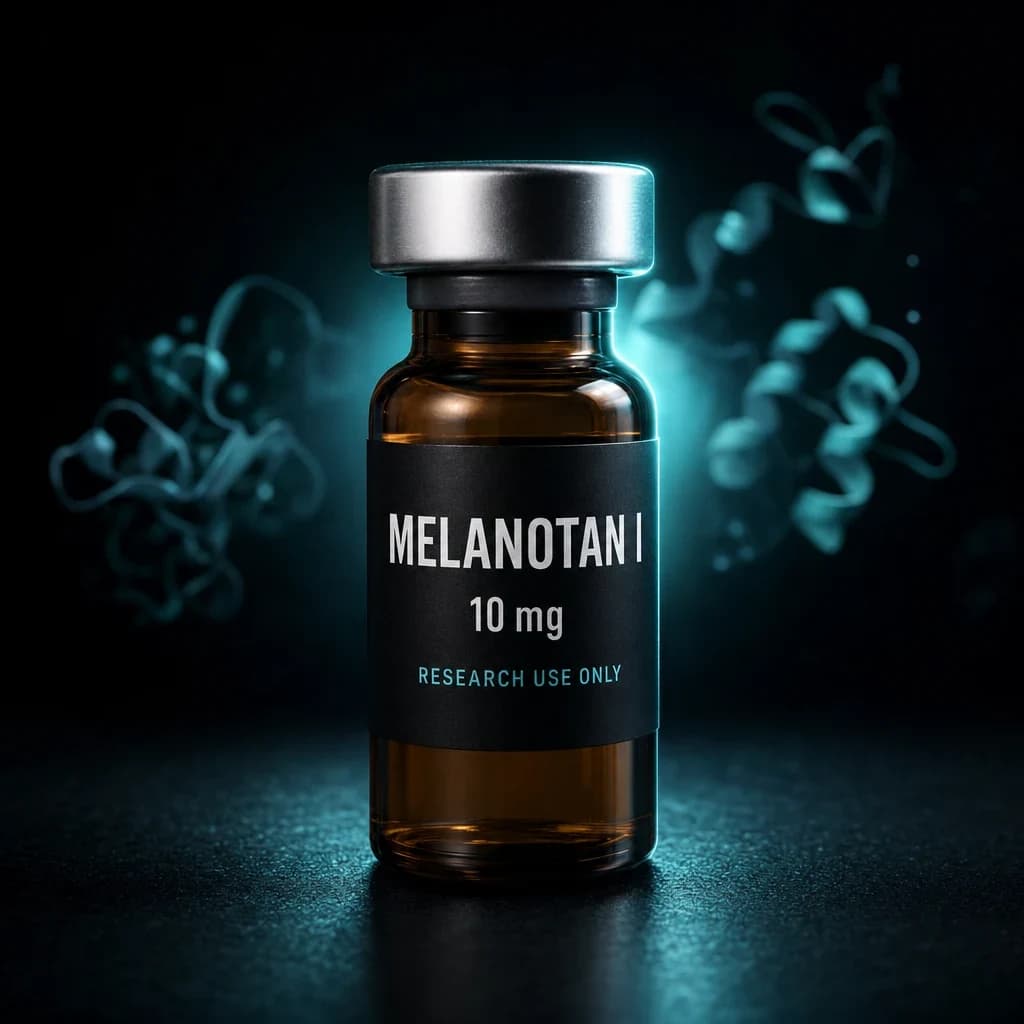
Melanotan I (afamelanotide; also written [Nle4-D-Phe7]-alpha-MSH, NDP-MSH, or CUV1647) is a synthetic tridecapeptide analog of alpha-melanocyte stimulating hormone (alpha-MSH). It was developed at the University of Arizona in the 1980s alongside Melanotan II, but it took a very different clinical path. As afamelanotide (brand name Scenesse, by Clinuvel), it became the first melanocortin analog to reach regulatory approval (EMA in 2014, FDA in 2019), indicated as a controlled-release subcutaneous implant to prevent phototoxicity in adults with erythropoietic protoporphyria (EPP) [1,5]. Where Melanotan II activates the full melanocortin receptor family, Melanotan I is valued for driving pigmentation mainly through MC1R, with far less of the central libido and appetite activity [2].
Mechanism
Melanotan I is a potent, MC1R-preferring melanocortin agonist. Binding MC1R on melanocytes activates adenylyl cyclase, raises intracellular cAMP, and drives the MITF pathway to upregulate tyrosinase, shifting synthesis toward photoprotective eumelanin [3]. Beyond pigment, MC1R signaling enhances antioxidant defenses and DNA-repair capacity, which underpins the photoprotective effect studied in EPP [1,3]. The Nle4 and D-Phe7 substitutions make the peptide far more resistant to enzymatic degradation and roughly 1000 times more potent than native alpha-MSH [2]. In practice its effect is dominated by MC1R pigmentation, without the strong MC3R/MC4R central activity that gives Melanotan II its pronounced libido and appetite effects [2].
Researched benefits
- MC1R-driven melanogenesis (eumelanin) for UV-independent pigmentation
- Milder central profile than Melanotan II (less libido, appetite, and nausea signaling)
- Photoprotection studied in erythropoietic protoporphyria (EPP)
- Antioxidant and DNA-repair support via MC1R signaling
- Basis of afamelanotide (Scenesse), the first approved melanocortin analog
Frequently asked
How is Melanotan I different from Melanotan II?
Both are alpha-MSH analogs, but their real-world profiles diverge. Melanotan II is a cyclic, non-selective melanocortin agonist with strong central activity at MC3R/MC4R, which is why research subjects report libido effects, appetite suppression, and nausea alongside tanning. Melanotan I (afamelanotide) is a linear analog whose effect in practice is dominated by MC1R-driven pigmentation, with far less of that central activity. If the research target is pigmentation with a cleaner side-effect profile, Melanotan I is the analog that went on to become a licensed drug.
What are afamelanotide and Scenesse?
Afamelanotide is the pharmaceutical name for Melanotan I ([Nle4-D-Phe7]-alpha-MSH). Marketed as Scenesse by Clinuvel, it is a 16mg controlled-release subcutaneous implant given roughly every two months. The EMA approved it in 2014 and the FDA in 2019, making it the first melanocortin analog to reach approval. Its approved indication is preventing phototoxicity in adults with erythropoietic protoporphyria.
What is erythropoietic protoporphyria (EPP) and how does afamelanotide help?
EPP is a rare inherited disorder in which protoporphyrin builds up in the skin and causes severe burning pain within minutes of sunlight or even visible light. In the pivotal randomized, placebo-controlled trials, afamelanotide increased pain-free light exposure and improved quality of life versus placebo [1]. A long-term observational study in 115 patients supported sustained benefit and tolerability [4]. The proposed mechanism is MC1R-driven eumelanin plus enhanced antioxidant and DNA-repair activity [3,5].
Does Melanotan I cause the nausea and libido effects of Melanotan II?
Reports and clinical data point to much less. The spontaneous erections, appetite suppression, and nausea linked to Melanotan II are driven largely by central MC3R/MC4R activity. Melanotan I's profile is dominated by MC1R pigmentation, so those central effects are far less prominent at typical doses, though mild facial flushing and transient nausea can still occur.
Is Melanotan I truly MC1R-selective?
Not strictly. In receptor-binding assays afamelanotide is a potent agonist across several melanocortin receptors, similar to native alpha-MSH. What separates it from Melanotan II in practice is a pigmentation-dominant, milder central profile rather than pure receptor selectivity [2]. Describing it as flatly 'MC1R-selective' is a simplification worth being honest about.
How is Melanotan I reconstituted and dosed?
For research use, a 10mg vial is typically reconstituted with 1mL of bacteriostatic water, giving 10mg/mL (so 500 mcg equals 0.05mL, or 5 units on a U-100 insulin syringe). Community loading protocols use roughly 0.5-1mg subcutaneously daily until target pigmentation, then 2-3x weekly maintenance. The licensed clinical form is instead a 16mg controlled-release implant. Refrigerate after reconstitution and protect from light.
Scientific Literature
References
- [1]
Langendonk JG, Balwani M, Anderson KE, et al. (2015). Afamelanotide for Erythropoietic Protoporphyria.
New England Journal of Medicine · PubMed: 26132941
- [2]
Minder EI, Barman-Aksoezen J, Schneider-Yin X. (2017). Pharmacokinetics and Pharmacodynamics of Afamelanotide and its Clinical Use in Treating Dermatologic Disorders.
Clinical Pharmacokinetics · PubMed: 28063031
- [3]
Wolf Horrell EM, Boulanger MC, D'Orazio JA. (2016). Melanocortin 1 Receptor: Structure, Function, and Regulation.
Frontiers in Genetics · PubMed: 27303435
- [4]
Biolcati G, Marchesini E, Sorge F, et al. (2015). Long-term observational study of afamelanotide in 115 patients with erythropoietic protoporphyria.
British Journal of Dermatology · PubMed: 25494545
- [5]
Minder EI, Schneider-Yin X. (2015). Afamelanotide (CUV1647) in dermal phototoxicity of erythropoietic protoporphyria.
Expert Review of Clinical Pharmacology · PubMed: 25470471
Citations are provided for educational purposes. Always verify primary sources before drawing research conclusions.
Keep researching
Next steps for Melanotan I
The compound page is the overview. Charts, certificates, and the vendor audit sit one click away.
Protocol
Melanotan I dosage chart
Research dosing ranges, reconstitution math, and stacks for Melanotan I.
Open dosage chartCOA
Where to buy Melanotan I
Lot-level HPLC records and vendor comparison before you pay.
Compare lab testsVendor
Ascension Peptides review
The COA audit and the ENHANCED 50% code for injectable research peptides.
Read the reviewReady to start your research
Get Melanotan I from Ascension Peptides
COA-verified, US-based, discreet shipping. Use code ENHANCED for 50% off your entire order.
Buy Melanotan I now