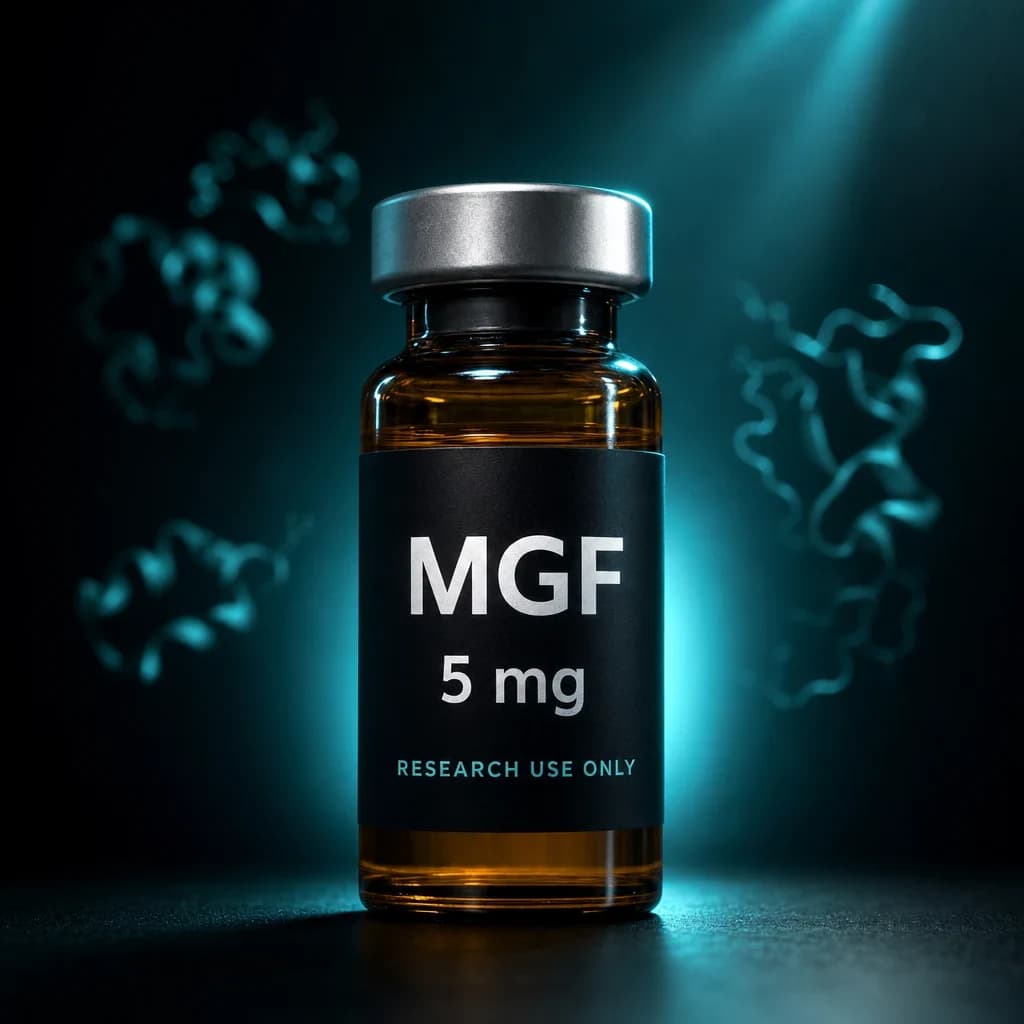
MGF (Mechano Growth Factor)Research guide
IGF-1Ec splice variant the body expresses locally after mechanical muscle damage to activate satellite cells
Half-life
~5-7 min (synthetic, non-pegylated)
Typical Dose
200-400mcg post-workout (local IM or subcutaneous)
Format
Injectable
Purity
≥98%
Overview
MGF (Mechano Growth Factor) is the IGF-1Ec splice variant that muscle transcribes locally after mechanical loading or damage. Goldspink's group first cloned it from stretched skeletal muscle and showed the IGF-1 gene splices toward this autocrine isoform when muscle is stretched or stimulated [1,2]. Following damage, MGF appears as a short pulse that precedes satellite (stem) cell activation, then hands off to the systemic IGF-IEa isoform for the slower repair phase [3]. Human biopsy data back the exercise link: one bout of heavy resistance work raised MGF mRNA in young men but barely moved it in elderly subjects [4]. The synthetic injectable version is a research compound. Be clear about the ceiling here: the endogenous biology is well documented, but injecting synthetic MGF has essentially no human trial data. What follows is mechanism, animal work, and honest gaps.
Mechanism
MGF is produced by alternative splicing of the IGF-1 gene: a reading-frame shift in the E-domain yields a distinct C-terminal peptide separate from mature IGF-1 [1,2]. It behaves as a local pulse. Within hours of mechanical overload it activates quiescent satellite cells and expands the muscle progenitor pool before those cells commit to differentiation [3]. The E-peptide portion appears to drive myoblast proliferation partly independent of the IGF-1 receptor, which is why researchers treat it as its own signal rather than a shortened IGF-1 [6]. In rodents, MGF also rescued motor neurons and improved muscle function in an ALS (SOD1) model, pointing to a repair role beyond skeletal muscle [7]. The practical catch: serum peptidases cleave the native peptide within minutes, so systemic exposure from an injection is fleeting [6].
Researched benefits
- Satellite (stem) cell activation after muscle damage
- Myoblast proliferation ahead of differentiation
- Local repair signaling in the post-training window
- Studied against the age-related drop in the loading response
- Neuroprotective effects in rodent motor-neuron models
Frequently asked
MGF vs PEG-MGF, what's the actual difference?
Native MGF is the raw peptide with a 5-7 minute serum half-life, so it clears almost as fast as the body's own pulse. PEG-MGF attaches a polyethylene glycol chain that shields the peptide from peptidases and stretches the half-life to hours. Native MGF is used to mimic the local post-damage pulse; PEG-MGF trades that pulse profile for systemic longevity and less frequent dosing.
Why does timing matter so much with MGF?
Because the half-life is roughly 5-7 minutes. Researchers dose it immediately post-training and often inject directly into the muscle just worked, on the logic that MGF is a local signal and needs to reach satellite cells before peptidases clear it. This is the single biggest reason PEG-MGF exists: unmodified MGF is gone before it can travel far.
What does the human evidence actually show?
The endogenous story is solid. MGF was cloned from stretched muscle [1], its splice pattern tracks mechanical loading in animals [2,3], and human biopsies show MGF mRNA rising after heavy resistance exercise in young but not older subjects [4]. The injectable synthetic peptide is a different question: there are no published human trials of exogenous MGF. Claims about injected MGF building muscle are extrapolated from gene-expression and rodent data, not from clinical outcomes.
What's the typical research dose?
200-400mcg post-workout is the common research protocol, injected locally into the trained muscle or subcutaneously nearby, on non-rest days or only after training sessions. Dosing is entirely empirical. No human dose-response work exists, and the very short half-life means most of an injected dose is degraded quickly regardless of amount.
How is MGF reconstituted?
Bacteriostatic water is the standard diluent. For a 2mg vial, 2mL of BAC water gives 1mg/mL, so 200mcg sits in 0.2mL. Add the water slowly down the vial wall, swirl gently, and never shake. Keep it refrigerated and protected from light after mixing, and use within a few weeks.
Is MGF stacked with other compounds?
In research settings it is often paired with GH secretagogues like CJC-1295 or MK-677, which raise circulating GH and IGF-IEa, while MGF is positioned as the local satellite-cell trigger. Some protocols also run it alongside IGF-1 LR3 for longer systemic IGF-1 exposure. These combinations are theoretical constructs built on mechanism, not stacks validated in human trials.
Scientific Literature
References
- [1]
Yang S, Alnaqeeb M, Simpson H, Goldspink G. (1996). Cloning and characterization of an IGF-1 isoform expressed in skeletal muscle subjected to stretch.
Journal of Muscle Research and Cell Motility · PubMed: 8884603
- [2]
McKoy G, Ashley W, Mander J, et al. (1999). Expression of insulin growth factor-1 splice variants and structural genes in rabbit skeletal muscle induced by stretch and stimulation.
Journal of Physiology · PubMed: 10087355
- [3]
Hill M, Goldspink G. (2003). Expression and splicing of the insulin-like growth factor gene in rodent muscle is associated with muscle satellite (stem) cell activation following local tissue damage.
Journal of Physiology · PubMed: 12692175
- [4]
Hameed M, Orrell RW, Cobbold M, et al. (2003). Expression of IGF-I splice variants in young and old human skeletal muscle after high resistance exercise.
Journal of Physiology · PubMed: 12562960
- [5]
Hameed M, Lange KH, Andersen JL, et al. (2004). The effect of recombinant human growth hormone and resistance training on IGF-I mRNA expression in the muscles of elderly men.
Journal of Physiology · PubMed: 14565994
- [6]
Goldspink G. (2005). Research on mechano growth factor: its potential for optimising physical training as well as misuse in doping.
British Journal of Sports Medicine · PubMed: 16244184
- [7]
Riddoch-Contreras J, Yang SY, Dick JR, et al. (2009). Mechano-growth factor, an IGF-I splice variant, rescues motoneurons and improves muscle function in SOD1(G93A) mice.
Experimental Neurology · PubMed: 19038252
Citations are provided for educational purposes. Always verify primary sources before drawing research conclusions.
Keep researching
Next steps for MGF (Mechano Growth Factor)
The compound page is the overview. Charts, certificates, and the vendor audit sit one click away.
Vendor
Ascension Peptides review
The COA audit and the ENHANCED 50% code for injectable research peptides.
Read the reviewArticle
MGF vs PEG-MGF: Local Pulse vs Extended Muscle Repair
A deeper read that sits next to the MGF (Mechano Growth Factor) guide.
Read articleTool
Reconstitution calculator
Convert vial size and bacteriostatic water into syringe units.
Open calculatorReady to start your research
Get MGF (Mechano Growth Factor) from Ascension Peptides
COA-verified, US-based, discreet shipping. Use code ENHANCED for 50% off your entire order.
Buy MGF (Mechano Growth Factor) now