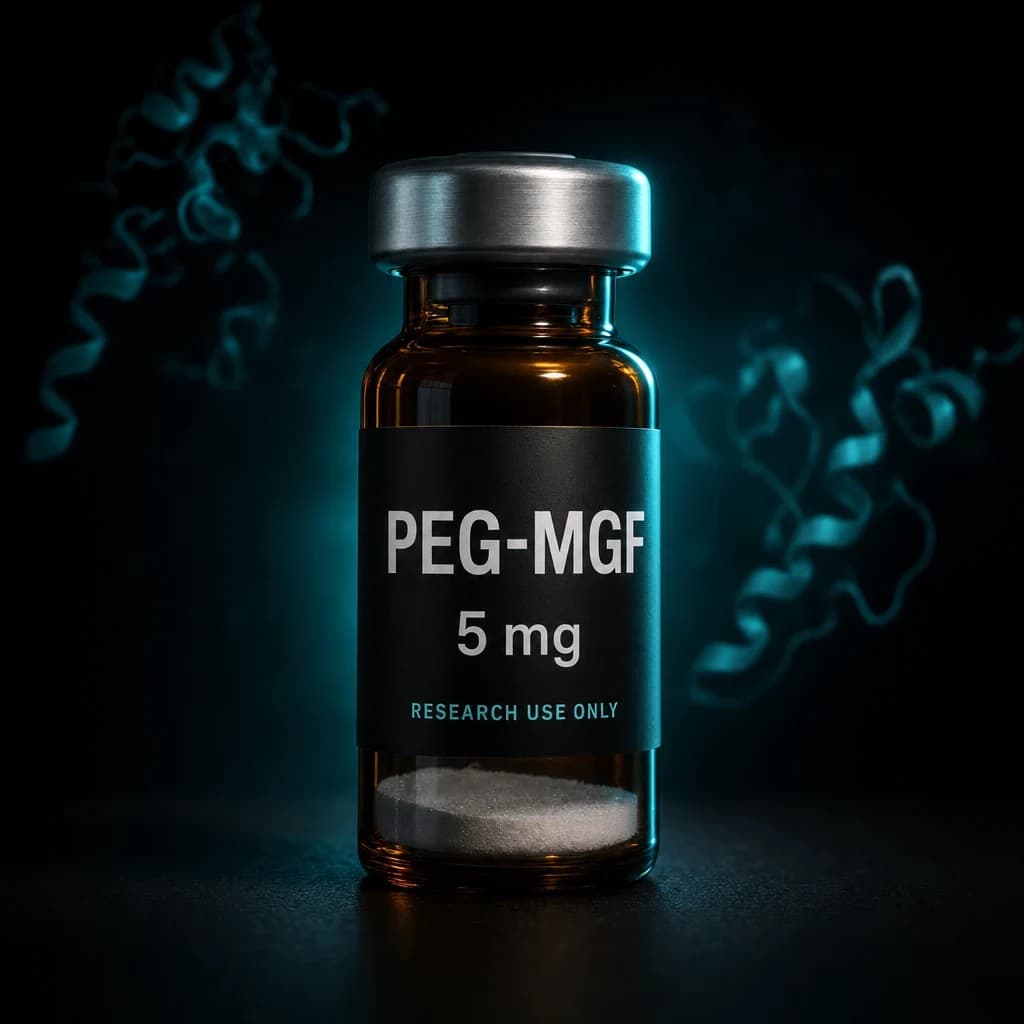
PEG-MGFResearch guide
PEGylated Mechano Growth Factor, an IGF-1 splice variant studied for satellite cell activation and muscle repair with extended systemic exposure
Half-life
~5-7 min (native MGF) / est. 2-5 days (PEGylated, vendor-reported)
Typical Dose
200-400mcg post-workout, 2-3x weekly
Format
Injectable
Purity
≥98%
Overview
PEG-MGF is a PEGylated form of Mechano Growth Factor (MGF), the IGF-1Ec splice variant that skeletal muscle produces locally in response to mechanical loading and damage [1]. Native MGF clears from plasma in minutes, so a polyethylene glycol (PEG) chain is attached to slow renal filtration and shield the peptide from proteases, stretching systemic exposure well past the native molecule. The underlying MGF E-domain has been studied for its ability to expand the muscle satellite (stem) cell pool and delay differentiation, a pattern distinct from mature IGF-1 [2,3]. Be clear-eyed here: human data on PEG-MGF specifically are minimal. The extended half-life and dosing figures come largely from vendor material and animal work, not published human pharmacokinetic trials, and at least one controlled study found a synthetic MGF peptide did nothing to myoblasts [7].
Mechanism
MGF is a locally acting splice variant of IGF-1 (IGF-1Ec) generated when muscle is mechanically stressed or injured [1,5]. Its distinct C-terminal E-domain peptide acts as an autocrine/paracrine signal that increases myoblast proliferation and keeps satellite cells in a proliferative state rather than driving them straight to differentiation, an effect that appears to run through a receptor separate from the classical IGF-1 receptor [2,3]. In human primary muscle cultures the MGF-E peptide expanded the progenitor cell pool across both young and older donors [4], and MGF expression is itself upregulated by growth hormone and by mechanical/myofibrillar signals [5,6]. PEGylation does not change this signaling; it only extends how long the peptide survives in circulation. One caveat worth stating plainly: a controlled study found a synthetic MGF peptide had no measurable effect on myoblast or muscle stem cell proliferation, so the mechanism is not settled [7].
Researched benefits
- Activates muscle satellite (stem) cells and expands the progenitor pool
- Extended systemic exposure compared to native MGF
- Researched for muscle repair after mechanical loading and damage
- Delays myoblast differentiation to prolong the proliferative window
- Commonly stacked with GH secretagogues and IGF-1 analogs in research
Frequently asked
How does PEG-MGF's half-life compare to native MGF?
Native MGF is cleared from plasma in roughly 5-7 minutes, which is why the native peptide is dosed frequently and locally. PEGylation slows renal filtration and blunts protease degradation, and vendors typically claim exposure lasting several days. Treat the multi-day figure with caution: it is derived from PEG chemistry and animal work, not from published human pharmacokinetic studies of PEG-MGF.
Weekly dosing or strictly post-workout?
Native MGF's short window is the reason the classic research protocol injects it right after training, near the muscle that was worked. PEG-MGF's longer circulating time is the rationale some researchers give for less frequent, non-workout-day dosing. No human trial has compared the two schedules head-to-head, so both approaches are empirical.
What's the actual evidence behind MGF?
The strongest data are cell-culture and animal studies showing the MGF E-domain increases myoblast proliferation and expands the satellite cell pool, including in human primary cultures across ages [2,3,4]. Against that, a rigorous 2014 study reported a synthetic MGF peptide had no effect on myoblasts or muscle stem cells [7]. There are no human efficacy trials on PEG-MGF itself. The honest read: promising signaling biology, unsettled and no clinical proof in people.
Subcutaneous, intramuscular, or local injection?
Because MGF works as a local autocrine/paracrine signal, the common research practice is intramuscular injection into or near the trained muscle after a session. Subcutaneous administration is also used. No pharmacokinetic study has compared routes for PEG-MGF, so route selection is based on MGF's biology rather than human data.
Can PEG-MGF be stacked with CJC-1295 or MK-677?
Researchers commonly pair it with GH secretagogues like CJC-1295 or MK-677. Those compounds raise systemic GH and IGF-1, while MGF adds a local repair signal at the muscle. There is a plausible link, since growth hormone upregulates endogenous MGF expression [5]. That said, the combination has no controlled human data, so any synergy is theoretical.
How is PEG-MGF reconstituted?
Bacteriostatic water is the standard diluent. For a 2mg vial, 2mL of BAC water yields 1mg/mL, so 200mcg sits in 0.2mL. Add the water slowly down the vial wall, swirl gently rather than shaking, and refrigerate after mixing. Protect from light.
Scientific Literature
References
- [1]
Hill M, Goldspink G. (2003). Expression and splicing of the insulin-like growth factor gene in rodent muscle is associated with muscle satellite (stem) cell activation following local tissue damage.
Journal of Physiology · PubMed: 12692175
- [2]
Yang SY, Goldspink G. (2002). Different roles of the IGF-I Ec peptide (MGF) and mature IGF-I in myoblast proliferation and differentiation.
FEBS Letters · PubMed: 12095637
- [3]
Ates K, Yang SY, Orrell RW, et al. (2007). The IGF-I splice variant MGF increases progenitor cells in ALS, dystrophic, and normal muscle.
FEBS Letters · PubMed: 17531227
- [4]
Kandalla PK, Goldspink G, Butler-Browne G, Mouly V. (2011). Mechano Growth Factor E peptide (MGF-E), derived from an isoform of IGF-1, activates human muscle progenitor cells and induces an increase in their fusion potential at different ages.
Mechanisms of Ageing and Development · PubMed: 21354439
- [5]
Imanaka M, Iida K, Murawaki A, et al. (2008). Growth hormone stimulates mechano growth factor expression and activates myoblast transformation in C2C12 cells.
Kobe Journal of Medical Sciences · PubMed: 18772608
- [6]
Kravchenko IV, Furalyov VA, Popov VO. (2012). Stimulation of mechano-growth factor expression by myofibrillar proteins in murine myoblasts and myotubes.
Molecular and Cellular Biochemistry · PubMed: 22160926
- [7]
Fornaro M, Hinken AC, Needle S, et al. (2014). Mechano-growth factor peptide, the COOH terminus of unprocessed insulin-like growth factor 1, has no apparent effect on myoblasts or primary muscle stem cells.
American Journal of Physiology - Endocrinology and Metabolism · PubMed: 24253050
Citations are provided for educational purposes. Always verify primary sources before drawing research conclusions.
Keep researching
Next steps for PEG-MGF
The compound page is the overview. Charts, certificates, and the vendor audit sit one click away.
Vendor
Ascension Peptides review
The COA audit and the ENHANCED 50% code for injectable research peptides.
Read the reviewArticle
MGF vs PEG-MGF: Local Pulse vs Extended Muscle Repair
A deeper read that sits next to the PEG-MGF guide.
Read articleTool
Reconstitution calculator
Convert vial size and bacteriostatic water into syringe units.
Open calculatorReady to start your research
Get PEG-MGF from Ascension Peptides
COA-verified, US-based, discreet shipping. Use code ENHANCED for 50% off your entire order.
Buy PEG-MGF now