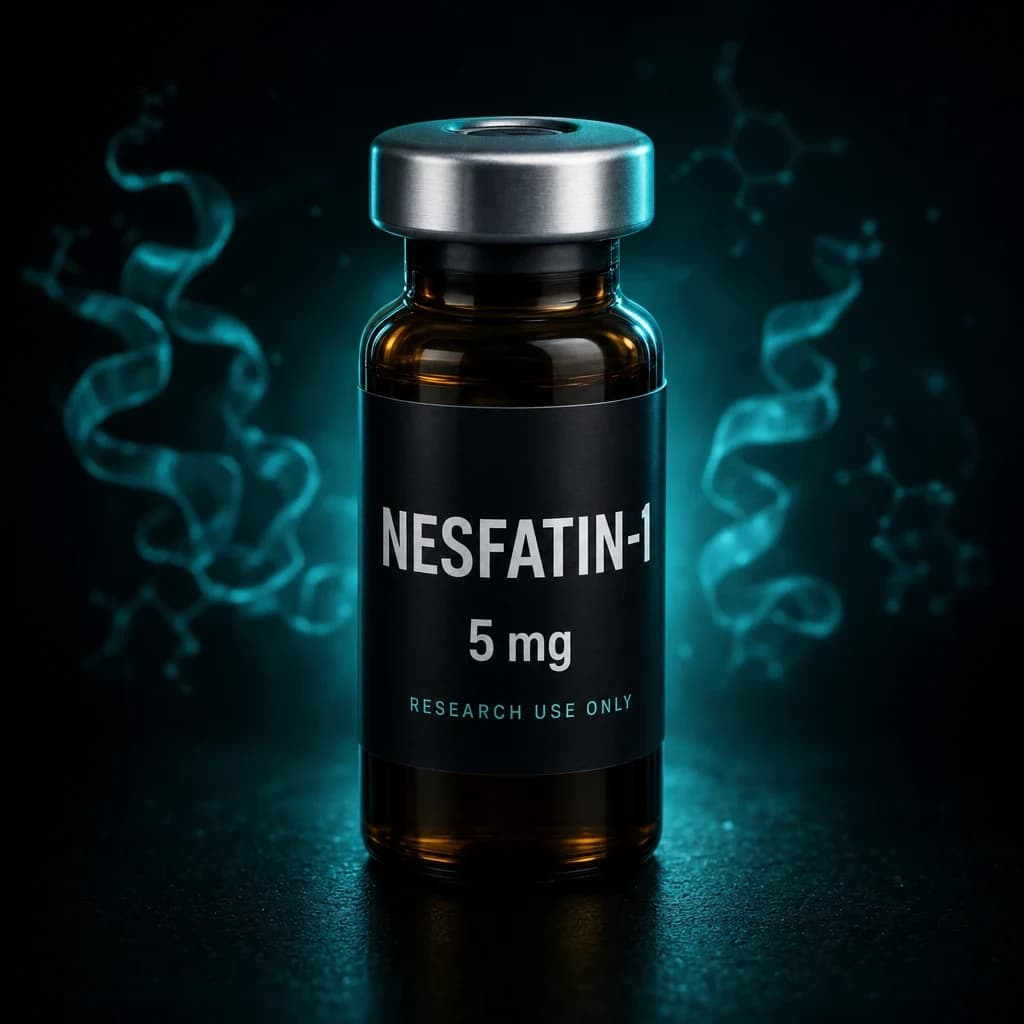
Nesfatin-1Research guide
Anorexigenic peptide cleaved from NUCB2, researched for leptin-independent appetite suppression in rodents
Half-life
Not established in humans (rodent data only)
Typical Dose
No validated human dose. Rodent studies used microgram-range central (ICV) or intraperitoneal dosing; experimental compound only
Format
Injectable
Purity
≥98%
Overview
Nesfatin-1 is an 82-amino-acid anorexigenic peptide cleaved from the precursor protein nucleobindin-2 (NUCB2), first identified in the rat hypothalamus by Oh-I and colleagues in 2006 [1]. Intracerebroventricular injection reduced food intake in a dose-dependent manner and chronic dosing lowered body weight in rats, while a neutralizing antibody stimulated appetite [1]. Its appetite-suppressing action persists in leptin-resistant rodents, which established it as a leptin-independent satiety signal [2]. It is strictly a research compound. There is no approved drug, no human dosing standard, and essentially all efficacy evidence comes from rodent and mechanistic studies [3,6]. A specific nesfatin-1 receptor has not been identified.
Mechanism
Nesfatin-1 is the N-terminal fragment of nucleobindin-2 (NUCB2), released by prohormone convertase cleavage in the hypothalamus, brainstem, and periphery [1,4]. Central administration reduces feeding dose-dependently, and its effect is retained in leptin-receptor-deficient and diet-induced obese rodents, indicating a leptin-independent pathway [2]. It signals through melanocortin-dependent circuits and recruits oxytocin neurons and the brainstem nucleus tractus solitarius rather than a cloned nesfatin-1 receptor, which remains unidentified [2,4]. Beyond feeding, it acts on pancreatic beta-cells to promote glucose-stimulated insulin secretion via L-type calcium channel influx [5], linking it to glucose homeostasis as well as satiety [3,6].
Researched benefits
- Dose-dependent reduction in food intake in rodent studies [1]
- Suppresses appetite independent of leptin signaling [2]
- Lowered body weight gain with chronic administration in rats [1]
- Enhanced glucose-stimulated insulin secretion in mouse islet beta-cells [5]
- Engages hypothalamic and brainstem satiety circuits [4]
- Studied as a modulator of energy balance and body weight regulation [3]
Frequently asked
What is nesfatin-1 and how is it related to NUCB2?
Nesfatin-1 is an 82-amino-acid peptide cleaved from the N-terminal region of nucleobindin-2 (NUCB2) by prohormone convertases. NUCB2 is the precursor protein; nesfatin-1 is the biologically active fragment shown to suppress food intake when injected into the brain of rats [1].
How does nesfatin-1 suppress appetite without leptin?
In leptin-receptor-deficient Zucker rats and diet-induced obese mice, nesfatin-1 still reduced food intake, so its action does not depend on leptin signaling [2]. It works instead through melanocortin-dependent pathways and recruits oxytocin neurons and the brainstem nucleus tractus solitarius [2,4].
Is there human evidence that nesfatin-1 causes weight loss?
No. There are no human trials demonstrating that administering nesfatin-1 produces fat loss. The appetite and body-weight effects come from rodent ICV and intraperitoneal studies [1,2]. Human work has largely measured circulating nesfatin-1 as a correlational biomarker, not tested it as a therapy [3,6].
What is the research and regulatory status of nesfatin-1?
It is an unapproved research compound. There is no marketed drug, no established human dose, and no validated administration protocol. Reviews consistently frame it as a mechanistic target under investigation rather than a treatment [3,6].
Does nesfatin-1 affect blood sugar?
In isolated mouse islets, nesfatin-1 enhanced glucose-stimulated insulin secretion by promoting calcium influx through L-type channels, with no effect at low glucose [5]. This points to a role in glucose homeostasis, but again the data are preclinical and not established in humans.
What dose is used in nesfatin-1 studies?
Rodent experiments have used microgram-range doses delivered centrally (intracerebroventricular) or intraperitoneally [1,2]. Because no human pharmacology or safety data exist, there is no validated human dose, titration schedule, or route.
Scientific Literature
References
- [1]
Oh-I S, Shimizu H, Satoh T, et al. (2006). Identification of nesfatin-1 as a satiety molecule in the hypothalamus.
Nature · PubMed: 17036007
- [2]
Shimizu H, Oh-I S, Hashimoto K, et al. (2009). Peripheral administration of nesfatin-1 reduces food intake in mice: the leptin-independent mechanism.
Endocrinology · PubMed: 19176321
- [3]
Stengel A, Goebel M, Taché Y. (2011). Nesfatin-1: a novel inhibitory regulator of food intake and body weight.
Obesity Reviews · PubMed: 20546141
- [4]
Stengel A, Taché Y. (2013). Role of NUCB2/Nesfatin-1 in the hypothalamic control of energy homeostasis.
Hormone and Metabolic Research · PubMed: 24048879
- [5]
Nakata M, Manaka K, Yamamoto S, Mori M, Yada T. (2011). Nesfatin-1 enhances glucose-induced insulin secretion by promoting Ca2+ influx through L-type channels in mouse islet beta-cells.
Endocrine Journal · PubMed: 21325742
- [6]
Stengel A, Mori M, Taché Y. (2013). The role of nesfatin-1 in the regulation of food intake and body weight: recent developments and future endeavors.
Obesity Reviews · PubMed: 23980879
Citations are provided for educational purposes. Always verify primary sources before drawing research conclusions.
Keep researching
Next steps for Nesfatin-1
The compound page is the overview. Charts, certificates, and the vendor audit sit one click away.
Vendor
Ascension Peptides review
The COA audit and the ENHANCED 50% code for injectable research peptides.
Read the reviewTool
Reconstitution calculator
Convert vial size and bacteriostatic water into syringe units.
Open calculatorReady to start your research
Get Nesfatin-1 from Ascension Peptides
COA-verified, US-based, discreet shipping. Use code ENHANCED for 50% off your entire order.
Buy Nesfatin-1 now