CerebrolysinResearch guide
Porcine-brain-derived neuropeptide preparation studied for stroke, dementia, and TBI neurorecovery
Half-life
Not standardized for the mixture; peptide components clear within hours
Typical Dose
10-30mL IV daily in 10-20 day courses (dosed in mL, not mg)
Format
Injectable
Purity
Standardized peptide preparation (not a single-sequence ≥98% peptide)
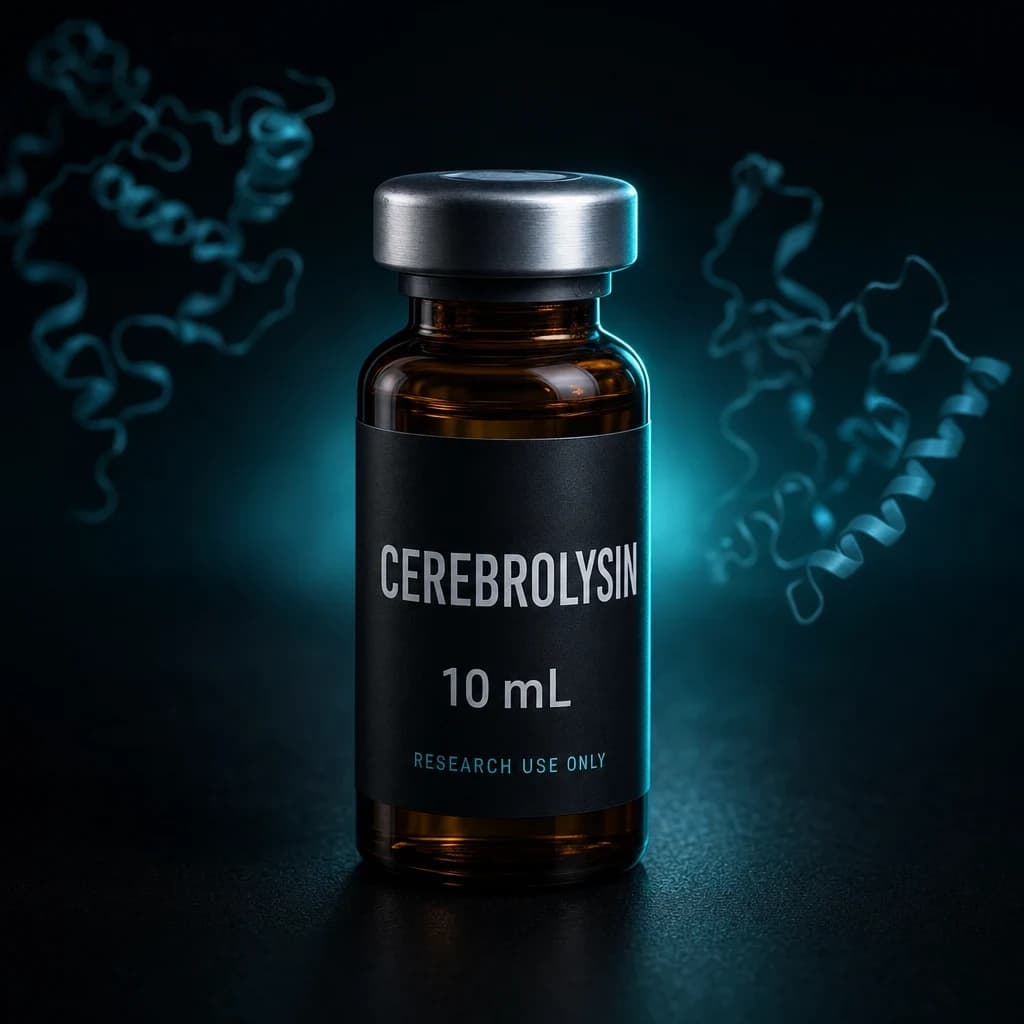
Overview
Cerebrolysin is not a single peptide. It is a standardized preparation of low-molecular-weight neuropeptides and free amino acids produced by the controlled enzymatic breakdown of purified porcine brain proteins [1]. The peptide fraction is thought to imitate endogenous neurotrophic factors such as NGF and BDNF, which is why it has been trialed across acute ischaemic stroke, vascular dementia, Alzheimer's disease, and traumatic brain injury [1,2,3]. The evidence is genuinely mixed. A meta-analysis in mild-to-moderate Alzheimer's reported a favorable benefit-risk ratio [3] and the CAPTAIN TBI series showed small-to-medium neurorecovery signals [4,5], but the most recent Cochrane review in acute ischaemic stroke found it probably has little or no effect on death or disability and flagged more non-fatal serious adverse events at higher doses [1].
Mechanism
The peptide components are proposed to act like endogenous neurotrophic factors (NGF and BDNF), supporting neuronal survival, synaptic repair, and protection against ischaemic and excitotoxic damage [1,2]. Because it is a mixture and not a single sequence, no one receptor explains its activity; the free amino acids and short peptides are thought to feed several pathways at once, including modulation of apoptosis and inflammation [1,3]. Clinically the picture is inconsistent by indication: neurorecovery signals appear in Alzheimer's and TBI analyses [3,5], while Cochrane reviews in stroke and vascular dementia rate the effect uncertain and the underlying trials at high risk of bias [1,2].
Researched benefits
- Neurorecovery signals after moderate-to-severe TBI (CAPTAIN trials)
- Neurotrophic activity mimicking NGF and BDNF
- Cognitive and global-function improvement in mild-to-moderate Alzheimer's trials
- Studied for vascular dementia via intravenous courses
- Neuroprotection in ischaemic and excitotoxic injury models
Frequently asked
Is Cerebrolysin a single peptide?
No. Cerebrolysin is a mixture, not one sequence. It is made by enzymatically digesting purified porcine (pig) brain proteins into low-molecular-weight neuropeptides plus free amino acids. That is why it cannot carry a normal peptide purity spec and is instead sold as a standardized preparation with a defined peptide and amino-acid profile.
Does it actually work for stroke?
The evidence does not support it. The 2020 Cochrane review by Ziganshina and colleagues concluded that Cerebrolysin probably has little or no effect on all-cause death in acute ischaemic stroke, and found moderate-quality evidence of more non-fatal serious adverse events at higher dosing. Despite this, it is still widely used for stroke in Russia, Eastern Europe, and China.
What about Alzheimer's and vascular dementia?
Here the data are more favorable but far from definitive. Gauthier's 2015 meta-analysis in mild-to-moderate Alzheimer's reported an overall beneficial effect and a favorable benefit-risk ratio. The 2019 Cochrane vascular dementia review (Cui) found modest cognitive and global-function gains with no obvious safety signal, but rated the trials at high risk of bias and cautioned any real effect may be too small to be clinically meaningful.
How is a course dosed?
Cerebrolysin is dosed in millilitres, not milligrams, and given as a course rather than a standing daily dose. Typical protocols run 10-30mL IV daily (up to 50mL in stroke/TBI settings) for 10 to 20 consecutive days, then repeat the cycle after a break. IV doses are diluted in saline and infused over 15-60 minutes.
Does it need reconstitution?
No. Unlike lyophilized research peptides, Cerebrolysin ships as a ready-to-use sterile solution in sealed glass ampoules, so there is no powder to reconstitute and no bacteriostatic water involved. You draw directly from the ampoule; for IV use it is diluted into normal saline for infusion.
IV or IM administration?
Both are used. Larger course doses (10-50mL) are given as an intravenous infusion diluted in saline. Smaller volumes, up to roughly 5mL, can be given as a slow intramuscular injection. The major trials, including the CAPTAIN TBI series and the dementia studies, used IV infusion courses.
Scientific Literature
References
- [1]
Ziganshina LE, Abakumova T, Hoyle CHV. (2020). Cerebrolysin for acute ischaemic stroke.
Cochrane Database of Systematic Reviews · PubMed: 32662068
- [2]
Cui S, Chen N, Yang M, Guo J, Zhou M, Zhu C, He L. (2019). Cerebrolysin for vascular dementia.
Cochrane Database of Systematic Reviews · PubMed: 31710397
- [3]
Gauthier S, Proaño JV, Jia J, Froelich L, Vester JC, Doppler E. (2015). Cerebrolysin in mild-to-moderate Alzheimer's disease: a meta-analysis of randomized controlled clinical trials.
Dementia and Geriatric Cognitive Disorders · PubMed: 25832905
- [4]
Poon W, Matula C, Vos PE, Muresanu DF, et al. (2020). Safety and efficacy of Cerebrolysin in acute brain injury and neurorecovery: CAPTAIN I, a randomized, placebo-controlled, double-blind, Asian-Pacific trial.
Neurological Sciences · PubMed: 31494820
- [5]
Vester JC, Buzoianu AD, Florian SI, Muresanu DF, et al. (2021). Cerebrolysin after moderate to severe traumatic brain injury: prospective meta-analysis of the CAPTAIN trial series.
Neurological Sciences · PubMed: 33620612
Citations are provided for educational purposes. Always verify primary sources before drawing research conclusions.
Keep researching
Next steps for Cerebrolysin
The compound page is the overview. Charts, certificates, and the vendor audit sit one click away.
Vendor
Ascension Peptides review
The COA audit and the ENHANCED 50% code for injectable research peptides.
Read the reviewTool
Reconstitution calculator
Convert vial size and bacteriostatic water into syringe units.
Open calculatorReady to start your research
Get Cerebrolysin from Ascension Peptides
COA-verified, US-based, discreet shipping. Use code ENHANCED for 50% off your entire order.
Buy Cerebrolysin now