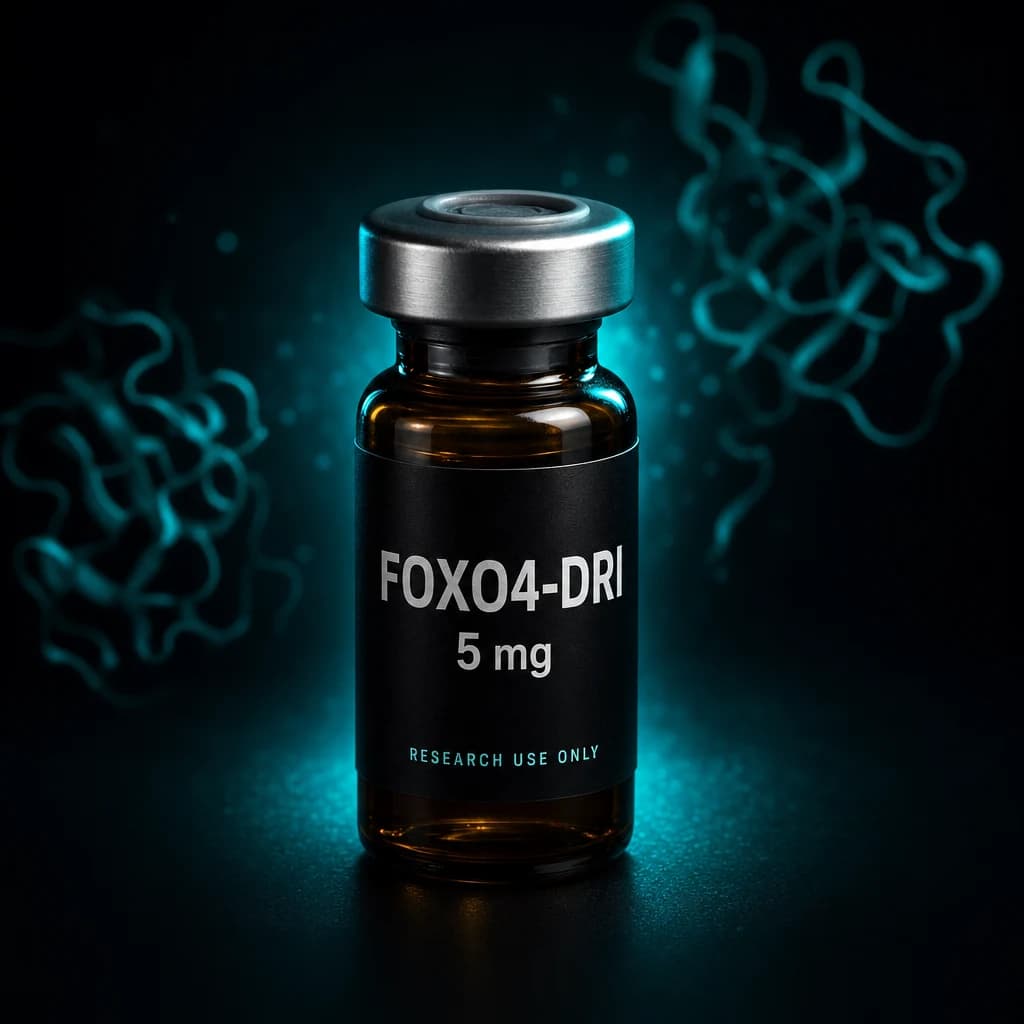
FOX04-DRI
D-retro-inverso peptide designed to disrupt FOXO4-p53 interaction and induce apoptosis in senescent cells
Half-life
Short (research peptide)
Typical Dose
Experimental — research protocols only
Format
Injectable
Purity
≥98%
Overview
FOX04-DRI is a designer peptide developed in Peter de Keizer's lab at Erasmus Medical Center. It disrupts the interaction between FOXO4 and p53 inside senescent cells, freeing p53 to trigger programmed cell death selectively in 'zombie' cells while leaving healthy cells unaffected. The seminal paper was published in Cell in 2017 and launched significant interest in senolytic peptide therapy for age-related conditions.
Mechanism
Senescent cells up-regulate FOXO4, which binds and sequesters p53 to prevent apoptosis — allowing the cells to persist in a growth-arrested but metabolically active state. FOX04-DRI is a D-retro-inverso peptide that competes with endogenous FOXO4 for p53 binding. Displacing p53 allows it to enter the nucleus and trigger apoptosis specifically in senescent cells that depend on this mechanism for survival. Healthy, non-senescent cells do not rely on FOXO4-p53 sequestration and are spared.
Researched benefits
- Selective senolytic activity
- Clearance of senescent ('zombie') cells
- Age-related condition research
- Tissue function in aged models
- Preservation of healthy cells (selective mechanism)
- Designer D-retro-inverso stability
Frequently asked
What does 'D-retro-inverso' mean?
D-retro-inverso (DRI) peptides are built with D-amino acids in the reverse sequence of the native peptide. The resulting molecule presents similar side-chain topology to the natural peptide but is highly resistant to proteolytic degradation, greatly extending biological half-life compared to the L-form. This stabilization is what makes FOX04-DRI viable as a research tool.
Is FOX04-DRI selective for senescent cells only?
The published mechanism proposes selectivity because senescent cells depend on FOXO4 sequestering p53 to avoid apoptosis — healthy cells do not use this survival strategy and are therefore unaffected when the interaction is disrupted. In vivo studies in aged and progeroid mice reported functional improvements without the toxicity seen with broader cytotoxic agents.
What are the typical research dosing patterns?
The de Keizer group's rodent studies used pulsed dosing (three injections over a week, repeated after a rest period) rather than continuous administration. Human translational protocols remain experimental and doses are extrapolated from animal data — there is no established human dose.
Ready to start your research
Get FOX04-DRI from Ascension Peptides
COA-verified, US-based, discreet shipping. Use code ENHANCED for 50% off your entire order.
Buy FOX04-DRI now