GHRP-2Research guide
Potent ghrelin-receptor (GHS-R1a) agonist studied as a growth hormone secretagogue
Half-life
~30-60 min (plasma)
Typical Dose
100-300mcg per dose, 1-3x daily (SC)
Format
Injectable
Purity
≥98%
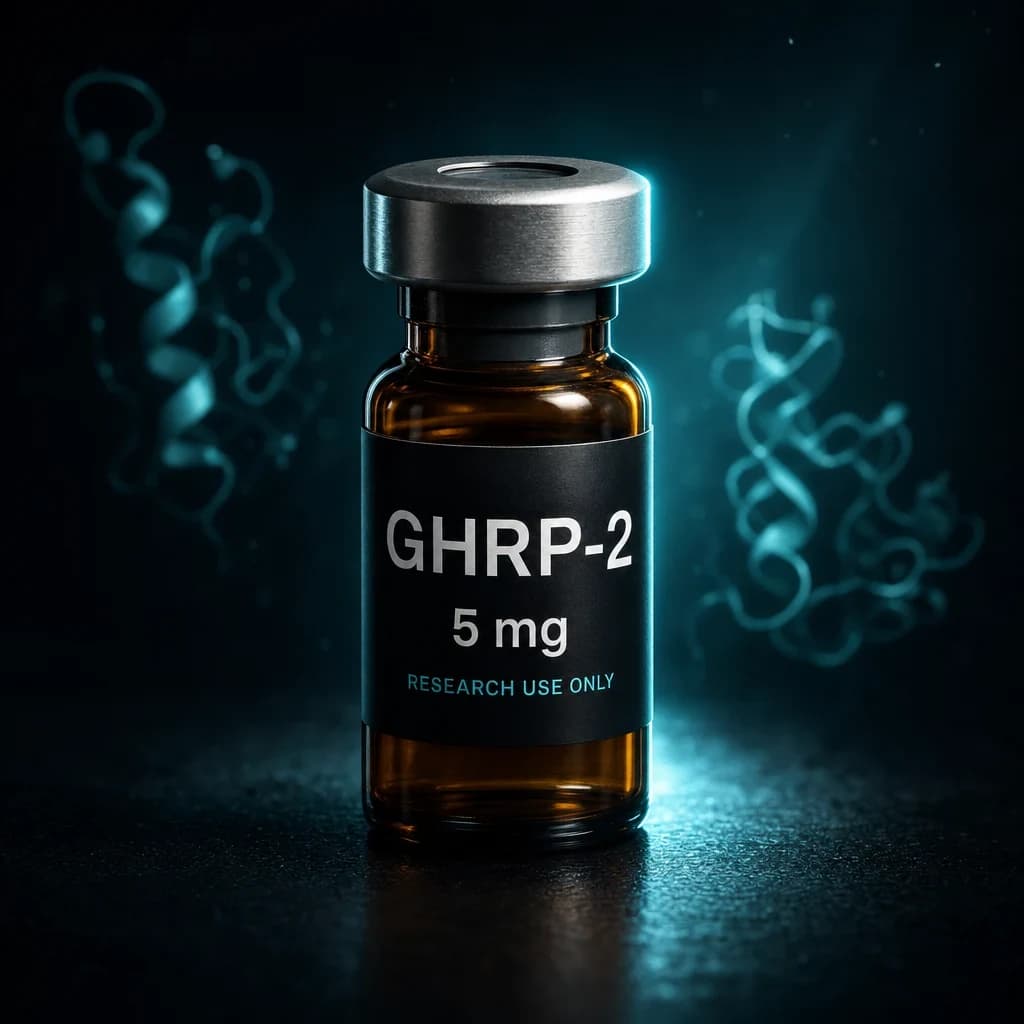
Overview
GHRP-2 (also called pralmorelin) is one of the earliest and most thoroughly studied growth hormone secretagogues, developed by Cyril Bowers and colleagues [1]. It is a ghrelin-receptor agonist, so alongside GH release it reliably raises appetite: healthy men given GHRP-2 ate roughly 36% more at a buffet meal than on saline [2]. Human pharmacokinetic work reports a short plasma half-life near 0.5 hours after intravenous dosing, with each dose driving a GH pulse that lasts a couple of hours [1]. Dose-ranging studies in GH-deficient children showed stepwise increases in overnight GH secretion and growth velocity across 0.3 to 3.0 mcg/kg/day [3]. Most of the rigorous human data comes from short-stature and diagnostic research rather than healthy adults [3,4], so effects on body composition in athletic populations remain largely extrapolated.
Mechanism
GHRP-2 is a synthetic hexapeptide that acts as an agonist at the growth hormone secretagogue receptor GHS-R1a, the same receptor bound by the gut hormone ghrelin [2]. Binding on pituitary somatotrophs triggers a sharp, dose-dependent GH pulse, and central activity helps blunt somatostatin tone [1]. Because it works through a pathway independent of GHRH, co-administration with a GHRH analog produces a synergistic GH response larger than either agent alone [5].
Researched benefits
- Potent, dose-dependent growth hormone release
- Downstream IGF-1 elevation via natural GH pulses
- Synergistic GH response when stacked with a GHRH analog
- Increased appetite through ghrelin-receptor activation
- Well-characterized human pharmacokinetic profile
Frequently asked
How is GHRP-2 different from GHRP-6?
Both are ghrelin-receptor hexapeptides, but GHRP-2 is more potent per microgram and drives a stronger GH pulse. GHRP-6 causes markedly more hunger; GHRP-2 still increases appetite, just less dramatically. Researchers who want GH release with less eating pressure tend to pick GHRP-2.
What's the half-life of GHRP-2?
Short. Intravenous pharmacokinetics in children reported a beta half-life near 0.5 hours (about 30 minutes) with plasma clearance around 0.66 L/h per kg [1]. The GH pulse itself lasts roughly 2-3 hours, which is why research protocols commonly dose 1-3 times daily.
Does GHRP-2 stack with CJC-1295 or another GHRH analog?
Yes. GHRP-2 (ghrelin pathway) and GHRH analogs act through separate receptors, and the combination produces a GH release larger than the sum of each alone [5]. This receptor-level synergy is the rationale behind the common GHRP-plus-GHRH research pairing.
Why does GHRP-2 make you hungry?
It activates the same GHS-R1a receptor as ghrelin, the body's main hunger signal. In a controlled study, lean men infused with GHRP-2 ate about 36% more than on placebo, and every subject increased their intake [2]. Appetite stimulation is a consistent, dose-related effect, not an occasional one.
What research dose is typical?
Human studies used roughly 1 mcg/kg per dose (intravenous or subcutaneous). The common research range is 100-300mcg per dose, once to three times daily, often timed pre-bed and post-exercise. GH output rises with dose up to a plateau, so more is not linearly better [3].
How is GHRP-2 reconstituted?
With bacteriostatic water. Adding 2mL to a 5mg vial gives 2.5mg/mL, so 0.1mL delivers 250mcg. Swirl gently, do not shake, and refrigerate at 2-8°C after mixing. Reconstituted peptide is generally used within 2-4 weeks.
Scientific Literature
References
- [1]
Pihoker C, Kearns GL, French D, Bowers CY. (1998). Pharmacokinetics and pharmacodynamics of growth hormone-releasing peptide-2: a phase I study in children.
Journal of Clinical Endocrinology & Metabolism · PubMed: 9543135
- [2]
Laferrère B, Abraham C, Russell CD, Bowers CY. (2005). Growth hormone releasing peptide-2 (GHRP-2), like ghrelin, increases food intake in healthy men.
Journal of Clinical Endocrinology & Metabolism · PubMed: 15699539
- [3]
Mericq V, Cassorla F, Salazar T, Avila A, Iñiguez G, Bowers CY, Merriam GR. (1998). Effects of eight months treatment with graded doses of a growth hormone (GH)-releasing peptide in GH-deficient children.
Journal of Clinical Endocrinology & Metabolism · PubMed: 9661608
- [4]
Pihoker C, Badger TM, Reynolds GA, Bowers CY. (1997). Treatment effects of intranasal growth hormone releasing peptide-2 in children with short stature.
Journal of Endocrinology · PubMed: 9390009
- [5]
Wideman L, Weltman JY, Patrie JT, Bowers CY, Shah N, Story S, Veldhuis JD, Weltman A. (2000). Synergy of L-arginine and GHRP-2 stimulation of growth hormone in men and women: modulation by exercise.
American Journal of Physiology - Regulatory, Integrative and Comparative Physiology · PubMed: 11004017
Citations are provided for educational purposes. Always verify primary sources before drawing research conclusions.
Keep researching
Next steps for GHRP-2
The compound page is the overview. Charts, certificates, and the vendor audit sit one click away.
Vendor
Ascension Peptides review
The COA audit and the ENHANCED 50% code for injectable research peptides.
Read the reviewArticle
GHRP-2 vs GHRP-6 vs Ipamorelin: Which GH Secretagogue?
A deeper read that sits next to the GHRP-2 guide.
Read articleTool
Reconstitution calculator
Convert vial size and bacteriostatic water into syringe units.
Open calculatorReady to start your research
Get GHRP-2 from Ascension Peptides
COA-verified, US-based, discreet shipping. Use code ENHANCED for 50% off your entire order.
Buy GHRP-2 now