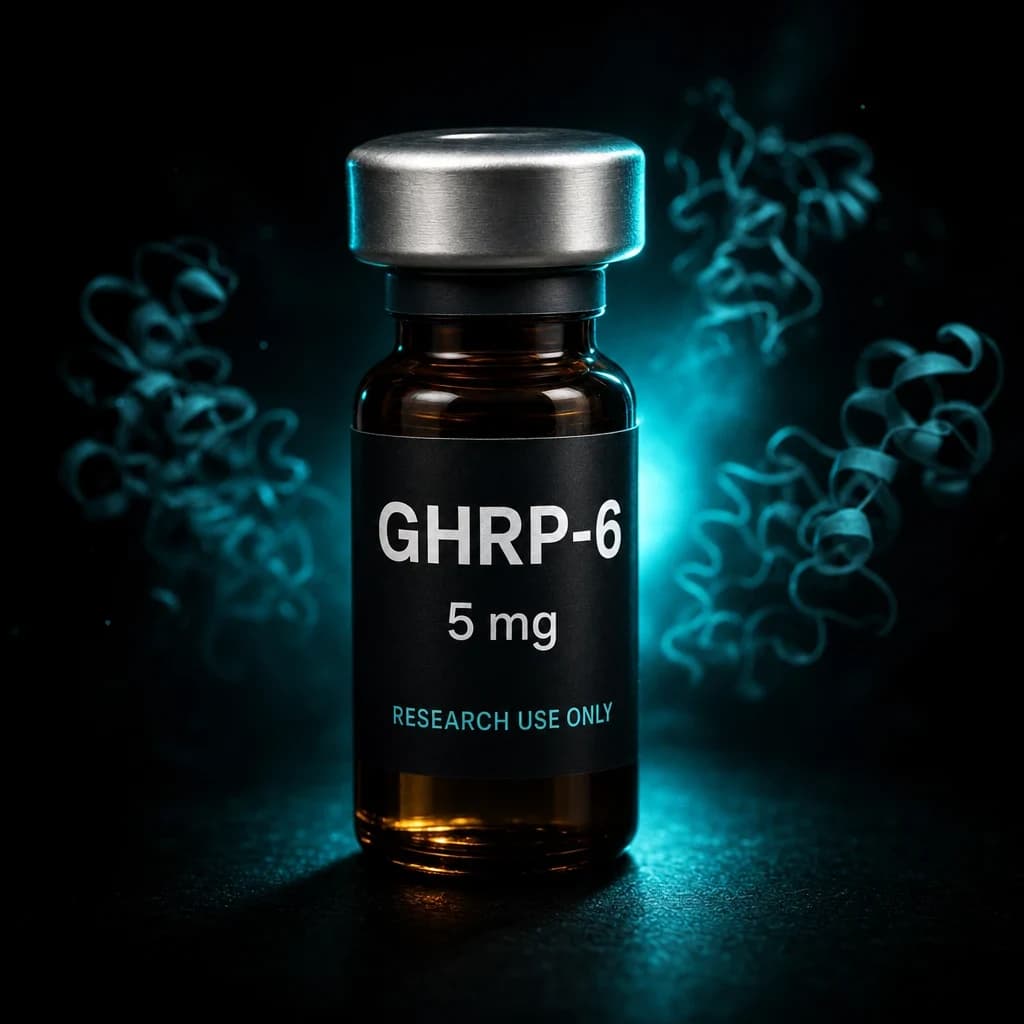
GHRP-6Research guide
Ghrelin-receptor agonist and growth hormone secretagogue known for strong appetite stimulation
Half-life
~15-60 min (plasma); GH peaks ~15-30 min post-dose
Typical Dose
100-200mcg per dose (subcutaneous), 1-3x daily
Format
Injectable
Purity
≥98%
Overview
GHRP-6 is a synthetic hexapeptide (His-D-Trp-Ala-Trp-D-Phe-Lys) and one of the first growth hormone secretagogues characterized in humans [1]. It is a full agonist at the ghrelin receptor (GHS-R1a), the receptor later shown to bind endogenous ghrelin, so research on GHRP-6 actually predates the discovery of ghrelin itself [2]. Most of the data is preclinical or comes from older endocrine challenge studies. GHRP-6 is best known for two things: a fast pulse of natural GH that depends partly on intact GHRH signaling [3], and intense, rapid-onset hunger [5]. It has also been used clinically as a provocative challenge to diagnose growth hormone deficiency [6].
Mechanism
Binds GHS-R1a on pituitary somatotrophs and hypothalamic neurons, activating the phospholipase C / IP3 / diacylglycerol pathway and calcium-driven GH exocytosis [4]. The GH response is amplified by, and partly dependent on, endogenous GHRH, so the two systems act together rather than in isolation [1,3]. The same receptor on arcuate NPY/AgRP neurons drives potent appetite stimulation, and rodent work shows this orexigenic effect is glucocorticoid-dependent [5]. Separate research has explored GHRP-6 as a cytoprotective agent independent of GH release, including prevention of organ injury [7].
Researched benefits
- Strong, dose-dependent pulse of natural growth hormone
- Marked appetite stimulation (studied in cachexia and wasting models)
- Validated as a GH-deficiency diagnostic challenge
- Short-acting profile that mimics physiological GH pulses
- Preclinical cytoprotective and cardioprotective signals
Frequently asked
Why does GHRP-6 cause such strong hunger?
GHRP-6 is a functional ghrelin mimetic. It activates GHS-R1a on NPY/AgRP neurons in the hypothalamic arcuate nucleus, the same orexigenic pathway the body's hunger hormone uses. Hunger typically hits within 20-30 minutes of injection and is far more pronounced than with GHRP-2 or Ipamorelin. Whether this is useful or limiting depends entirely on the research goal.
How does GHRP-6 compare to GHRP-2 and Ipamorelin?
All three are GHS-R1a agonists that release GH. GHRP-6 produces the strongest appetite response and can nudge cortisol and prolactin at higher doses. GHRP-2 releases somewhat more GH with less hunger. Ipamorelin is the most selective, with minimal hunger, cortisol, or prolactin effect. GHRP-6 is generally chosen when appetite stimulation is part of the research question.
What's the typical research dose?
Around 100mcg per dose is the common reference point, since the GH response tends to saturate near that level. Protocols run 100-200mcg subcutaneously, 1-3x daily, often pre-bed, post-workout, or fasted. Pushing the dose higher raises cortisol and prolactin more than it raises GH, so larger amounts offer diminishing returns.
Should GHRP-6 be combined with a GHRH like CJC-1295?
This is the standard research pairing. GHRP-6 acts on the ghrelin receptor while CJC-1295 (or Sermorelin) acts on the GHRH receptor. Because the two receptors act in synergy, the combined GH pulse is larger than either compound produces alone. A common approach is 100mcg of each dosed together.
Does food affect GHRP-6?
Yes. Elevated blood glucose and free fatty acids blunt the GH response, so research protocols dose on an empty stomach and wait roughly 2 hours around meals, especially those high in carbohydrate or fat. This is one reason pre-bed and fasted-morning timing are common.
How is GHRP-6 reconstituted?
Bacteriostatic water is the standard diluent. For a 5mg vial, 2.5mL of BAC water yields 2mg/mL, so 100mcg sits in 0.05mL. Add the water slowly down the vial wall, swirl gently, never shake, then refrigerate and protect from light.
Scientific Literature
References
- [1]
Bowers CY, Sartor AO, Reynolds GA, Badger TM. (1991). On the actions of the growth hormone-releasing hexapeptide, GHRP.
Endocrinology · PubMed: 2004615
- [2]
Bowers CY. (1998). Growth hormone-releasing peptide (GHRP).
Cellular and Molecular Life Sciences · PubMed: 9893708
- [3]
Micic D, Mallo F, Peino R, Cordido F, Leal-Cerro A, Garcia-Mayor RV, Casanueva FF. (1993). Regulation of growth hormone secretion by the growth hormone releasing hexapeptide (GHRP-6).
Journal of Pediatric Endocrinology · PubMed: 7920995
- [4]
Mau SE, Witt MR, Bjerrum OJ, Saermark T, Vilhardt H. (1995). Growth hormone releasing hexapeptide (GHRP-6) activates the inositol (1,4,5)-trisphosphate/diacylglycerol pathway in rat anterior pituitary cells.
Journal of Receptor and Signal Transduction Research · PubMed: 8903947
- [5]
Tung YL, Hewson AK, Dickson SL. (2004). Glucocorticoid-dependent stimulation of adiposity and appetite by a ghrelin mimetic in the rat.
European Journal of Endocrinology · PubMed: 15191362
- [6]
Pombo M, Leal-Cerro A, Barreiro J, Peñalva A, Peino R, Mallo F, Dieguez C, Casanueva FF. (1996). Growth hormone releasing hexapeptide-6 (GHRP-6) test in the diagnosis of GH-deficiency.
Journal of Pediatric Endocrinology and Metabolism · PubMed: 8887178
- [7]
Cibrián D, Ajamieh H, Berlanga J, et al. (2006). Use of growth-hormone-releasing peptide-6 (GHRP-6) for the prevention of multiple organ failure.
Clinical Science (London) · PubMed: 16417467
Citations are provided for educational purposes. Always verify primary sources before drawing research conclusions.
Keep researching
Next steps for GHRP-6
The compound page is the overview. Charts, certificates, and the vendor audit sit one click away.
Protocol
GHRP-6 dosage chart
Research dosing ranges, reconstitution math, and stacks for GHRP-6.
Open dosage chartVendor
Ascension Peptides review
The COA audit and the ENHANCED 50% code for injectable research peptides.
Read the reviewArticle
GHRP-2 vs GHRP-6 vs Ipamorelin: Which GH Secretagogue?
A deeper read that sits next to the GHRP-6 guide.
Read articleReady to start your research
Get GHRP-6 from Ascension Peptides
COA-verified, US-based, discreet shipping. Use code ENHANCED for 50% off your entire order.
Buy GHRP-6 now