GonadorelinResearch guide
Synthetic GnRH (LHRH) studied for pituitary stimulation, fertility, and as a TRT fertility-preservation adjunct
Half-life
~2-10 minutes
Typical Dose
Pulsatile: 5-20mcg per pulse every 90-120 min via pump. GnRH stimulation test: 100mcg IV/SC bolus.
Format
Injectable
Purity
≥98%
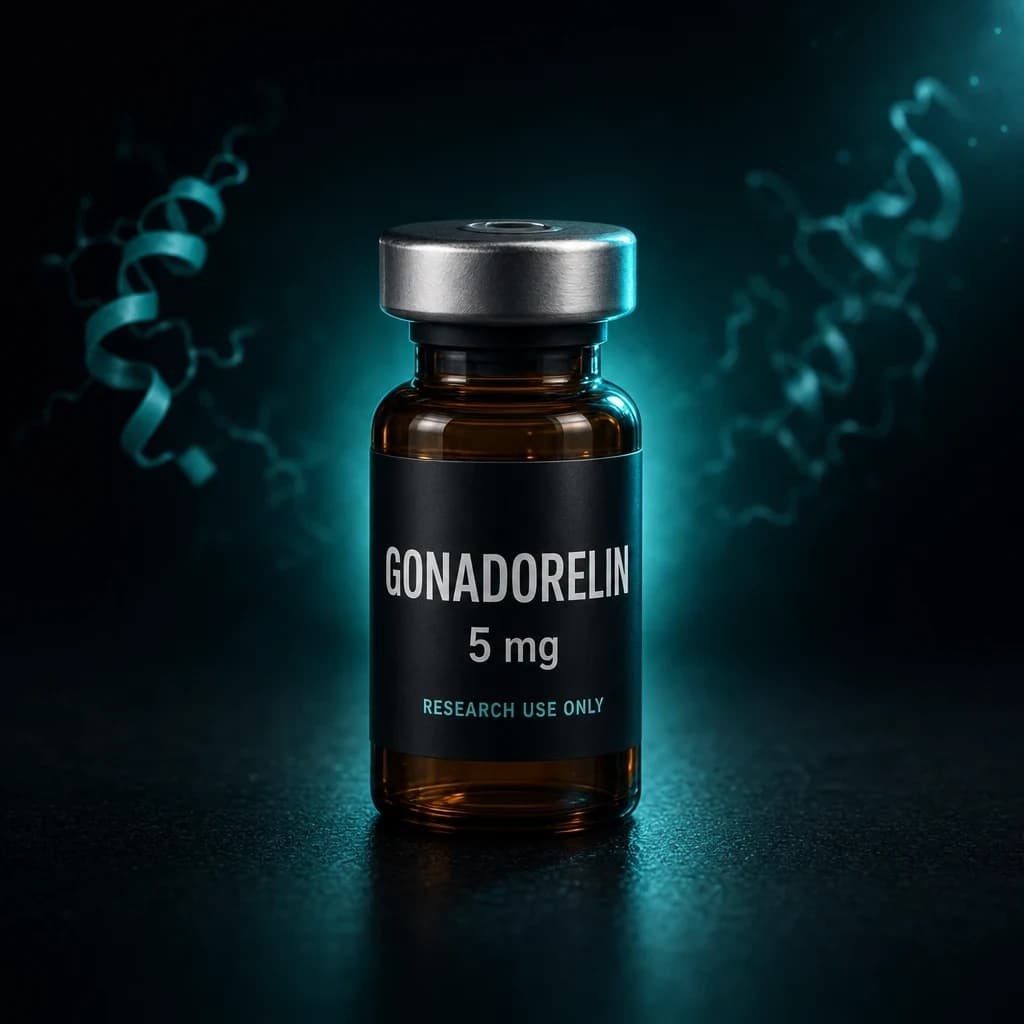
Overview
Gonadorelin is synthetic gonadotropin-releasing hormone (GnRH, also called LHRH), a decapeptide identical to the hormone the hypothalamus secretes to run the reproductive axis. It acts one step upstream of nearly every other fertility compound: rather than mimicking LH at the testis, it tells the pituitary to make its own LH and FSH [1,3]. The critical fact is timing. Delivered in brief pulses, the way the hypothalamus naturally releases it, gonadorelin drives sustained gonadotropin secretion and downstream testosterone and spermatogenesis [1,4]. Delivered continuously, the same molecule desensitizes the pituitary and shuts the axis down, which is why long-acting GnRH agonists are used for chemical castration. It is also the basis of the classic GnRH stimulation test used to separate hypothalamic from pituitary causes of hypogonadism [3,5].
Mechanism
Gonadorelin binds GnRH receptors on the gonadotroph cells of the anterior pituitary, triggering release of luteinizing hormone (LH) and follicle-stimulating hormone (FSH) [1]. LH drives Leydig cells to produce testosterone; FSH supports Sertoli cells and sperm production. The receptor response is frequency-dependent: physiologic pulses every 90 to 120 minutes keep the receptors sensitive and gonadotropins flowing, whereas continuous exposure downregulates and desensitizes them, collapsing LH and FSH output [1,3]. This is the single most important distinction for anyone comparing it to HCG. HCG works downstream as a direct LH-receptor agonist at the testis, so it bypasses the pituitary entirely and does not need pulsing. Gonadorelin works upstream and requires an intact, responsive pituitary plus pulsatile delivery to stimulate rather than suppress [4,5].
Researched benefits
- Stimulates the body's own LH and FSH rather than replacing them [1]
- Preserves testicular volume and intratesticular testosterone during TRT
- Restores spermatogenesis in hypogonadotropic hypogonadism when dosed pulsatile [4]
- Upstream action: works at the pituitary, not directly on the testis
- Diagnostic GnRH stimulation test to localize hypothalamic vs pituitary defects [3,5]
Frequently asked
Gonadorelin vs HCG: what's the actual difference?
They hit the axis at different points. HCG is a downstream LH mimetic that binds LH receptors directly on testicular Leydig cells, so it stimulates testosterone regardless of pituitary status. Gonadorelin is upstream GnRH that acts on the pituitary and asks it to secrete your own LH and FSH. That means gonadorelin only works if the pituitary is intact and responsive, and only if it is delivered in pulses. HCG is simpler to use because it does not need pulsing and has a much longer effective duration.
Why does pulsatile dosing stimulate but continuous dosing suppress?
GnRH receptors on pituitary gonadotrophs stay sensitive only when stimulated intermittently, roughly every 90 to 120 minutes, mirroring the natural hypothalamic rhythm. Constant exposure downregulates and desensitizes those receptors, so LH and FSH output falls instead of rising. Belchetz and colleagues demonstrated this directly in primates in 1978: intermittent GnRH sustained gonadotropin secretion while continuous infusion of the identical peptide shut it off [1]. It is the reason long-acting GnRH agonists are used to suppress the axis, not stimulate it.
Why is gonadorelin used alongside testosterone replacement?
Standard TRT suppresses LH and FSH, which shrinks the testes and stalls sperm production. Gonadorelin is used to keep the pituitary-to-testis signal alive so intratesticular testosterone, testicular volume, and fertility are preserved. It targets the same problem HCG addresses but from one step higher up the axis. Büchter and colleagues showed pulsatile GnRH and HCG-based regimens were both effective for restoring gonadal function in hypogonadotropic hypogonadism [4].
What is the half-life and how often does it need to be dosed?
Very short: roughly 2 to 10 minutes in circulation, because it is cleared and degraded the same way native GnRH is. That short duration is exactly why true pulsatile therapy historically used a programmable infusion pump delivering a micro-pulse every 90 to 120 minutes. It is also the honest limitation for at-home use: twice-weekly or even daily subcutaneous injections do not reproduce genuine physiologic pulsatility, which is a real pharmacological caveat when comparing it to longer-acting HCG.
Does gonadorelin work if the pituitary is damaged?
No, and that is precisely what makes it a diagnostic tool. Because gonadorelin acts on the pituitary rather than the testis, a blunted LH and FSH response to a gonadorelin challenge points to a pituitary problem, while a normal response localizes the defect to the hypothalamus. This GnRH stimulation test is a standard part of the workup for isolated GnRH deficiency and hypogonadotropic hypogonadism [3,5].
How is gonadorelin reconstituted?
Bacteriostatic water or sterile saline is the standard diluent. For a 2mg vial, 2mL yields 1mg/mL (100mcg per 0.1mL), which suits bolus and stimulation-test dosing; more dilute preparations are used for micro-pulse protocols. Add the diluent slowly down the vial wall, swirl gently, never shake, then refrigerate and protect from light.
Scientific Literature
References
- [1]
Belchetz PE, Plant TM, Nakai Y, et al. (1978). Hypophysial responses to continuous and intermittent delivery of hypothalamic gonadotropin-releasing hormone.
Science · PubMed: 100883
- [2]
Santoro N, Filicori M, Crowley WF Jr. (1986). Hypogonadotropic disorders in men and women: diagnosis and therapy with pulsatile gonadotropin-releasing hormone.
Endocrine Reviews · PubMed: 3082615
- [3]
Whitcomb RW, Crowley WF Jr. (1990). Clinical review 4: Diagnosis and treatment of isolated gonadotropin-releasing hormone deficiency in men.
Journal of Clinical Endocrinology & Metabolism · PubMed: 2403572
- [4]
Büchter D, Behre HM, Kliesch S, Nieschlag E. (1998). Pulsatile GnRH or human chorionic gonadotropin/human menopausal gonadotropin as effective treatment for men with hypogonadotropic hypogonadism: a review of 42 cases.
European Journal of Endocrinology · PubMed: 9758439
- [5]
Sykiotis GP, Hoang XH, Avbelj M, et al. (2010). Congenital idiopathic hypogonadotropic hypogonadism: evidence of defects in the hypothalamus, pituitary, and testes.
Journal of Clinical Endocrinology & Metabolism · PubMed: 20382682
Citations are provided for educational purposes. Always verify primary sources before drawing research conclusions.
Keep researching
Next steps for Gonadorelin
The compound page is the overview. Charts, certificates, and the vendor audit sit one click away.
Vendor
Ascension Peptides review
The COA audit and the ENHANCED 50% code for injectable research peptides.
Read the reviewArticle
Kisspeptin Side Effects: What 150+ Human Subjects Actually Reported
A deeper read that sits next to the Gonadorelin guide.
Read articleTool
Reconstitution calculator
Convert vial size and bacteriostatic water into syringe units.
Open calculatorReady to start your research
Get Gonadorelin from Ascension Peptides
COA-verified, US-based, discreet shipping. Use code ENHANCED for 50% off your entire order.
Buy Gonadorelin now