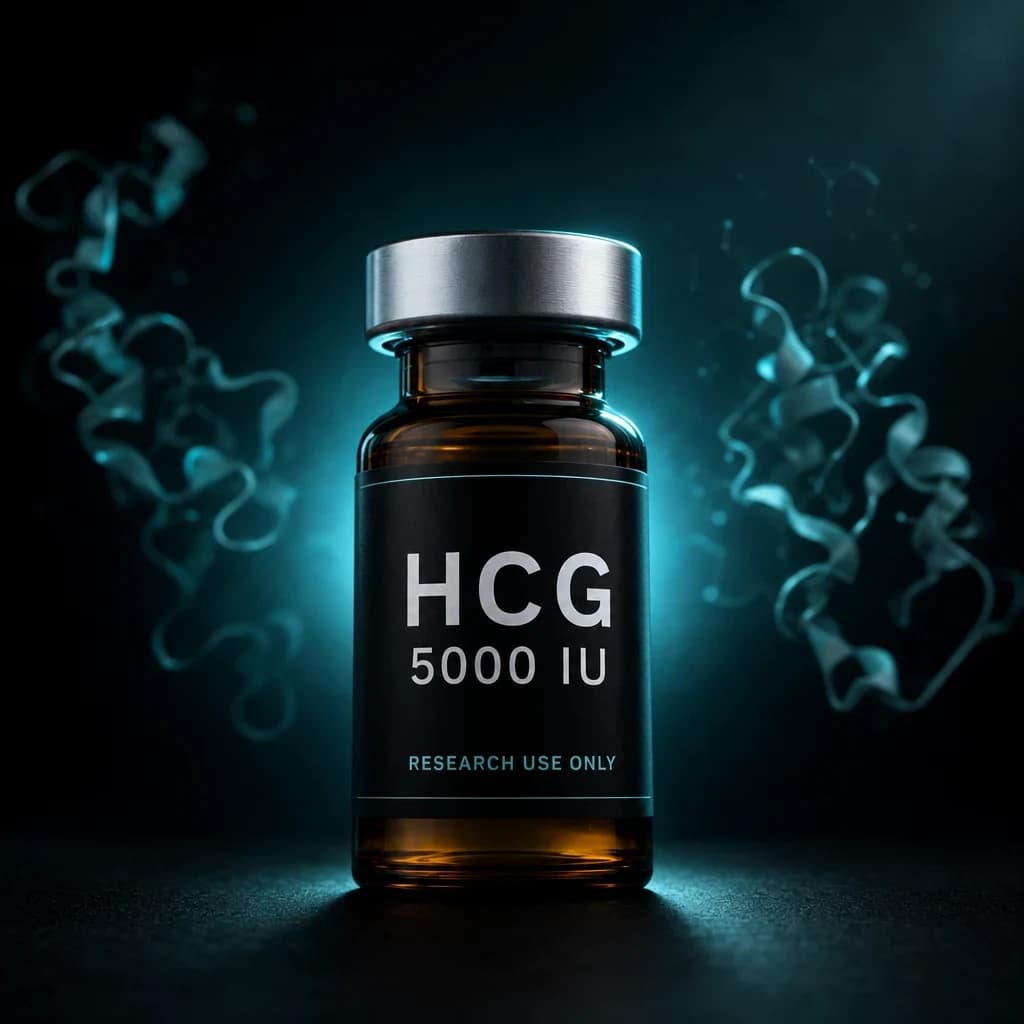
HCG (Human Chorionic Gonadotropin)Research guide
LH-mimetic hormone studied for preserving testicular function and fertility during testosterone therapy
Half-life
~24-36 hours
Typical Dose
250-500 IU 2-3x weekly (TRT adjunct)
Format
Injectable
Purity
≥98%
Overview
Human chorionic gonadotropin (HCG) is a glycoprotein hormone that functions as a luteinizing hormone (LH) mimic. Its beta subunit binds the same LHCG receptor as LH, so it directly stimulates the testicular Leydig cells to produce testosterone and, importantly, intratesticular testosterone [1,4]. In men on testosterone replacement therapy (TRT), exogenous testosterone suppresses the pituitary's LH and FSH output, which shuts down the testes' own production and can cause testicular atrophy and infertility. Low-dose HCG added alongside TRT maintains intratesticular testosterone within the normal range and helps preserve spermatogenesis [1,2,4]. It is also used to induce or maintain fertility in men with hypogonadotropic hypogonadism [3,5] and as an ovulation trigger in female fertility protocols. HCG is a prescription hormone in established clinical use; the information here is for research and educational purposes.
Mechanism
HCG shares near-identical tertiary structure with luteinizing hormone and binds the LHCG receptor on testicular Leydig cells, activating the same cAMP and protein kinase A cascade that drives steroidogenesis [1,4]. This stimulates conversion of cholesterol to testosterone and sustains intratesticular testosterone at concentrations far above serum levels, which is what spermatogenesis depends on [1,2]. Because it acts directly on the gonad, HCG bypasses the pituitary entirely, so it works even when endogenous LH is suppressed by exogenous testosterone or absent in hypogonadotropic hypogonadism [3,5]. In females, the same LH-like activity triggers final oocyte maturation and ovulation. The response is dose-dependent: intratesticular testosterone rises with increasing HCG dose across the low-IU range [4].
Researched benefits
- Preserves intratesticular testosterone during TRT
- Maintains testicular volume and counters shrinkage on exogenous testosterone
- Supports spermatogenesis and fertility preservation
- Directly stimulates Leydig cell testosterone production (LH mimic)
- Used as an ovulation trigger in female fertility protocols
- Long half-life allows 2-3x weekly dosing
Frequently asked
Why is HCG used alongside TRT?
Exogenous testosterone suppresses the pituitary hormones LH and FSH, which switches off the testes' own testosterone and sperm production. That causes testicular shrinkage and, in many men, infertility. HCG mimics LH and stimulates the Leydig cells directly, so it keeps intratesticular testosterone and testicular volume up while a man stays on TRT. Coviello and colleagues (2005) showed that low-dose HCG maintained intratesticular testosterone in the normal range during testosterone-induced gonadotropin suppression.
What is the typical HCG dose in IU?
As a TRT adjunct, research and clinical protocols commonly use 250-500 IU subcutaneously two to three times per week. Fertility induction in hypogonadotropic hypogonadism uses higher doses, often 1,000-2,500 IU two to three times weekly, sometimes combined with FSH. As a female ovulation trigger, a single 5,000-10,000 IU dose is standard. HCG is dosed in international units rather than milligrams because it is a glycoprotein hormone standardized by bioactivity.
Does HCG protect fertility on testosterone?
In many men, yes. Hsieh and colleagues (2013) gave 500 IU HCG every other day to men on testosterone replacement and found that no patient became azoospermic, with intratesticular testosterone preserved. Depenbusch and colleagues (2002) showed HCG alone can maintain spermatogenesis in hypogonadotropic men. It is not a guarantee for every individual, and men actively trying to conceive are sometimes managed off testosterone entirely, but co-administered HCG is the most common strategy for preserving fertility during TRT.
How is HCG different from gonadorelin?
Gonadorelin is a GnRH analog that acts on the pituitary to release the body's own LH and FSH, so it requires an intact pituitary and has a very short half-life that calls for frequent or pulsatile dosing. HCG skips that step and stimulates the testicular Leydig cells directly as an LH mimic, with a much longer half-life. Gonadorelin keeps both LH and FSH signaling engaged, whereas HCG replaces only the LH-like signal, which is why FSH is sometimes added to HCG for full fertility induction.
How is HCG different from enclomiphene?
Enclomiphene is an oral SERM that blocks estrogen receptors at the hypothalamus and pituitary, which raises the body's own LH and FSH and therefore its own testosterone. It needs a functioning HPG axis to work. HCG is injectable and acts downstream, directly on the testes, so it works even when LH is suppressed by exogenous testosterone. Enclomiphene is convenient and oral, while HCG gives more direct, predictable Leydig cell stimulation.
What is HCG's half-life and injection frequency?
HCG has a long, biphasic half-life, roughly 24 to 36 hours in the terminal phase, far longer than natural LH. That is why 2-3 subcutaneous injections per week are enough to keep testicular stimulation steady, unlike short-acting GnRH agonists that need frequent dosing.
Scientific Literature
References
- [1]
Coviello AD, Matsumoto AM, Bremner WJ, et al. (2005). Low-dose human chorionic gonadotropin maintains intratesticular testosterone in normal men with testosterone-induced gonadotropin suppression.
Journal of Clinical Endocrinology & Metabolism · PubMed: 15713727
- [2]
Hsieh TC, Pastuszak AW, Hwang K, Lipshultz LI. (2013). Concomitant intramuscular human chorionic gonadotropin preserves spermatogenesis in men undergoing testosterone replacement therapy.
The Journal of Urology · PubMed: 23260550
- [3]
Depenbusch M, von Eckardstein S, Simoni M, Nieschlag E. (2002). Maintenance of spermatogenesis in hypogonadotropic hypogonadal men with human chorionic gonadotropin alone.
European Journal of Endocrinology · PubMed: 12444893
- [4]
Roth MY, Page ST, Lin K, et al. (2010). Dose-dependent increase in intratesticular testosterone by very low-dose human chorionic gonadotropin in normal men with experimental gonadotropin deficiency.
Journal of Clinical Endocrinology & Metabolism · PubMed: 20484472
- [5]
Rastrelli G, Corona G, Mannucci E, Maggi M. (2014). Factors affecting spermatogenesis upon gonadotropin-replacement therapy: a meta-analytic study.
Andrology · PubMed: 25271205
Citations are provided for educational purposes. Always verify primary sources before drawing research conclusions.
Keep researching
Next steps for HCG (Human Chorionic Gonadotropin)
The compound page is the overview. Charts, certificates, and the vendor audit sit one click away.
Vendor
Ascension Peptides review
The COA audit and the ENHANCED 50% code for injectable research peptides.
Read the reviewArticle
Peptides for Testosterone: Which Ones Actually Raise It
A deeper read that sits next to the HCG (Human Chorionic Gonadotropin) guide.
Read articleTool
Reconstitution calculator
Convert vial size and bacteriostatic water into syringe units.
Open calculatorReady to start your research
Get HCG (Human Chorionic Gonadotropin) from Ascension Peptides
COA-verified, US-based, discreet shipping. Use code ENHANCED for 50% off your entire order.
Buy HCG (Human Chorionic Gonadotropin) now