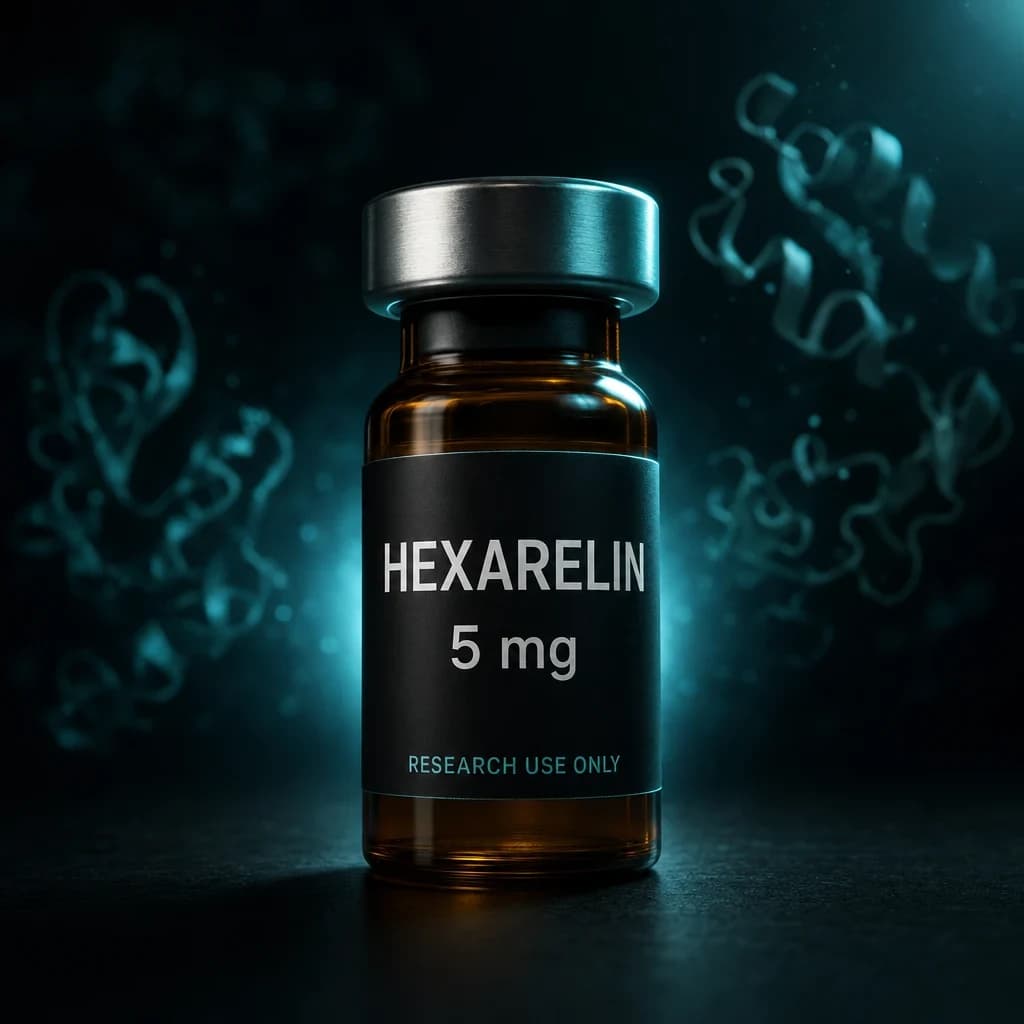
HexarelinResearch guide
Potent synthetic hexapeptide GH secretagogue with a distinct cardiac (CD36) mechanism
Half-life
~55 minutes (plasma)
Typical Dose
100mcg 1-2x daily (subcutaneous); human studies used 1-2mcg/kg
Format
Injectable
Purity
≥98%
Overview
Hexarelin is a synthetic hexapeptide growth hormone secretagogue and a close analog of its parent compound GHRP-6. In humans it drives a strong, dose-dependent GH pulse, and it stays potent across intravenous, subcutaneous, intranasal, and oral routes, though injection is far more effective than nasal or oral delivery [1]. Researchers study it for a second reason as well: separate from GH release, hexarelin binds the CD36 scavenger receptor in cardiac tissue, which underlies its studied cardiovascular actions [2,4]. Almost all of that heart data is preclinical, and one well-documented limitation is that repeated daily dosing blunts the GH response over time [3].
Mechanism
Hexarelin activates the growth hormone secretagogue receptor GHS-R1a (the ghrelin receptor) on pituitary somatotrophs and in the hypothalamus, triggering phospholipase C signaling, IP3-mediated calcium release, and GH exocytosis [1]. In rodents it can upregulate its own GHS-R1a mRNA, an effect that appears age-dependent [5]. A separate, GH-independent pathway runs through the CD36 scavenger receptor in cardiac tissue, which mediates its coronary and cardioprotective actions in animal models [2,4,6].
Researched benefits
- Potent, dose-dependent GH release in human studies
- Active across injectable, nasal, and oral routes [1]
- Direct cardiac CD36 signaling separate from GH (preclinical)
- Studied for ischemia/reperfusion protection in rodents
- Short-acting profile that mimics a natural GH pulse
Frequently asked
How is Hexarelin different from Ipamorelin or GHRP-6?
All three are ghrelin/GHS-R1a agonists, but hexarelin is more potent per microgram and adds a cardiac CD36 interaction the others lack. GHRP-6 (its parent peptide) drives noticeably more hunger, while Ipamorelin is the cleaner option for cortisol and prolactin. Hexarelin's trade-off is a stronger tendency toward desensitization with daily use.
Does Hexarelin cause tolerance or receptor desensitization?
Yes, and this is its main limitation. Rahim and Shalet dosed healthy elderly subjects twice daily for 16 weeks and saw the GH response decline significantly over time [3]. The good news is that the attenuation was partial and reversible: responsiveness returned after a treatment-free break. This is why research protocols favor intermittent dosing and defined cycles rather than continuous daily use.
What's the typical research dose and route?
Human studies used 1-2mcg/kg by intravenous or subcutaneous bolus, which translates to roughly 100mcg once or twice daily subcutaneously in practical research protocols. Intranasal and oral routes are active but need much larger doses for the same GH rise due to low bioavailability [1]. Subcutaneous injection is the standard research route.
What's the half-life of Hexarelin?
Plasma half-life is about 55 minutes. GH typically peaks near 30 minutes after a dose and returns to baseline within roughly 4 hours. Rodent pharmacokinetic work reported a comparable intravenous half-life of around 76 minutes with rapid clearance [7].
Does Hexarelin affect cortisol or prolactin?
It can produce mild, transient rises in ACTH, cortisol, and prolactin, more than a selective agent like Ipamorelin but generally modest at research doses. Notably, exogenous GH feedback does not suppress the GH response to hexarelin in normal men, which points to a mechanism acting above the usual somatostatin brake [8].
What are the cardiac effects, and are they proven in humans?
Hexarelin binds CD36 on cardiomyocytes and, in rodent models, raises coronary perfusion pressure and protects heart tissue from ischemia/reperfusion injury through interleukin-1 signaling [2,6]. These effects are GH-independent and genuinely interesting, but the evidence is preclinical. Hexarelin is not an established cardiac therapy in humans.
Scientific Literature
References
- [1]
Ghigo E, Arvat E, Gianotti L, et al. (1994). Growth hormone-releasing activity of hexarelin, a new synthetic hexapeptide, after intravenous, subcutaneous, intranasal, and oral administration in man.
Journal of Clinical Endocrinology & Metabolism · PubMed: 8126144
- [2]
Bodart V, Febbraio M, Demers A, et al. (2002). CD36 mediates the cardiovascular action of growth hormone-releasing peptides in the heart.
Circulation Research · PubMed: 11988484
- [3]
Rahim A, Shalet SM. (1998). Does desensitization to hexarelin occur?.
Growth Hormone & IGF Research · PubMed: 10990150
- [4]
Mao Y, Tokudome T, Kishimoto I. (2014). The cardiovascular action of hexarelin.
Journal of Geriatric Cardiology · PubMed: 25278975
- [5]
Bresciani E, Nass R, Torsello A, et al. (2004). Hexarelin modulates the expression of growth hormone secretagogue receptor type 1a mRNA at hypothalamic and pituitary sites.
Neuroendocrinology · PubMed: 15361691
- [6]
Huang J, Li Y, Zhang J, et al. (2017). The Growth Hormone Secretagogue Hexarelin Protects Rat Cardiomyocytes From in vivo Ischemia/Reperfusion Injury Through Interleukin-1 Signaling Pathway.
International Heart Journal · PubMed: 28321024
- [7]
Roumi M, Marleau S, du Souich P, et al. (2000). Kinetics and disposition of hexarelin, a peptidic growth hormone secretagogue, in rats.
Drug Metabolism and Disposition · PubMed: 10611139
- [8]
Cappa M, Setzu S, Bernardini S, et al. (1995). Exogenous growth hormone administration does not inhibit the growth hormone response to hexarelin in normal men.
Journal of Endocrinological Investigation · PubMed: 8787952
Citations are provided for educational purposes. Always verify primary sources before drawing research conclusions.
Keep researching
Next steps for Hexarelin
The compound page is the overview. Charts, certificates, and the vendor audit sit one click away.
Vendor
Ascension Peptides review
The COA audit and the ENHANCED 50% code for injectable research peptides.
Read the reviewTool
Reconstitution calculator
Convert vial size and bacteriostatic water into syringe units.
Open calculatorReady to start your research
Get Hexarelin from Ascension Peptides
COA-verified, US-based, discreet shipping. Use code ENHANCED for 50% off your entire order.
Buy Hexarelin now