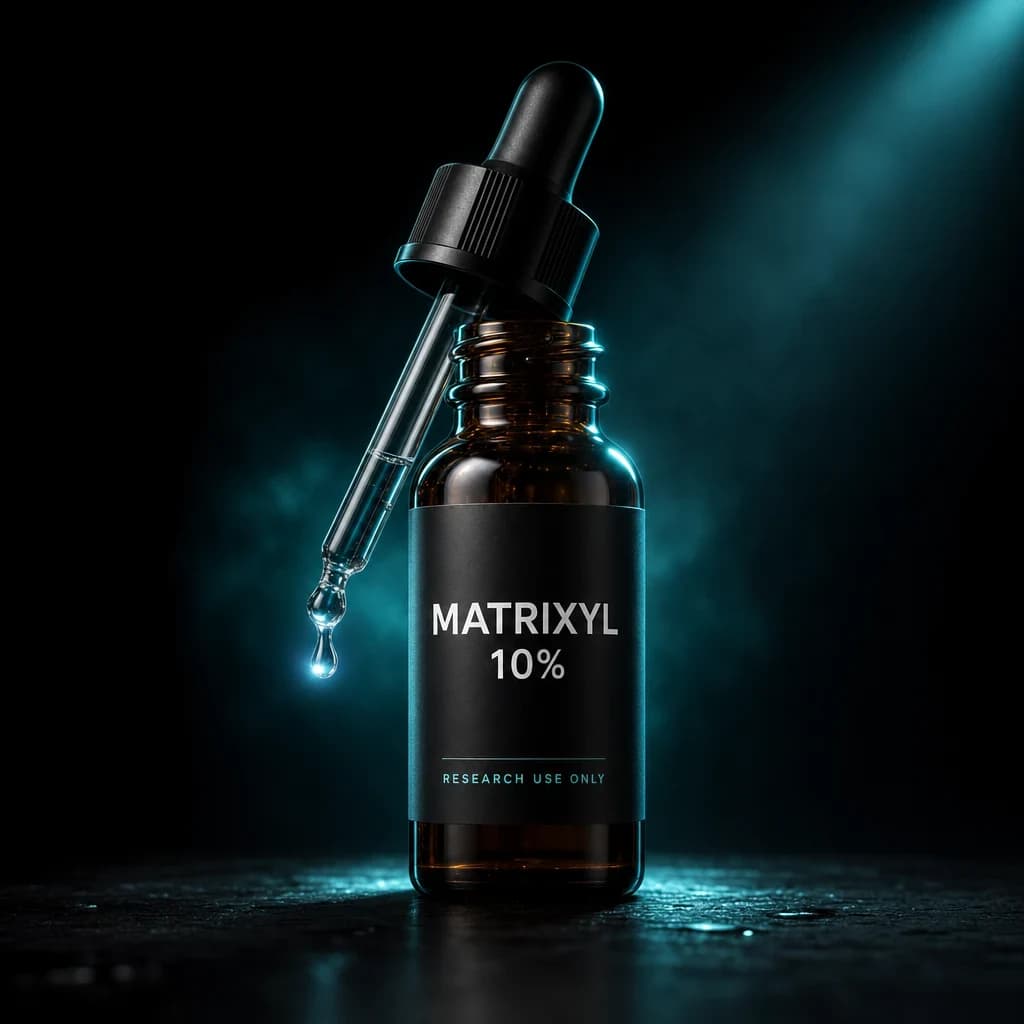
Matrixyl (Palmitoyl Pentapeptide-4)Research guide
Palmitoyl pentapeptide-4 (pal-KTTKS) matrikine studied for topical collagen stimulation and wrinkle reduction
Half-life
Topical, minimal systemic absorption. Free KTTKS degrades within minutes in skin; the palmitoyl chain slows breakdown [4].
Typical Dose
3-10% Matrixyl blend in leave-on serums (pal-KTTKS active at ppm levels), applied 1-2x daily
Format
Topical
Purity
≥95%
Overview
Matrixyl (palmitoyl pentapeptide-4, or pal-KTTKS) is a matrikine: a fragment of type I collagen (the KTTKS sequence) anchored to a palmitic acid chain for better skin penetration. When collagen breaks down, fragments like KTTKS signal fibroblasts to rebuild the extracellular matrix, and Matrixyl mimics that repair cue on demand [1]. It is one of the more independently studied cosmetic peptides, backed by a 12-week placebo-controlled facial study [2] and supporting fibroblast data [3]. The later 'Matrixyl 3000' system pairs two different matrikines (palmitoyl tripeptide-1 and palmitoyl tetrapeptide-7) instead of pal-KTTKS. Much of the headline collagen data is in-vitro or manufacturer-sponsored, so expect gradual improvement rather than retinoid-level change.
Mechanism
KTTKS is a signal fragment released when type I collagen degrades. Applied topically as the palmitoylated form, it acts as a matrikine that tells dermal fibroblasts to increase synthesis of collagen I, collagen III, collagen IV, and fibronectin, effectively faking the 'rebuild' cue of wound repair [1]. In-vitro work confirms concentration-dependent collagen stimulation in human dermal and corneal fibroblasts, tied to the peptide amphiphile's self-assembly near its critical aggregation concentration [3]. The palmitoyl chain is functional, not decorative: free KTTKS is degraded within minutes in skin, while pal-KTTKS is more stable and lipophilic enough to cross the stratum corneum [4].
Researched benefits
- Fine line and wrinkle reduction (12-week clinical data)
- Signals collagen I, III, and IV synthesis
- Supports fibronectin and extracellular matrix rebuilding
- Improved skin firmness and texture
- Gentle, low-irritation alternative to retinoids
Frequently asked
Matrixyl vs Matrixyl 3000: what's the difference?
'Matrixyl' originally refers to palmitoyl pentapeptide-4 (pal-KTTKS), a single matrikine derived from a type I collagen fragment. 'Matrixyl 3000' is Sederma's later two-peptide system pairing palmitoyl tripeptide-1 (pal-GHK) with palmitoyl tetrapeptide-7 (pal-GQPR), aimed at both collagen stimulation and reducing glycation-related inflammatory damage. There is no independent head-to-head trial proving one clearly beats the other, and most comparative claims come from the manufacturer.
Does Matrixyl actually work?
The strongest independent evidence is Robinson 2005 [2]: a 12-week, double-blind, split-face, placebo-controlled study in 93 women where 3 ppm pal-KTTKS reduced fine lines and wrinkles versus a matched moisturizer. In-vitro, KTTKS raises collagen I, III, and fibronectin in fibroblasts [1,3]. The effect is real but modest and slower than prescription retinoids. Many of the 'collagen +300%' figures come from manufacturer in-vitro data, not clinical trials.
How do you use Matrixyl?
Apply a leave-on serum containing roughly 3-10% Matrixyl blend to clean, dry skin once or twice daily, then seal with moisturizer. Peptides are water-soluble, so use them before heavier oils. Give it 8-12 weeks: the benefit in Robinson 2005 [2] built over 12 weeks. Free KTTKS degrades quickly in skin, which is why the palmitoyl-anchored form is used for better stability and penetration [4].
Matrixyl vs retinol: which is better?
They work differently. Retinoids bind nuclear retinoic acid receptors and drive faster, better-documented remodeling, but often cause irritation, peeling, and sun sensitivity. Matrixyl signals fibroblasts through the KTTKS matrikine pathway [1] with far less irritation, which makes it useful for sensitive skin or as a daytime partner to nighttime retinoid use. Head-to-head clinical data are limited, and retinoids still have the deeper evidence base.
Can Matrixyl be combined with other peptides?
Yes. Matrixyl layers well with GHK-Cu (copper peptide) and hyaluronic acid for complementary collagen and hydration support, and with Argireline (acetyl hexapeptide-8) or SNAP-8 for expression-line products. Avoid stacking it in the same step as strong acids or high-strength vitamin C, which can affect peptide stability.
Is the collagen data trustworthy?
Be skeptical of large percentages. The foundational collagen-stimulation work is legitimate in-vitro science [1,3], and there is one solid independent clinical study [2] plus a small 2023 randomized trial on crow's feet [5]. But a large share of 'clinically proven' marketing rests on small, short, or manufacturer-funded studies. Expect gradual softening of fine lines, not a dramatic transformation.
Scientific Literature
References
- [1]
Katayama K, Armendariz-Borunda J, Raghow R, et al. (1993). A pentapeptide from type I procollagen promotes extracellular matrix production.
Journal of Biological Chemistry · PubMed: 8486721
- [2]
Robinson LR, Fitzgerald NC, Doughty DG, et al. (2005). Topical palmitoyl pentapeptide provides improvement in photoaged human facial skin.
International Journal of Cosmetic Science · PubMed: 18492182
- [3]
Jones RR, Castelletto V, Connon CJ, Hamley IW. (2013). Collagen stimulating effect of peptide amphiphile C16-KTTKS on human fibroblasts.
Molecular Pharmaceutics · PubMed: 23320752
- [4]
Choi YL, Park EJ, Kim E, et al. (2014). Dermal Stability and In Vitro Skin Permeation of Collagen Pentapeptides (KTTKS and palmitoyl-KTTKS).
Biomolecules & Therapeutics · PubMed: 25143811
- [5]
Aruan RR, Hutabarat H, Widodo AA, et al. (2023). Double-blind, Randomized Trial on the Effectiveness of Acetylhexapeptide-3 Cream and Palmitoyl Pentapeptide-4 Cream for Crow's Feet.
Journal of Clinical and Aesthetic Dermatology · PubMed: 36909866
Citations are provided for educational purposes. Always verify primary sources before drawing research conclusions.
Keep researching
Next steps for Matrixyl (Palmitoyl Pentapeptide-4)
The compound page is the overview. Charts, certificates, and the vendor audit sit one click away.
Vendor
Ascension Peptides review
The COA audit and the ENHANCED 50% code for injectable research peptides.
Read the reviewArticle
Peptides for Skin (2026): The Ones With Real Evidence
A deeper read that sits next to the Matrixyl (Palmitoyl Pentapeptide-4) guide.
Read articleTool
Reconstitution calculator
Convert vial size and bacteriostatic water into syringe units.
Open calculatorReady to start your research
Get Matrixyl (Palmitoyl Pentapeptide-4) from Ascension Peptides
COA-verified, US-based, discreet shipping. Use code ENHANCED for 50% off your entire order.
Buy Matrixyl (Palmitoyl Pentapeptide-4) now