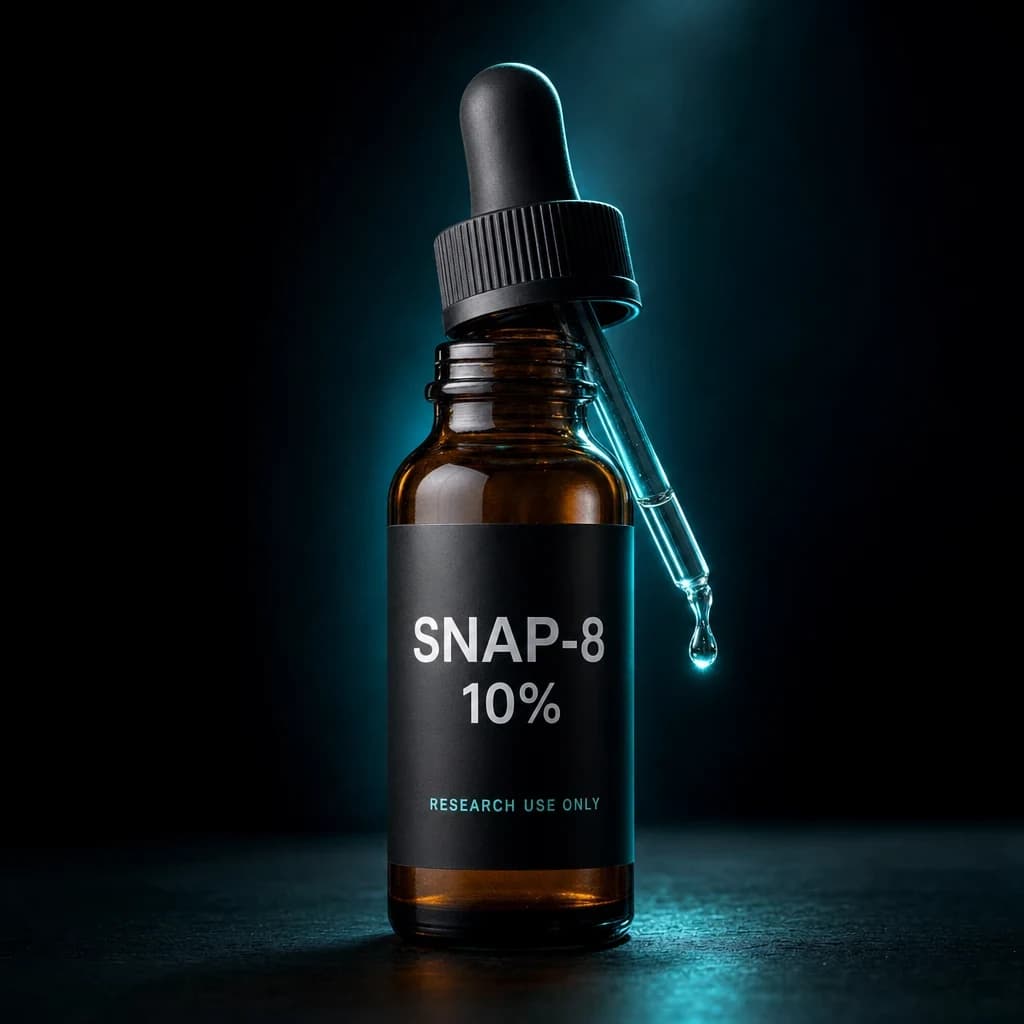
SNAP-8Research guide
Acetyl octapeptide-3, an elongated Argireline analog studied for softening dynamic expression lines
Half-life
Topical; not systemically characterized
Typical Dose
3-10% topical solution, applied twice daily
Format
Topical
Purity
≥95%
Overview
SNAP-8 (Acetyl Octapeptide-3, also listed on labels as Acetyl Glutamyl Heptapeptide-1) is an eight-amino-acid topical peptide developed as an elongated analog of Argireline (Acetyl Hexapeptide-8) [1]. It belongs to the neurotransmitter-inhibiting class of cosmetic peptides [3,5] and is sold as a needle-free alternative to botulinum toxin injections for softening dynamic expression lines. Direct clinical evidence for SNAP-8 is thin and comes mostly from manufacturer-sponsored testing [6]. The better-studied parent peptide Argireline has independent placebo-controlled data [4], and both peptides share the same core limitation: poor penetration through the stratum corneum [2].
Mechanism
The muscle contractions that etch expression lines depend on acetylcholine release at the neuromuscular junction, which requires assembly of the SNARE complex from SNAP-25, syntaxin, and VAMP/synaptobrevin. SNAP-8 mimics a longer stretch of the N-terminal end of SNAP-25 than Argireline does and competes with native SNAP-25 for its place in the SNARE complex, destabilizing assembly so vesicles release less acetylcholine and micro-contractions soften [1,6]. Unlike botulinum toxin type A, which enzymatically cleaves SNAP-25 and causes lasting paralysis, SNAP-8 does not cut the protein and its effect is mild and reversible, so it depends on continuous topical use [5]. As a water-loving peptide it crosses the lipophilic stratum corneum poorly, which is why formulation and delivery drive real-world results [2].
Researched benefits
- Softening of dynamic expression lines (crow's feet, frown and forehead lines)
- Topical, needle-free alternative to botulinum toxin injections
- Extended eight-amino-acid analog of Argireline
- Non-paralytic and fully reversible
- Layers well with collagen-building peptides like Matrixyl and GHK-Cu
Frequently asked
SNAP-8 vs Argireline: what's the difference?
Both are topical peptides that mimic the N-terminal end of SNAP-25 to blunt the muscle micro-contractions behind expression lines. SNAP-8 (Acetyl Octapeptide-3) is the longer, eight-amino-acid version; Argireline (Acetyl Hexapeptide-8) is six amino acids. The manufacturer's own testing reports SNAP-8 edging out Argireline (roughly 35% versus 27% wrinkle-depth reduction at 10% over 28 days), but that comparison is manufacturer-sponsored, not independent. Argireline still carries more published evidence, including a placebo-controlled trial [4].
Does topical SNAP-8 actually work?
Honestly, the evidence is limited. The often-quoted figure of up to a 63% reduction in wrinkle depth comes from manufacturer testing [6], not independent peer-reviewed trials. The bigger practical issue is delivery: SNAP-8 is a hydrophilic peptide that struggles to cross the oily stratum corneum, so much of what you apply never reaches its target [2]. Expect subtle softening of fine dynamic lines at best, not injectable-level results.
What concentration of SNAP-8 should a formula use?
Commercial SNAP-8 is supplied as a dilute solution (around 0.05% actual peptide). Finished products typically use 3-10% of that solution in a leave-on serum or cream, applied twice daily, and it should be added at the end of manufacturing below 40°C. Pushing past 10% rarely helps because penetration, not concentration, is the bottleneck.
Is SNAP-8 the same as Botox?
No. Botulinum toxin type A enzymatically cuts the SNAP-25 protein and causes weeks of muscle paralysis after injection. SNAP-8 only competes with SNAP-25 for a spot in the SNARE complex, does not cleave anything, and its mild effect fades once you stop applying it [1,5]. It is a cosmetic ingredient, not a drug, and will not reproduce injectable results.
How long until I see results, and do they last?
Manufacturer protocols run twice-daily use for about 28 days before assessing changes. Any benefit is contingent on continuous application; because the mechanism is reversible, expression lines drift back toward baseline within weeks of stopping. Treat it as a maintenance ingredient, not a one-time fix.
Can SNAP-8 be combined with other peptides?
Yes, and it usually is. SNAP-8 only addresses movement-related lines, so it is commonly layered with collagen-building peptides such as Matrixyl (palmitoyl pentapeptide-4) and the copper peptide GHK-Cu, which target firmness and static wrinkles through a different pathway. Stacking a neurotransmitter-inhibiting peptide with signal peptides is a standard cosmetic approach [3].
Scientific Literature
References
- [1]
Blanes-Mira C, Clemente J, Jodas G, et al. (2002). A synthetic hexapeptide (Argireline) with antiwrinkle activity.
International Journal of Cosmetic Science · PubMed: 18498523
- [2]
Zdrada-Nowak J, Surgiel-Gemza A, Szatkowska M. (2025). Acetyl Hexapeptide-8 in Cosmeceuticals: A Review of Skin Permeability and Efficacy.
International Journal of Molecular Sciences · PubMed: 40565185
- [3]
Skibska A, Perlikowska R. (2021). Signal Peptides, Promising Ingredients in Cosmetics.
Current Protein and Peptide Science · PubMed: 34382523
- [4]
Wang Y, Wang M, Xiao S, et al. (2013). The anti-wrinkle efficacy of argireline, a synthetic hexapeptide, in Chinese subjects: a randomized, placebo-controlled study.
American Journal of Clinical Dermatology · PubMed: 23417317
- [5]
Reddy BY, Jow T, Hantash BM. (2012). Bioactive oligopeptides in dermatology: Part II.
Experimental Dermatology · PubMed: 22672721
- [6]
Lipotec S.A. (manufacturer technical data) (2009). SNAP-8 (Acetyl Octapeptide-3) anti-wrinkle efficacy dossier (not peer-reviewed; sponsor-funded).
Manufacturer technical brochure
Citations are provided for educational purposes. Always verify primary sources before drawing research conclusions.
Keep researching
Next steps for SNAP-8
The compound page is the overview. Charts, certificates, and the vendor audit sit one click away.
Vendor
Ascension Peptides review
The COA audit and the ENHANCED 50% code for injectable research peptides.
Read the reviewArticle
Peptides for Skin (2026): The Ones With Real Evidence
A deeper read that sits next to the SNAP-8 guide.
Read articleTool
Reconstitution calculator
Convert vial size and bacteriostatic water into syringe units.
Open calculatorReady to start your research
Get SNAP-8 from Ascension Peptides
COA-verified, US-based, discreet shipping. Use code ENHANCED for 50% off your entire order.
Buy SNAP-8 now