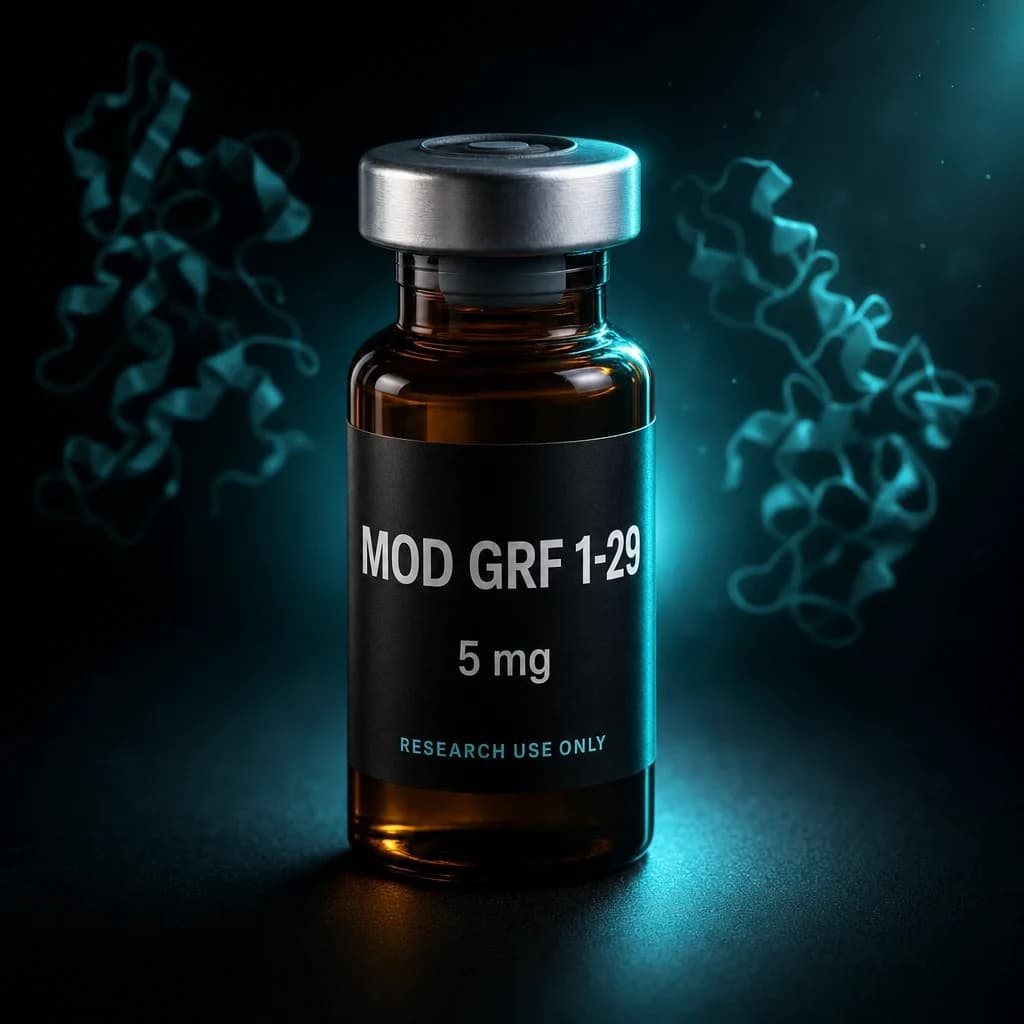
Modified GRF 1-29Research guide
Short-acting GHRH(1-29) analog (CJC-1295 without DAC) studied for pulsatile growth hormone release
Half-life
~30 min
Typical Dose
~100mcg per dose, 1-3x daily (subcutaneous)
Format
Injectable
Purity
≥98%
Overview
Modified GRF 1-29 (also called CJC-1295 without DAC or Mod GRF 1-29) is a tetra-substituted analog of the first 29 amino acids of growth hormone releasing hormone, the fragment that carries GHRH's full biological activity [1]. Four substitutions (D-Ala at position 2, Gln8, Ala15, Nle27) block dipeptidyl peptidase-4 cleavage and slow degradation, stretching plasma half-life to roughly 30 minutes while preserving the brief, pulsatile release pattern of native GHRH [1,3]. Because it lacks the albumin-binding DAC found on long-acting CJC-1295, researchers reach for it when the goal is to model physiological GH pulses rather than a flat, sustained IGF-1 elevation [2,3].
Mechanism
Binds the GHRH receptor on pituitary somatotrophs and drives synthesis and pulsatile release of growth hormone, raising downstream IGF-1 [2,4]. The DPP-4-resistant backbone lets the peptide reach the pituitary intact, but the absence of a DAC anchor keeps its action short, so GH is released in distinct pulses rather than continuously [1,3]. It acts on a receptor separate from the ghrelin/GHS-R receptor that GHRPs target, which is why a GHRH analog paired with a GHRP produces a combined GH release greater than either compound alone [5].
Researched benefits
- Increased natural growth hormone output in discrete pulses
- IGF-1 elevation without continuous receptor saturation
- Improved sleep depth and recovery
- Body composition support (lean mass, fat loss research)
- Larger GH response when stacked with a GHRP
Frequently asked
Mod GRF 1-29 vs CJC-1295 with DAC?
They share the same tetra-substituted GRF(1-29) backbone. The difference is the DAC (Drug Affinity Complex): the with-DAC version binds serum albumin and lasts 6-8 days, producing a sustained bleed of GH and IGF-1 on weekly dosing. Mod GRF 1-29 has no DAC, clears in about 30 minutes, and is dosed 1-3 times daily. The no-DAC version restores natural pulsatility, which is why it is preferred for research modeling physiological GH secretion [3]. The DAC version trades that pulsatility for convenience and a higher steady-state IGF-1 [2].
Why stack Mod GRF 1-29 with a GHRP?
A GHRH analog like Mod GRF 1-29 tells the pituitary to make and release GH, while a GHRP (ipamorelin, GHRP-2, GHRP-6) acts on the separate ghrelin/GHS-R receptor to amplify the release signal and blunt somatostatin. Because the two act on different receptors, the combined GH pulse is larger than either compound produces alone [5]. The most common research pairing is 100mcg Mod GRF 1-29 plus 100-200mcg ipamorelin, dosed together.
What's the typical research dose?
Around 100mcg per dose subcutaneously, 1-3 times daily. 100mcg is often described as the saturation dose for the GHRH receptor, meaning higher single doses tend to widen pulse duration more than they raise the peak. Doses are titrated on IGF-1 response and tolerability (flushing, transient dizziness).
When should it be dosed?
Food, especially fats and carbohydrates, blunts the GH pulse, so research protocols dose on an empty stomach and wait 20-30 minutes before eating. Pre-sleep dosing lines up with the body's largest natural GH pulse; post-workout is a second common window.
How is Mod GRF 1-29 reconstituted?
Bacteriostatic water is the standard diluent. For a 2mg vial, 2mL of BAC water yields 1mg/mL, so 100mcg is 0.1mL. Swirl gently, never shake, and refrigerate. Reconstituted peptide is generally stable for 2-4 weeks at 2-8°C.
Are there contraindications?
Commonly reported transient effects include injection-site flushing, a brief head-rush, tingling, and hunger (from GHS-R crossover when stacked with a GHRP). GH secretagogues are contraindicated in active malignancy because of GH/IGF-1 mitogenic concerns, and used with caution in diabetes or active retinopathy. This compound is sold for laboratory research use only.
Scientific Literature
References
- [1]
Jetté L, Léger R, Thibaudeau K, et al. (2005). Human growth hormone-releasing factor (hGRF)1-29-albumin bioconjugates activate the GRF receptor on the anterior pituitary in rats: identification of CJC-1295 as a long-lasting GRF analog.
Endocrinology · PubMed: 15817669
- [2]
Teichman SL, Neale A, Lawrence B, et al. (2006). Prolonged stimulation of growth hormone (GH) and insulin-like growth factor I secretion by CJC-1295, a long-acting analog of GH-releasing hormone, in healthy adults.
Journal of Clinical Endocrinology & Metabolism · PubMed: 16352683
- [3]
Ionescu M, Frohman LA. (2006). Pulsatile secretion of growth hormone (GH) persists during continuous stimulation by CJC-1295, a long-acting GH-releasing hormone analog.
Journal of Clinical Endocrinology & Metabolism · PubMed: 17018654
- [4]
Sackmann-Sala L, Ding J, Frohman LA, Kopchick JJ. (2009). Activation of the GH/IGF-1 axis by CJC-1295, a long-acting GHRH analog, results in serum protein profile changes in normal adult subjects.
Growth Hormone & IGF Research · PubMed: 19386527
- [5]
Bowers CY, Sartor AO, Reynolds GA, Badger TM. (1991). On the actions of the growth hormone-releasing hexapeptide, GHRP.
Endocrinology · PubMed: 2004615
Citations are provided for educational purposes. Always verify primary sources before drawing research conclusions.
Keep researching
Next steps for Modified GRF 1-29
The compound page is the overview. Charts, certificates, and the vendor audit sit one click away.
Vendor
Ascension Peptides review
The COA audit and the ENHANCED 50% code for injectable research peptides.
Read the reviewArticle
CJC-1295 With DAC vs Modified GRF 1-29 (No-DAC): Half-Life, Pulsatility, and Which to Run
A deeper read that sits next to the Modified GRF 1-29 guide.
Read articleTool
Reconstitution calculator
Convert vial size and bacteriostatic water into syringe units.
Open calculatorReady to start your research
Get Modified GRF 1-29 from Ascension Peptides
COA-verified, US-based, discreet shipping. Use code ENHANCED for 50% off your entire order.
Buy Modified GRF 1-29 now