At a glance
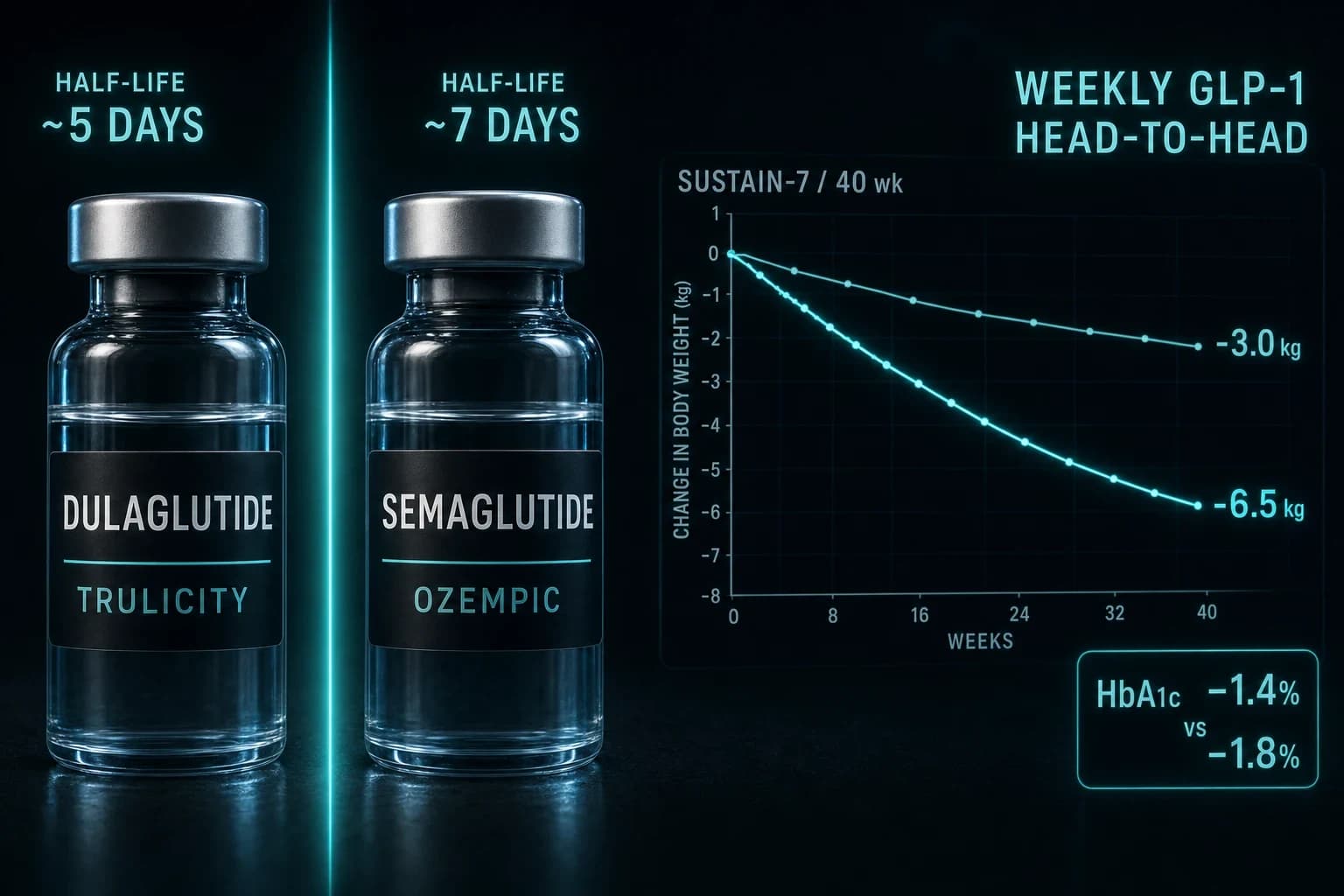
- In SUSTAIN-7, semaglutide 1.0 mg cut HbA1c 1.8% vs 1.4% for dulaglutide 1.5 mg, with 6.5 kg vs 3.0 kg weight loss at 40 weeks
- Semaglutide's half-life is about 7 days; dulaglutide's is about 5 days (Geiser et al. 2016)
- Semaglutide 2.4 mg produced 14.9% weight loss in STEP 1; dulaglutide's max 4.5 mg dose managed roughly 4.7 kg
- REWIND cut MACE 12% (HR 0.88) over 5.4 years; SUSTAIN-6 cut MACE 26% (HR 0.74) over about 2 years
- Both dose once weekly; dulaglutide uses a fixed-dose pen, semaglutide titrates from 0.25 mg upward
The two drugs raced each other once, head to head, and it was not close. In SUSTAIN-7, once-weekly semaglutide 1.0 mg dropped HbA1c by 1.8% and body weight by 6.5 kg at 40 weeks. Dulaglutide 1.5 mg, dosed the same way over the same period, managed 1.4% and 3.0 kg (Pratley et al. 2018). Same class, same schedule, same trial. Semaglutide won on both endpoints.
That single trial answers most of the question people are actually asking when they type "Trulicity vs Ozempic" into a search bar. But the full comparison is more interesting than one winner, because dulaglutide and semaglutide were built for slightly different jobs, and the gap between them changes depending on whether you care about blood sugar, body weight, cardiovascular risk, or how the drug feels to inject.
Here is the whole picture, with the numbers that matter.
Dulaglutide vs semaglutide at a glance
| Feature | Dulaglutide (Trulicity) | Semaglutide (Ozempic / Wegovy) |
|---|---|---|
| Class | GLP-1 receptor agonist | GLP-1 receptor agonist |
| Molecular design | GLP-1 analog fused to a modified IgG4 Fc fragment | GLP-1 analog with a C18 fatty-diacid chain that binds albumin |
| Half-life | ~5 days | ~7 days |
| Dosing | Fixed-dose pen: 0.75, 1.5, 3.0, 4.5 mg weekly | Titrated: 0.25 to 0.5 to 1.0 to 2.0 mg (Ozempic); up to 2.4 mg (Wegovy) |
| HbA1c drop (high dose, SUSTAIN-7) | -1.4% | -1.8% |
| Avg weight loss | ~3.0 kg at 1.5 mg; ~4.7 kg at 4.5 mg | 6.5 kg at 1.0 mg; 14.9% at 2.4 mg (STEP 1) |
| CV outcome | 12% MACE reduction (REWIND, HR 0.88) | 26% MACE reduction (SUSTAIN-6, HR 0.74) |
| Reconstitution | None (prefilled pen) | None for pens; research-grade powder needs mixing |
| Best use | Simple glucose control, needle-averse patients | Maximum glucose and weight response |
Same receptor, two ways of staying in the blood
Both molecules do the same core work. They mimic GLP-1, the gut hormone your body releases after a meal, and switch on the GLP-1 receptor. That triggers glucose-dependent insulin release, suppresses glucagon, slows how fast your stomach empties, and quiets appetite signaling in the hypothalamus. Native GLP-1 does all of this too, but it is destroyed by the enzyme DPP-4 within about two minutes. The entire engineering challenge behind dulaglutide and semaglutide was making that signal last for a week instead of two minutes.
They solved it differently. Dulaglutide bolts two GLP-1 analog chains onto a modified human antibody fragment (IgG4 Fc). The bulk of that antibody scaffold slows kidney clearance and shields the peptide from DPP-4, stretching its half-life to about 5 days (Geiser et al. 2016). Semaglutide takes a leaner approach: it modifies the GLP-1 backbone at a few positions and adds a long fatty-acid chain that latches onto albumin, the most abundant protein in your blood. Riding along on albumin keeps semaglutide circulating for roughly 7 days.
Those two extra days sound trivial. They are not. A 7-day half-life means semaglutide reaches steady-state plasma levels that stay flatter across the week, which is part of why its glucose and weight effects run deeper than a drug cleared faster.
SUSTAIN-7: the only true head-to-head
Most "X vs Y" drug comparisons stitch together separate trials with different populations. Dulaglutide and semaglutide are one of the rare pairs tested directly against each other, which is why SUSTAIN-7 carries so much weight.
The design was clean. 1,201 adults with type 2 diabetes on metformin, randomized to four arms: semaglutide 0.5 mg, dulaglutide 0.75 mg, semaglutide 1.0 mg, or dulaglutide 1.5 mg, all once weekly for 40 weeks (Pratley et al. 2018). Low dose against low dose, high dose against high dose.
Semaglutide won every matchup:
- Low dose: semaglutide 0.5 mg cut HbA1c 1.5% vs 1.1% for dulaglutide 0.75 mg. Weight: 4.6 kg vs 2.3 kg.
- High dose: semaglutide 1.0 mg cut HbA1c 1.8% vs 1.4% for dulaglutide 1.5 mg. Weight: 6.5 kg vs 3.0 kg.
More patients on semaglutide hit an HbA1c under 7% and lost at least 5% of body weight. Side effects told a familiar story: gastrointestinal complaints (nausea, diarrhea) were the most common in both groups, reported by roughly two-thirds to three-quarters of participants, with no meaningful safety gap between the drugs.
Bottom line: When the two drugs are compared directly, at matched doses, on the same patients, semaglutide beats dulaglutide on both blood sugar and weight. That is not extrapolation. It is one 40-week randomized trial.
Weight loss is not a close race
For glucose control the gap is real but modest. For weight loss it is a canyon, and it widens once you leave the diabetes doses behind.
Dulaglutide was never engineered as an obesity drug. Its highest approved dose, 4.5 mg, produced about 4.7 kg of weight loss at 36 weeks in AWARD-11, the trial that expanded its dose range (Bonora et al. 2021). That is the ceiling for dulaglutide. There is no Trulicity-branded obesity version.
Semaglutide has one, and the numbers are on another level. In STEP 1, semaglutide 2.4 mg (marketed as Wegovy) produced 14.9% mean body-weight loss at 68 weeks versus 2.4% on placebo, and 86% of participants lost at least 5% of their body weight (Wilding et al. 2021). Roughly 15% of starting weight from a drug you inject once a week reset the entire field's expectations.
So the honest framing is this: if the goal is weight, dulaglutide is not really a contender. Its 4.7 kg maximum sits against semaglutide's 14.9%, and no dose of dulaglutide closes that distance.
Cardiovascular outcomes: REWIND vs SUSTAIN-6
Both drugs ran large cardiovascular outcome trials, and both reduced major adverse cardiovascular events (MACE: cardiovascular death, non-fatal heart attack, non-fatal stroke). The headline percentages look different, but read the fine print before you rank them.
REWIND tested dulaglutide 1.5 mg against placebo in 9,901 patients over a median 5.4 years, the longest follow-up of any GLP-1 outcome trial. MACE occurred in 12.0% of the dulaglutide group vs 13.4% on placebo, a 12% relative reduction (HR 0.88, 95% CI 0.79 to 0.99, p=0.026) (Gerstein et al. 2019). What makes REWIND unusual is who was in it: about two-thirds of participants had no established cardiovascular disease at baseline. It is the strongest GLP-1 evidence in a primary-prevention population.
SUSTAIN-6 tested semaglutide 0.5 or 1.0 mg against placebo in 3,297 higher-risk patients over about 2 years. MACE occurred in 6.6% on semaglutide vs 8.9% on placebo, a 26% relative reduction (HR 0.74, 95% CI 0.58 to 0.95, p=0.02) (Marso et al. 2016). The benefit was driven heavily by a drop in non-fatal stroke.
Warning: Do not read "26% beats 12%" as "semaglutide protects your heart twice as well." REWIND and SUSTAIN-6 enrolled different populations (mostly primary prevention vs mostly high-risk), ran for different lengths (5.4 years vs 2 years), and were never compared head to head. Cross-trial percentages are not a leaderboard. Both drugs have a legitimate, guideline-recognized cardiovascular benefit.
Dosing and the needle question
This is where dulaglutide claws back some ground, because for a lot of people the experience of using the drug matters as much as the last decimal of HbA1c.
Dulaglutide ships as a fixed-dose, single-use pen with a hidden, pre-attached needle. You do not see it, you do not titrate a dial, you do not draw anything up. Press it to the skin and click. For a needle-averse patient, that design is the entire selling point.
Semaglutide (Ozempic) uses a multi-dose pen that you titrate deliberately: 0.25 mg for four weeks to blunt nausea, then 0.5 mg, then 1.0 mg, then 2.0 mg if needed. The slower ramp is the tradeoff for the deeper response. Skip the titration and the gastrointestinal side effects get ugly fast.
One more practical wrinkle applies only to the research space. Neither branded pen requires mixing, but research-grade semaglutide ships as a lyophilized powder that has to be reconstituted with bacteriostatic water before use, which is why our reconstitution calculator exists. Dulaglutide has no meaningful research-grade equivalent, because manufacturing an antibody-Fc fusion protein is far harder than synthesizing a modified peptide. That asymmetry matters if you are sourcing outside a pharmacy.
Where tirzepatide changes the math
Any 2026 comparison of these two has to acknowledge the drug that outran both. Tirzepatide (Mounjaro, Zepbound) is not a pure GLP-1 agonist. It hits two receptors, GLP-1 and GIP, and it beat semaglutide in their own head-to-head trial.
In SURPASS-2, tirzepatide 15 mg cut HbA1c by 2.30% vs 1.86% for semaglutide 1.0 mg, and produced 5.5 kg more weight loss than semaglutide (both p<0.001) (Frías et al. 2021). If semaglutide outclasses dulaglutide, tirzepatide outclasses semaglutide on raw efficacy. The class has a clear pecking order right now: tirzepatide, then semaglutide, then dulaglutide.
That does not make dulaglutide obsolete. It makes it the simplest, gentlest, lowest-ramp option in a class where the strongest drugs demand the most titration.
Cost and how people actually get them
Both dulaglutide and semaglutide are prescription drugs. In the United States, Trulicity and Ozempic both carry list prices near or above $1,000 a month, and what you actually pay depends entirely on insurance, coupons, and whether you qualify for the diabetes versus obesity indication.
If cost is the deciding factor, the two realistic paths look like this:
-
A prescribed telehealth route. Several services will evaluate you and, if appropriate, prescribe branded or compounded GLP-1 therapy, sometimes well below pharmacy list price. We track the current options and pricing on our cheapest GLP-1 guide. This is the right path if you want medical supervision, dose titration, and a legitimate prescription.
-
Research-grade semaglutide. For laboratory and research use, semaglutide is available from Ascension Peptides at 50% off with code ENHANCED. It arrives as powder for reconstitution, not a ready-to-use pen, and it is sold for research purposes, not human use. There is no comparable research-grade dulaglutide, for the manufacturing reason noted above. Check the lot in the lab-tests library.
Be honest with yourself about which lane you are in. A prescription with a clinician monitoring your titration is a different thing from a research vial, and they are not interchangeable.
Which one fits the endpoint
Match the drug to the goal, not to the marketing.
- You want the strongest glucose and weight response, and you will titrate patiently: semaglutide. It won SUSTAIN-7 outright and its 2.4 mg obesity dose is in a different weight-loss tier than anything dulaglutide offers.
- You want simple, low-drama once-weekly dosing with a hidden-needle pen and no titration dial: dulaglutide. It gives up efficiency for ease of use, and for some people that trade is worth it.
- You want maximum efficacy, period, and dulaglutide vs semaglutide feels like the wrong bracket: look at tirzepatide, which beat semaglutide in SURPASS-2.
- You are choosing mainly on cardiovascular data: both have real MACE benefit. Dulaglutide has the strongest primary-prevention evidence (REWIND); semaglutide has a larger relative reduction in a higher-risk group (SUSTAIN-6).
Bottom line: Semaglutide is the more powerful drug on almost every measured endpoint. Dulaglutide is the easier drug to use and the better-studied option for people without established heart disease. Pick the winner for your specific endpoint, not the one with the loudest headline number.
This article is for research and educational purposes only. It is not medical advice. Dulaglutide, semaglutide, and tirzepatide are prescription medications; decisions about starting, switching, or dosing any of them should be made with a licensed clinician. Research-grade peptides referenced here are sold for laboratory research use only and are not intended for human consumption.