At a glance
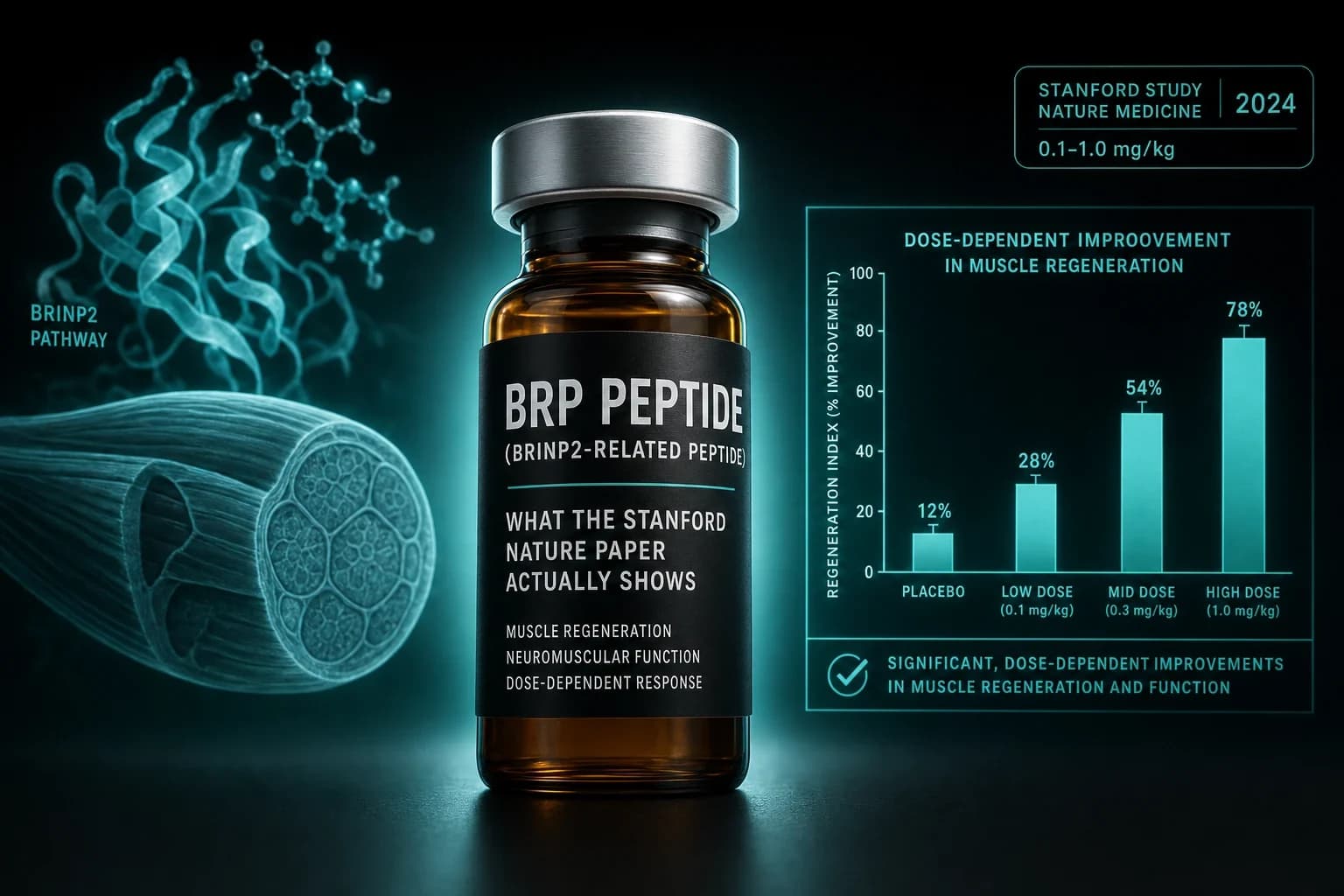
- BRP is a 12-mer (THRILRRLFNLC-amide) cleaved from BRINP2 by PCSK1, first described by Coassolo et al. Nature 2025 (PMID 40044869).
- In lean and diet-induced obese mice, BRP 5 mg/kg IP cut acute food intake; 20 mg/kg near-completely suppressed feeding for up to 3 hours.
- BRP works independently of the GLP-1 receptor, MC4R, and leptin, activating hypothalamic POMC neurons via a CREB-FOS mechanism.
- Only preclinical mouse and lean minipig data exist. No human safety, PK, dosing, or efficacy data have been published as of 2026.
- Merrifield Therapeutics, co-founded by Katrin Svensson, plans human trials but has not announced a Phase 1 timeline.
The Stanford BRP story, minus the hype
The March 2025 headlines called BRP a natural Ozempic. The Coassolo et al. Nature paper describes a 12-amino-acid peptide that reduced food intake in lean mice, diet-induced obese mice, and lean Göttingen minipigs. Both statements are about the same molecule. Only the second one matches what the paper actually reports.
BRP received a single Nature publication and a wave of press that overshot the underlying evidence. This article walks the primary evidence trail so anyone researching BRP, comparing it to GLP-1 agonists, or looking at the research chemicals now appearing on peptide vendor pages has the actual numbers to work from.
What BRP actually is
BRP stands for BRINP2-related peptide. BRINP2 is a 78-kDa secreted parent protein. The 12-amino-acid stretch corresponding to residues 386 to 397, sequence THRILRRLFNLC with C-terminal amidation, is flanked by dibasic KK and KR cleavage motifs. Prohormone convertase 1/3 (PCSK1) recognizes those motifs and releases the peptide fragment. That fragment is what the Stanford team calls BRP.
The Coassolo et al. 2025 paper in Nature (PMID 40044869) is the first published record of BRP as a candidate anti-obesity agent. Before that paper, BRINP2 was known primarily as a brain-expressed protein in the BRINP family (BRINP1, BRINP2, BRINP3) associated with neuronal proliferation. The idea that a specific 12-residue fragment cleaved from BRINP2 has a hypothalamic appetite-suppressing role was new with that publication.
Two structural details matter for anyone reading a vendor product page:
- C-terminal amidation is required for activity. Non-amidated BRP is inert in the Stanford assays.
- The leucine at position 8 is required. Substituting other residues at that position eliminates activity.
That is a specific pharmacophore. It also means "BRP peptide" listed on a random research chemical vendor page has to be synthesized with the correct amide and correct residue 8, or the material will not do anything in a bioassay. Verification of the pharmacophore is not optional.
What the Nature 2025 paper actually showed
Coassolo et al. used a computational platform called Peptide Predictor to systematically map more than 2,600 previously uncharacterized human peptide fragments cleavable from prohormones by prohormone convertases. From that computational search, BRP surfaced as a candidate. The paper then ran the pharmacology on the shortlisted peptide.
BRP in the 2025 Nature paper
| Model | Route and dose | Endpoint | Reported result |
|---|---|---|---|
| Lean mice, acute | 5 mg/kg IP before feeding | Food intake, 1 hour | Significantly reduced vs vehicle |
| Lean mice, acute | 20 mg/kg IP before feeding | Food intake, up to 3 hours | Near-complete suppression |
| DIO mice, chronic | Daily IP over 14 days | Body weight change | ~3 g weight loss, fat-predominant; vehicle controls gained ~3 g |
| DIO mice, chronic | Daily IP over 14 days | Lean mass | No detectable loss on DEXA-equivalent readout |
| Göttingen minipigs | Single IM before feeding | Food intake, 1 hour | ~50 percent reduction vs vehicle |
| Mice | ICV 0.5 mg/kg | Hypothalamic FOS | Increased in dorsomedial, preoptic, tuberal, and arcuate nuclei |
All six of these results are preclinical. The animals are lean or high-fat-diet-induced obese mice and lean Göttingen minipigs. There is no human data, no primate data, and no obese-minipig longitudinal remodeling data. The Fos activation pattern is consistent with direct central engagement of the arcuate POMC circuit, and the aversion assays did not detect conditioned taste aversion at the doses tested.
Why "no nausea" is not a human claim
Every semi-legitimate BRP write-up has led with "works like Ozempic, without the nausea." The framing comes from a real observation. Mice given BRP did not show conditioned taste aversion, a standard rodent readout that tracks GI aversion. Body composition analysis suggested lean mass was preserved. The animals did not lose weight through obvious signs of distress.
That is worth reporting. It is also not a human safety signal. Nausea in humans on GLP-1 receptor agonists is common. In the Wharton et al. 2022 pooled analysis of STEP 1 through 3 (PMID 34514682), 43.9 percent of participants on semaglutide 2.4 mg reported nausea, 24.5 percent vomiting, and 29.7 percent diarrhea. Most events were mild to moderate, transient, and clustered around dose escalation, with 4.3 percent discontinuing for GI events. That is the human GI backdrop against which any "no nausea" claim has to be tested.
Predicting from rodent conditioned taste aversion to human nausea is a bad historical prediction. Rodent aversion assays have been reassuring for many candidates that later produced clinically significant nausea in first-in-human dosing. The rodent aversion result does not tell you that BRP will cause nausea in humans, and it does not tell you that it will not. Only Phase 1 does.
How BRP's mechanism differs from GLP-1 agonists
BRP does not appear to work through the same circuit as semaglutide or tirzepatide. The 2025 paper reports that BRP:
- Activates FOS in hypothalamic nuclei (dorsomedial, preoptic, tuberal, arcuate), consistent with direct central engagement of the anorexigenic arm.
- Reduces food intake independent of leptin, the GLP-1 receptor, and the melanocortin-4 receptor (MC4R). Knockout and pharmacological blockade did not eliminate the effect.
- Signals through the CREB-FOS axis downstream of POMC neuron activation.
That is a genuinely different pharmacological entry point from GLP-1 receptor agonism. GLP-1 receptor activation on peripheral vagal afferents and central hindbrain neurons feeds into the same anorexic circuit, but the entry point is further downstream in gut-brain space. The hypothalamic POMC/CART system that BRP hits is the same anorexigenic hub that melanocortin agonists (setmelanotide, MTII) target, except BRP hits it upstream of MC4R rather than through MC4R. Reviews of the wiring diagram are in Andermann and Lowell 2017 (PMID 28817798) and the central melanocortin anatomy is in Cone 2005 (PMID 15856065).
Whether direct hypothalamic POMC activation without MC4R engagement produces a different tolerability profile in humans is the open question. Setmelanotide, an MC4R agonist, has real hyperpigmentation and libido side effect signatures that follow directly from MC4R biology. BRP bypasses MC4R. That may matter or it may not. Nobody has run the human study.
BRP vs semaglutide, honest comparison
Nearly every popular BRP write-up compares it to Ozempic. Here is that comparison against a real evidence base rather than a headline.
Table: BRP vs semaglutide
| Dimension | BRP (2025 Nature) | Semaglutide (STEP-1, Wilding 2021) |
|---|---|---|
| Human evidence | None | 15.0 percent body weight loss vs 2.4 percent placebo at 68 weeks, 1,961 adults |
| Mechanism | Non-incretin; hypothalamic POMC via CREB-FOS | Incretin; GLP-1R agonism, central and peripheral |
| Reported nausea | Not observed in mice (CTA); no human data | 43.9 percent vs 16.1 percent placebo (Wharton 2022) |
| Lean mass loss | Not observed in 14-day mouse study | ~30 to 40 percent of weight loss from lean mass in STEP-1 DEXA substudy |
| Half-life | Not published; short peptide backbone with likely rapid clearance | ~1 week (albumin-binding fatty acid moiety) |
| Regulatory status | Preclinical only; no IND announced | FDA-approved (Wegovy 2021 obesity; Ozempic 2017 T2D) |
| Commercial status | Merrifield Therapeutics (Svensson) planning trials | Novo Nordisk, marketed globally |
| Approximate time to potential clinic | 5 to 7 years assuming clean IND, Phase 1, 2, 3 | Approved and prescribed |
The gap between column 2 and column 3 is a full drug development program. The gap does not invalidate the Stanford science, and it does not justify dismissing BRP as a research direction. It is the state of the evidence base as of mid-2026, and it should shape how BRP gets discussed.
Where BRP fits in the anti-obesity pipeline
The anti-obesity field is crowded. GLP-1 monoagonists (semaglutide, oral orforglipron). GLP-1/GIP dual agonists (tirzepatide, oral VK-2735). Triple agonists (retatrutide). Amylin analogs (cagrilintide, petrelintide, eloralintide). GLP-1/glucagon dual agonists (survodutide, mazdutide, pemvidutide). Non-incretin candidates like bimagrumab (myostatin/activin) and BRP.
The non-incretin bucket is where BRP matters. GLP-1 agonists work in the sense that they produce durable double-digit weight loss with a manageable side effect profile in registration trials. They also produce meaningful lean mass loss, predictable GI intolerance, and gastric emptying delay with an ongoing gastroparesis debate. A hypothalamic-only appetite mechanism that skips the vagal and gut arms may in principle avoid some of those side effects. It may also produce new ones nobody has predicted. Phase 1 exists to find those.
Should you buy BRP as a research chemical
No credible research supplier is selling validated BRP at the amide and residue-specific quality the Stanford paper used. What you can purchase today falls into two categories:
- Amidated 12-mer BRP peptide from established reagent catalogs (Cayman Chemical, Phoenix Pharmaceuticals, Novopro) at low mg quantities as reference standards for in vitro research. These are catalog reagents, not clinical-grade material.
- Gray-market vials from peptide vendors that appeared after the Stanford press cycle. Very few of these vendors publish HPLC purity, mass spectrometry identification, or C-terminal amidation confirmation for BRP. Without that documentation, buyers cannot know whether the pharmacophore is intact.
Any peptide with a known critical pharmacophore (amidation, specific residue) makes a full certificate of analysis non-optional. Non-amidated BRP is inert. Substituted-residue-8 BRP is inert. If the vendor cannot show a mass spectrum resolving the correct mass and confirming amidation, the material may not be an active peptide at all.
Beyond the manufacturing question: BRP has zero human safety data, zero human dosing data, zero human pharmacokinetic data. The rodent effective doses (5 to 20 mg/kg) do not translate directly to a human dose, and body-surface-area scaling from mouse to human puts a 5 mg/kg mouse dose in a range that would be a large peptide bolus for a first-in-human. Nobody has published a rational human starting dose. There is not one to publish yet.
Our affiliate partners Ascension Peptides and Limitless Biotech carry peptides with published human evidence trails, and both offer code ENHANCED for research-only purchases. BRP is not in either catalog as a validated reference product, and nothing here should be read as endorsing a personal research purchase of BRP. For a broader look at the sourcing question, see Peptide Gray-Market Sourcing Truth 2026.
What would change our view
The article gets rewritten if any of the following happens:
- Merrifield Therapeutics files an IND and posts Phase 1 tolerability and PK data.
- A second independent lab replicates the Coassolo 2025 anti-obesity effect in a peer-reviewed publication with matched controls and clean methods.
- A rodent chronic-exposure study (12 weeks or more) is published without a cardiovascular, renal, hepatic, or CNS adverse signal.
- A head-to-head rodent study against semaglutide or tirzepatide shows a durable body composition advantage over a longer time window than 14 days.
Until one of those lands, BRP remains a promising, high-quality single-paper preclinical finding. Precise words matter here: promising, single-paper, preclinical.
Bottom line: BRP is a 12-amino-acid POMC-activating peptide with one 2025 Nature paper (Coassolo et al., PMID 40044869) showing appetite suppression and modest weight loss in lean mice, diet-induced obese mice, and lean Göttingen minipigs. The "natural Ozempic" framing does not match the evidence. Merrifield Therapeutics is trying to bring BRP toward IND on a 5-to-7-year best-case timeline. Any 2026 pitch to buy BRP as a research chemical and use it as a semaglutide substitute is running years ahead of the data.
Related reading
- GLP-1 Muscle Loss: What the Research Shows in 2026
- Bimagrumab BELIEVE Phase 2: GLP-1 Muscle Loss Rescue Evidence
- Setmelanotide (Imcivree) MC4R Agonist Evidence in 2026
- Amycretin GLP-1/Amylin Co-Agonist Phase 1 Evidence
- Retatrutide TRIUMPH-1 Phase 3 Topline (May 2026)
- Peptide Gray-Market Sourcing Truth 2026
This article is for research and educational purposes only and is not medical advice. BRP (BRINP2-related peptide) is a preclinical research compound. The Coassolo et al. 2025 Nature paper (PMID 40044869) is the only peer-reviewed publication reporting anti-obesity activity of BRP as of July 2026. All efficacy and tolerability data described above come from lean mice, high-fat-diet-induced obese mice, and lean Göttingen minipigs. No human safety, efficacy, pharmacokinetic, or dosing data have been published, and no first-in-human trial has been announced. Merrifield Therapeutics, the company Katrin Svensson co-founded to develop BRP, has not disclosed a Phase 1 timeline as of this writing. Do not construe rodent tolerability observations as evidence that BRP will be well tolerated in humans, and do not source BRP from gray-market vendors as a substitute for GLP-1 receptor agonists or any other approved obesity medication. Consult a licensed clinician about weight and metabolic questions rather than acting on preclinical results. Body-surface-area scaling and rodent effective doses are not a rational basis for a human starting dose in the absence of a Phase 1 program.