At a glance
- Melanotan 1 (afamelanotide) is FDA-approved as Scenesse; Melanotan 2 remains unapproved and research-only.
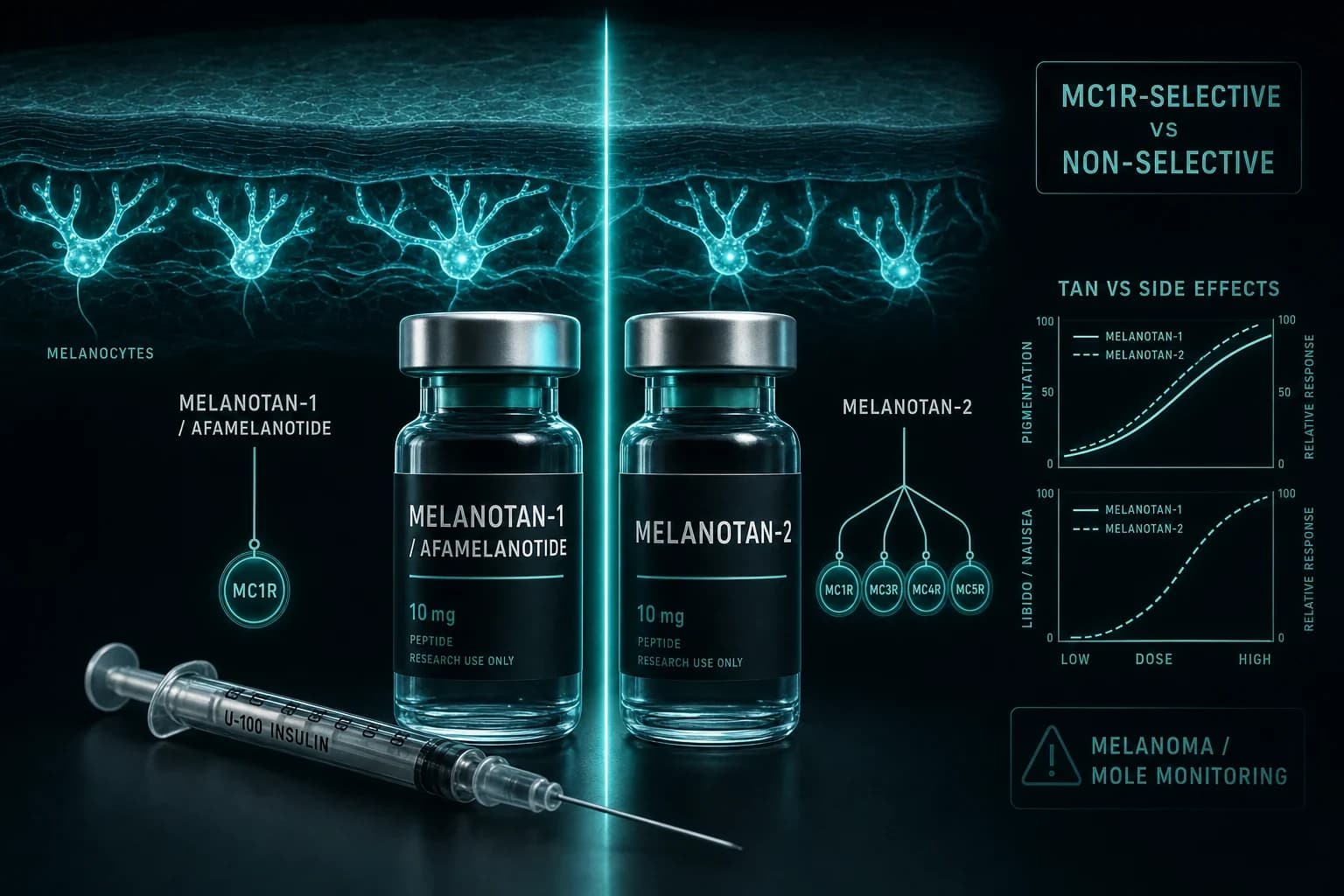
- MT-1 is functionally MC1R-dominant; MT-2 activates MC1R, MC3R, MC4R and MC5R non-selectively.
- MT-2's MC4R activation drives libido, appetite suppression, and nausea that MT-1 largely avoids.
- Wessells (2000): MT-2 produced erections in 17 of 20 men without any sexual stimulation.
- MT-2 is linked to eruptive dysplastic nevi and melanoma in situ case reports; monitor your moles.
Two peptides sit one letter apart, yet only one of them has an FDA approval, a brand name, and a New England Journal of Medicine trial behind it. The other is sold as a research chemical, gives some users an erection they did not ask for, and shows up in dermatology case reports next to the word "melanoma."
That gap is the whole story. Melanotan 1 and Melanotan 2 both tell your skin to make more pigment, but they do it through different receptor math, and that math decides everything: how dark you get, whether your libido spikes, how nauseous you feel, and whether a regulator ever signed off.
Here is what actually separates them.
The one-letter difference that changes the whole molecule
Melanotan 1 and Melanotan 2 are both synthetic analogs of alpha-melanocyte-stimulating hormone (alpha-MSH), the natural signal that tells melanocytes to produce eumelanin, the brown-black pigment that darkens skin.
Melanotan 1, known generically as afamelanotide, keeps the linear 13-amino-acid backbone of alpha-MSH with two stabilizing swaps (Nle4, D-Phe7). It behaves, clinically, like a longer-lasting version of the hormone your body already makes.
Melanotan 2 is a different animal. It is a truncated, cyclized heptapeptide, a ring-shaped molecule engineered for potency rather than fidelity. That ring makes it resistant to breakdown and turns it into a superpotent agonist at nearly every melanocortin receptor at once.
The names suggest MT-2 is just "MT-1, version two." It is not. They are structurally distinct compounds with different receptor targets and very different risk profiles.
Receptor selectivity: why MT-1 stays in its lane
Your body has five melanocortin receptors, and they do wildly different jobs:
- MC1R sits on melanocytes and controls pigmentation.
- MC3R and MC4R live in the brain and regulate appetite, energy, and sexual function.
- MC5R is tied to exocrine gland function.
Afamelanotide is functionally MC1R-dominant in practice. It is delivered as a slow-release subcutaneous implant that produces skin pigmentation while keeping central melanocortin effects mild. When Langendonk et al. (2015) ran two randomized, placebo-controlled trials of the 16 mg implant every 60 days (74 patients in the EU, 94 in the US), the standout finding was pigmentation and pain-free sun tolerance with an acceptable adverse-event profile. No spontaneous-erection epidemic. No appetite crash.
Melanotan 2 is the opposite design philosophy. It is non-selective, hitting MC1R, MC3R, MC4R, and MC5R together. You get the MC1R tan, but you also get the full brain-side package: appetite suppression, sexual arousal, flushing, and nausea, all riding along whether you want them or not.
Bottom line: MT-1 is a targeted key that mostly fits the pigmentation lock. MT-2 is a master key that opens the pigmentation lock and several doors in your brain at the same time.
Tanning: which one actually gets you darker
Both work, and both do it without the UV damage that normally drives a tan. That is the appeal: pigment first, sun second.
For afamelanotide, Dorr et al. (2004) combined the peptide with solar UV across three phase 1 trials and found it acted synergistically with light. Treated subjects needed roughly 50% less sun exposure to reach the same tan, and the pigmentation persisted for at least three weeks longer than in controls. The mechanism is clean MC1R stimulation of eumelanin.
Melanotan 2 tans harder and faster because it is simply more potent at MC1R. The earliest human data, Dorr et al. (1996), gave three healthy men low subcutaneous doses (around 0.01 mg/kg) and produced visible tanning after only a handful of injections. The catch was in the same sentence as the tan: dose-dependent nausea, facial flushing, and spontaneous erections.
So MT-2 wins on raw darkening speed. It also charges a tax that MT-1 does not.
The MC4R effects: libido, appetite, and the nausea nobody mentions
This is where the two peptides stop resembling each other.
MC4R activation in the brain drives sexual arousal, and Melanotan 2 hits it hard. Wessells et al. (2000) gave MT-2 to 20 men and recorded penile erections in 17 of them without any sexual stimulation, with a mean of 41 minutes of Rigiscan tip rigidity above 80%. Reported sexual desire jumped after 13 of 19 MT-2 doses (68%) versus 4 of 21 placebo doses (19%), a difference at P less than 0.01. A companion study, Wessells et al. (2000, Urology), found erections after 12 of 19 MT-2 injections versus 1 of 21 with placebo in men with organic erectile dysfunction.
That same MC4R signal suppresses appetite and, less pleasantly, triggers nausea through brainstem regions that control vomiting. Users describe an initial-dose queasiness that lands 10 to 30 minutes after injection. It is not a rare quirk; it is the receptor doing exactly what it does.
Afamelanotide largely sidesteps all of this because it is not built to flood MC4R at pigmentation doses. You tan without the arousal, the appetite drop, or the reliable wave of nausea.
The PT-141 connection you should understand
If MT-2's sexual effects sound like a drug in their own right, that is because they became one.
PT-141, or bremelanotide, is a metabolite of Melanotan 2, refined to lean on the MC4R-driven sexual pathway while dropping most of the pigmentation baggage. The FDA approved it in 2019 as Vyleesi for hypoactive sexual desire disorder in premenopausal women.
The pivotal evidence, Kingsberg et al. (2019), ran the two RECONNECT phase 3 trials of bremelanotide 1.75 mg injected as needed. Both showed significant improvements in sexual desire and in the distress tied to low desire (P less than 0.001 for the integrated data). The most common side effects, reported in 10% or more of women, were nausea, flushing, and headache. Recognize those? They are the same MC4R signatures MT-2 users describe. PT-141 is essentially the arousal half of Melanotan 2, isolated and studied properly.
Melanotan 1 vs Melanotan 2, side by side
| Feature | Melanotan 1 (afamelanotide) | Melanotan 2 |
|---|---|---|
| Structure | Linear 13-aa alpha-MSH analog (Nle4, D-Phe7) | Cyclic heptapeptide |
| Receptor selectivity | Functionally MC1R-dominant | Non-selective: MC1R, MC3R, MC4R, MC5R |
| Tanning | Reliable, synergistic with UV, longer-lasting (Dorr 2004) | Faster and more potent at MC1R (Dorr 1996) |
| Libido / erections | Minimal at pigmentation doses | Strong; 17 of 20 men, no stimulation needed (Wessells 2000) |
| Appetite | Largely unaffected | Suppressed via MC4R |
| Nausea / flushing | Mild | Common, dose-dependent |
| Regulatory status | FDA-approved (Scenesse, 2019); EMA-approved | Unapproved; sold as research chemical |
Side effects and the melanoma question
Here is the shared risk that no tanning-forum post likes to sit with: both peptides stimulate melanocytes, and stimulating melanocytes means stimulating the exact cells that turn into melanoma.
The signal is strongest for Melanotan 2, largely because it is the one people buy online and self-inject without oversight. Ong et al. (2012) documented a case of melanoma in situ associated with melanotan use, and the broader dermatology literature ties these peptides to eruptive dysplastic nevi, atypical moles that darken, enlarge, or multiply within weeks of a course. Dysplastic nevi are established melanoma precursors, which is why dermatologists treat new or changing moles in a melanotan user as a red flag rather than a cosmetic side note.
Warning: Neither peptide replaces sunscreen, and a deeper tan can mask early skin-cancer changes. If you are stimulating melanocytes with either compound, get a baseline full-skin exam and monitor every mole for changes in size, shape, color, or border. Any new or evolving lesion warrants a dermatologist, not another dose. This risk is real for MT-1 and elevated for the self-administered, non-selective MT-2.
Beyond the mole issue, MT-2 carries the MC4R load already described (nausea, flushing, and unwanted erections) plus reports of blood-pressure and heart-rate changes tied to central melanocortin activation. Afamelanotide's controlled implant delivery and approved indication give it a far cleaner monitored safety record, established across the Langendonk (2015) trial population.
Regulatory status: approved medicine vs research chemical
The paperwork gap is the sharpest line between these two.
Afamelanotide is a real, approved drug. The FDA cleared it in 2019 under the brand Scenesse to prevent phototoxicity in adults with erythropoietic protoporphyria (EPP), a rare disorder in which sunlight causes excruciating pain. The European Medicines Agency approved it earlier. It is prescribed, implanted by a clinician, and monitored.
Melanotan 2 has no such standing anywhere. It has never been approved for any indication and is sold explicitly for research use only. Every human dose taken for cosmetic tanning is off-label self-experimentation with an unregulated product of uncertain purity.
Which one, and for what
For a prescribed EPP patient, this is not a choice; afamelanotide is the studied, approved option.
For research contexts, the decision comes down to what receptor profile you are actually after. If pigmentation is the endpoint and you want to minimize central effects, the MT-1-style, MC1R-dominant approach is the cleaner tool. If a project centers on MC4R-driven arousal or appetite pathways, that is precisely the territory MT-2, and its refined descendant PT-141, were built to probe.
Whichever peptide a protocol calls for, accurate reconstitution and dosing matter more with superpotent compounds, not less. Run your numbers through the reconstitution calculator before drawing a single unit, and compare full profiles across the peptide library rather than trusting a forum screenshot.
For research-grade injectable melanocortin peptides, Melanotan 1 and Melanotan 2 are available from Ascension Peptides with 50% off using code ENHANCED. Lot purity is in the lab-tests library.
Bottom line: Melanotan 1 is the selective, approved, monitored option that tans with minimal collateral. Melanotan 2 tans faster but activates your whole melanocortin system, bringing libido, appetite, and nausea effects along for the ride, with no regulator watching. The letters are close. The compounds are not.
This article is for research and educational purposes only. It is not medical advice. Melanotan 2 is not approved for human use in any jurisdiction. Melanocortin peptides can alter moles and skin lesions; anyone using them should undergo regular dermatological monitoring. Consult a qualified healthcare professional before making any health decisions.