At a glance
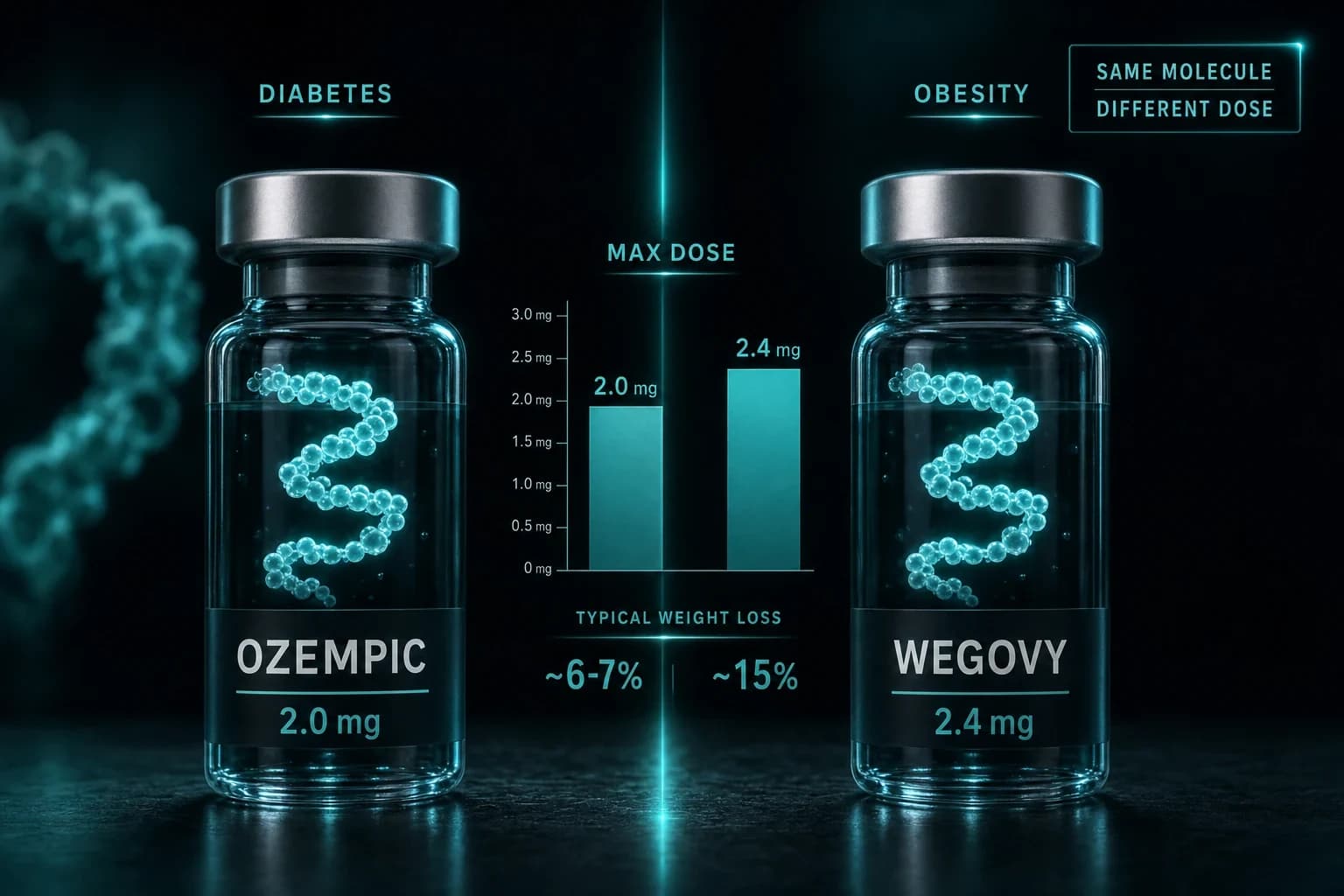
- Ozempic and Wegovy are identical semaglutide; only dose, label, and pen differ.
- Wegovy titrates to 2.4 mg; Ozempic maxes at 2 mg (SUSTAIN FORTE).
- Semaglutide 2.4 mg cut 14.9% of body weight in STEP 1.
- SELECT: semaglutide 2.4 mg cut major cardiac events 20% (HR 0.80).
- Insurance covers Ozempic for diabetes far more often than Wegovy for obesity.
Ozempic and Wegovy are the same drug. Not similar, not cousins, not two takes on the same idea. The same molecule, semaglutide, made by the same company, injected once a week from the same kind of pen. Your pharmacy stocks them as two products because they carry two labels, two approved uses, and two maximum doses. That single fact settles most of the arguments people have about which one is "stronger," and it explains why one is far easier to get covered than the other.
Here is the whole comparison: what is identical, what actually differs, and which route makes sense if you care about both the result and the price.
Same molecule, two labels
Semaglutide is a GLP-1 receptor agonist. It mimics glucagon-like peptide-1, a gut hormone that prompts your pancreas to release insulin when blood sugar rises, slows how fast your stomach empties, and quiets appetite signaling in the brain. Novo Nordisk sells that exact peptide under two brand names.
Ozempic is semaglutide approved for type 2 diabetes. Wegovy is semaglutide approved for chronic weight management. Read that twice, because the marketing works hard to make them feel like different products. Same active ingredient, same mechanism, same weekly subcutaneous shot. You can see the full receptor and pharmacokinetic profile on our semaglutide page.
Bottom line: Ozempic and Wegovy are both semaglutide. The difference is the label they were approved under and the top dose they titrate to, not the drug inside the pen.
Ozempic vs Wegovy at a glance
| Feature | Ozempic | Wegovy |
|---|---|---|
| Same molecule? | Yes, semaglutide | Yes, semaglutide |
| Maker | Novo Nordisk | Novo Nordisk |
| Approved indication | Type 2 diabetes | Chronic weight management |
| Max dose | 2.0 mg/week | 2.4 mg/week |
| Typical maintenance | 0.5-2.0 mg | 2.4 mg |
| Avg weight loss at top dose | ~6-7% (2.0 mg) | ~15% (STEP 1) |
| Pen type | Multi-dose dial pen | Single-dose fixed pens |
| Insurance angle | Often covered for diabetes | Frequently excluded for obesity |
What the diabetes dose actually does
Ozempic's job is blood sugar. It was approved on the SUSTAIN program, a run of phase 3 trials in people with type 2 diabetes. In SUSTAIN 7, Pratley et al. (2018) randomized 1,201 patients on metformin to weekly semaglutide or weekly dulaglutide. At the 1.0 mg dose, semaglutide dropped HbA1c by 1.8 percent and body weight by 6.5 kg, beating dulaglutide 1.5 mg on both counts. That 6.5 kg is the kind of weight loss the "Ozempic dose" delivers as a side benefit, not a primary target.
Then Novo pushed the diabetes dose higher to see if more semaglutide meant more control. SUSTAIN FORTE answered it. Frías et al. (2021) compared weekly 2.0 mg against 1.0 mg in 961 patients over 40 weeks. HbA1c fell 2.2 percent on 2.0 mg versus 1.9 percent on 1.0 mg, with a bit more weight loss on the higher dose. That trial is why Ozempic's ceiling is 2.0 mg. It is a diabetes ceiling, set by glucose data, not by an obesity endpoint.
Why Wegovy loses more weight
Wegovy exists because Novo ran semaglutide up to a higher dose and studied it specifically for obesity. The anchor is STEP 1. Wilding et al. (2021) enrolled 1,961 adults with overweight or obesity and no diabetes, gave them weekly semaglutide 2.4 mg or placebo for 68 weeks alongside lifestyle counseling, and measured a mean weight loss of 14.9 percent versus 2.4 percent on placebo. More than a third of the treated group lost at least 20 percent of their starting weight.
Set that against the 6 to 7 kg the diabetes dose produces and the pattern is plain. Same molecule, higher dose, dedicated obesity trial, bigger result. The extra 0.4 mg (2.4 versus 2.0) plus the slower obesity-specific titration are doing real work. This is why anyone chasing STEP 1 numbers on a 1.0 mg Ozempic script is underdosed for that goal by design.
Warning: Do not switch between Ozempic and Wegovy, or nudge an Ozempic prescription up toward 2.4 mg on your own, without a clinician steering the titration. The pens deliver different fixed increments, dose errors are easy, and gastrointestinal side effects scale sharply with the jump.
The heart data behind both
Weight is only half of why these drugs matter. Both doses carry cardiovascular outcome data, earned in different populations.
For the diabetes dose, SUSTAIN-6 is the reference. Marso et al. (2016) followed 3,297 patients with type 2 diabetes at high cardiovascular risk and recorded major adverse cardiovascular events in 6.6 percent on semaglutide versus 8.9 percent on placebo, a hazard ratio of 0.74. That is the protective signal behind Ozempic's cardiovascular labeling.
For the 2.4 mg obesity dose, the landmark is SELECT. Lincoff et al. (2023) enrolled 17,604 people with overweight or obesity and established heart disease but no diabetes, then tracked them for nearly four years. Semaglutide 2.4 mg cut the primary composite of cardiovascular death, heart attack, and stroke by 20 percent, a hazard ratio of 0.80. That result reframed Wegovy as a cardiovascular drug that also strips weight, not just a weight drug.
The side effects are identical, and here is why
Because Ozempic and Wegovy are the same molecule, they carry the same side-effect profile: nausea, vomiting, diarrhea, constipation, and the occasional early week of feeling genuinely rough. The complaints scale with dose and with how fast you climb, which is the whole case for slow titration. Wegovy's obesity schedule steps through 0.25, 0.5, 1.0, 1.7, and finally 2.4 mg over roughly 16 to 20 weeks. Ozempic climbs from 0.25 to 0.5 to 1.0 and, if needed, to 2.0 mg on a similar cadence.
The shared warnings come from the same place. Both carry a boxed thyroid C-cell tumor warning based on rodent studies, so a personal or family history of medullary thyroid carcinoma or MEN2 rules out either. Pancreatitis is a rare labeled risk for both. Gallbladder problems show up more with faster, larger weight loss. None of that shifts between the two brands, because there is nothing different to shift.
Different pens, same needle
The one place the products genuinely diverge in your hand is the pen. Ozempic ships as a multi-dose dial pen: one pen holds several weekly doses and you turn it to the prescribed amount. Wegovy, in its original form, ships as single-dose pens, one fixed dose per pen, color-coded by titration step. That hardware difference is why you cannot casually convert an Ozempic prescription into a Wegovy dose or the reverse at home. The delivery device assumes a specific dosing plan, and mixing them up is how people end up over- or underdosing themselves.
Where the two really split: coverage
If the drug is identical, why does the brand you are handed matter so much? Insurance. Type 2 diabetes is a covered medical condition almost everywhere, so Ozempic tends to clear prior authorization when a diabetes diagnosis is on file. Obesity is still treated as a lifestyle exclusion by a large share of US plans, which is why Wegovy gets denied or capped far more often despite being the same peptide.
That mismatch drives a lot of confusing behavior. People with obesity but no diabetes sometimes get Ozempic off-label because it is the version their plan will touch, which fed the shortages that made both brands hard to find through 2023 and 2024. Meanwhile the drug actually approved for their goal, Wegovy, sits behind a coverage wall. On Medicare the rules are their own maze; our Medicare GLP-1 bridge guide walks through what Part D will and will not touch.
The supervised route that skips the brand markup
Here is the practical bind. List price for either brand runs north of 1,000 dollars a month without coverage, and coverage for the weight indication is the coin flip described above. You do not have to choose between full retail and giving up.
Compounded semaglutide, prescribed through telehealth, is the middle path most cost-conscious readers land on. Yucca Health connects you with US-licensed clinicians who review your history, and if semaglutide is appropriate, a compounding pharmacy fills and ships it, starting from around 129 dollars a month with no insurance required. Same active ingredient, supervised, at a fraction of brand pricing. See how it works on our compounded semaglutide guide, and compare every legitimate low-cost option in our cheapest GLP-1 breakdown.
If you would rather source research-grade semaglutide for laboratory use, Ascension Peptides carries it and code ENHANCED takes 50 percent off. That material is sold for research only and is not a prescription product or a substitute for clinical care. Confirm the certificate in the lab-tests library.
So which one is "better"?
Wrong question, mostly. They are the same drug, so "better" collapses into "which dose and label fit your goal and your coverage."
- If you have type 2 diabetes, Ozempic is the version built and reimbursed for you, and 2.0 mg is its ceiling.
- If your goal is maximum weight loss and you have no diabetes, Wegovy's 2.4 mg is the dose STEP 1 was built on, assuming you can get it.
- If cost or coverage is the wall, a supervised compounded semaglutide program gets you the identical molecule without the brand tax.
Weighing semaglutide against the newer dual agonist? Tirzepatide beat it head to head for weight loss, so read our tirzepatide profile and the sibling breakdowns on Ozempic vs Mounjaro and Wegovy vs Zepbound before you commit. For the wider field, our best peptides for weight loss guide ranks where semaglutide sits today.
Bottom line: Ozempic and Wegovy are one molecule, semaglutide, at two doses under two labels. Ozempic is the diabetes version (up to 2.0 mg), Wegovy is the obesity version (2.4 mg), and the bigger weight loss tracks the higher dose, not a different drug.
Disclaimer: This article is educational and summarizes published clinical-trial data. Ozempic and Wegovy are prescription medications, and the decision to start, switch, or stop either belongs to you and a licensed clinician who knows your history. Compounded and research-grade semaglutide are not FDA-approved finished products. Nothing here is medical advice.