At a glance
- Formula: concentration (mcg/mL) = peptide mg x 1000 / water mL
- Use bacteriostatic water (0.9% benzyl alcohol), not plain sterile water
- Reconstituted vials last 14-30 days at 2-8 C; never freeze after mixing
- Always swirl gently to dissolve; shaking denatures peptides and causes foaming
- Standard: 2 mL BAC water per vial balances accuracy and injection volume
What reconstitution is
Most research peptides ship as lyophilized powder (freeze-dried, shelf-stable, no preservatives needed). Before they can be used, they must be dissolved in a sterile aqueous solvent. This process is called reconstitution.
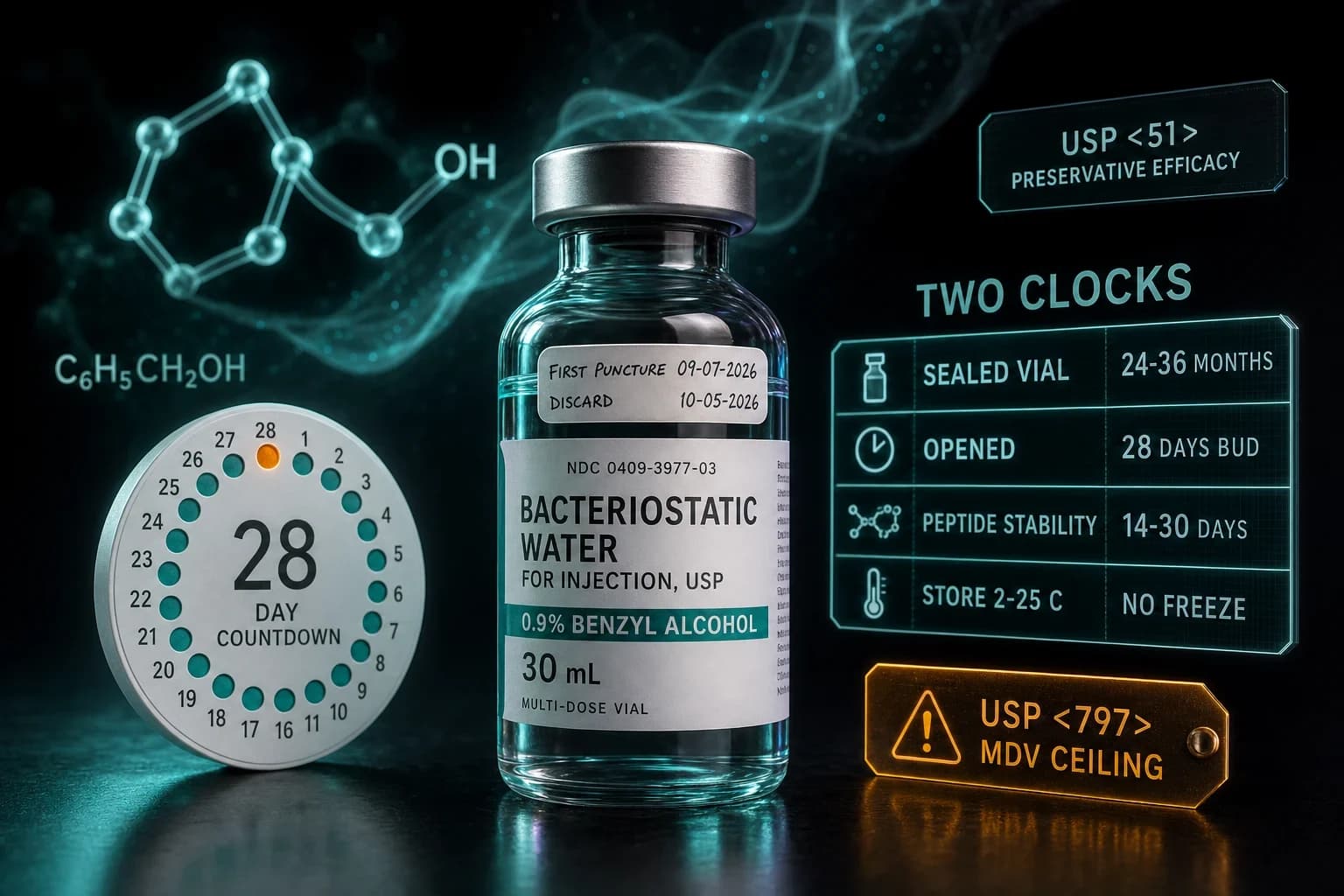
The solvent used is typically bacteriostatic water for injection (BAC water), which is sterile water containing 0.9% benzyl alcohol as a preservative. Benzyl alcohol works by disrupting bacterial cell membrane integrity: the aromatic ring resists degradation while the hydroxyl group penetrates and destabilizes microbial cell walls (PMC, "Antimicrobial Preservatives for Protein and Peptide Formulations," 2023). At 0.9%, it is effective against most common environmental contaminants, particularly Gram-negative bacteria that might be introduced when a needle punctures the stopper. This action is bacteriostatic (growth-inhibiting) rather than bactericidal (killing), but that is sufficient for multi-use vials. The result: reconstituted solutions can be stored safely for up to 28 days under refrigeration.
The math
The core formula is:
Concentration (mcg/mL) = (peptide mg × 1000) / water mL
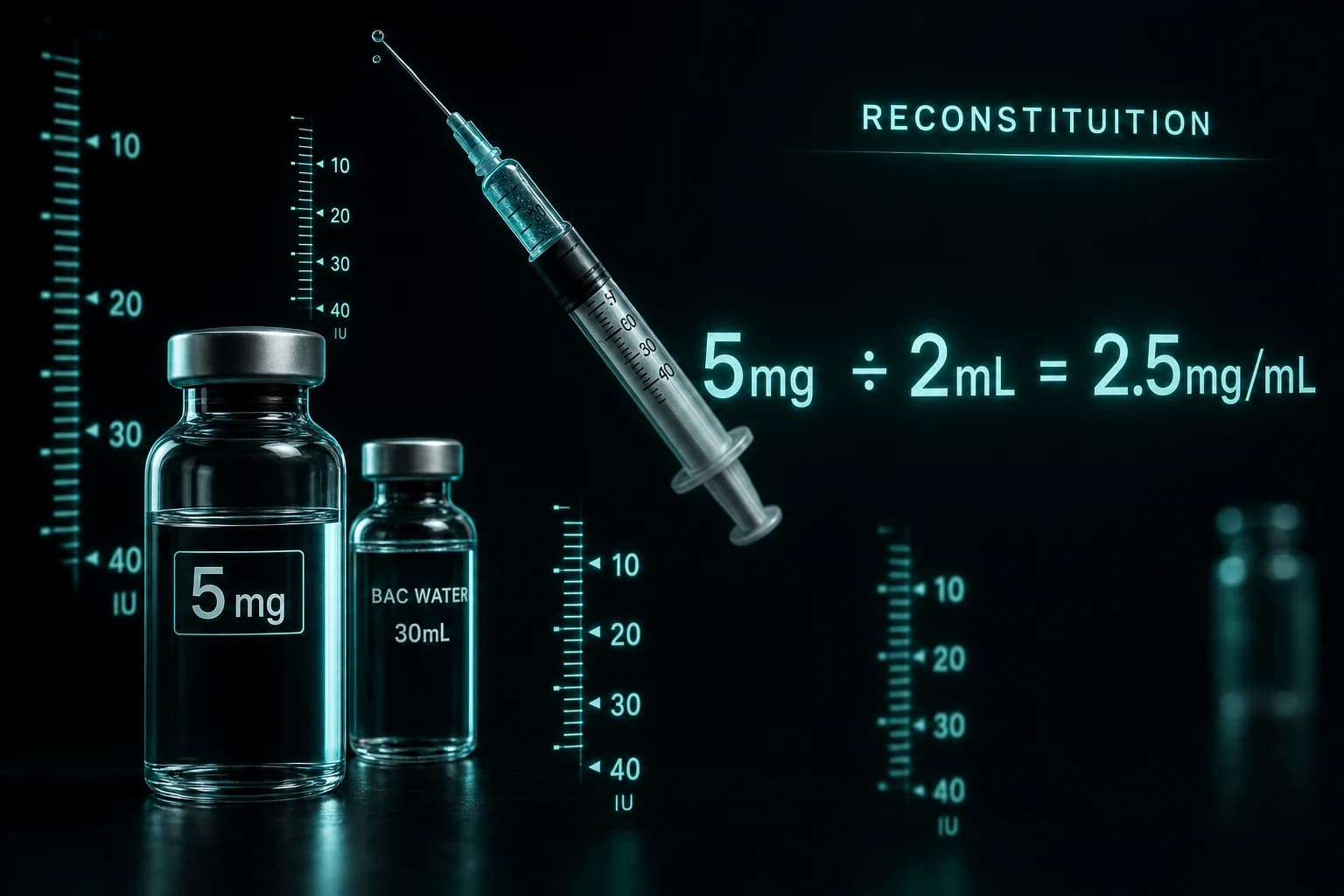
Example: 5 mg peptide + 2 mL BAC water = (5 × 1000) / 2 = 2,500 mcg/mL
Once you have concentration, volume per dose is:
Volume per dose (mL) = target dose (mcg) / concentration (mcg/mL)
Continuing the example: 250 mcg / 2,500 mcg/mL = 0.10 mL
And for an insulin syringe:
U-100 units = volume (mL) × 100
So: 0.10 mL × 100 = 10 units on a U-100 insulin syringe.
You can verify any combination with the reconstitution calculator.
Choosing water volume
The amount of BAC water you add determines concentration. There are tradeoffs:
More water (lower concentration)
- Larger injection volumes per dose
- Easier to measure small doses accurately
- More dilute (less sting on injection)
- Example: 5mg peptide + 5mL water = 1 mg/mL
Less water (higher concentration)
- Smaller injection volumes (more comfortable)
- Risk of inaccurate dosing for very small amounts
- Higher chance of needle-draw errors
- Example: 5mg peptide + 1mL water = 5 mg/mL
Standard recommendation: Use 2 mL of BAC water per vial for most research peptides. This gives accurate measurement for typical dose ranges while keeping injection volume reasonable.
Step by step
Equipment needed
- Lyophilized peptide vial
- Bacteriostatic water (30 mL vial typical)
- 3 mL syringe with 23-25g needle (for drawing BAC water)
- U-100 insulin syringe with 29-31g needle (for injection)
- Alcohol swabs
Procedure
- Let the peptide come to room temperature. Cold vials can cause condensation when opened.
- Swab both vial stoppers (peptide vial and BAC water vial) with an alcohol swab.
- Draw BAC water into the 3 mL syringe. The amount depends on your target concentration.
- Slowly inject the BAC water into the peptide vial. Aim the stream at the inner wall of the vial, not directly at the powder. This reduces foaming and protein damage.
- Gently swirl the vial to dissolve the powder. Do not shake. Shaking can denature peptides and cause foaming. Most peptides dissolve within 30-60 seconds of gentle swirling.
- Label the vial with the reconstitution date. Track expiration (typically 28 days refrigerated).
- Store at 2-8°C (refrigerator). Do not freeze reconstituted solution.
Common mistakes
Shaking the vial
Peptides are fragile. Vigorous agitation introduces air-liquid interfaces that can cause physical aggregation (non-covalent clustering through hydrophobic interactions) and foaming that denatures the compound. Research on protein and peptide formulations (Interface Focus, Royal Society, 2017) identifies agitation stress as a primary driver of physical instability in therapeutic peptide solutions. Always swirl gently.
Using plain sterile water
Plain sterile water contains no preservative. Once the vial is punctured, there is no defense against microbial contamination, and peptides reconstituted with sterile water should be used within 24 hours even when refrigerated. BAC water extends the usable window to approximately 28 days at 2-8 degrees C. The only scenario where sterile water is preferred: cell-culture research, where benzyl alcohol can be cytotoxic to certain cell lines at the 0.9% concentration.
Not accounting for dead space and syringe precision
U-100 insulin syringes come in three sizes: 0.3 mL (30 units), 0.5 mL (50 units), and 1 mL (100 units). For peptide dosing, the smaller 0.3 mL syringes are preferred because they are graduated in 1-unit (0.01 mL) increments, and some models offer half-unit markings for even finer precision. The larger 1 mL syringes have 2-unit graduations, which halves your measurement resolution. All insulin syringes have a small amount of "dead space" between the needle hub and the plunger tip. For very small doses (under 5 units), this dead space can represent a significant percentage of the total volume. Use syringes with integrated (permanently attached) needles to minimize dead space. For doses below 3 units, consider reconstituting with more BAC water to increase the volume per dose.
Incorrect dose math
The most common error: confusing mg and mcg. 1 mg = 1,000 mcg. Double-check every calculation. The reconstitution calculator eliminates this error.
Storage after reconstitution
- Temperature: 2-8 degrees C (standard refrigerator)
- Duration: 14-30 days depending on peptide stability
- Light: Protect from direct light (original vial or dark container). Tryptophan, histidine, and tyrosine residues can be photo-oxidized under light exposure, degrading purity.
- Position: Store upright to prevent stopper degradation
- Freezing: Do not freeze reconstituted peptides. Ice crystal formation can physically disrupt peptide tertiary structure and cause aggregation upon thawing.
For concrete numbers: a stability study on MOTS-c peptide (Peptide Crafters) found purity maintained above 99% for the first 14 days post-reconstitution at 2-4 degrees C, then dipped below 98% by day 30. This pattern is representative of most mid-length peptides. Peptides containing cysteine (Cys), methionine (Met), tryptophan (Trp), asparagine (Asn), or glutamine (Gln) residues are especially vulnerable to degradation in solution, as these amino acids are susceptible to oxidation and deamidation. As a general rule, every 10 degrees C increase roughly doubles the rate of chemical degradation for most peptides.
The major degradation pathways in reconstituted solution are:
- Oxidation: Met and Cys residues oxidize in the presence of dissolved oxygen, accelerated by light and heat
- Deamidation: Asn-Gly and Gln-Gly sequences convert to aspartate/glutamate, altering charge and activity. Strongly pH-dependent, faster above pH 6.
- Aggregation: Stress conditions (temperature fluctuation, agitation, freeze-thaw) can cause peptides to aggregate through hydrophobic interactions or covalent cross-linking
- Hydrolysis: Peptide bond cleavage, accelerated by extreme pH and temperature
Some peptides degrade faster than others. BPC-157, CJC-1295 with DAC, and long-acting GLP-1s (Semaglutide, Tirzepatide, Retatrutide) are relatively stable due to their engineered modifications. Short-sequence peptides and those with vulnerable residues may degrade faster.
Lyophilized storage (before reconstitution)
Unreconstituted lyophilized peptides are far more stable than solutions. At -20 degrees C, most lyophilized peptides remain stable for 3-5 years. At 2-8 degrees C, stability extends to months or years depending on the sequence. Even at room temperature, lyophilized peptides typically maintain over 96% purity for weeks. A 2024 melanoma peptide vaccine study (International Journal of Peptide Research and Therapeutics) tested 18 lyophilized peptides stored at room temperature for three months: 17 of 18 remained fully stable. After four weeks of extreme heat and humidity exposure, active substance content stayed within the 90-110% acceptable range, and purity dropped only from approximately 98% to 96%.
The practical takeaway: lyophilized vials can tolerate brief room-temperature exposure during shipping without meaningful degradation. Refrigerate upon receipt for best long-term results, and store at -20 degrees C if you plan to hold them for more than a few months.
Common concentration presets
For reference, here are typical reconstitution setups for popular research peptides:
| Peptide | Vial | Water | Concentration | Typical dose | Volume | IU | | BPC-157 | 5 mg | 2 mL | 2.5 mg/mL | 250 mcg | 0.10 mL | 10 | | CJC-1295 (no DAC) | 2 mg | 2 mL | 1 mg/mL | 100 mcg | 0.10 mL | 10 | | Ipamorelin | 2 mg | 2 mL | 1 mg/mL | 200 mcg | 0.20 mL | 20 | | Tesamorelin | 5 mg | 2 mL | 2.5 mg/mL | 1 mg | 0.40 mL | 40 | | Semaglutide | 5 mg | 2 mL | 2.5 mg/mL | 250 mcg | 0.10 mL | 10 | | Tirzepatide | 10 mg | 2 mL | 5 mg/mL | 2.5 mg | 0.50 mL | 50 | | Retatrutide | 10 mg | 2 mL | 5 mg/mL | 2 mg | 0.40 mL | 40 | | GHK-Cu | 50 mg | 2 mL | 25 mg/mL | 2 mg | 0.08 mL | 8 |
Ready to start?
All compounds listed above are available from Ascension Peptides at research-grade purity with 50% off using code ENHANCED. Purity records are in the lab-tests library.