BPC-157Research guide
Body Protection Compound studied for tissue repair, gut healing, and joint recovery
Half-life
~4 hours
Typical Dose
250-500mcg daily (subcutaneous)
Format
Injectable
Purity
≥98%
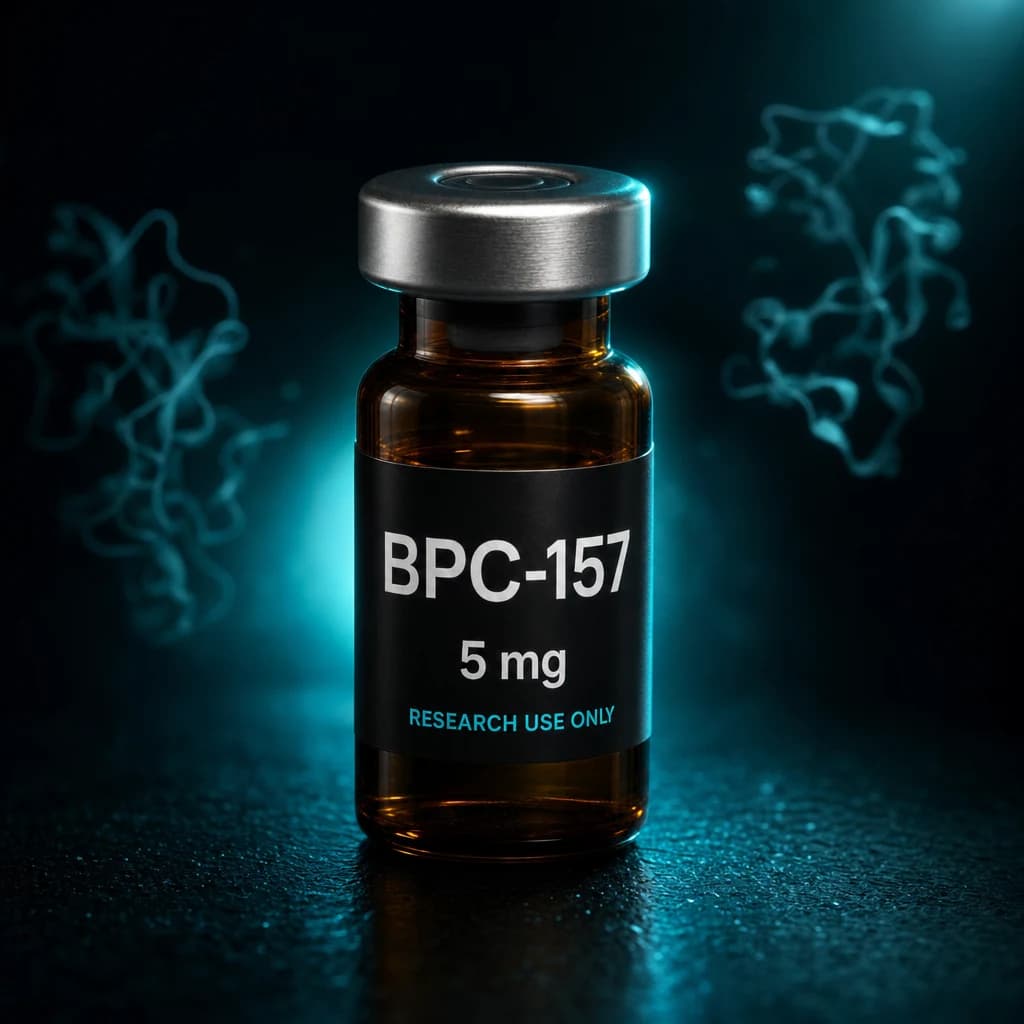
Overview
BPC-157 (Body Protection Compound) is a 15-amino-acid peptide derived from human gastric juice [1]. The most-researched recovery peptide, with extensive animal data on tendon [2,5], ligament, and gut healing [4]. Reviews of its musculoskeletal soft tissue effects highlight consistent benefits across rodent injury models [6].
Sequence & properties
Sequence, colored by side chain
Length
15 aa
Avg mass
1,419.6 Da
Theoretical pI
3.88
Net charge (pH 7)
-2.0
Mechanism
Promotes angiogenesis (new blood vessel formation) [3], upregulates growth factors including VEGFR2, and modulates the nitric oxide system [1,7]. Acts on multiple healing pathways simultaneously and counteracts NSAID-induced gastrointestinal injury in rodents [4]. Recent work also implicates dopaminergic and serotonergic system modulation [8].
Researched benefits
- Accelerated tendon and ligament healing
- Gut tissue repair (IBD research)
- Joint pain reduction in studies
- Vascular regeneration
- Anti-inflammatory effects
Wolverine Stack
BPC-157 10mg + TB-500 10mg — pre-mixed, research-ready
Partner price
$130
- Single vial, single reconstitution
- Proven 1:1 ratio from recovery protocols
- Same-day US shipping · COA verified
Code ENHANCED applies at checkout
GLOW Blend
GHK-Cu + BPC-157 + TB-500 — the complete recovery + skin stack
Partner price
$160
- Three proven compounds in one vial
- Covers skin, tissue repair, and systemic healing
- Premium formulation
Code ENHANCED applies at checkout
Frequently asked
BPC-157 oral vs injectable?
Injectable BPC-157 (subcutaneous) has the most rodent literature for systemic tendon, ligament, and vascular effects. Oral BPC-157 is researched specifically for gut-related conditions where local intestinal action is desired and systemic absorption is incidental.
Can BPC-157 be combined with TB-500?
Yes — researchers commonly combine BPC-157 with TB-500 (Thymosin Beta-4 fragment) for synergistic tissue repair effects. They act through different mechanisms: BPC-157 drives angiogenesis and growth factor upregulation, TB-500 drives actin polymerization and cell migration.
What's the half-life of BPC-157?
Approximately 4 hours in plasma, though some preclinical data suggest tissue effects persist longer than plasma levels would predict. The peptide's stability in gastric juice is unusually high, which is the basis for its 'body protection compound' name.
Subcutaneous vs intramuscular for BPC-157?
Subcutaneous near the area of interest is the most common research approach. Some protocols use intramuscular near injury sites under the hypothesis that local concentration matters. Both routes appear effective in animal models, with no head-to-head pharmacokinetic comparison in humans.
What's the typical research dose?
250-500mcg once or twice daily subcutaneously is the most common research protocol, typically run in 4-week cycles. Some protocols extend to 1mg/day in larger subjects. Dosing is empirical — no human dose-response trials exist.
How is BPC-157 reconstituted?
Bacteriostatic water is the standard diluent. For a 5mg vial, 2.5mL of BAC water yields 2mg/mL (250mcg per 0.125mL). Add slowly down the vial wall, swirl gently, never shake. Refrigerate after reconstitution and protect from light.
Scientific Literature
References
- [1]
Sikiric P, Seiwerth S, Rucman R, et al. (2018). Stable Gastric Pentadecapeptide BPC 157 in the Treatment of Various Wounds.
Current Pharmaceutical Design · PubMed: 29623643
- [2]
Chang CH, Tsai WC, Lin MS, et al. (2011). The promoting effect of pentadecapeptide BPC 157 on tendon healing involves tendon outgrowth, cell survival, and cell migration.
Journal of Applied Physiology · PubMed: 21030672
- [3]
Seiwerth S, Brcic L, Vuletic LB, et al. (2014). BPC 157 and blood vessels.
Current Pharmaceutical Design · PubMed: 23782145
- [4]
Sikiric P, Seiwerth S, Rucman R, et al. (2010). Toxicity by NSAIDs. Counteraction by stable gastric pentadecapeptide BPC 157.
Current Pharmaceutical Design · PubMed: 23092289
- [5]
Krivic A, Anic T, Seiwerth S, et al. (2006). Achilles detachment in rat and stable gastric pentadecapeptide BPC 157: Promoted tendon-to-bone healing and opposed corticosteroid aggravation.
Journal of Orthopaedic Research · PubMed: 16609964
- [6]
Gwyer D, Wragg NM, Wilson SL. (2019). Gastric pentadecapeptide body protection compound BPC 157 and its role in accelerating musculoskeletal soft tissue healing.
Cell and Tissue Research · PubMed: 31062110
- [7]
Hsieh MJ, Liu HT, Wang CN, et al. (2017). Therapeutic potential of pro-angiogenic BPC157 is associated with VEGFR2 activation and up-regulation.
Journal of Molecular Medicine · PubMed: 27847966
- [8]
Sikiric P, Hahm KB, Blagaic AB, et al. (2020). Stable Gastric Pentadecapeptide BPC 157, Robert's Stomach Cytoprotection/Adaptive Cytoprotection/Organoprotection, and Selye's Stress Coping Response.
Inflammopharmacology · PubMed: 32468232
- [9]
Vukojevic J, Siroglavic M, Kasnik K, et al. (2018). Rat inferior caval vein syndrome therapy with BPC 157.
Inflammopharmacology · PubMed: 29804210
- [10]
Sikiric P, Seiwerth S, Brcic L, et al. (2010). Revised Robert's cytoprotection and adaptive cytoprotection and stable gastric pentadecapeptide BPC 157.
Current Pharmaceutical Design · PubMed: 20388083
- [11]
Tkalcević VI, Cuzić S, Brajsa K, et al. (2007). Enhancement by PL 14736 of granulation and collagen organization in healing wounds and the potential role of egr-1 expression.
European Journal of Pharmacology · PubMed: 17499241
- [12]
Park JM, Lee HJ, Sikiric P, Hahm KB. (2020). BPC 157 rescued NSAID-cytotoxicity via stabilizing intestinal permeability and enhancing cytoprotection.
Current Pharmaceutical Design · PubMed: 32056521
Citations are provided for educational purposes. Always verify primary sources before drawing research conclusions.
Keep researching
Next steps for BPC-157
The compound page is the overview. Charts, certificates, and the vendor audit sit one click away.
Protocol
BPC-157 dosage chart
Research dosing ranges, reconstitution math, and stacks for BPC-157.
Open dosage chartCOA
Where to buy BPC-157
Lot-level HPLC records and vendor comparison before you pay.
Compare lab testsVendor
Ascension Peptides review
The COA audit and the ENHANCED 50% code for injectable research peptides.
Read the reviewReady to start your research
Get BPC-157 from Ascension Peptides
COA-verified, US-based, discreet shipping. Use code ENHANCED for 50% off your entire order.
Buy BPC-157 now