At a glance
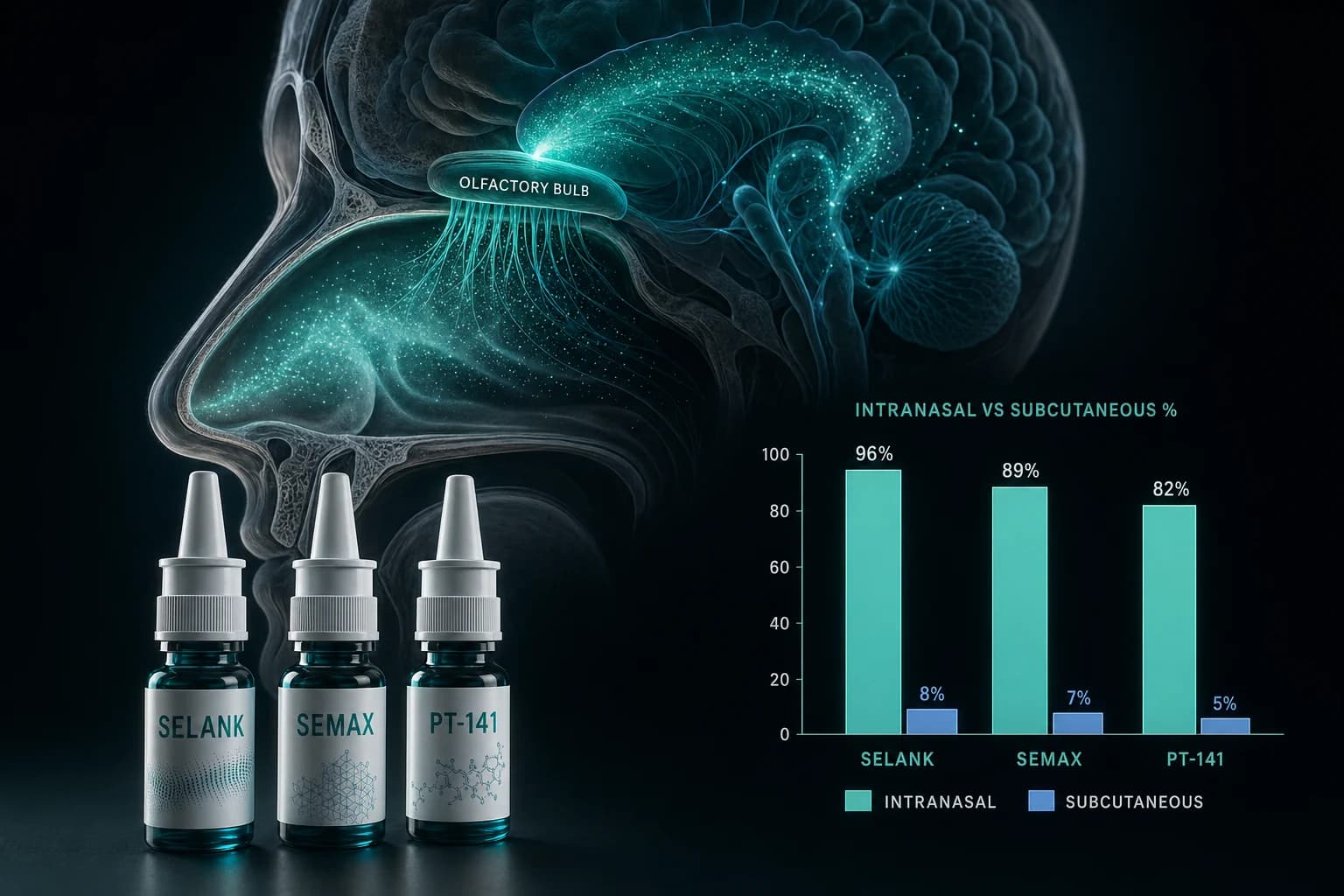
- Nasal bioavailability spans under 1% for oxytocin to near 30% for small nootropic peptides
- Intranasal oxytocin raised CSF levels within 75 minutes at 24 IU (Striepens et al. 2013)
- Intranasal PT-141 development was halted after blood-pressure spikes in Phase 2b
- Selank and Semax are the best-documented nasal-route nootropic peptides in humans
- Most large peptides (BPC-157, GHRH analogs) lack meaningful nasal-route human data
You sprayed it. Did any of it actually reach the brain?
Most nasal peptide marketing skips the step that matters. A spray bottle is an administration device, not a pharmacokinetic guarantee. The nasal cavity is a hostile environment for peptides: ciliary clearance sweeps the dose backward in 15 to 20 minutes, peptidases in the mucosa cleave peptide bonds, and most of what sits on the turbinates drains into the stomach rather than crossing the mucosa. For most peptides on the market, nasal bioavailability is a small single-digit percentage of what was sprayed.
That does not make the route useless. It means the question "does nasal work" has to be answered peptide by peptide, with real pharmacokinetic data. This guide walks through the peptides where nasal administration is defensible, the ones where it has been studied and abandoned, and the ones where vendor claims outrun the evidence.
Why the nasal route exists at all
Two features of the nasal cavity make it interesting for peptide research. First, the respiratory epithelium sits on a dense vascular bed that feeds directly into systemic circulation, bypassing first-pass hepatic metabolism. Second, the olfactory and trigeminal nerve endings in the upper nasal cavity provide a direct anatomical pathway from the nasal mucosa to the olfactory bulb and brainstem, bypassing the blood-brain barrier (Lochhead and Thorne, 2012).
The olfactory pathway is the part that gets oversold. In humans, the olfactory epithelium covers roughly 5% of the nasal cavity, sits high in the nasal vault, and most delivery devices cannot reliably deposit drug there. Peptides that do reach the olfactory region travel to the CNS by extracellular transport along neural fibers (Meredith et al., 2015). The transit time is minutes to hours depending on molecular size, not seconds.
Systemic absorption across the respiratory mucosa is the more consistent effect. Small peptides (under 3 kDa) with favorable physicochemical properties can reach detectable plasma levels. Larger peptides, or peptides without penetration enhancers, generally do not.
Nasal bioavailability: the real numbers
The table below summarizes reported human or animal bioavailability data for the most discussed nasal peptides. Numbers vary widely across studies because formulation, device, and measurement method change the outcome more than the peptide itself.
| Peptide | Approx. nasal bioavailability | Evidence level | Route status |
|---|---|---|---|
| Oxytocin | ~1 to 2% systemic; CSF measurable at 75 min | Multiple human PK trials | Off-label research; no FDA-approved nasal |
| PT-141 (bremelanotide) | 10 to 20% systemic in Phase 1 | Phase 2b halted | Intranasal discontinued; subQ approved 2019 |
| Selank | Human PK data sparse; Russian clinical use | Phase 2/3 Russia | Approved in Russia only |
| Semax | Human PK data sparse; Russian clinical use | Phase 2/3 Russia | Approved in Russia only |
| DSIP | No human nasal PK data published | Mechanistic/animal | Research only |
| Epithalon | No human nasal PK data published | Preclinical only | Research only |
| Insulin (for reference) | ~8 to 10% with Intravail | FDA-reviewed formulation | Pfizer intranasal insulin discontinued |
| BPC-157 | No peer-reviewed nasal PK data | None in humans | Off-label research |
The honest reading of the table: only oxytocin and PT-141 have been studied in human intranasal pharmacokinetics at a level that would satisfy a regulator. Everything else is either Russian-market data, extrapolation from animal work, or vendor claim.
Oxytocin: the most studied nasal peptide, and the most argued
Oxytocin is the peptide that made "intranasal peptide research" a discipline. Thousands of behavioral studies have used the 24 IU intranasal dose since the mid-2000s, and two findings from that literature matter for anyone considering this route.
First, the CSF signal is real but slow. Striepens and colleagues gave 11 subjects 24 IU intranasal oxytocin and sampled plasma and CSF over 75 minutes (Striepens et al., 2013). Plasma oxytocin peaked at 15 minutes and declined by 75 minutes. CSF oxytocin rose more slowly and was still increasing at the end of sampling. Peripheral and central compartments do not move in lockstep.
Second, the behavioral literature is messier than the pharmacokinetics. The Parker group's 2017 PNAS trial randomized 32 children with autism to 24 IU twice daily for four weeks and reported a Social Responsiveness Scale improvement that scaled with baseline oxytocin concentration (Parker et al., 2017). A larger Yamasue multicenter trial using a higher-bioavailability formulation later produced a null primary endpoint. The honest summary: intranasal oxytocin produces detectable central exposure, but the behavioral effect is small, responder-dependent, and not yet a reliable clinical tool.
Note: Researcher protocols that use oxytocin for bonding, social anxiety, or sleep typically land between 12 and 24 IU per spray event. The 75-minute CSF peak means timing matters. Using oxytocin five minutes before a social interaction is a pharmacokinetic mismatch with the current data.
PT-141 intranasal: the route the sponsor abandoned
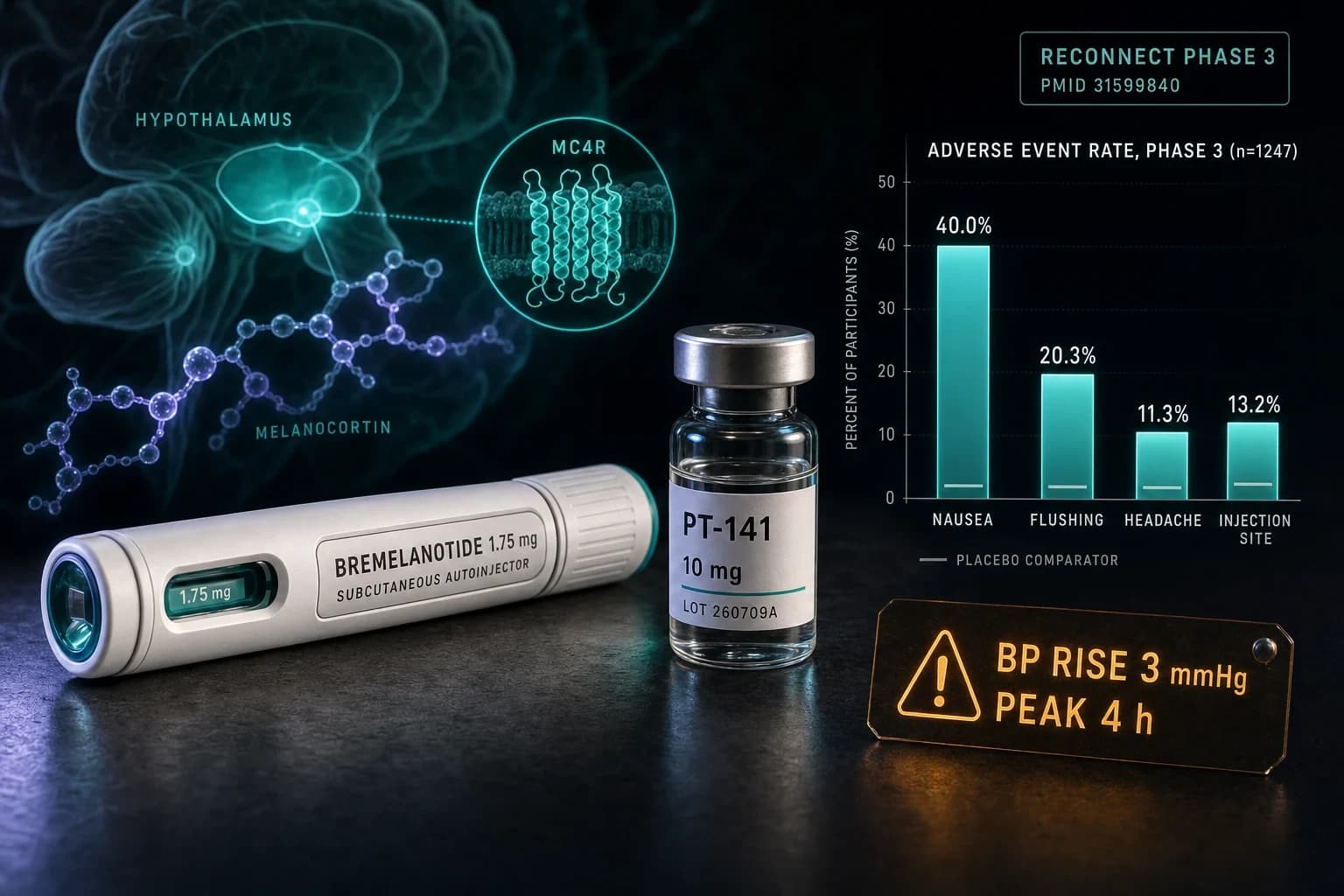
The nasal version of bremelanotide (PT-141) was the first formulation advanced to late-stage trials. Diamond and colleagues ran a double-blind Phase 1 in healthy men and men with mild-to-moderate erectile dysfunction using intranasal doses from 4 to 20 mg (Diamond et al., 2004). The nasal route produced measurable plasma PT-141, dose-dependent erectile responses, and, notably, dose-dependent blood pressure elevations.
The blood pressure signal did not resolve in Phase 2b. Palatin Technologies discontinued the intranasal erectile dysfunction program in 2008. The subcutaneous formulation for hypoactive sexual desire disorder in premenopausal women (Vyleesi) was later approved by the FDA in 2019, in part because the subcutaneous route produced more predictable pharmacokinetics and a narrower peak-to-trough spread.
The lesson is worth stating plainly. A peptide that "worked" intranasally in Phase 1 can still fail the route when the peak plasma concentration drives an unacceptable pressor effect. Anyone considering intranasal PT-141 outside a research setting is working off a program the sponsor stopped funding.
For researchers studying libido-active peptides, the injectable remains the better-characterized route. The PT-141 research guide covers the subcutaneous pharmacokinetics and endpoint data.
Selank: a peripheral peptide with a real Russian clinical file
Selank is a heptapeptide (Thr-Lys-Pro-Arg-Pro-Gly-Pro) developed at the Russian Academy of Sciences and licensed in Russia as an anxiolytic. Zozulya and colleagues randomized 62 patients with generalized anxiety disorder or neurasthenia to Selank or medazepam and reported comparable anxiolytic efficacy, with Selank producing an antiasthenic signal the benzodiazepine did not (Zozulya et al., 2008). Subsequent mechanistic work showed positive allosteric modulation at GABA-A receptors and preservation of endogenous enkephalins, which is a distinct profile from classical benzodiazepines.
The practical issue for non-Russian researchers is that the Russian dossier is not on ClinicalTrials.gov, dose-finding data for the intranasal formulation are thin in English-language PubMed, and human PK papers for the nasal route are hard to find. The typical research protocol cites 250 to 500 mcg per nostril, two to three times daily, based on the Russian product label rather than an independent PK study.
For anyone running a nootropic stack, Selank fits best as a short-acting anxiolytic modifier, not a standalone daily driver. The Calm + Clarity cognitive stack covers how researchers combine it with longer-acting peptides.
Semax: the ACTH fragment with a long clinical history
Semax is Met-Glu-His-Phe-Pro-Gly-Pro, a derivative of ACTH(4-10) stripped of hormonal activity and extended for metabolic stability. It has been used clinically in Russia for ischemic stroke, cognitive impairment, and optic nerve atrophy since the late 1990s. The mechanistic case is strongest on BDNF and trkB: Dolotov and colleagues showed that a single Semax administration increased both BDNF protein and trkB expression in rat hippocampus within four hours (Dolotov et al., 2006).
English-language human PK data is again limited. Most published Russian trials used an intranasal dose range of 250 mcg to 1 mg per dose, one to three times daily. The absence of Western PK work means researchers are extrapolating from rodent intranasal studies that show brain penetration within minutes.
Two honest caveats. First, most Semax mechanistic papers are preclinical, and the human cognitive outcome literature is dominated by open-label stroke-rehabilitation reports rather than placebo-controlled trials. Second, the BDNF signal is a proxy endpoint, not a validated clinical outcome for cognition in healthy subjects.
DSIP, Epithalon, and the lower-evidence tier
The remaining peptides commonly sold as nasal sprays have thinner files.
DSIP (delta sleep-inducing peptide) has sporadic human sleep-architecture data from the 1980s and no modern intranasal pharmacokinetic study in English-language peer-reviewed literature. Most contemporary protocols cite 100 to 500 mcg intranasally at bedtime, without a defensible PK basis.
Epithalon (Ala-Glu-Asp-Gly) has a Russian clinical program from the Khavinson lab focused on melatonin rhythm and telomere biology. Intranasal administration was a common research route, but the human pharmacokinetics have not been independently replicated. Claims about telomere lengthening in humans should be read against the fact that the tetrapeptide is small, polar, and rapidly cleared; most circulating effects plausibly come from downstream signaling rather than direct cellular uptake.
Kisspeptin and LL-37 have been tested intranasally in mechanistic rodent work but lack the human PK base needed to support a consumer nasal spray.
Warning: A vendor "nasal" label does not imply human pharmacokinetic validation. For most peptides outside oxytocin and PT-141, the nasal route is research-grade extrapolation, not an approved delivery method.
What does not work well through the nose
Several peptides sold for nasal administration have poor underlying biology for that route.
- BPC-157 is a 15-amino-acid peptide. The published data base is almost entirely oral and intraperitoneal in rodents. There is no peer-reviewed human nasal PK study. Vendor claims of nose-to-brain BPC-157 activity are extrapolated from gut-vagal work that was done by a different route.
- GHRH analogs (sermorelin, CJC-1295, tesamorelin) are 29 to 44 amino acids and carry enough peptide-bond exposure that nasal peptidases would degrade most of the dose before absorption. No human intranasal GHRH analog program has succeeded.
- GH secretagogues like ipamorelin and hexarelin are smaller, but the published human PK work has used injectable or oral routes. Intranasal has not been validated.
- TB-500 / thymosin beta-4 is 43 amino acids. The only human-dose work has been intravenous or subcutaneous.
The pattern is consistent: peptides above roughly 3 kDa without a penetration enhancer do not reach therapeutically relevant plasma concentrations through the nasal mucosa. Researchers who want those peptides in circulation should use injectable formulations. The injectable versus oral bioavailability guide lays out the route comparison in more depth.
How to evaluate a nasal spray before buying
A short checklist for anyone comparing nasal peptide products:
- Peptide identity and dose per spray. A reputable product lists the exact peptide, the concentration per mL, and the volume per actuation. If a spray lists only "per bottle" dosing, you cannot calculate a dose.
- Preservative and pH. Most peptides require a preservative (benzyl alcohol or phenol) for multi-dose stability. pH should be close to physiological (5.5 to 7.5) to minimize mucosal irritation.
- Penetration enhancer. For larger peptides, absorption enhancers (cyclodextrins, surfactants, chitosan) materially affect bioavailability. Products without an enhancer that claim CNS action for large peptides are overclaiming.
- Stability data. Peptides in aqueous solution degrade over weeks. Refrigeration and a reasonable beyond-use date matter more than the label art.
- Vendor transparency. If the vendor cannot state the peptide supplier, COA testing cadence, and filling environment, the product is a branding exercise, not a research-grade article.
Oral capsule formulations (covered in the injectable versus oral bioavailability guide) are available from Limitless Biotech with code ENHANCED, and injectable references for peptides like PT-141 are available from Ascension Peptides with 50% off using code ENHANCED. For nasal-specific research articles, match the device to the peptide and the peptide to the evidence base.
Bottom line
Bottom line: The nasal route is defensible for a narrow set of peptides. Oxytocin has the cleanest human CSF data. PT-141 had the route but lost it to pressor effects. Selank and Semax have real Russian clinical history but thin English-language PK. Everything else is research-grade extrapolation, not validated delivery.
Nasal administration is a delivery strategy with real pharmacokinetic constraints. For small peptides targeting the CNS (oxytocin, Semax, Selank), it can move measurable drug across the mucosa and, in favorable cases, toward the brain. For larger peptides or peptides built for peripheral endpoints (BPC-157, GHRH analogs, most recovery peptides), the nasal route is the wrong tool.
The useful mental model: ask what the peptide is supposed to do, then ask whether the nasal dose that reaches the target is sufficient. If the answer depends on a bioavailability number no one has measured in humans, treat the route as experimental and plan the protocol accordingly.
Related reading
- Injectable vs Oral Peptides: Bioavailability Guide
- PT-141 Bremelanotide Libido Peptide Guide
- Calm + Clarity Cognitive Stack (Selank, Pinealon, PE-22-28)
- Peptide Reconstitution Complete Guide
- Reconstitution Calculator
- Oxytocin research page
- Selank research page
- Semax research page
This article is for educational and research purposes only. None of the peptides discussed are approved by the FDA for the uses described, with the exception of subcutaneous bremelanotide (Vyleesi) for hypoactive sexual desire disorder in premenopausal women. All other applications are investigational. Cited efficacy and pharmacokinetic data are derived from published peer-reviewed research. Consult a qualified healthcare professional before making any decisions about peptide research.