At a glance
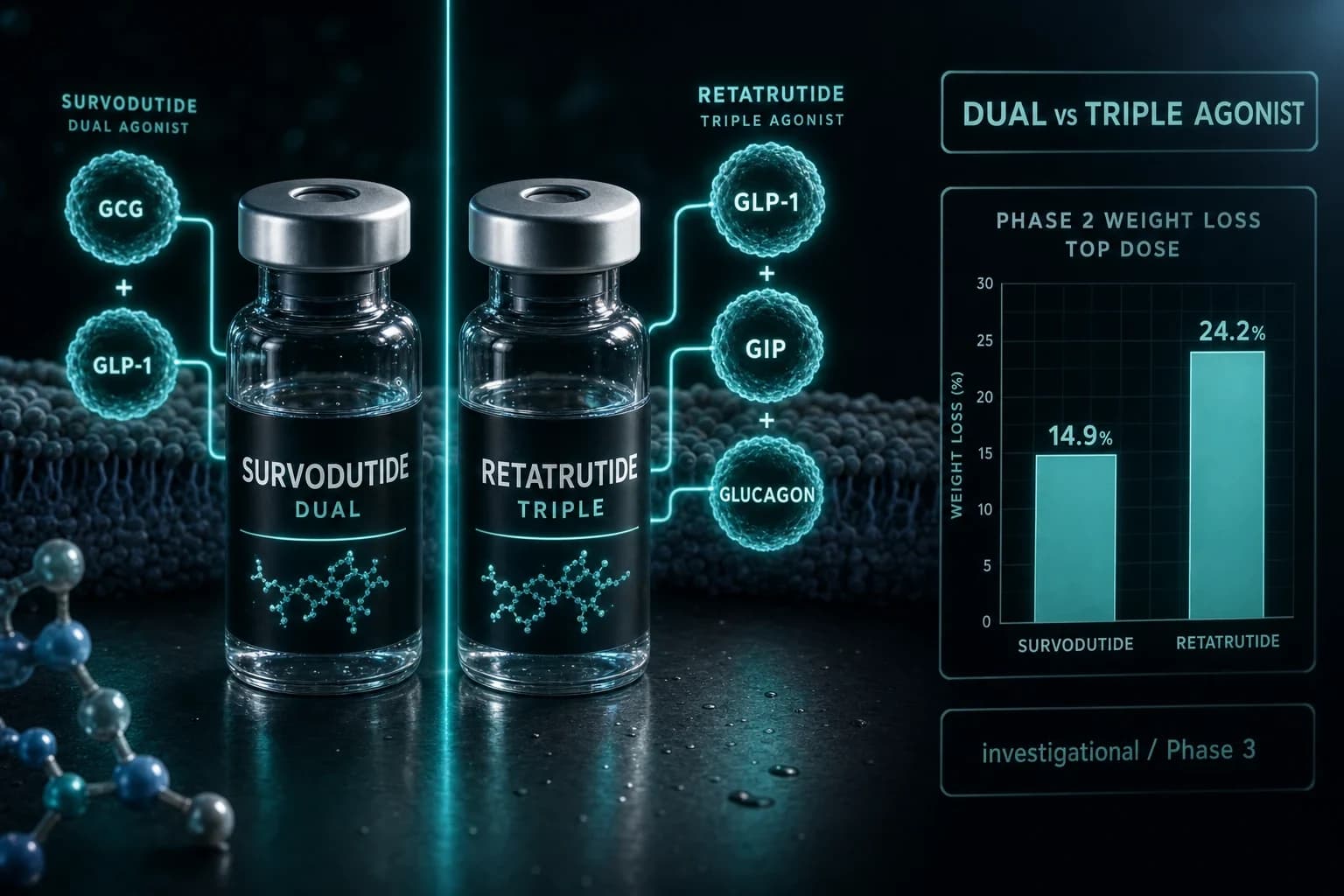
- Retatrutide (triple agonist) hit 24.2% weight loss at 48 weeks; survodutide reached 14.9% at 46 weeks.
- Survodutide is a dual glucagon/GLP-1 agonist; retatrutide adds a third target, GIP.
- Survodutide improved MASH without worsening fibrosis in 62% of patients at 4.8 mg (Sanyal 2024).
- Retatrutide cut liver fat 82% at 24 weeks; 86% of patients reached normal liver fat.
- Both are investigational and not FDA-approved; both were in Phase 3 as of 2026.
Retatrutide hit 24.2% body weight reduction in 48 weeks. Survodutide topped out at 14.9% over 46 weeks in the main analysis, closer to 19% in the people who finished on the highest dose. Same broad idea. One extra receptor. A meaningfully different number at the end.
Both compounds chase weight loss by borrowing the body's own gut and pancreatic hormone signaling, and both add a glucagon component that older drugs like semaglutide never touched. That is where the similarity ends. One is a dual agonist. The other is a triple. The receptor math explains most of the gap between them, and it also explains why both post liver-disease data that make hepatologists sit up.
Here is the honest framing before you read another word: neither drug is approved. You cannot get a prescription for either as of mid-2026. Both are working through Phase 3. Everything below is Phase 2 data, which is where the story is genuinely interesting and also where the caveats stack up.
The receptor math: dual vs triple
Survodutide, originally coded BI 456906 and developed by Boehringer Ingelheim with Zealand Pharma, is a dual agonist. It activates two receptors: glucagon and GLP-1 (glucagon-like peptide-1). GLP-1 is the same target semaglutide hits. It curbs appetite, slows gastric emptying, and improves glucose control. The glucagon arm is the twist. Glucagon raises energy expenditure and pushes the liver to burn stored fat.
Retatrutide, coded LY3437943 and developed by Eli Lilly, is a triple agonist. It keeps GLP-1 and glucagon, then adds GIP (glucose-dependent insulinotropic polypeptide). GIP is the same second receptor that tirzepatide uses, and it appears to blunt nausea while amplifying the metabolic effect of GLP-1.
So the difference is not subtle. Survodutide leans on glucagon plus appetite suppression. Retatrutide runs three hormone pathways at once. If you think of these drugs as engines, survodutide has two cylinders and retatrutide has three, and the third cylinder is doing real work.
Weight loss, head to head
The cleanest way to compare them is the top-dose result from each Phase 2 trial.
Survodutide's dose-finding trial ran 46 weeks in 387 adults with obesity and no diabetes, published by le Roux et al. (2024) in Lancet Diabetes & Endocrinology. The headline for the 4.8 mg dose was a 14.9% reduction in body weight under the main analysis, against 2.8% for placebo. Among people who actually completed treatment on 4.8 mg, the number climbed toward 19%. More than half the highest-dose group lost at least 15% of their starting weight, and close to 40% lost 20% or more.
Retatrutide's Phase 2 trial ran 48 weeks in 338 adults, published by Jastreboff et al. (2023) in the New England Journal of Medicine. The 12 mg dose delivered a 24.2% reduction against 2.1% for placebo. The dose-response was steep and clean: 8.7% at 1 mg, 17.1% at 4 mg, 22.8% at 8 mg, 24.2% at 12 mg. The detail that got the most attention was that the weight curve had not flattened at 48 weeks. Patients were still losing.
| Survodutide (BI 456906) | Retatrutide (LY3437943) | |
|---|---|---|
| Receptor targets | Glucagon + GLP-1 (dual) | GLP-1 + GIP + glucagon (triple) |
| Sponsor | Boehringer Ingelheim / Zealand | Eli Lilly |
| Phase 2 top-dose weight loss | 14.9% at 46 wks (up to ~19% in completers) | 24.2% at 48 wks |
| Placebo comparator | 2.8% | 2.1% |
| Highest dose tested | 4.8 mg weekly | 12 mg weekly |
| Weight curve at trial end | Approaching plateau | Not yet plateaued |
| Liver headline | 62% MASH improvement, no fibrosis worsening (4.8 mg) | 82% relative liver-fat cut; 86% reached normal liver fat |
| Phase 3 program | SYNCHRONIZE (obesity), LIVERAGE (MASH) | TRIUMPH (obesity) |
| Route and frequency | Subcutaneous, once weekly | Subcutaneous, once weekly |
| Approval status | Investigational, not approved | Investigational, not approved |
Bottom line: On raw Phase 2 weight loss, retatrutide wins by roughly nine percentage points at top dose. But the trials differed in length, dose ceiling, and population, so this is a strong signal rather than a settled verdict. A true answer needs a head-to-head trial that does not yet exist.
What glucagon actually adds
The reason both drugs matter is the glucagon receptor, and it is worth understanding why.
GLP-1 drugs work mostly by making you eat less. Glucagon works from the other side of the equation. It increases resting energy expenditure, so you burn more even at rest, and it mobilizes fat directly out of the liver. That second effect is why a dual or triple agonist with a glucagon arm tends to punch above a pure GLP-1 drug on hepatic fat.
The catch is that glucagon raises blood sugar on its own. The engineering problem both Boehringer and Lilly had to solve was balancing enough GLP-1 signaling to keep glucose in check against enough glucagon signaling to drive expenditure and liver-fat clearance. Get the ratio wrong and you either lose the metabolic upside or you worsen glycemic control. Both Phase 2 datasets suggest the ratios landed in a usable range, with glucose control maintained or improved.
The liver story is where it gets serious
Weight loss gets the headlines. The liver data may end up mattering more, because MASH (metabolic dysfunction-associated steatohepatitis, the disease formerly filed under NASH) has almost no approved drug options and a large untreated population.
Survodutide ran a dedicated 48-week MASH trial in 293 adults with biopsy-confirmed disease and fibrosis stages F1 to F3, published by Sanyal et al. (2024) in NEJM. MASH improved without worsening of fibrosis in 47% of the 2.4 mg group, 62% of the 4.8 mg group, and 43% of the 6.0 mg group, versus 14% on placebo. That is a biopsy-confirmed endpoint, which is the hard currency of liver trials, not a surrogate marker.
Retatrutide's liver data came from a substudy of its obesity trial, reported by Sanyal et al. (2024) in Nature Medicine. In 98 participants with elevated liver fat, the relative reduction in liver fat at 24 weeks reached 81.4% at 8 mg and 82.4% at 12 mg, against a 0.3% increase on placebo. Normal liver fat, defined as under 5%, was reached by 79% of the 8 mg group and 86% of the 12 mg group.
The two liver readouts are not the same measurement. Survodutide's is a biopsy endpoint (disease resolution and fibrosis), which regulators weigh most heavily. Retatrutide's is an imaging endpoint (liver-fat percentage by MRI), which is dramatic but earlier-stage evidence. Survodutide has the more advanced liver dataset. Retatrutide has the more extreme fat-clearance numbers.
Bottom line: For a reader focused on fatty liver, survodutide has the deeper, biopsy-backed MASH evidence, and it has a dedicated Phase 3 liver program (LIVERAGE). Retatrutide's liver-fat reduction is jaw-dropping on imaging but sits on a smaller substudy. Different strength of evidence, both promising.
Where each drug sits in development
Neither is close to your pharmacy. This matters more than any efficacy number if you are actually planning around them.
Survodutide is in the SYNCHRONIZE Phase 3 program for obesity and the LIVERAGE Phase 3 trial for MASH. Retatrutide is in the TRIUMPH Phase 3 program for obesity, plus cardiovascular and osteoarthritis outcome studies. Both sponsors have deep pockets and strong incentives to finish, but Phase 3 readouts and regulatory review take years. Realistically, neither reaches approval before the late 2020s, and each still has to clear the safety bar at scale.
That is not a footnote. Phase 2 flatters drugs. Effect sizes shrink, rare side effects surface, and dropout patterns shift once trials get larger and longer. Read the 24.2% and the 62% as best-case early signals, not guarantees.
How they compare to what you can actually get
Two drugs in this class are already approved, and they set the benchmark both investigational agents have to beat.
| Drug | Class | Top-dose weight loss | Approved? |
|---|---|---|---|
| Semaglutide | GLP-1 | 14.9% (68 wks) | Yes (Wegovy) |
| Tirzepatide | GIP + GLP-1 dual | 20.9% (72 wks) | Yes (Zepbound) |
| Survodutide | Glucagon + GLP-1 dual | ~14.9% (46 wks) | No |
| Retatrutide | GLP-1 + GIP + glucagon triple | 24.2% (48 wks) | No |
Semaglutide delivered 14.9% at 68 weeks in STEP 1, per Wilding et al. (2021). Tirzepatide reached 20.9% at 15 mg over 72 weeks in SURMOUNT-1, per Jastreboff et al. (2022). Note the trial lengths: the approved drugs ran 68 to 72 weeks, while survodutide and retatrutide reported at 46 to 48. The investigational drugs were still losing weight when their trials ended, so their longer-term ceilings may be higher than the numbers above suggest. Cross-trial comparisons like this are directional, not definitive, because populations and protocols differ.
The practical takeaway: retatrutide looks like it could set a new high-water mark, while survodutide's obesity numbers land near semaglutide with a distinct liver advantage. If you want the approved-drug economics today rather than a Phase 3 promise, the cheapest legitimate routes to semaglutide and tirzepatide are broken down on our cheapest GLP-1 guide.
Which one matters more, and for whom
If the goal is maximum weight loss, retatrutide is the standout on current Phase 2 evidence. The triple mechanism and the 24.2% figure are hard to argue with, and the un-plateaued curve hints there is more in the tank.
If the concern is fatty liver disease, survodutide has the more mature case. A biopsy-confirmed MASH trial with 62% disease improvement and a dedicated Phase 3 liver program is a stronger regulatory position than an imaging substudy, however striking the imaging looks.
If you want something now, neither answers the question. Approved dual-mechanism therapy already exists in tirzepatide, and it delivers over 20%. That reframes the stakes: retatrutide has to clear tirzepatide, not just semaglutide, to justify itself. Survodutide's argument leans as much on the liver as on the scale.
Getting access, honestly
Both survodutide and retatrutide are investigational. They are not approved, not prescribable, and any material offered as either is sold strictly for laboratory research, not human use.
For researchers working within that framework, research-grade GLP-1 and multi-agonist compounds are stocked by Ascension Peptides, with 50% off using code ENHANCED. That is a research-supply channel, not a treatment path, and the distinction is not cosmetic. Confirm lots in the lab-tests library.
If your actual goal is medically supervised weight loss you can start this month, the approved route is a telehealth prescription for semaglutide or tirzepatide. We break down the lowest legitimate pricing, including compounded and brand options, in the cheapest GLP-1 guide. Approved, supervised, and available beats investigational-and-years-away for anyone treating a real condition rather than studying a molecule.
The verdict
Retatrutide is the more powerful weight-loss agent on paper, and by a wide margin. Survodutide is the more compelling liver drug, with biopsy-backed MASH data that retatrutide's imaging substudy has not yet matched. The extra receptor on retatrutide shows up as extra pounds lost. The tuned glucagon-GLP-1 balance on survodutide shows up in the liver.
Both are bets on the same insight, that adding glucagon to gut-hormone therapy unlocks energy expenditure and hepatic fat clearance that pure GLP-1 drugs leave on the table. As of 2026, both are still bets. Watch the Phase 3 readouts before you crown either.
This article is for research and educational purposes only. It is not medical advice. Survodutide and retatrutide are investigational compounds that are not approved by the FDA or any regulatory agency for human use. Nothing here is a recommendation to purchase, possess, or administer any compound. Consult a qualified healthcare professional before making any medical or health decision.