Wolverine StackPre-mixed peptide stack
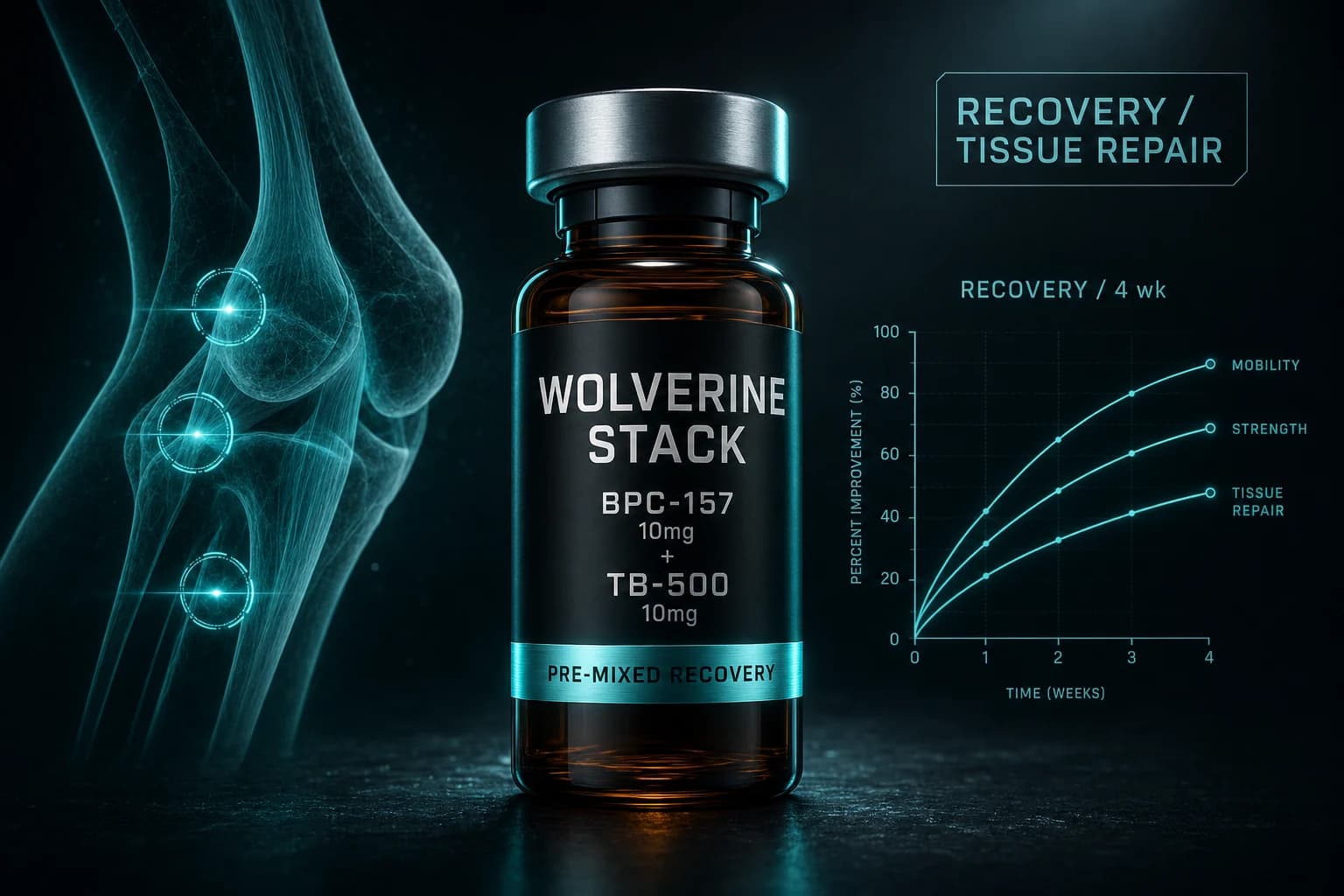
BPC-157 10mg + TB-500 10mg pre-mixed — the classic recovery & tissue repair stack
Price
$130
Compounds
2 peptides
Category
Recovery
Format
Pre-Mixed Injectable
Overview
The Wolverine Stack is BPC-157 and TB-500 pre-mixed in one vial, usually 10 mg of each. The name comes from the X-Men character, and it stuck because the two compounds together are the most widely run recovery protocol in peptide research.
BPC-157 is a 15-amino-acid sequence derived from a protein found in human gastric juice. Its rodent literature is unusually deep for a research peptide: accelerated Achilles tendon and ligament healing, gut protection, and vascular effects, driven by VEGF expression and new vessel formation [1]. It also promoted healing in alkali-burn models with measurable increases in proliferation, migration, and angiogenesis [2].
The detail most write-ups miss is that BPC-157 actually reached human clinical trials. Under the designation PL 14736 it was investigated for inflammatory bowel disease, which puts it ahead of nearly every other compound in this category on regulatory progress [3]. That program did not produce an approved drug, and no human trial has tested the tendon or recovery claims the stack is usually bought for. Both facts are true at once, and most pages selling this blend mention neither.
TB-500 is the synthetic fragment of Thymosin Beta-4 containing the actin-binding domain. Thymosin Beta-4 accelerated wound closure in dermal models [4] and drives directional migration of endothelial cells [5], which is the mechanistic basis for pairing it with a locally acting compound.
Worth stating plainly: both compounds are prohibited by WADA, and neither is approved for human use in any jurisdiction. Everything above is animal and cell-culture data.
Why this combination works
BPC-157 and TB-500 are stacked because their mechanisms do not overlap. BPC-157 works at the site: it upregulates VEGF, drives angiogenesis, and accelerates fibroblast activity where it is administered [1]. TB-500 works everywhere: by sequestering G-actin monomers it enables the cell migration that any repair process depends on, and it does so systemically regardless of injection site [5]. The practical framing researchers use is local plus systemic. BPC-157 concentrates the repair signal, TB-500 prepares the wider tissue environment to respond to it. One initiates, the other resolves. Neither covers both halves alone, which is the entire argument for running them together rather than sequentially.
What's inside
BPC-157
~4 hours half-lifeDrives local tissue repair through VEGF upregulation, angiogenesis, and fibroblast migration. The most-researched peptide for tendon, ligament, and gut healing in animal models.
TB-500
~2-3 hours half-lifeProvides systemic anti-inflammatory and tissue-remodeling support via actin regulation and cell migration signaling. Complements BPC-157's local action with body-wide healing support.
Researched benefits
- The two most-studied recovery peptides in one vial, one reconstitution
- Non-overlapping mechanisms: local angiogenesis (BPC-157) plus systemic cell migration (TB-500)
- BPC-157 has rodent data across tendon, ligament, muscle, and gut models
- BPC-157 reached human trials as PL 14736 for inflammatory bowel disease
- Pre-mixed at the 1:1 ratio most research protocols use
- COA-verified purity from Ascension Peptides
Dosing & reconstitution
Research dosing
Most research protocols run 250-500 mcg of BPC-157 with 2-5 mg of TB-500, subcutaneously, once daily. At a pre-mixed 1:1 ratio in a 20 mg vial, one draw delivers proportional amounts of both. Cycles typically run 4-6 weeks, extending to 8 for chronic models. Injection site is worth thinking about. In animal studies BPC-157 is often administered near the tissue of interest, on the reasoning that local concentration matters for the angiogenic effect. TB-500 acts systemically either way, so placing the shared draw near the target site costs nothing and may help the BPC-157 half.
Reconstitution
Add 2 mL of bacteriostatic water to the 20 mg vial for 10 mg/mL, which is 5 mg/mL of each compound. A typical daily draw is 0.05-0.1 mL, or 5-10 units on a U-100 insulin syringe. Inject the water slowly down the side of the vial rather than onto the powder, and swirl instead of shaking. Refrigerate immediately. The reconstitution calculator handles other vial sizes.
Open reconstitution calculatorFrequently asked
What is the Wolverine Stack?
BPC-157 and TB-500 combined in a single pre-mixed vial, typically 10 mg of each. It is named for the X-Men character's healing, and it is the most commonly run recovery pairing in peptide research because the two compounds work through separate mechanisms.
Why stack them instead of buying two vials?
One reconstitution, one draw, one syringe. The ratio is fixed at the 1:1 most protocols use, and the combined vial usually costs less than equivalent amounts bought separately. The tradeoff is that you cannot adjust the ratio.
Is there human data on the Wolverine Stack?
Not for the recovery use. BPC-157 did reach human trials as PL 14736 for inflammatory bowel disease, which is further than most compounds in this category get, but no trial has tested the tendon, ligament, or muscle-recovery claims. The evidence behind those is rodent and cell-culture work. TB-500 has no completed human efficacy trials.
Can I inject near a specific injury site?
That is the common approach in animal research for the BPC-157 half, on the reasoning that local concentration drives the angiogenic effect. TB-500 acts systemically regardless of where it goes in, so local placement of the shared draw does not cost you the TB-500 benefit.
How long before effects show up in research models?
Animal studies typically show measurable changes in healing markers within 1-2 weeks, peaking around weeks 3-4. Protocols run a minimum of 4 weeks for usable data. Both compounds clear quickly (BPC-157 roughly 4 hours), which is why daily dosing is standard rather than weekly.
Wolverine Stack vs GLOW vs KLOW: which one?
Wolverine is the recovery base: BPC-157 plus TB-500. GLOW adds GHK-Cu for skin and matrix rebuilding. KLOW adds GHK-Cu and KPV, bringing inflammatory suppression and a gut angle. If the question is purely musculoskeletal, Wolverine is the focused option and the other two are broader.
Are BPC-157 and TB-500 banned in sport?
Yes. Both appear on the WADA Prohibited List. Neither is approved for human use in any jurisdiction, and both are sold for laboratory research only.
References
- [1]
Chang CH, Tsai WC, Lin MS, et al. (2011). The promoting effect of pentadecapeptide BPC 157 on tendon healing involves tendon outgrowth, cell survival, and cell migration.
Journal of Applied Physiology · PubMed 21030672
- [2]
Huang T, Zhang K, Sun L, et al. (2015). Body protective compound-157 enhances alkali-burn wound healing in vivo and promotes proliferation, migration, and angiogenesis in vitro.
Drug Design, Development and Therapy · PubMed 25995620
- [3]
Sikiric P, Seiwerth S, Brcic L, et al. (2006). Stable gastric pentadecapeptide BPC 157 in trials for inflammatory bowel disease (PL-10, PLD-116, PL 14736).
Inflammopharmacology · PubMed 17186181
- [4]
Malinda KM, Sidhu GS, Mani H, et al. (1999). Thymosin beta4 accelerates wound healing.
Journal of Investigative Dermatology · PubMed 10469335
- [5]
Malinda KM, Goldstein AL, Kleinman HK. (1997). Thymosin beta 4 stimulates directional migration of human umbilical vein endothelial cells.
FASEB Journal · PubMed 9194528
Ready to start your research
Get the Wolverine Stack from Ascension Peptides
2 compounds, one vial, one reconstitution. COA-verified, US-based, discreet shipping. Use code ENHANCED for 50% off your entire order.
Buy Wolverine Stack — $130