At a glance
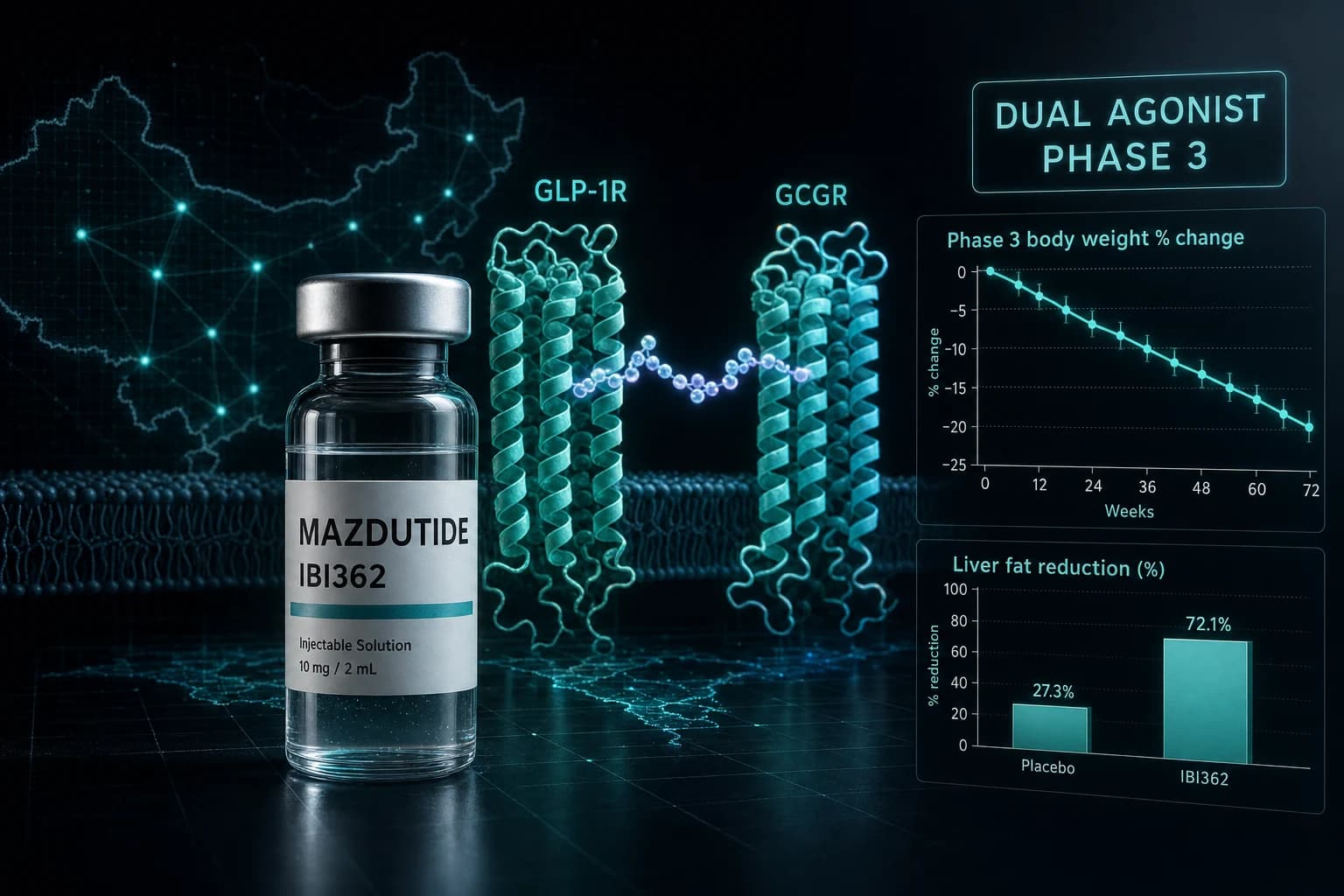
- GLORY-1 Phase 3 (Ji et al. NEJM 2025, PMID 40421736) reported -14.0% mean weight change at 48 weeks on mazdutide 6 mg in 610 Chinese adults with obesity
- DREAMS-1 Phase 3 (Nature 2025, PMID 41407859): HbA1c dropped 2.15 percentage points on 6 mg vs 0.14 on placebo at 24 weeks in 320 Chinese adults with type 2 diabetes
- DREAMS-2 head-to-head vs dulaglutide (Nature 2025, PMID 41407860): mazdutide 6 mg cut HbA1c 1.66% and body weight 8.53% vs 1.36% and 2.77% on dulaglutide 1.5 mg
- Mazdutide was approved in China for chronic weight management in mid-2025; no FDA or EMA submission has been made for Western markets
- Topline GLORY-2 readout pushes weight loss to 20.1% on the 9 mg dose, but those data are not yet peer-reviewed
A dual agonist that already cleared Phase 3 in obesity
Mazdutide is the first GLP-1 plus glucagon dual receptor agonist approved for obesity by any regulator. The approval was granted in China in mid-2025, the trials enrolled Chinese adults, and the headline weight loss number from the GLORY-1 Phase 3 trial sits between semaglutide and tirzepatide. That last point is why the molecule matters in 2026 even if it cannot legally be prescribed in the United States or Europe.
The peer-reviewed evidence is unusually strong for a drug that most Western readers have not heard of. GLORY-1 reported 14.0 percent mean weight loss at 48 weeks on the 6 mg dose in 610 Chinese adults with obesity (Ji et al., NEJM 2025, PMID 40421736). Two back-to-back Phase 3 type 2 diabetes trials, DREAMS-1 versus placebo and DREAMS-2 versus dulaglutide, were published in Nature in late 2025 (PMID 41407859 and PMID 41407860). The Phase 2 obesity trial is in Nature Communications (Ji et al. 2023, PMID 38092790). The Phase 1b high-dose study is in eClinicalMedicine (Ji et al. 2022, PMID 36247927).
Bottom line: Mazdutide is the first GLP-1/glucagon dual agonist with a published, peer-reviewed Phase 3 obesity readout and the first dual agonist approved for obesity by any regulator. Headline efficacy lands in the semaglutide neighborhood, the higher 9 mg dose may stretch toward tirzepatide territory, and almost all of the human evidence is in Chinese populations.
What mazdutide actually is
Mazdutide, also known as IBI362, is a once-weekly subcutaneous peptide developed by Innovent Biologics. Structurally it is a synthetic mammalian oxyntomodulin analogue with a fatty acid side chain that anchors the molecule to circulating albumin. The albumin binding stretches the plasma half-life into a range that supports weekly dosing. Functionally, it activates two receptors at once: the glucagon-like peptide-1 receptor (GLP-1R) and the glucagon receptor (GCGR).
Native oxyntomodulin is a 37 amino acid peptide that the gut releases after meals. It binds both receptors with modest affinity, suppresses appetite, and increases energy expenditure, but its short half-life made the unmodified molecule unworkable as a chronic obesity drug. Mazdutide is the engineered version: receptor selectivity tuned toward GLP-1 dominance, glucagon activity dialed down enough to avoid hyperglycemia, and a fatty acid linker that fixes the half-life problem.
The class context is what makes mazdutide easy to slot into the rest of the obesity drug class:
| Drug | Receptor profile | Schedule |
|---|---|---|
| Semaglutide | GLP-1R | Weekly |
| Tirzepatide | GLP-1R + GIPR | Weekly |
| Retatrutide | GLP-1R + GIPR + GCGR | Weekly |
| Survodutide | GLP-1R + GCGR | Weekly |
| Mazdutide | GLP-1R + GCGR | Weekly |
Mazdutide and survodutide are the two GLP-1/glucagon dual agonists with Phase 3 human data. They are different molecules with different sponsors, different dose ranges, and different geographies, but they answer overlapping mechanistic questions about whether glucagon receptor activation adds something useful on top of GLP-1.
For the broader pharmacology of the class, our writeups on tirzepatide, semaglutide, and retatrutide cover the underlying receptor biology and how each compound was engineered.
GLORY-1: the obesity Phase 3 that supported the China approval
GLORY-1 is the trial that sits behind the China NMPA approval. Design and outcomes from Ji et al., NEJM 2025 (PMID 40421736):
- 610 Chinese adults aged 18 to 75
- BMI of at least 28, or BMI 24 to less than 28 with at least one weight-related comorbidity
- Mean baseline body weight 87.2 kg, mean BMI 31.1
- Randomized 1:1:1 to mazdutide 4 mg, mazdutide 6 mg, or placebo, once weekly subcutaneously
- 48 weeks of treatment, with co-primary endpoints assessed at week 32 and durability data at week 48
The headline numbers are in two pieces, week 32 (the regulatory primary) and week 48 (the durability secondary):
| Endpoint | Mazdutide 4 mg | Mazdutide 6 mg | Placebo |
|---|---|---|---|
| Mean body weight change, week 32 | -10.09% | -12.55% | +0.45% |
| Mean body weight change, week 48 | -11.00% | -14.01% | +0.30% |
| ≥5% weight loss at week 32 | 73.9% | 82.0% | 10.5% |
| ≥15% weight loss at week 48 | 35.7% | 49.5% | 2.0% |
Source: Ji et al., NEJM 2025.
Three details deserve attention beyond the headline:
- The placebo arm gained essentially zero weight, so the active-arm reductions are not flattered by placebo regain. This is unusual and suggests the trial population was unusually compliant with the lifestyle baseline.
- Half of participants on 6 mg lost at least 15 percent of body weight at 48 weeks. That is the threshold most cardiometabolic studies use as the line for clinically meaningful weight reduction.
- The 6 mg curve had not flattened by week 48, which means steady-state weight loss is plausibly higher with continued treatment.
The single number to remember from GLORY-1 is 14 percent at 48 weeks on the 6 mg dose.
DREAMS-1 and DREAMS-2: the type 2 diabetes Phase 3 program
The diabetes pillar of the China approval is two Phase 3 trials published back-to-back in Nature in late 2025.
DREAMS-1 (PMID 41407859) randomized 320 Chinese adults with type 2 diabetes inadequately controlled on diet and exercise alone to mazdutide 4 mg, mazdutide 6 mg, or placebo for 24 weeks of double-blind treatment, followed by 24 weeks of open-label extension. At week 24:
| Endpoint | Mazdutide 4 mg | Mazdutide 6 mg | Placebo |
|---|---|---|---|
| HbA1c change from baseline | -1.57% | -2.15% | -0.14% |
| Body weight change | -5.61% | -7.81% | -1.26% |
Both mazdutide doses met the primary endpoint with p < 0.0001 versus placebo on HbA1c and on body weight, with significantly more participants reaching HbA1c below 7.0 percent and at least 5 percent weight loss.
DREAMS-2 (PMID 41407860) randomized 731 Chinese adults with type 2 diabetes who had insufficient glycemic control on metformin (alone or in combination) to mazdutide 4 mg, mazdutide 6 mg, or dulaglutide 1.5 mg for 28 weeks, head to head. At week 28:
| Endpoint | Mazdutide 4 mg | Mazdutide 6 mg | Dulaglutide 1.5 mg |
|---|---|---|---|
| HbA1c change from baseline | -1.61% | -1.66% | -1.36% |
| Body weight change | -6.55% | -8.53% | -2.77% |
Both mazdutide doses met non-inferiority on HbA1c and demonstrated statistically significant superiority over dulaglutide. The weight loss difference was the larger story: roughly four to six additional percentage points of body weight reduction on top of better glycemic control.
The diabetes data are tighter and shorter than the obesity data, which is expected because HbA1c moves on a faster clock than body weight. The clean read across both diabetes trials: mazdutide is meaningfully better than dulaglutide on both primary axes, and the dual-agonist mechanism does not appear to carry a glycemic penalty in the populations studied.
How mazdutide compares to the rest of the obesity drug class
Cross-trial comparisons in obesity pharmacology are directional, not definitive. Trial durations differ, populations differ, and the highest-dose mean weight loss is not the same metric across every program. With those caveats, the relative positioning is:
| Drug | Pivotal obesity trial | Highest-dose mean weight loss | Duration | Approval status (May 2026) |
|---|---|---|---|---|
| Semaglutide 2.4 mg | STEP 1 (Wilding et al., NEJM 2021, PMID 33567185) | -14.9% | 68 wk | Approved (Wegovy, Ozempic) |
| Tirzepatide 15 mg | SURMOUNT-1 (Jastreboff et al., NEJM 2022, PMID 35658024) | -22.5% (efficacy estimand) | 72 wk | Approved (Zepbound, Mounjaro) |
| Retatrutide 12 mg | Phase 2 (Jastreboff et al., NEJM 2023, PMID 37366315) | -24.2% | 48 wk | Investigational |
| Survodutide 6 mg | SYNCHRONIZE-1 (topline, not yet peer-reviewed) | -16.6% | 76 wk | Investigational |
| Mazdutide 6 mg | GLORY-1 (Ji et al., NEJM 2025, PMID 40421736) | -14.0% | 48 wk | Approved in China |
Two patterns jump out of the table. First, both GLP-1/glucagon dual agonists with reportable Phase 3 data (mazdutide and survodutide) sit in the semaglutide range, not the tirzepatide range. Second, triple agonism (retatrutide) and the GLP-1 + GIP combination (tirzepatide) are pulling ahead of GLP-1 + glucagon dual agonism on raw efficacy in current head-to-head and indirect comparisons.
For the GIP-antagonist counterpoint that is also reaching Phase 3, see our maridebart cafraglutide (MariTide) Phase 2 evidence guide. For the survodutide story specifically, survodutide GCG/GLP-1 dual agonist trial evidence covers the parallel Phase 3 program.
Why GLP-1 plus glucagon, and what the trade-off costs
The dual-agonist logic is straightforward in principle. GLP-1 receptor activation suppresses appetite, slows gastric emptying, and stimulates glucose-dependent insulin secretion. Glucagon receptor activation increases hepatic energy expenditure and lipid oxidation, with less direct effect on appetite. Adding glucagon to GLP-1 was supposed to bring the energy-expenditure side of the equation into a class that was already dominant on appetite suppression.
The trade-off is glucose. Glucagon receptor activation raises blood glucose by promoting hepatic glucose output. A pure glucagon analogue is not a viable obesity drug because the hyperglycemia would be intolerable. Mazdutide and survodutide both solve that problem the same way: tune the GCGR potency low enough that the GLP-1 arm's insulin-secreting effect more than compensates, with net glycemic improvement.
That tuning is also why the dual agonists have not produced retatrutide-class weight loss. Retatrutide adds a GIP arm rather than relying on glucagon for the additional energy-expenditure boost, and GIP appears to add weight loss without the glucose-management constraint that more aggressive glucagon dosing would create. The dual-agonist class is the mid-tier of the modern obesity drug shelf: clearly better than GLP-1 alone, plausibly capped below the triple agonists, and limited by how much glucagon activity the metabolic margin can absorb.
Tolerability and safety
The adverse-event profile in mazdutide trials is class-typical for GLP-1 receptor agonism: nausea, diarrhoea, decreased appetite, vomiting, and upper respiratory tract infection. The Phase 1b high-dose trial of 9 mg and 10 mg in Chinese adults with overweight or obesity reported tolerability that did not show steep dose-dependent severity escalation in a small cohort (Ji et al., eClinicalMedicine 2022, PMID 36247927).
A few specifics from the published Phase 3 data:
- GLORY-1 reported low rates of treatment discontinuation due to adverse events on mazdutide 6 mg, broadly in the same range as semaglutide 2.4 mg in STEP 1.
- DREAMS-2 reported no severe hypoglycemia events with mazdutide; mild-to-moderate hypoglycemia rates were similar to dulaglutide 1.5 mg. This is the central safety question for any glucagon-active drug, and the result is reassuring.
- The Phase 2 obesity trial reported mean weight reductions of -6.7%, -10.4%, and -11.3% on 3 mg, 4.5 mg, and 6 mg respectively at 24 weeks, with all doses well tolerated and the same GI-dominant adverse event profile (Ji et al., Nature Communications 2023, PMID 38092790).
The lean mass question that follows every GLP-1 class drug applies to mazdutide too. The appetite-suppression mechanism is the dominant arm of the molecule, and rapid weight loss in a calorie-deficit setting drives a meaningful fraction of total weight loss out of lean tissue. Our GLP-1 muscle loss research roundup covers the lean-mass-preservation strategies that hold up across the class, and the same principles apply to mazdutide users.
GLORY-2 and the 9 mg high dose
Innovent has run a separate Phase 3 trial called GLORY-2 testing mazdutide at 9 mg in Chinese adults with obesity. The topline announcement (December 2025) reported up to 20.1 percent mean weight loss, which would put mazdutide closer to tirzepatide territory than to semaglutide. As of May 2026 the GLORY-2 full data have not been peer-reviewed or PubMed-indexed, so the 20 percent figure should be treated as a press-release number rather than a confirmed publication.
If the 20 percent number holds up in peer review, the dual-agonist class has more headroom than the 4 mg and 6 mg doses suggested. It would not change the relative ranking against the triple agonist retatrutide, but it would close most of the gap to tirzepatide on monotherapy weight loss. That readout is the next near-term milestone to watch for the molecule.
Western markets: why mazdutide is not at your pharmacy
Mazdutide is approved in China by the National Medical Products Administration for chronic weight management in adults with obesity, with parallel Phase 3 evidence supporting type 2 diabetes use. As of May 2026:
- No FDA submission for any indication
- No EMA submission for any indication
- No published Phase 3 trial in non-Chinese populations
- No global commercial supply chain
This matters for two reasons. The first is straightforward population biology. All five Phase 3 trials that have reported (GLORY-1, GLORY-2 topline, DREAMS-1, DREAMS-2, plus a Phase 3 program component for adolescents that has not yet read out) enrolled Chinese adults. Body composition, baseline BMI distribution, and dietary patterns differ between Chinese and Western obesity-trial populations, and the pharmacokinetic properties of weight-loss drugs do not always translate directly. Tirzepatide, semaglutide, and retatrutide were each studied in multinational pivotal programs that included sizable non-Asian cohorts; mazdutide has not been studied that way yet.
The second is regulatory. Either route to a Western approval requires substantial additional clinical work: bridging studies in non-Chinese populations, or a fresh global pivotal program. Both pathways add at least two to three years before mazdutide could be available outside China through a regulated channel.
For research-peptide markets in Western jurisdictions, some compounding labs and grey-market vendors have started selling material labeled as mazdutide, with very limited evidence that the product matches the validated reference standard. The same cautions we covered in where to buy BPC-157 with a real COA and the broader best legit peptide vendors of 2026 apply: without a third-party certificate of analysis and bioequivalence evidence, a vial labeled "mazdutide" is not necessarily the same molecule that produced the GLORY-1 numbers.
Mazdutide versus survodutide, dual agonist to dual agonist
Mazdutide and survodutide are the two GLP-1/glucagon dual agonists with Phase 3 evidence in obesity. They are different molecules with different sponsors, different trial designs, and different dose ranges. The honest comparison:
| Comparison | Mazdutide (Innovent) | Survodutide (Boehringer/Zealand) |
|---|---|---|
| Pivotal obesity trial | GLORY-1 (peer-reviewed), GLORY-2 (topline) | SYNCHRONIZE-1 (topline only) |
| Doses tested in pivotal program | 4 mg, 6 mg, 9 mg | 1.2 mg to 6 mg |
| Headline weight loss at top dose | -14.0% (6 mg, 48 wk); -20.1% (9 mg topline) | -16.6% (6 mg, 76 wk) |
| Trial duration | 48 weeks | 76 weeks |
| Approval status | China, mid-2025 | None yet |
| Peer-reviewed Phase 3 | Yes (NEJM 2025) | Topline announcement only |
The directional read at the 6 mg comparable doses: similar weight loss, similar GI-dominant tolerability profile, similar mechanistic argument. The differences come from trial duration (survodutide ran 76 weeks, longer than GLORY-1) and from dose range (mazdutide pushed higher with 9 mg, survodutide stayed at 6 mg in its pivotal trial). Both compounds validate the dual-agonist hypothesis. Neither displaces tirzepatide as the dominant approved option in Western markets, and both lag retatrutide on raw efficacy.
For ongoing context on adjacent mechanisms and how cagrilintide (an amylin analogue that pairs with semaglutide as CagriSema) fits in, see our cagrilintide and CagriSema REDEFINE Phase 3 guide. The amylin-and-GLP-1 combination is the parallel mechanistic bet that the class is making.
What this means if you are weighing GLP-1 class options today
If you are interested in mazdutide because you are weighing real options in 2026, the practical mental model is:
- For approved obesity therapy in the United States or Europe with the strongest evidence today, the clinical defaults remain tirzepatide (Zepbound) and semaglutide (Wegovy). Mazdutide is not approved in either jurisdiction and there is no current submission timeline.
- For obesity therapy in mainland China, mazdutide is now an approved option alongside semaglutide and a small number of other agents. The 6 mg dose is the on-label maintenance dose for chronic weight management.
- For research peptide users, mazdutide is a new entry in the catalog with limited COA-backed availability. The same evaluation framework that applies to any novel compound applies here: third-party purity testing, bioequivalence to the validated reference standard, and a clean source-to-vial chain.
- Withdrawal and weight-regain dynamics that hold for the rest of the GLP-1 class are likely to apply to mazdutide as well, given the dominant role of GLP-1 receptor agonism in the molecule. Our stopping GLP-1s research summary covers the maintenance and rebound question.
- Reconstitution math for any GLP-1 class peptide can be checked against our reconstitution calculator.
For research-grade injectable peptides that ship with verifiable certificates of analysis, Ascension Peptides is where most of the people we trust source from; code ENHANCED takes 50 percent off. For oral peptides and nasal sprays in adjacent categories, Limitless Biotech carries those formats; code ENHANCED applies. Neither vendor carries mazdutide as a validated product as of this writing, and any other vendor advertising mazdutide should be evaluated against the same COA and bioequivalence standards as any novel research compound.
Warning: Mazdutide is approved as a prescription drug in China, not as a research-only compound, and there is no peer-reviewed bioequivalence study of any grey-market mazdutide product against the Innovent reference standard. Material sold under the name today is not, by default, the same molecule that produced the GLORY-1 and DREAMS Phase 3 data.
Honest evidence summary
- Mechanism: well-validated GLP-1 plus glucagon dual receptor agonism, with the receptor balance explicitly tuned toward GLP-1 dominance and the glucagon arm tuned low enough to avoid hyperglycemia.
- Efficacy: 14.0 percent at 48 weeks on 6 mg in GLORY-1, with the 9 mg GLORY-2 topline reaching 20.1 percent. Diabetes data show HbA1c reductions of 1.6 to 2.2 percent on 6 mg with concurrent weight loss superior to dulaglutide.
- Safety: GI adverse events are class-typical and dominated by nausea, diarrhoea, and decreased appetite. No severe hypoglycemia signal in published Phase 3 data, including in the head-to-head versus dulaglutide.
- Geographic context: every Phase 3 readout to date is in Chinese adults. There are no published Western or multinational pivotal trials.
- Western availability: no FDA or EMA submission, no global commercial supply, and a realistic two-to-three-year minimum before any approved use outside China.
- Practical takeaway: this is the molecule that proved a GLP-1/glucagon dual agonist can clear Phase 3 in obesity. Acting on it as a Western patient or research user is a separate question with weaker support.
Bottom line
Mazdutide is the first GLP-1/glucagon dual agonist with peer-reviewed Phase 3 obesity evidence and the first dual agonist approved for obesity by any regulator. Its 14 percent weight loss at 48 weeks puts it in the same band as semaglutide on the same schedule, with a higher 9 mg dose plausibly reaching 20 percent once the GLORY-2 full paper publishes. The diabetes program shows clean superiority over dulaglutide on both glycemic control and weight loss. None of this changes what is available in Western markets in 2026, where tirzepatide and semaglutide remain the approved defaults and any mazdutide vial sold outside China carries the same source-of-truth questions that any novel research compound carries.
The realistic mental model: track GLORY-2 for the high-dose readout, watch whether Innovent or a partner files for FDA or EMA review in 2026 to 2027, and treat the mazdutide story as the moment the dual-agonist class graduated from interesting hypothesis to approved therapy. The class effect on weight loss is now established; the durability and Western generalizability questions are still open.
This article is for educational and research purposes only. Mazdutide is approved in China for chronic weight management and is investigational in the United States and Europe. Tirzepatide and semaglutide referenced above are FDA approved for the indications cited; this content is not medical advice and is not a substitute for guidance from a qualified clinician. Citations link to PubMed for verification.