At a glance
- Stopping tirzepatide led to 14% mean weight regain at 52 weeks in SURMOUNT-4 (Aronne et al. 2024)
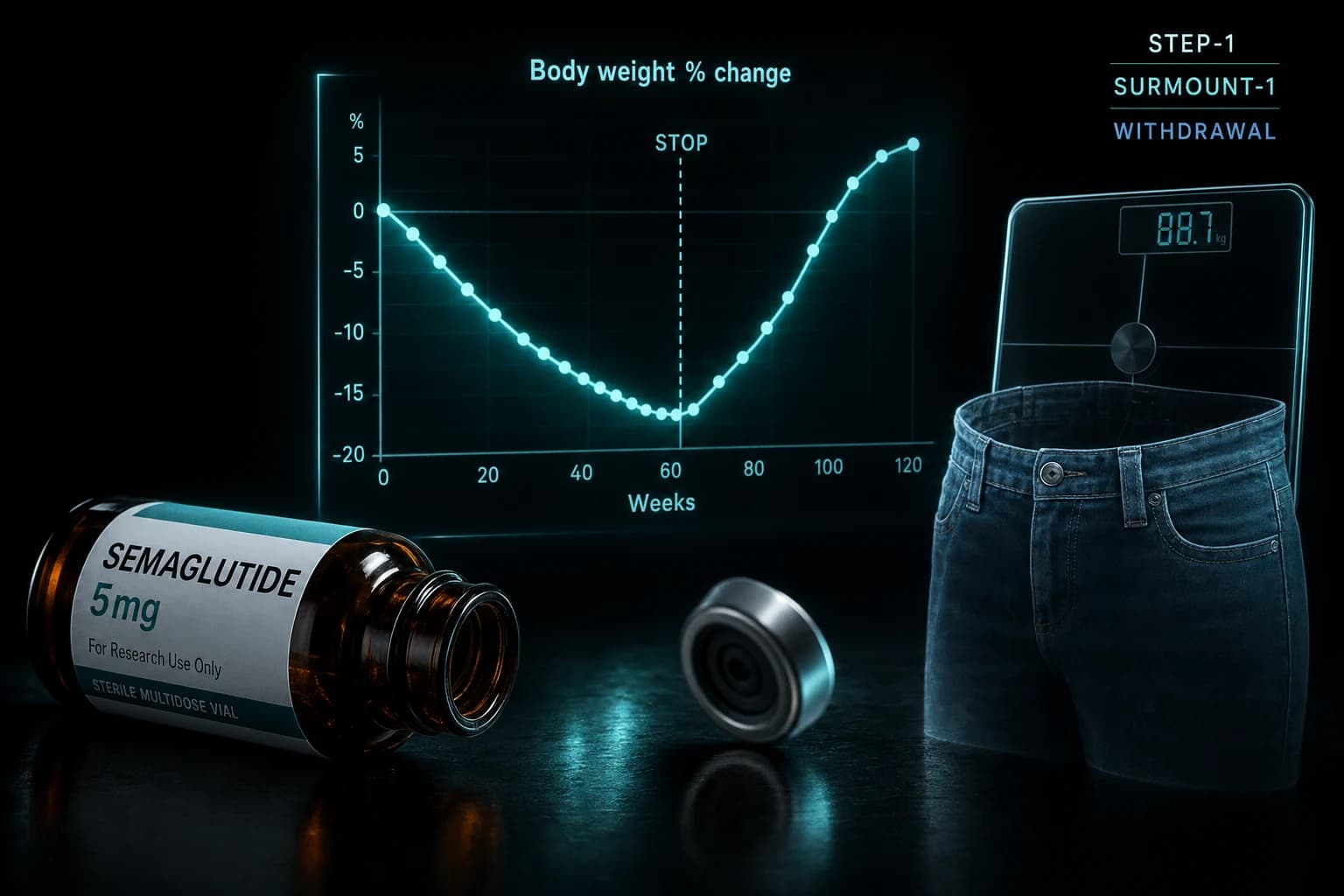
- Two-thirds of semaglutide weight loss came back within a year off drug (Wilding et al. 2022)
- 82.5% of SURMOUNT-4 participants regained at least 25% of lost weight by week 88 off tirzepatide
- A 2025 meta-analysis pooled 5.63 kg of regain across 18 RCTs and 3,771 obese participants
- A 2026 Scripps case series held weight steady when patients moved to every-other-week dosing
- Cardiometabolic gains track the scale: blood pressure, A1c, and lipids reverse with regain
The number people googling this want
Stop tirzepatide cold after 36 weeks of weight loss, and the average regain over the next year is 14% of body weight. Continue tirzepatide instead and you lose another 6.7%. That gap is the SURMOUNT-4 result in one sentence (Aronne et al., JAMA 2024).
The post hoc analysis published in JAMA Internal Medicine a year later sharpened the finding. Among participants who had cleared at least 10% weight loss in the lead-in, 82.5% regained 25% or more of that loss within 52 weeks off drug. The blood pressure, A1c, and lipid gains they had accumulated regressed in step with the scale (Horn et al., JAMA Intern Med 2025).
If you have read the headlines, that is the part you already know. The part worth reading for is what changes when you bring in the older semaglutide withdrawal data, the new reduced-frequency case series out of Scripps, and a 2025 meta-analysis that pooled the entire class. The picture that comes out is more nuanced than "stop and you regain." It is closer to: stop and you regain on a predictable curve, taper and you might not.
The four trials that anchor the conversation
Four randomized data sets carry most of the weight on this question. STEP 1 extension and STEP 4 cover semaglutide. SURMOUNT-4 and its post hoc analysis cover tirzepatide. Reading them side by side is more useful than reading any one in isolation.
| Trial | Drug | N (withdrawal arm) | On-drug weight loss | Off-drug regain | Follow-up |
|---|---|---|---|---|---|
| STEP 1 extension (Wilding 2022) | Semaglutide 2.4 mg | 327 | 17.3% at week 68 | 11.6 percentage points by week 120 | 52 weeks off drug |
| STEP 4 (Rubino 2021) | Semaglutide 2.4 mg | 268 (placebo arm) | 10.6% during 20-week run-in | 6.9% regain on placebo vs 7.9% additional loss continuing | 48 weeks |
| SURMOUNT-4 main (Aronne 2024) | Tirzepatide 10/15 mg | 335 (placebo arm) | 20.9% during 36-week run-in | 14.0% regain on placebo vs 5.5% additional loss continuing | 52 weeks |
| SURMOUNT-4 post hoc (Horn 2025) | Tirzepatide 10/15 mg | Same cohort, regain quartiles | Same | 82.5% regained at least 25% of lost weight | 52 weeks |
A few things stand out. The on-drug losses scale with drug class, with tirzepatide pulling about 4 to 8 percentage points further than semaglutide at 2.4 mg. The off-drug regain also scales, but in a way that flatters tirzepatide. SURMOUNT-4 participants kept a larger fraction of their starting deficit at 52 weeks off drug than STEP 1 participants did at the same time point. That fits the depth-of-loss pattern: the further you push body weight down, the more absolute pounds come back when the drug stops, but the percent of loss retained tends to be similar across compounds.
Bottom line: Across two drug classes and four trials, the off-drug regain trajectory looks similar in shape. About two-thirds of the lost weight comes back in the first 12 months. The slope is steeper in the first six months, flatter after.
The class-level meta-analysis
A November 2025 systematic review in eClinicalMedicine pulled the four anchor trials together with 14 others and ran the math on 3,771 participants (Tang et al., eClinicalMedicine 2025).
Headline numbers from the obesity arm:
- Body weight regain: 5.63 kg (95% CI, 3.52 to 7.73)
- HbA1c rebound: 0.25% (95% CI, 0.18 to 0.32)
- Waist circumference, BMI, systolic blood pressure, fasting plasma glucose all moved in the wrong direction with statistical significance.
The same review reported a clean dose-response with follow-up duration. At over 26 weeks off drug, mean regain was 7.31 kg. At under 26 weeks, it was 2.51 kg. Semaglutide arms regained 8.21 kg at long follow-up, liraglutide arms regained 4.29 kg. Tirzepatide-specific subgroup data are sparse in the meta-analysis because the long-tail SURMOUNT data is still rolling out, but the SURMOUNT-4 numbers we already cited put it in the same neighborhood as semaglutide.
What the meta-analysis really shows is not that any one drug is unusual. It is that the regain pattern is consistent enough across studies to model. That matters for protocol design: if you can predict regain at 26 and 52 weeks, you can design a maintenance plan with realistic expectations rather than wishful thinking.
Why the body resists holding the loss
The mechanism is not a mystery. GLP-1 receptor agonists do three things at once that get unwound the moment the drug clears.
First, central appetite suppression is unwound within days. GLP-1 signaling in the hypothalamic arcuate nucleus and brainstem reduces hunger and post-meal craving. Half-lives are long for the long-acting agents (about 7 days for semaglutide and tirzepatide), but receptor occupancy still falls below the appetite-suppression threshold within four to six weeks of the last dose. Subjective hunger climbs back to baseline before the scale moves much.
Second, slowed gastric emptying reverses. Tirzepatide and semaglutide delay gastric emptying by a meaningful amount, which extends meal-related satiety. That reverses on a similar timeline to the central effect.
Third, the hormonal counter-regulation that always follows weight loss reasserts itself. Leptin falls, ghrelin rises, resting energy expenditure runs lower than weight alone would predict. This is the same biology that drives regain after diet-only weight loss, and GLP-1 agonists do not switch it off. They override it pharmacologically. Remove the override and the underlying drive returns.
The Look AHEAD-style behavioral data and the GLP-1 cohort data converge on the same point: maintained loss requires either continued pharmacology, or a behavioral and metabolic rebuild strong enough to replace the drug. The maintenance plans that work try to address both.
Note: The same biology drives the lean mass loss story. The fraction of weight regained as fat is consistently higher than the fraction of weight lost as fat, because muscle does not come back automatically. That is one reason a "stop the drug, regain ten pounds" outcome can leave body composition worse than baseline.
What reverses with the regain
The SURMOUNT-4 post hoc is the cleanest readout on cardiometabolic reversibility because it stratified by regain quartile. Participants who held within 5% of nadir kept their improvements. Those who regained over 25% gave most of them back.
Across the measured parameters, the directional finding looked like this:
| Parameter | Direction with regain | Magnitude (highest regain quartile) |
|---|---|---|
| Waist circumference | Worsened | Most of the lead-in improvement reversed |
| Systolic blood pressure | Worsened | Returned toward baseline |
| Non-HDL cholesterol | Worsened | Reversed proportional to regain |
| Triglycerides | Worsened | Reversed proportional to regain |
| HbA1c | Worsened | Returned toward baseline |
| Fasting glucose | Worsened | Returned toward baseline |
| Fasting insulin | Worsened | Returned toward baseline |
| HOMA2-IR | Worsened | Returned toward baseline |
The minimum-regain quartile is more interesting than the maximum-regain quartile. Participants who regained less than 25% of lost weight did not show statistically significant changes in waist circumference, triglycerides, non-HDL cholesterol, fasting insulin, or HOMA2-IR. The cardiometabolic protection appears to be tied to the loss being held, not to the drug being on board. If you can hold the loss without the drug, you keep most of the protection. If you cannot, you do not.
That framing is closer to how patients should think about exit decisions than the standard "you have to be on this for life" framing. The conditional matters. Lifelong therapy is one strategy. So is a maintenance protocol that keeps weight near nadir without daily or weekly full-dose injection.
The 2026 reduced-frequency case series
In February 2026 Obesity published a 30-patient case series from Scripps that reframed the maintenance question (Wong et al., Obesity 2026).
The setup: patients on weekly semaglutide or tirzepatide who had reached a weight plateau were switched to reduced-frequency dosing at the same dose (typically every other week, sometimes every three weeks). They were followed across three time points: pre-treatment, plateau on weekly dosing, and steady-state on reduced frequency.
What the data showed:
- Pre-treatment weight: 87.9 ± 2.4 kg
- Plateau weight (weekly dosing): 74.1 ± 2.4 kg, a 17.2% reduction
- Maintenance weight (reduced-frequency dosing): 72.4 ± 2.2 kg, an additional 2.3% loss from plateau
- Mean arterial pressure improved through the weekly phase and held during reduced-frequency dosing
- Metabolic syndrome prevalence dropped from 83% pre-treatment to 68% at plateau to 58.6% on reduced-frequency dosing
The case series is small and uncontrolled. It does not prove every patient can de-escalate. What it does show is that a meaningful fraction of patients on tirzepatide or semaglutide can hold their weight loss on roughly half the drug exposure. That is consistent with the pharmacology: long-acting GLP-1 agonists maintain partial receptor occupancy for several days past the dose interval. Stretching the interval reduces total exposure without dropping receptor coverage to zero.
A separate 2025 paper in Obesity by Wu and colleagues argued the same point from the other direction, framing reduced-frequency dosing as a viable maintenance strategy for patients who plateau. Both papers point at the same hypothesis: the binary "stay on full dose forever vs come off entirely" framing is too narrow. There is a middle path that has not been formally tested in a phase 3 trial yet, but is being practiced.
A decision matrix for exiting GLP-1 therapy
Different goals call for different exit strategies. The trial data does not collapse to one answer.
| Strategy | Best fit | What the data shows | Risk |
|---|---|---|---|
| Continue full dose indefinitely | Severe obesity, T2D, ASCVD, history of cycling | SURMOUNT-4: additional 6.7% loss at week 88; STEP 4: continued loss vs placebo regain | Cost, GI side effects over years, tachyphylaxis questions still open |
| Step down to a lower dose (5 mg or 2.4 mg) | Stable weight near goal | Limited published data; SURMOUNT-MAINTAIN reading out 2026-2027 | Regain risk if step is too aggressive |
| Reduced-frequency dosing | Plateaued patients with strong adherence | Wong 2026: 30-patient case series held weight on every-other-week | Uncontrolled data, not yet phase 3 validated |
| Stop drug entirely with structured maintenance | Younger, less severe obesity, strong behavioral foundation | STEP 1 extension: 5.6% net loss retained at week 120 vs starting weight | Two-thirds of loss likely returns within 12 months |
| Stop drug entirely without maintenance | Generally not supported | SURMOUNT-4: 14% mean regain in 52 weeks | Cardiometabolic gains track the regain |
The decision is rarely "stop or stay." It is usually "stay at what dose, on what frequency, with what behavioral and resistance training scaffolding around it." The patients who keep most of their loss tend to keep some level of pharmacology. The patients who lose the loss are usually the ones who stopped without a maintenance plan.
What the data does not yet say
A few honest caveats are worth naming, because most of the popular-press coverage smooths over them.
The SURMOUNT-MAINTAIN trial is in flight, not read out. It will be the first phase 3b read on whether reducing the tirzepatide dose preserves weight loss across 52 weeks compared with placebo and continued maximum dose. Until that lands, every "step down to 5 mg and you keep the weight off" claim is extrapolation from baseline characteristics and case series.
Retatrutide has no published withdrawal trial. Phase 3 TRIUMPH program design includes treatment-cessation arms but the data is not public. Given retatrutide's deeper weight loss in phase 2, regain after cessation is likely to be larger in absolute terms than what we see with tirzepatide. The percent-of-loss-retained question is open.
Cagrilintide adds a separate axis. The amylin pathway is mechanistically distinct from GLP-1, and the CagriSema REDEFINE results suggest amylin contribution to satiety persists through similar pharmacokinetic windows. Whether that buffers regain after stopping the GLP-1 component is a question for the REDEFINE long-term extension, not for current clinical practice.
Reduced-frequency dosing is not the same as alternate-week injection in a vacuum. The Wong case series patients had reached a plateau on weekly dosing, meaning their weight had already stopped responding to weekly stimulation. They stretched the interval after stabilization, not before. Doing the same on a patient still in the active loss phase would likely produce different results.
Practical takeaways for protocol design
The literature supports a few concrete points without overclaiming.
-
Plan for maintenance before you stop. The patients who hold their loss are the ones who built a maintenance plan during the active loss phase, not after the regain started. Resistance training, protein intake at 1.2 to 1.6 g/kg, and a clear de-escalation step should be in place before the last full-dose injection.
-
If you stop, expect the curve, not a cliff. The two-thirds-of-loss-back-in-a-year pattern is consistent across STEP 1 extension, SURMOUNT-4, and the 2025 meta-analysis. Reframing weight regain as a predictable trajectory rather than a personal failure is closer to how the data reads.
-
Consider reduced-frequency dosing before full discontinuation. The Wong case series and the Wu commentary both point toward stretching the interval rather than coming off. The phase 3 read is not yet in, but the mechanism makes sense.
-
Track the parameters that matter. Body weight is the noisiest measure on a weekly timeline. Waist circumference, blood pressure, fasting glucose, and HbA1c are slower-moving and reflect the cardiometabolic protection more accurately. The SURMOUNT-4 post hoc shows these reverse with regain, but more slowly than the scale.
-
Do not stop without addressing lean mass. The fraction of weight lost as muscle on full-dose tirzepatide or semaglutide tracks 25 to 40% across STEP 1, SURMOUNT-1, and the BELIEVE trial. Regaining mostly fat means the post-stop body composition can be worse than the pre-treatment baseline. The GLP-1 muscle loss read covers this in detail.
Sourcing for research-grade tirzepatide and semaglutide
If you are running a structured protocol for body composition research, the supply side matters. Reconstitution, dose accuracy, and storage all feed back into whether the trial-grade weight loss numbers are achievable in practice. The reconstitution calculator handles the math.
For injectable tirzepatide and semaglutide, Ascension Peptides offers research-grade vials with the ENHANCED code at 50% off. For oral GLP-1 alternatives and adjacent compounds, Limitless Biotech is the cleaner option, also with code ENHANCED. Neither is a substitute for FDA-approved branded therapy under medical supervision. They are the route most researchers use to run dose-response and protocol comparison work.
Bottom line
Bottom line: Stopping a long-acting GLP-1 agonist returns about two-thirds of the weight loss within a year, and the cardiometabolic gains track the regain. The newer reduced-frequency case series suggests a middle path. The cleanest protocol decision is not "stop or stay," but "what dose, what frequency, and what scaffolding."
The withdrawal trials are useful precisely because they answered the question patients ask out loud. The harder question, the one current data only partially answers, is how to maintain. SURMOUNT-MAINTAIN should fill in the dose-reduction half of that picture in 2026 to 2027. The Scripps reduced-frequency series should generate hypotheses for a phase 3 of its own. Until then, the best we have is the curve. Plan for it.
Related research on this site
- GLP-1 Muscle Loss: What the Research Shows in 2026
- Tirzepatide vs Semaglutide: The 2026 Head-to-Head
- Retatrutide vs Tirzepatide vs Semaglutide: 2026 GLP-1 Comparison
- 12-Week Retatrutide Titration Protocol
- CagriSema REDEFINE 1 Phase 3 Results
- Semaglutide research page
- Tirzepatide research page
- Retatrutide research page
- Reconstitution Calculator
This article is for educational and research purposes only. It is not medical advice. Tirzepatide is FDA-approved for type 2 diabetes (Mounjaro) and chronic weight management (Zepbound). Semaglutide is FDA-approved for type 2 diabetes (Ozempic, Rybelsus) and chronic weight management (Wegovy). Reduced-frequency dosing strategies discussed here are off-label and based on small case-series data that has not been validated in phase 3 trials. Discontinuation, dose reduction, or interval stretching should be discussed with a qualified clinician, especially in patients with type 2 diabetes, established cardiovascular disease, or other comorbidities. The data on weight regain reviewed here is hypothesis-generating for protocol design and does not establish clinical efficacy or safety for any specific maintenance approach.