At a glance
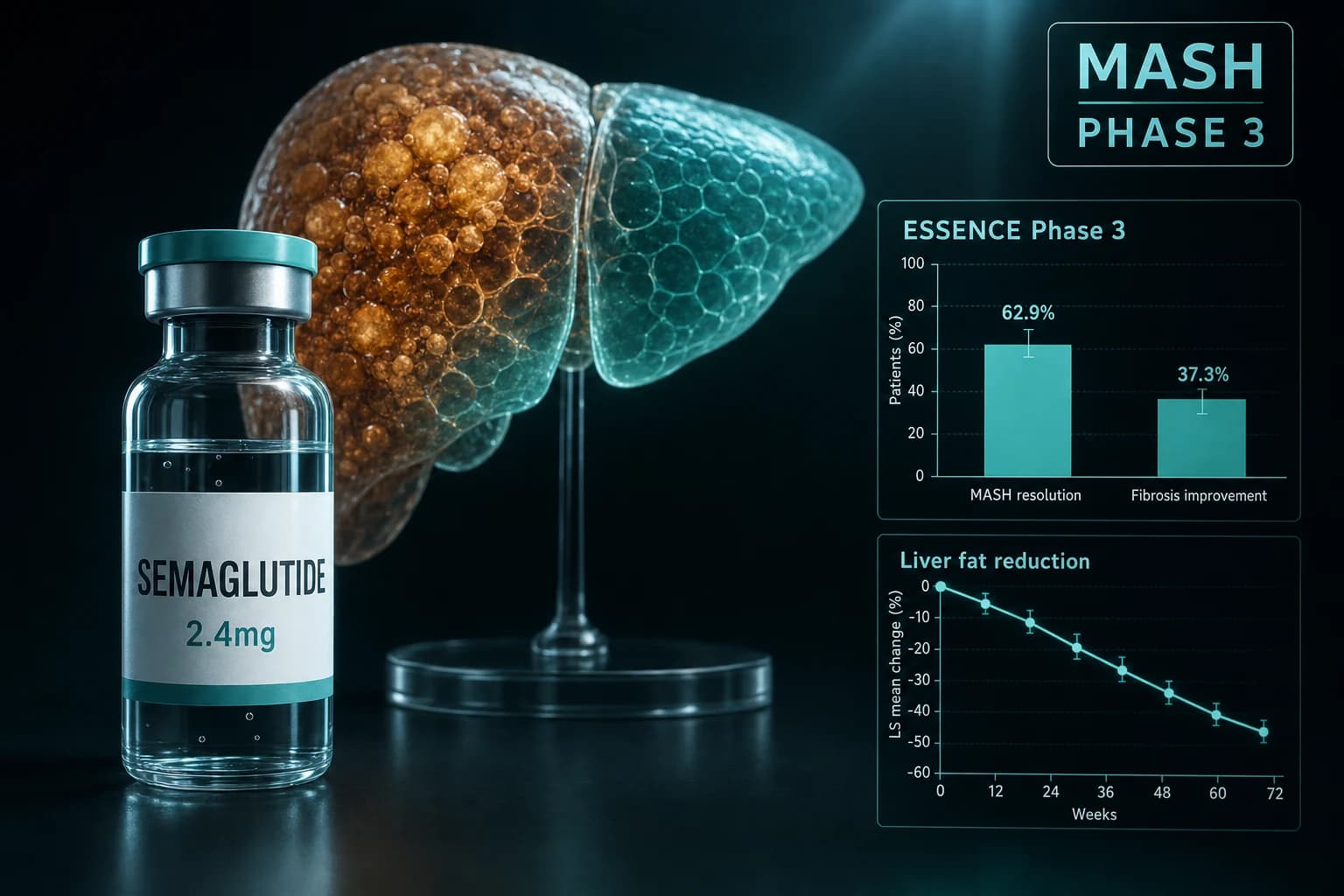
- ESSENCE Phase 3 (Sanyal et al. NEJM 2025, PMID 40305708) hit 62.9% steatohepatitis resolution at week 72 versus 34.3% on placebo
- Fibrosis improvement without worsening steatohepatitis: 36.8% on semaglutide 2.4 mg weekly versus 22.4% on placebo
- FDA approved semaglutide for moderate-to-advanced MASH on August 15, 2025
- Tirzepatide 15 mg weekly (SYNERGY-NASH Phase 2) produced 62% MASH resolution and 51% fibrosis improvement at 52 weeks
- Resmetirom 100 mg/day (MAESTRO-NASH Phase 3) reached 29.9% resolution and 25.9% fibrosis improvement, with no weight effect
- Earlier semaglutide Phase 2 in MASH cirrhosis (Loomba et al. 2023) showed no significant histological improvement at 48 weeks
The FDA approved semaglutide for moderate-to-advanced MASH on August 15, 2025. The Phase 3 ESSENCE trial got it there, and the headline numbers reset what physicians can offer patients with biopsy-confirmed steatohepatitis: 62.9% achieved resolution without worsening fibrosis at week 72, versus 34.3% on placebo (Sanyal et al. NEJM 2025, PMID 40305708).
Until that approval, resmetirom (Rezdiffra) was the only FDA-approved MASH drug, after MAESTRO-NASH cleared review in March 2024. Two approved options now exist, with a deeper bench of GLP-1 family agents (tirzepatide, survodutide, cagrilintide) sitting in late-stage trials. This article walks through what the published evidence actually shows, where the numbers diverge, and what each readout means for someone tracking the field.
What MASH is, briefly
MASH stands for metabolic dysfunction-associated steatohepatitis. The field renamed NASH in 2023 to reflect the metabolic drivers (visceral adiposity, insulin resistance, dyslipidemia) rather than defining the disease by what was absent. Around 30% of adults globally have MASLD, the broader fatty-liver umbrella, and a smaller subset has the inflammatory MASH subtype that drives fibrosis, cirrhosis, and liver-related death.
The trials reviewed here enrolled patients with biopsy-confirmed MASH and stage F2 or F3 fibrosis: the population at highest near-term risk and the group regulators care about most.
ESSENCE Phase 3: the headline data
ESSENCE was a 2:1 randomized, double-blind, placebo-controlled Phase 3 trial of semaglutide 2.4 mg weekly versus placebo in 1,197 patients with biopsy-confirmed MASH and F2 or F3 fibrosis (Sanyal et al. NEJM 2025, PMID 40305708). The protocol runs 240 weeks. The planned interim analysis at week 72 used the first 800 randomized patients and supplied the FDA submission package.
Two prespecified primary endpoints:
- Resolution of steatohepatitis without worsening of fibrosis: 62.9% on semaglutide vs 34.3% on placebo (estimated difference 28.7 percentage points; 95% CI 21.1 to 36.2)
- Reduction in liver fibrosis without worsening of steatohepatitis: 36.8% on semaglutide vs 22.4% on placebo (estimated difference 14.4 percentage points; 95% CI 7.5 to 21.3; P < 0.001)
The combined endpoint (both resolution and fibrosis improvement) hit 32.7% on semaglutide vs 16.1% on placebo. Mean body weight change was -10.5% versus -2.0% (estimated difference -8.5 percentage points; 95% CI -9.6 to -7.4).
GI adverse events were higher with semaglutide, as the rest of the GLP-1 class would predict. No new safety signal emerged that would change how clinicians use the drug in obesity or diabetes.
Bottom line: ESSENCE established that a once-weekly injection of an already-approved drug can resolve steatohepatitis in roughly two-thirds of treated patients at 72 weeks, with measurable fibrosis improvement in roughly one-third. The trial continues to week 240 for hard liver-outcome data.
Trial-by-trial comparison
This is a tricky comparison: trial designs are not identical, populations differ, and no head-to-head trial has been run. With those caveats, here is what the published data show.
| Trial | Drug & dose | Phase | Duration | Population | MASH resolution (vs placebo) | Fibrosis improvement (vs placebo) | Weight change |
|---|---|---|---|---|---|---|---|
| ESSENCE | Semaglutide 2.4 mg/wk | 3 (interim) | 72 wk | 800 (F2 or F3) | 62.9% vs 34.3% | 36.8% vs 22.4% | -10.5% vs -2.0% |
| SYNERGY-NASH | Tirzepatide 15 mg/wk | 2 | 52 wk | ~190 (F2 or F3) | 62% vs 10% | 51% vs 30% | -15.6% vs -0.8% |
| Survodutide MASH | Survodutide 4.8 mg/wk | 2 | 48 wk | 293 (F1 to F3) | 62% vs 14% | 36% vs 22% | reported as fat reduction only |
| MAESTRO-NASH | Resmetirom 100 mg/d | 3 | 52 wk | 966 (F1B to F3) | 29.9% vs 9.7% | 25.9% vs 14.2% | minimal |
SYNERGY-NASH: tirzepatide
SYNERGY-NASH was a Phase 2b trial of tirzepatide 5, 10, or 15 mg weekly versus placebo for 52 weeks in roughly 190 patients with biopsy-confirmed MASH and F2 or F3 fibrosis (Loomba et al. NEJM 2024, PMID 38856224).
MASH resolution without worsening fibrosis at week 52:
- Placebo: 10%
- Tirzepatide 5 mg: 44%
- Tirzepatide 10 mg: 56%
- Tirzepatide 15 mg: 62%
Fibrosis improvement by at least one stage without worsening MASH:
- Placebo: 30%
- Tirzepatide 5 mg: 55%
- Tirzepatide 10 mg: 51%
- Tirzepatide 15 mg: 51%
Mean weight change: -10.7% (5 mg), -13.3% (10 mg), -15.6% (15 mg), versus -0.8% on placebo.
Tirzepatide's 15 mg arm sits in the same MASH-resolution range as semaglutide 2.4 mg in ESSENCE, with a stronger weight effect. Phase 3 SYNERGY-NASH is enrolling, so a direct cross-comparison with ESSENCE has to wait for the larger readout. For the rest of tirzepatide's clinical program, see the SUMMIT trial coverage on HFpEF and SURMOUNT-OSA on sleep apnea.
Survodutide: GCG/GLP-1 dual agonist
Survodutide is Boehringer Ingelheim's GCG/GLP-1 dual agonist. The Phase 2 MASH trial enrolled 293 patients with F1 to F3 fibrosis, randomizing them to placebo or one of three doses (2.4, 4.8, or 6.0 mg weekly) for 48 weeks (Sanyal et al. NEJM 2024, PMID 38847460).
Improvement in MASH without worsening fibrosis:
- Placebo: 14%
- Survodutide 2.4 mg: 47%
- Survodutide 4.8 mg: 62%
- Survodutide 6.0 mg: 43%
Fibrosis improvement by at least one stage hit 34%, 36%, and 34% across the three doses, versus 22% on placebo. Liver fat reduction of at least 30% reached 63%, 67%, and 57%, versus 14% on placebo.
The dose-response was not strictly linear; the 4.8 mg arm produced the strongest result on the primary endpoint. Phase 3 SYNCHRONIZE-NASH is now running. For survodutide's broader mechanism and obesity context, see the survodutide GCG/GLP-1 dual agonist trial guide.
Resmetirom: the small-molecule comparator
Resmetirom is a thyroid hormone receptor beta agonist, not a peptide. It still belongs in this comparison because it set the FDA-approved baseline that every GLP-1 readout gets measured against. MAESTRO-NASH was the Phase 3 trial that delivered approval (Harrison et al. NEJM 2024, PMID 38324483).
In the 966-patient analysis population:
- NASH resolution without worsening fibrosis: 25.9% (80 mg), 29.9% (100 mg), 9.7% (placebo)
- Fibrosis improvement by at least one stage: 24.2% (80 mg), 25.9% (100 mg), 14.2% (placebo)
- LDL cholesterol change at week 24: -13.6% (80 mg), -16.3% (100 mg), 0.1% (placebo)
The numbers are real, but they sit clearly below what the GLP-1 and incretin agents produced on the same biopsy endpoints. Resmetirom does not drive weight loss, which simplifies the profile for patients who are already lean or who want to avoid GI side effects, but means the metabolic upstream of MASH (visceral adiposity, insulin resistance) is left untouched.
Why GLP-1 family drugs work for MASH
The mechanism story is still being filled in. Liver tissue does not express significant GLP-1 receptors, so the effect on hepatocytes is largely indirect. Four candidate pathways stand out:
- Weight loss reducing hepatic steatosis. Substantial weight loss alone improves MASH histology in lifestyle and bariatric studies.
- Improved insulin sensitivity reducing de novo lipogenesis.
- Lower postprandial glucose excursions and reduced hepatic substrate flux.
- Possible anti-inflammatory effects mediated through reduced ectopic fat and lower cytokine load.
Dual and triple agonists (tirzepatide, retatrutide, survodutide) layer additional pathways: GIP agonism for adipose handling, glucagon agonism for direct hepatic lipid mobilization. That likely explains why survodutide hit such strong fibrosis numbers at a moderate dose, despite a smaller weight effect than tirzepatide.
Note: Earlier-stage liver disease responds better than cirrhotic liver. A Phase 2 trial of semaglutide 2.4 mg weekly in compensated MASH cirrhosis (Loomba et al. Lancet GH 2023, PMID 36934740) found no significant histological improvement at 48 weeks. Treating before fibrosis becomes cirrhosis appears to matter.
How earlier evidence sets the context
GLP-1 effects on NASH histology were first signaled by liraglutide (1.8 mg daily) in the LEAN trial (Armstrong et al. Lancet 2016, PMID 26608256). LEAN was small (52 patients) but established histological NASH resolution as a plausible GLP-1 endpoint.
The earlier semaglutide Phase 2 trial in NASH (Newsome et al. NEJM 2021, PMID 33185364) tested daily semaglutide and showed strong NASH resolution (59% at 0.4 mg daily) but did not meaningfully improve fibrosis. ESSENCE's 36.8% fibrosis-improvement rate on weekly 2.4 mg is the first signal that the class can move both endpoints with sufficient duration and dose.
Limitations to keep in mind
- All four trials enrolled biopsy-confirmed F2 or F3 patients (with survodutide also including F1). The data do not generalize to the full MASLD population, which includes simple steatosis without significant inflammation or fibrosis.
- ESSENCE reported a planned interim at week 72. Hard liver-outcome endpoints (decompensation, transplant, death) read out at week 240.
- Across all GLP-1 arms, GI adverse events are common at therapeutic doses. They are dose-related and usually attenuate over time.
- Phase 2 readouts (SYNERGY-NASH, survodutide MASH) need confirmation in Phase 3 before being treated as established.
- Tirzepatide and survodutide do not have FDA approval for MASH yet.
- Steatohepatitis frequently rebounds when GLP-1 therapy stops, in parallel with weight regain. The dynamics here look similar to obesity. See GLP-1 maintenance and weight-regain research for the broader cessation picture.
Warning: MASH diagnosis requires liver biopsy and management in coordination with a hepatologist. Self-medicating fatty liver with research peptides is not a substitute for clinical workup, fibrosis staging (FibroScan or biopsy), and metabolic optimization.
What it changes in 2026
Going into 2026, the practical options for biopsy-confirmed MASH with significant fibrosis look like this:
- Resmetirom 100 mg daily is FDA-approved, oral, and weight-neutral. Best fit when weight loss is not desired or when GI tolerance to GLP-1 therapy is poor.
- Semaglutide 2.4 mg weekly is FDA-approved as of August 2025 for moderate-to-advanced MASH. Best fit when the patient also has obesity, type 2 diabetes, or established cardiovascular disease (semaglutide carries indications across all three).
- Tirzepatide and survodutide remain investigational for MASH. Strong Phase 2 data; Phase 3 readouts are pending.
- Cagrilintide and retatrutide have not reported MASH histology data publicly yet, though both are in active development. For background, see the cagrilintide/cagrisema REDEFINE Phase 3 guide.
For practical reconstitution math behind weekly injectable peptides, see the tirzepatide reconstitution chart and the semaglutide 5mg reconstitution guide.
Availability
Semaglutide is FDA-approved for MASH (under the Wegovy 2.4 mg weekly label) following the August 2025 update. For research-use semaglutide and tirzepatide, Ascension Peptides carries verified compounds with 50% off using code ENHANCED. Survodutide and retatrutide remain investigational; no approved product exists outside trial sites.
Disclaimer
This article summarizes published research for educational purposes only. It is not medical advice. MASH diagnosis requires liver biopsy and clinical management by a hepatologist. Drug approvals, labels, and the underlying clinical evidence change. Verify current FDA status, prescribing information, and contraindications before any clinical decision.