At a glance
- Four-week steps: 2 mg, 4 mg, 8 mg, then 12 mg weekly maintenance
- ~50% of total weight loss occurs in the first 20 weeks
- Many researchers plateau at 8 mg (~20% loss) to avoid 12 mg nausea
- 10 mg vial + 2 mL BAC water = 5 mg/mL; all doses are round syringe numbers
- If GI symptoms are severe, hold at the previous dose for 2-4 extra weeks
The titration principle
Every GLP-1 class compound shares the same dose-response gotcha: GI side effects are dose-dependent and strongly concentrated in the first 2-4 weeks after a dose increase. Skip the titration and you get nausea severe enough to end the protocol. Follow the titration and the same nausea is usually mild, transient, and gone by the time you reach the next dose tier.
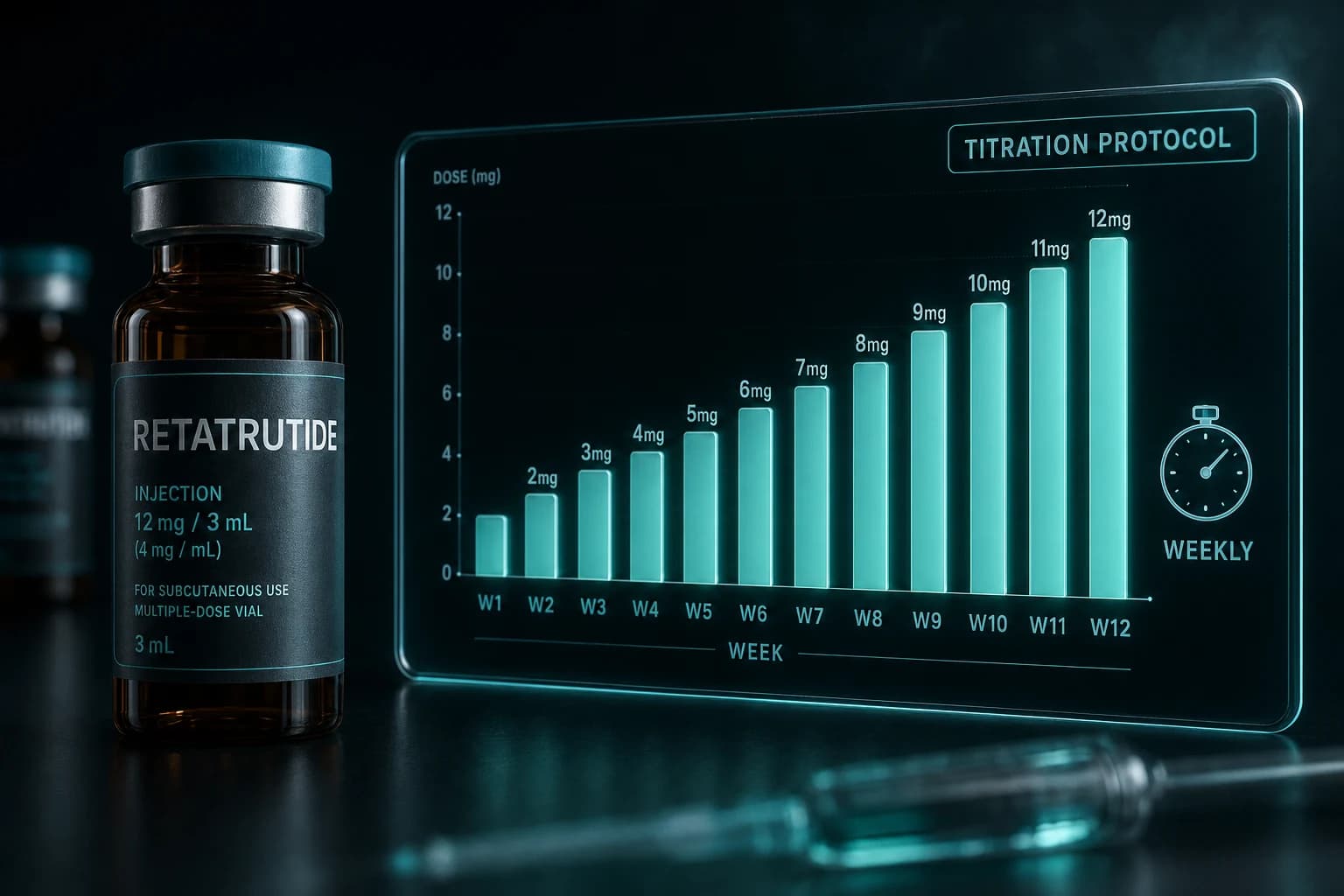
Retatrutide is no exception, and because it hits three receptors instead of one or two, the GI adjustment at maximum dose is a bit stronger than Tirzepatide or Semaglutide. That's why the Phase 2 trial (Jastreboff et al., NEJM 2023) used a strict 4-week-per-step ladder from 2mg up to 12mg. This protocol mirrors it exactly.
If you're new to the compound, start here. If you've run a shorter titration in the past and felt rough for it, here's why the longer ladder is worth the patience.
The 12-week schedule
The Phase 2 trial escalated in 4-week blocks:
| Week | Weekly dose | Purpose |
|---|---|---|
| 1-4 | 2 mg | Initiation: receptor adaptation, mild nausea expected |
| 5-8 | 4 mg | First efficacy tier: measurable weight loss begins |
| 9-12 | 8 mg | Primary efficacy tier: most researchers plateau here |
| 13+ | 12 mg | Maximum dose: highest efficacy, highest GI burden |
Note that 13+ isn't a "week 13 only" step. It's the maintenance plateau. Many research protocols hold at 8 mg rather than escalating to 12 mg because the additional ~4 percentage points of weight reduction at 12 mg come with the highest nausea rate in the class.
Alternatives
If 12 weeks feels too aggressive, Phase 2 also studied 8-week-per-step and 2-week-per-step variants. The 2-week variant produced more GI events. The 8-week variant showed no tolerability advantage over 4 weeks. Four weeks per step is the goldilocks zone: fast enough to see efficacy, slow enough to maintain adherence.
Reconstitution math for each step
The cleanest reconstitution setup for Retatrutide is a 10mg vial with 2mL bacteriostatic water, giving a 5 mg/mL concentration. From that one setup, every dose in the titration is a round insulin-syringe number.
| Week | Dose | Volume (mL) | U-100 units |
|---|---|---|---|
| 1-4 | 2 mg | 0.40 | 40 |
| 5-8 | 4 mg | 0.80 | 80 |
| 9-12 | 8 mg | 1.60 | 160 (2 × 80) |
| 13+ | 12 mg | 2.40 | 240 (3 × 80) |
Note that an insulin syringe holds 100 units max, so once you reach the 8mg and 12mg steps you'll split the dose across multiple draws or use a 1mL tuberculin syringe. Many researchers switch to a 5 mg vial + 1mL water setup (also 5 mg/mL) at the 8mg tier so the injection volume stays manageable.
Verify any vial/water combination with the reconstitution calculator.
Alternative concentration
If you prefer slightly smaller injection volumes, a 10mg vial with 1mL BAC water yields 10 mg/mL:
- 2 mg = 0.20 mL = 20 units
- 4 mg = 0.40 mL = 40 units
- 8 mg = 0.80 mL = 80 units
- 12 mg = 1.20 mL = 120 units (two draws)
Higher concentrations sting slightly more on injection but reduce volume by half. Either setup is valid; choose based on your comfort.
What trial data shows at each step
The Phase 2 trial published weight loss numbers at each dose tier. This gives a realistic expectation curve:
- Week 8 (2 mg step complete): ~5% weight loss
- Week 16 (4 mg step complete): ~12% weight loss
- Week 36 (8 mg maintained): ~20% weight loss
- Week 48 (12 mg maintained): ~24.2% weight loss
Two things worth noting. First, the curve is still trending down at week 48; the trial ended before the true plateau. Longer-duration data is expected from the Phase 3 TRIUMPH program. Second, roughly half of the total weight loss happens in the first 20 weeks. This front-loading is characteristic of the entire GLP-1 class and matches the pattern seen with Tirzepatide and Semaglutide.
If you want to compare the trajectory against other compounds, see Retatrutide vs Tirzepatide vs Semaglutide.
Managing side effects
The Phase 2 trial reported the following AE rates at maximum dose:
- Nausea: ~35%
- Vomiting: ~12%
- Diarrhea: ~12%
- Constipation: ~11%
The practical playbook for keeping these manageable:
Nausea
- Eat smaller meals. Gastric emptying is slowed dramatically, so the 3-meal day stops working. Switch to 5-6 small meals.
- Slow your eating pace. Put the fork down between bites. This is the single highest-ROI behavioral change.
- Avoid high-fat meals in the first 48 hours post-injection. Fat delays gastric emptying further and stacks with the drug effect.
- Hydration. Dehydration amplifies nausea perception. Target 3L/day during titration weeks.
- Anti-nausea adjuncts. Ginger, B6, or in persistent cases ondansetron. Consult a healthcare professional first.
Reflux
Slower gastric emptying also means more reflux potential. Don't lie down within 2 hours of meals during titration weeks. Elevate the head of the bed if nighttime reflux appears.
Constipation
Slowed GI motility affects the lower tract too. Magnesium citrate (200-400 mg/day) and fiber supplementation handle most cases. Hydration matters here even more than for nausea.
When to hold
If GI symptoms are severe at a new dose tier, hold at the previous tier for another 2-4 weeks before retrying the escalation. Adherence beats aggression. Retatrutide's efficacy at 4 mg is already ~12%, so you're not "failing" the protocol by staying there longer.
Storage and handling
- Lyophilized vial: -20°C long-term, 2-8°C short-term (weeks).
- Reconstituted vial: 2-8°C, use within 14-30 days. Do not freeze reconstituted solution.
- Protect from light: store in the original carton or a dark container.
- Do not shake: always swirl gently. Retatrutide is a fatty-acid-acylated peptide, and aggressive agitation damages the structure and promotes aggregation.
See peptide reconstitution: the complete guide for the full procedure.
Common protocol questions
Can I skip the 2mg step if I've done Tirzepatide before? No. Cross-class tolerability doesn't transfer cleanly. Start at 2mg regardless of GLP-1 history. The glucagon receptor component is new territory even for experienced researchers.
What if I'm still losing weight at 8mg? Do I need to escalate to 12mg? No. Efficacy at 8mg reaches ~20% in trial data. Many researchers plateau at 8mg indefinitely because the marginal 4-point gain at 12mg comes with the highest nausea rate in the class. Escalate only if 8mg weight loss has clearly plateaued for 6+ weeks.
How long can the maintenance phase run? Phase 2 data runs to 48 weeks. Phase 3 TRIUMPH trials extend to 72 weeks. Beyond that, long-term safety data is still accumulating. Typical research cycles run 24-48 weeks before a planned break.
Can I combine with Cagrilintide? Cagrilintide is an amylin agonist studied in combination with Semaglutide (CagriSema). There is no published data on Retatrutide + Cagrilintide stacking, and both compounds slow gastric emptying, so combining them would stack the GI burden significantly. Not recommended for typical protocols.
What about exercise during titration? Light to moderate exercise is fine and probably beneficial. Avoid high-intensity sessions in the 48 hours after a dose increase. You'll feel worse than the training is worth. Resume normal programming once the next tier feels stable.
Research access
Retatrutide 10mg and 5mg vials are available from Ascension Peptides with 50% off using code ENHANCED. Lot-level HPLC lives in the lab-tests library.
- Retatrutide research guide →
- Compare to Tirzepatide and Semaglutide →
- Reconstitution calculator →
- Half-life visualizer →
- Microdose scheduler →
Disclaimer
This article describes dose schedules used in published clinical research and is provided for research and educational purposes only. Retatrutide is not approved for general human use. Nothing here is medical advice, and any decision to self-administer should involve a qualified healthcare professional.