At a glance
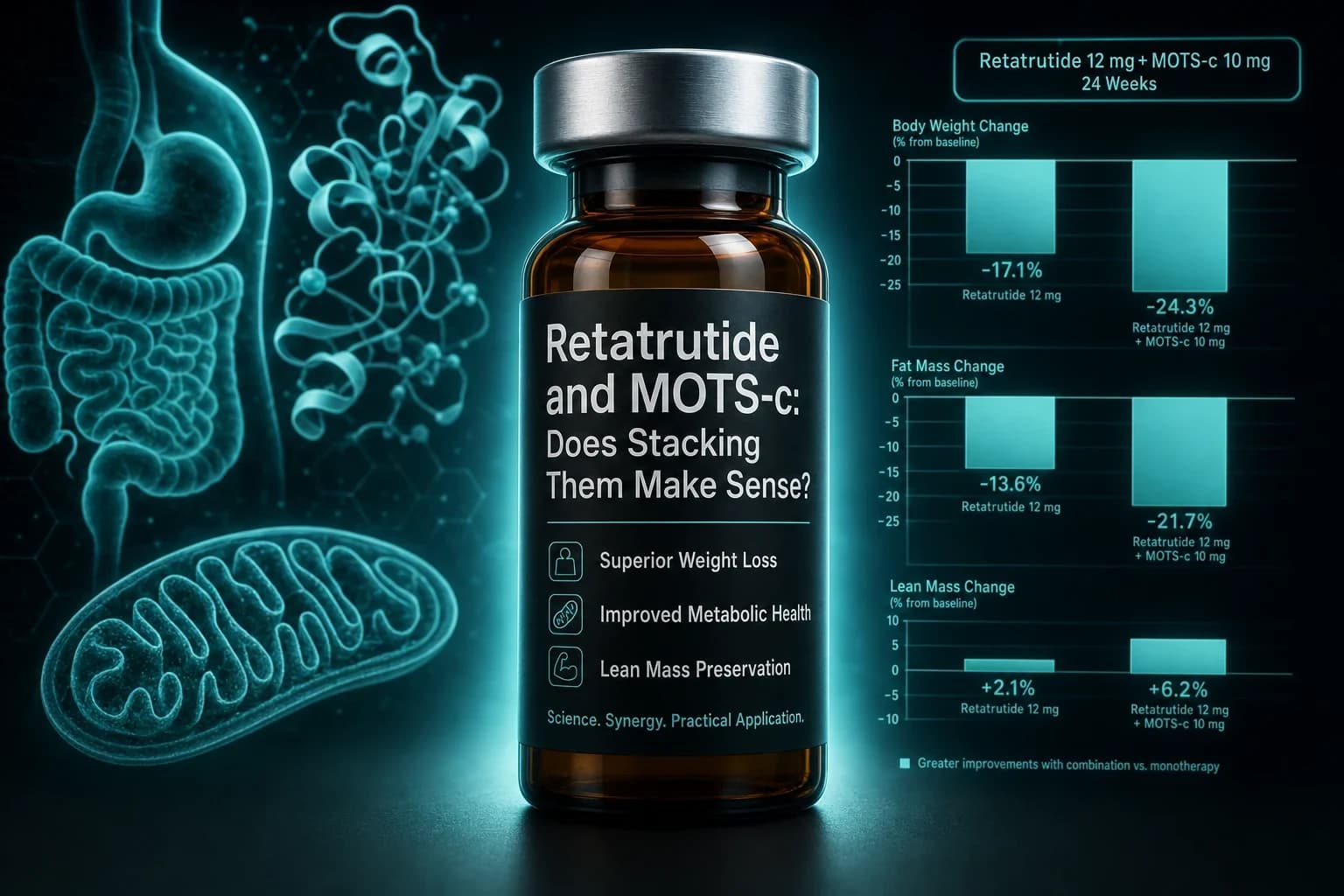
- No clinical trial has ever tested retatrutide and MOTS-c together.
- Retatrutide cut body weight 24.2% at 48 weeks (Jastreboff 2023).
- MOTS-c efficacy data is preclinical; human evidence is observational only.
- The stacking rationale is mechanistic metabolic support, not a proven outcome.
- Retatrutide is investigational; no legal prescription or telehealth path exists.
Retatrutide stripped 24.2% of body weight off trial participants in 48 weeks. MOTS-c is a peptide your own mitochondria make. On paper, pairing the most powerful fat-loss molecule in development with a peptide that props up metabolic machinery sounds like a smart hedge. There is one problem worth saying out loud before you buy anything: nobody has ever tested the two together in a single study.
This is an honest breakdown of what each compound does, why people pitch the combination, and where the reasoning runs out of evidence.
What retatrutide actually does
Retatrutide is a single molecule that hits three receptors at once: GLP-1, GIP, and glucagon. The GLP-1 and GIP arms suppress appetite and improve the insulin response. The glucagon arm is the twist, because glucagon activation raises energy expenditure, which is why retatrutide's weight-loss numbers outrun the dual agonists.
In the Phase 2 trial, participants on the 12 mg dose lost a least-squares mean of 24.2% of body weight at 48 weeks, versus 2.1% on placebo (Jastreboff et al. 2023). The Phase 3 TRIUMPH program is still running, and the compound is not FDA approved for anything. For the mechanism in depth, see our retatrutide triple agonist explainer and the retatrutide compound guide.
What MOTS-c actually does
MOTS-c is a mitochondrial-derived peptide: a 16-amino-acid chain encoded inside mitochondrial DNA rather than the cell nucleus. It behaves like a metabolic signal. When it was first characterized, MOTS-c was shown to activate AMPK, promote metabolic homeostasis, and reduce diet-induced obesity and insulin resistance in mice (Lee et al. 2015).
The exercise angle is where it gets interesting. MOTS-c rises with physical activity, and when given to mice it improved physical performance in young, middle-aged, and old animals (Reynolds et al. 2021). Human data is thinner and mostly observational: circulating MOTS-c tracks with insulin regulation in people, including studies in PCOS and healthy controls (Ramanjaneya et al. 2019). Note the gap. The interventional efficacy data lives in rodents; the human data describes correlations, not outcomes from injecting it. The full picture is in our MOTS-c compound guide.
Retatrutide vs MOTS-c side by side
| Attribute | Retatrutide | MOTS-c |
|---|---|---|
| Class | Triple agonist (GLP-1 / GIP / glucagon) | Mitochondrial-derived peptide (16 amino acids) |
| Primary mechanism | Appetite suppression plus raised energy expenditure | AMPK activation, intracellular energy sensing |
| Route | Subcutaneous, once weekly | Subcutaneous, several times weekly (research) |
| Half-life | Multi-day (supports weekly dosing) | Short circulating half-life |
| Human evidence | Phase 2 complete (-24.2% at 48 wk); Phase 3 TRIUMPH ongoing | Observational human data; efficacy data in mice |
| FDA status | Investigational, not approved | Not approved, research compound |
| Studied for | Obesity, type 2 diabetes, MASH | Insulin sensitivity, metabolic regulation, exercise capacity |
Why people pitch stacking them
The rationale is straightforward and, honestly, not stupid. Aggressive GLP-1-class weight loss comes with a cost people do not always plan for: you lose lean mass alongside fat, and rapid caloric restriction stresses metabolic machinery. The pitch for adding MOTS-c is metabolic and mitochondrial support during that aggressive loss phase. Activate AMPK, hold insulin sensitivity steady, prop up exercise capacity while you are eating far less.
On mechanism alone, the two do not obviously collide. Retatrutide works at cell-surface incretin and glucagon receptors to cut appetite and raise expenditure. MOTS-c works downstream on intracellular energy sensing. Different targets, complementary on paper.
Note: "Complementary on paper" is doing a lot of work in that sentence. A clean mechanistic story is a hypothesis, not a result. Plenty of combinations that made sense on a whiteboard did nothing (or worse) in a trial.
The honest problem: zero trials of this combination
Here is the part most stack guides skip. There is no clinical trial of retatrutide plus MOTS-c. None. Not Phase 2, not Phase 1, not a case series. Every claim you will read about the pairing is extrapolated from what each compound does alone, in separate studies, often in different species.
That matters for three reasons. First, retatrutide itself is investigational; its own long-term profile is still being characterized in TRIUMPH. Second, MOTS-c's strongest efficacy evidence is preclinical, so you are stacking a rodent-validated peptide onto an investigational drug. Third, nobody has looked for interactions, so the safety of the combination is genuinely unknown, not "probably fine."
Bottom line: The retatrutide MOTS-c stack is a mechanistic hypothesis, not an evidence-backed protocol. Treat any confident claim about it as marketing.
If you are researching the combination anyway
Dosing specifics belong on the chart pages, not buried in prose, so we keep the protocols there and updated. For research-dose ranges, titration schedules, and reconstitution math, use the retatrutide dosage chart and the MOTS-c dosage chart. If you have never mixed a lyophilized vial, read the reconstitution guide first, because getting the concentration wrong is the single most common dosing error.
A few practical pointers that do not require a trial to state. Retatrutide is dosed once weekly on account of its multi-day half-life, and it is always titrated up slowly to manage nausea. MOTS-c has a short circulating half-life, which is why research protocols dose it several times per week rather than weekly. Introduce one compound at a time, never both at once, so any reaction has a single obvious cause. MOTS-c is available from Ascension Peptides with 50% off using code ENHANCED.
Safety and monitoring
Both compounds are research chemicals in this context, not prescribed therapies, and neither is FDA approved. Retatrutide's known effects skew gastrointestinal (nausea, vomiting, diarrhea) and it can raise heart rate; the TRIUMPH program is still cataloging the rest. MOTS-c's human safety data is limited to whatever the circulating-level studies happen to report, which is not a safety database.
Because glucose regulation is where both compounds act, the combination's most plausible interaction is on blood sugar. Anyone studying this pairing should watch glucose closely rather than assume the two simply add up cleanly.
Warning: Retatrutide is investigational and not approved for human use. It has no legal prescription or telehealth pathway. If your actual goal is supervised weight loss you can start now, retatrutide is not the tool. Prescribed compounded semaglutide and tirzepatide are, and we rank them by real monthly cost on the cheapest GLP-1 guide.
The verdict
If you want the strongest possible fat-loss mechanism and you are running a legitimate research protocol, retatrutide is the headline and MOTS-c is a mechanistically reasonable add-on for metabolic support. Just be clear-eyed that "reasonable" means "untested." No study has ever measured whether MOTS-c improves any retatrutide outcome, protects lean mass, or does nothing at all. You would be running the experiment, not repeating one.
Choose the stack only if you accept that framing. If you want proven weight loss instead of a hypothesis, the prescribed GLP-1 route wins on evidence every time.
This article is for research and educational purposes only. Retatrutide is an investigational compound that is not approved by the FDA for any use, and MOTS-c is a research chemical, not an approved therapy. Nothing here is medical advice, a prescription, or a recommendation for human use. Consult a licensed clinician before making any health decision.