At a glance
- One formula runs everything: concentration = peptide mg divided by mL of water added.
- Dose volume in mL = your dose divided by concentration; syringe units = mL times 100.
- Example: a 10mg vial plus 2mL water is 5mg/mL, so a 5mg dose draws to 100 IU.
- Use bacteriostatic water (0.9% benzyl alcohol) for multi-dose vials, not plain sterile water.
- Reconstituted peptides stay stable refrigerated; heat drives degradation (PMID 40490042).
You drew 10 units and injected. But did you actually get 250 mcg? That depends on three numbers, and most people only track one of them.
Reconstitution looks intimidating because it wears the costume of chemistry. It is arithmetic. Learn one formula and you can dose any vial of any size without guessing.
The only formula you need
Everything comes from a single relationship:
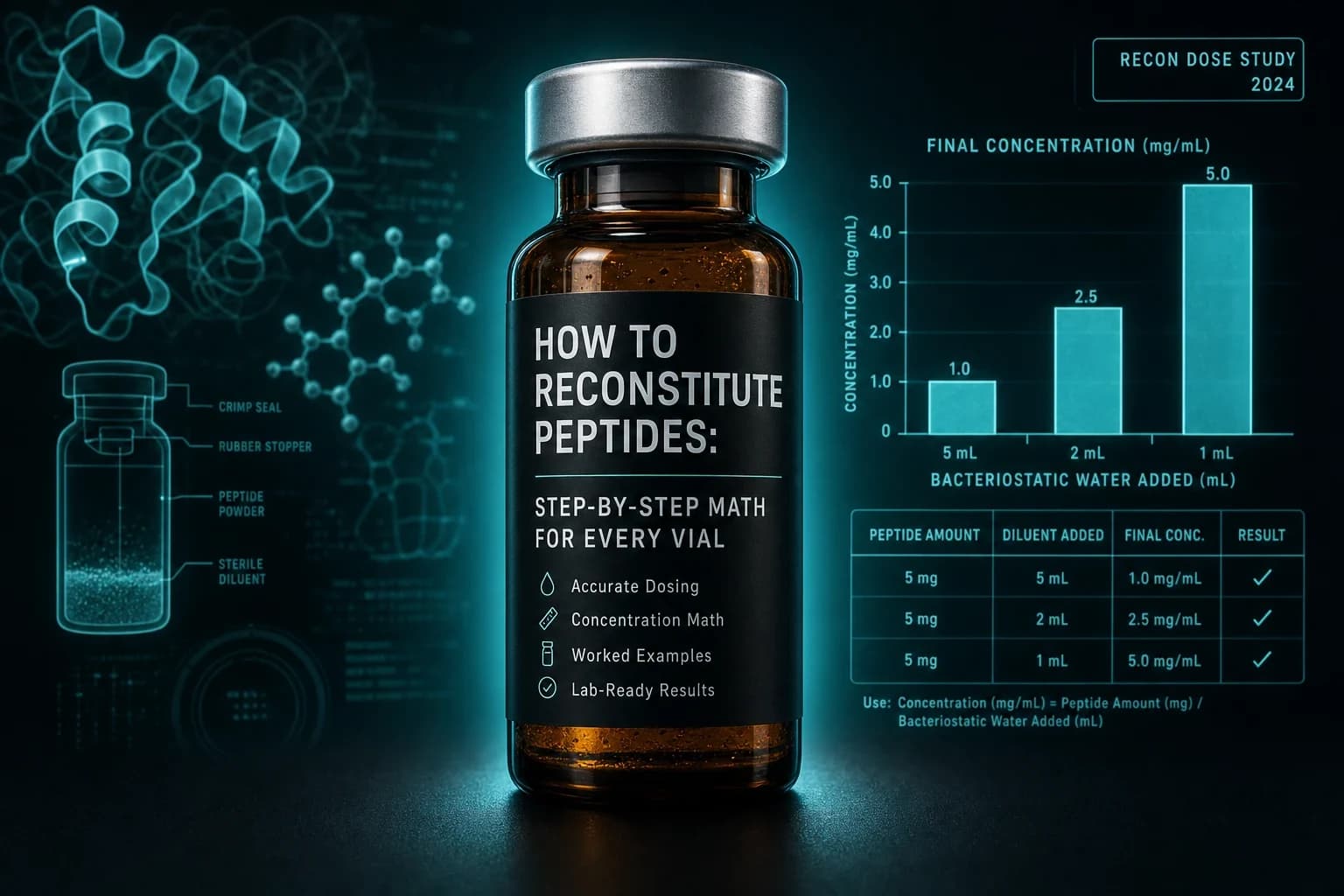
Concentration = peptide mass (mg) divided by water added (mL).
Add 2 mL of water to a 10 mg vial and you have 5 mg/mL. That is it. From concentration, two more steps get you to the syringe:
Dose volume (mL) = your dose divided by concentration.
Syringe units (on a U-100 insulin syringe) = dose volume in mL times 100.
So on that 5 mg/mL vial, a 5 mg dose is 5 divided by 5, which is 1 mL, which is 100 IU. A 2.5 mg dose is 0.5 mL, or 50 IU. The reconstitution calculator does this for you, but the math is worth understanding once so the calculator's output makes sense.
Why bacteriostatic water, not the sterile kind
Bacteriostatic water is sterile water with 0.9% benzyl alcohol added. The benzyl alcohol inhibits bacterial growth, which is what lets you draw from the same vial across multiple days. Plain sterile water has no preservative, so it is a single-use proposition.
There is a stability nuance worth knowing. Benzyl alcohol can increase protein aggregation at the moment of reconstitution in some lyophilized formulations, though in one study it did not accelerate aggregation during subsequent room-temperature storage (Fransson et al. 2004). For the multi-dose research vials most compounds ship in, bacteriostatic water is the standard choice.
Tip: Add water slowly down the inside wall of the vial. Do not blast it directly onto the peptide powder, and never shake. Swirl gently and let it dissolve.
Step by step, once
- Let both vials reach room temperature.
- Wipe both stoppers with alcohol.
- Draw your chosen water volume into the syringe.
- Inject it slowly down the vial wall, not onto the powder.
- Swirl gently until clear. Do not shake.
- Refrigerate the reconstituted vial.
The water volume you choose sets your concentration, which sets how many units any dose becomes. More water means a more dilute solution and larger, easier-to-measure unit counts. That matters most for microgram-dosed compounds.
Per-compound reconstitution table
These use common vial sizes. Adjust water volume to taste; the formula holds regardless.
| Compound | Vial | Water | Concentration | Example dose | Syringe units |
|---|---|---|---|---|---|
| MOTS-C | 10 mg | 2 mL | 5 mg/mL | 5 mg | 100 IU |
| BPC-157 | 10 mg | 2 mL | 5 mg/mL | 250 mcg | 5 IU |
| TB-500 | 10 mg | 2 mL | 5 mg/mL | 2.5 mg | 50 IU |
| Ipamorelin | 5 mg | 2 mL | 2.5 mg/mL | 300 mcg | 12 IU |
For the GLP-1 compounds, dosing is in smaller increments and the dedicated charts show the full unit ladder: see the semaglutide dosage chart and the tirzepatide dosage chart.
Converting any dose to syringe units
The trap with microgram compounds is unit precision. On a 5 mg/mL vial, a 250 mcg dose of BPC-157 is only 5 IU, which sits at the very bottom of the syringe and is hard to measure accurately. Reconstitute that same vial with more water, say a lower concentration, and the same dose spreads across more units, which improves accuracy. This is the entire reason people reconstitute the same peptide differently.
Note: There is no single "correct" water volume. There is only the concentration that makes your target dose land on a readable part of the syringe.
Storage: what actually degrades your peptide
Reconstituted peptides are stable in the fridge and unhappy in the heat. Semaglutide stability studies using HPLC show that temperature and pH are the primary drivers of solution-state degradation (Nayak et al. 2025), and thermal stress measurably reduces intact peptide content (Malgave et al. 2025). The practical translation: keep lyophilized powder cold, refrigerate after reconstitution at 2 to 8 degrees C, protect from light, and do not freeze the reconstituted solution.
Common mistakes
- Shaking the vial instead of swirling, which can shear fragile peptides.
- Blasting water directly onto the powder.
- Reconstituting a microgram-dosed peptide so concentrated that the dose is 2 to 3 units.
- Leaving the reconstituted vial at room temperature for days.
- Using plain sterile water for a vial you plan to draw from all week.
Bottom line: Concentration equals mg over mL, dose volume equals dose over concentration, units equal mL times 100. Master those three and every vial is trivial. Run your exact numbers in the reconstitution calculator. COA-verified compounds are available from Ascension Peptides with 50% off using code ENHANCED.
This article is for research and educational purposes only. It is not medical advice. Research compounds are not approved for human consumption. Always verify primary sources and applicable regulations before purchase.