At a glance
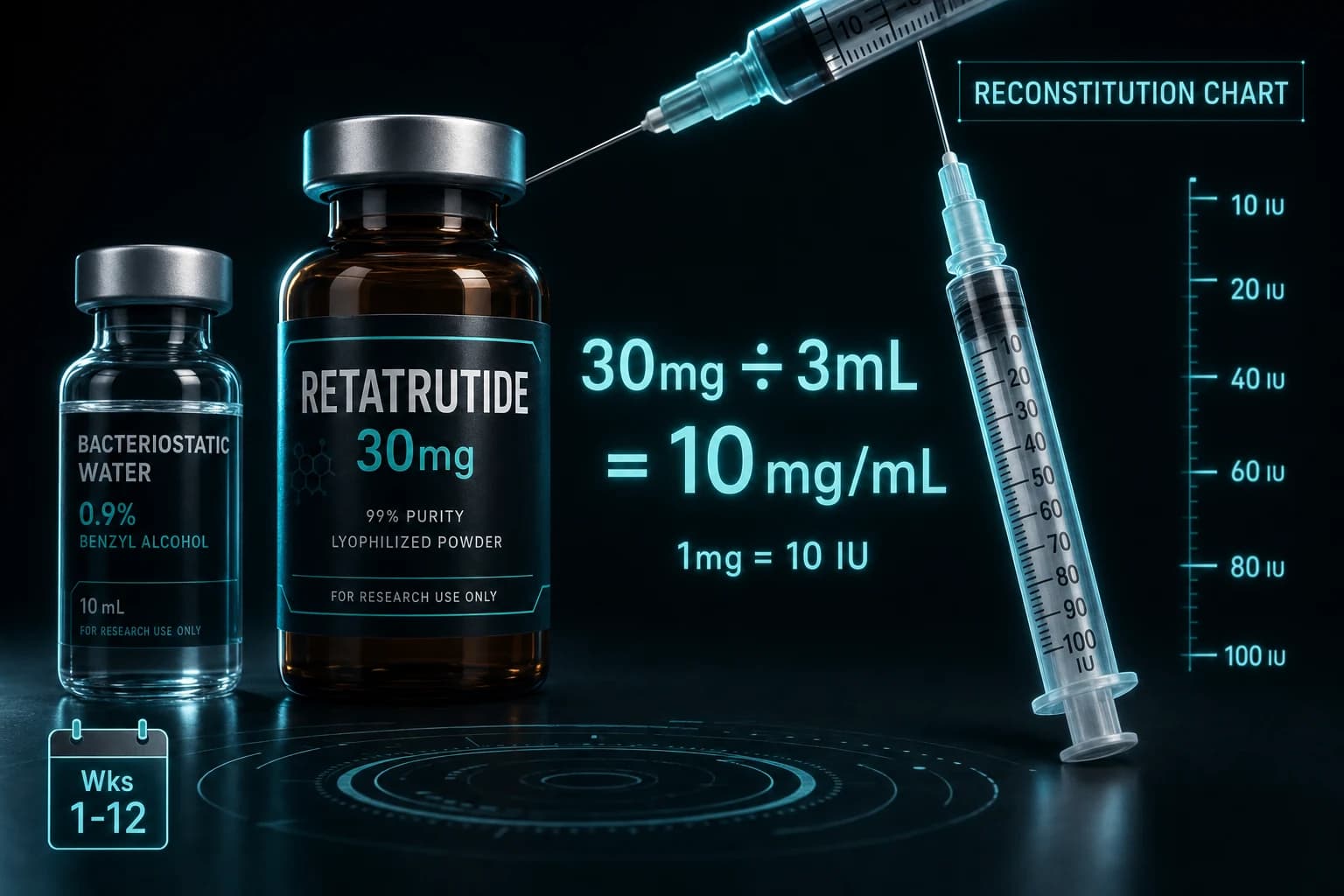
- 30mg in 3mL BAC water = 10 mg/mL concentration. Each U-100 insulin unit (0.01 mL) delivers 100 mcg
- TRIUMPH titration ramps from 2 mg/week to 12 mg/week. A 30mg vial covers 2.5 to 15 weeks at 2-12 mg/week
- BAC water (0.9% benzyl alcohol) is the standard reconstitution solvent; sterile water without preservative shortens shelf life
- Reconstituted retatrutide stays viable 2-8°C for ~28 days. Avoid freeze-thaw cycles
- Use a U-100 insulin syringe with 0.5 IU graduations or finer for accurate dosing at 2-3 mg weekly
Retatrutide ships as a lyophilized white powder in glass vials labeled R-10 or R-30 (10mg or 30mg of peptide per vial). The R-30 vial is the larger format, typically purchased for the higher end of the TRIUMPH ramp (8-12 mg weekly) where one R-30 covers 2.5 to 6 weeks of dosing depending on the protocol week. This guide walks through the reconstitution math for the 30mg vial specifically: BAC water volumes, the resulting concentration, syringe units per dose, and the practical handling steps that keep the reconstituted solution viable.
For the broader reconstitution mechanics that apply to any peptide, the peptide reconstitution complete guide covers the underlying math. For dose selection, the retatrutide 12-week titration protocol covers the week-by-week schedule. For sourcing the 30mg vial itself, the retatrutide where-to-buy guide and the retatrutide lab-tests page cover vendor selection.
The reconstitution math, simplified
Reconstituting a peptide vial means dissolving the lyophilized powder into a known volume of bacteriostatic water (BAC water) so each subsequent withdrawal delivers a precise dose. The math has three inputs and one output:
- Vial mass (mg of peptide): 30 mg for an R-30
- BAC water volume (mL): your choice between 1, 2, 3, or 5 mL
- Target dose (mg per injection): from your titration schedule
Concentration = vial mass / BAC water volume. Volume per dose = target dose / concentration. Insulin syringe units per dose = volume per dose × 100 (since a U-100 syringe reads 100 units per mL).
The same calculator with the same inputs runs at /calculators/reconstitution; the table below covers the four most common BAC water volumes for an R-30 vial.
BAC water volume choice for a 30mg vial
| BAC water | Concentration | mL per 1 mg | IU (U-100) per 1 mg | Best for |
|---|---|---|---|---|
| 1 mL | 30 mg/mL | 0.033 mL | 3.3 IU | Compact storage, very small dose volumes; harder to dose precisely below 0.5 mg |
| 2 mL | 15 mg/mL | 0.067 mL | 6.7 IU | Mid-range; reasonable precision across the full TRIUMPH ramp |
| 3 mL | 10 mg/mL | 0.10 mL | 10 IU | Cleanest math; 1 mg = 10 IU exactly. Recommended default for R-30 |
| 5 mL | 6 mg/mL | 0.167 mL | 16.7 IU | Larger injection volumes; better precision at low doses (2-4 mg) |
The 3 mL choice is the cleanest because it produces a 10 mg/mL concentration where 1 mg of peptide equals exactly 10 insulin units. This makes the chart memorable and minimizes withdrawal errors.
IU per dose chart (R-30 vial)
The TRIUMPH program titrated weekly doses of 2, 4, 6, 8, 10, and 12 mg. The table below shows how many U-100 insulin units each of those doses corresponds to at the four common reconstitution volumes.
| Weekly dose | 1 mL recon | 2 mL recon | 3 mL recon | 5 mL recon |
|---|---|---|---|---|
| 2 mg | 6.7 IU | 13.3 IU | 20 IU | 33.3 IU |
| 4 mg | 13.3 IU | 26.7 IU | 40 IU | 66.7 IU |
| 6 mg | 20 IU | 40 IU | 60 IU | 100 IU |
| 8 mg | 26.7 IU | 53.3 IU | 80 IU | 133.3 IU |
| 10 mg | 33.3 IU | 66.7 IU | 100 IU | 166.7 IU |
| 12 mg | 40 IU | 80 IU | 120 IU | 200 IU |
Notice that 10 mg in 3 mL fills exactly one full 100-IU U-100 syringe. 12 mg in 3 mL requires drawing a partial second syringe or upgrading to a 1 mL (100-IU) syringe at lower fill. For doses above 100 IU per injection, splitting into two injection sites is also a valid option.
Step-by-step reconstitution
- Gather the materials. R-30 vial, BAC water (0.9% benzyl alcohol in sterile water), one U-100 insulin syringe for the BAC water, alcohol prep pads, sharps container.
- Sanitize both vial tops. Wipe the rubber stopper of the BAC water vial and the R-30 vial with an alcohol pad. Let air-dry briefly.
- Withdraw the BAC water. Draw the chosen volume (1, 2, 3, or 5 mL) from the BAC water vial into the syringe. Let any large air bubbles rise and tap them out.
- Inject slowly into the R-30 vial. Tilt the R-30 vial. Insert the needle through the stopper at an angle and let the BAC water run down the inside wall of the vial slowly. Direct streams onto the lyophilized cake can fragment the peptide unevenly.
- Do not shake. Roll or swirl the vial gently between your palms until the powder dissolves. Most retatrutide lots dissolve within 30-60 seconds. Persistent cloudy or floating particles indicate either incomplete dissolution (let it sit a few more minutes) or a quality problem with the vial (which warrants checking the COA).
- Confirm clear solution. Reconstituted retatrutide should be clear and colorless. Yellow tint or visible particulates after 5 minutes of standing is a quality flag.
- Refrigerate immediately. 2-8°C. The reconstituted solution stays viable for approximately 28 days at refrigeration. Avoid freezing; freeze-thaw cycles degrade the peptide.
Stability and storage
Lyophilized retatrutide (the unreconstituted vial) is stable at -20°C for years per the manufacturer specifications mirrored across vendor disclosures. Once reconstituted with BAC water, the practical shelf life is:
- 2-8°C (refrigerator): ~28 days. The benzyl alcohol in BAC water is the bacteriostatic agent that prevents microbial growth at fridge temperature.
- Room temperature: do not use. Room-temperature storage shortens shelf life dramatically and is not standard practice.
- Frozen reconstituted: not recommended. The freeze-thaw cycle stresses the peptide structure and can cause aggregation.
For an R-30 vial reconstituted in 3 mL BAC water at 2 mg/week, you'll use the full vial in 15 weeks. At 4-6 mg/week, you'll use it in 5-7 weeks. Both fit comfortably inside the 28-day window only if dosing is at the higher end. At 2 mg/week, the vial volume outpaces the shelf life; consider an R-10 vial during the early titration weeks instead. The retatrutide where-to-buy guide covers when to stock R-10 versus R-30.
Choosing the right syringe
The dosing accuracy you can achieve depends on the syringe gradation. For research-grade dose precision:
- U-100 insulin syringe with 1-IU graduations (the most common): adequate for doses corresponding to 5+ IU. Smaller doses round up or down by 0.05 mL.
- U-100 insulin syringe with 0.5-IU graduations: better for the 2-3 mg weekly band on a 3 mL recon (where 2 mg = 20 IU and rounding to 1 IU is fine, but a 0.2 mg adjustment requires 0.5 IU graduations).
- Sub-100 syringes (50-IU or 30-IU U-100): finer markings on a smaller barrel; useful when most doses sit below 30 IU.
For the syringe selection logic in detail, the reconstitution calculator auto-suggests a syringe size given your inputs. The full reconstitution mechanics live in the peptide reconstitution complete guide.
Common errors and how to spot them
- Dosing 10× the target. The classic mistake: confusing mL with IU. 0.1 mL is 10 IU, not 1 IU. If you draw "1 mL" expecting 1 mg at 1 mg/mL concentration, you've drawn 10× the volume. Always double-check that the syringe markings match the IU you intended.
- Cloudy solution after reconstitution. If the vial does not clear within 5-10 minutes of gentle swirling, the lyophilized cake may be partly degraded or the BAC water may have been forced too aggressively. Set the vial aside and reach out to the vendor with the lot number for guidance.
- Withdrawing past the 28-day mark. Beyond 28 days at refrigeration, peptide degradation accelerates. Either use a smaller vial format or reconstitute less than the full volume at a time.
- Splitting a 30mg vial across two BAC water bottles. Don't. Reconstitute the full vial at once and store it. Adding BAC water in stages introduces concentration ambiguity.
Sourcing the 30mg vial
The retatrutide where-to-buy guide covers the full vendor comparison. The short version: Ascension Peptides is the only vendor in our public COA database that publishes a per-batch certificate of analysis on every R-30 lot. Recent verified HPLC purity is 99.86-99.88% on the most recent R-30 batches. Code ENHANCED takes 50% off at checkout. How we grade that library, including the lots that miss, is in the Ascension Peptides review.
FAQ
How much BAC water do I add to a 30mg retatrutide vial?
3 mL is the cleanest default because it produces a 10 mg/mL concentration where 1 mg of peptide equals exactly 10 insulin units (IU on a U-100 syringe). 1 mL, 2 mL, and 5 mL are also valid choices with different precision tradeoffs (see the table above for IU per mg at each volume).
What syringe size do I use for retatrutide?
A U-100 insulin syringe is standard. For doses below 30 IU per injection, a 30-IU or 50-IU barrel gives finer markings. For doses above 60 IU, a 100-IU barrel is necessary. The reconstitution calculator recommends a specific syringe based on your inputs.
How long does reconstituted retatrutide last?
Approximately 28 days at 2-8°C (refrigeration). The benzyl alcohol in BAC water is the bacteriostatic preservative that defines this window. Sterile water without preservative shortens the window to 24 hours. Avoid freezing reconstituted solution.
Does it matter if the lyophilized cake is intact when I open the vial?
Slight cake breakage during shipping is normal and does not affect the peptide. What matters is full dissolution into a clear, colorless solution after BAC water addition. A solution that stays cloudy after 10 minutes of gentle swirling is a quality flag worth raising with the vendor.
Can I reconstitute with regular sterile water instead of BAC water?
You can, but the shelf life drops to roughly 24 hours because there is no preservative. For a 30mg vial dosed at 2-12 mg/week, this is impractical; the vial would need to be reconstituted weekly in tiny batches. BAC water is the standard for any reconstitution that needs to last more than a day.
What if my dose comes out to a non-integer number of insulin units?
Round to the nearest 0.5 IU at most. A 0.2 mg dose adjustment is below the noise floor of most insulin syringes. For doses where precision matters (2-4 mg early in the TRIUMPH ramp), the 5 mL recon volume gives more IU-per-mg headroom and easier rounding.
Should I use a 30mg vial or a 10mg vial for early titration?
R-10 (10mg) is better for the first 4-6 weeks of the TRIUMPH ramp (2-4 mg weekly) because the vial gets used up before the 28-day reconstitution window expires. R-30 is the right format from week 5-6 onward when weekly doses hit 6-12 mg. The retatrutide 12-week titration protocol covers the week-by-week math.
Continue researching
The retatrutide research guide covers the underlying mechanism, half-life, and pharmacokinetics. The 12-week titration protocol is the schedule the TRIUMPH program actually used. For broader reconstitution mechanics across any peptide vial size, the peptide reconstitution complete guide covers the underlying math, and the reconstitution calculator is the live tool. To verify the specific R-30 lot you're about to buy, the retatrutide lab-tests page shows every COA on file.
This article is for educational and research purposes only. Retatrutide is not FDA-approved and is not for human consumption. Reconstitution math and storage guidance reflect standard research-peptide practice; they are not protocols for human use. Always work in a sterile environment, document lot numbers, and follow institutional procedures for handling and disposal. Consult a qualified clinician for individual medical questions.