At a glance
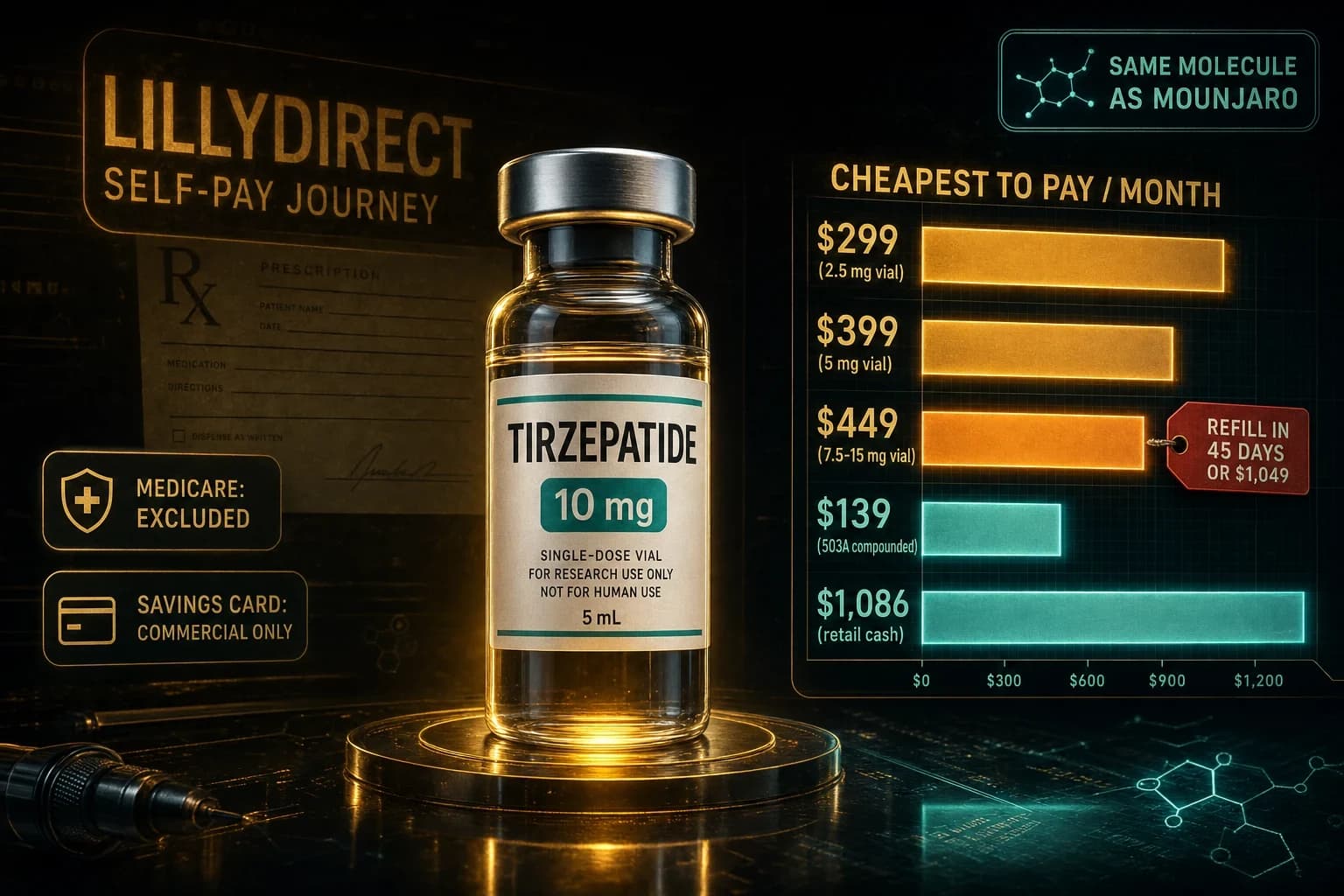
- Cheapest legal Zepbound self-pay in 2026: LillyDirect vials at $299 (2.5 mg) and $399 (5 mg).
- Higher doses ($449 flat, 7.5 to 15 mg) only hold that price with a refill inside 45 days.
- Mounjaro is the same molecule (tirzepatide). Retail runs ~$1,069/mo and GoodRx barely dents it.
- 503A patient-specific compounded tirzepatide is still legal in 2026 and telehealth prices start near $139/mo.
- SURMOUNT-5 (Aronne 2025, PMID 40353578): tirzepatide beat semaglutide 20.2% vs 13.7% at 72 weeks.
The cheapest legal way to get Zepbound without insurance in 2026 is a LillyDirect single-dose vial at $299 (2.5 mg) or $399 (5 mg). That is the floor. Everything else, including the higher doses, sits above it, and most of the "cheap" paths people find on Reddit either cost more than they look on the surface or stop being cheap the moment you miss a refill window.
This guide prices every real option end to end: manufacturer self-pay, the Zepbound Savings Card, retail pharmacy with GoodRx, patient-assistance, and 503A patient-specific compounded tirzepatide through licensed telehealth. It treats Mounjaro as the same drug (it is: tirzepatide, same molecule), because paying diabetes-brand prices for an obesity dose is one of the most common ways people overspend.
The one thing to understand first
Zepbound and Mounjaro are both tirzepatide, a dual GIP and GLP-1 receptor agonist made by Eli Lilly. Same molecule, same doses, different label. Zepbound is FDA-approved for chronic weight management and obstructive sleep apnea in adults with obesity. Mounjaro is FDA-approved for type 2 diabetes. The molecule that shows up in the vial is identical.
That matters for cost because Lilly gates the cheap self-pay path (LillyDirect vials at $299 to $449) to the Zepbound label, not to Mounjaro. Patients who need tirzepatide for weight loss and try to run it through their diabetes card, or through Mounjaro coupons, generally pay full retail. The SURMOUNT-5 trial (Aronne et al. 2025, PMID 40353578) is why demand is stacked on the tirzepatide side: at 72 weeks tirzepatide produced 20.2% mean weight reduction versus 13.7% for semaglutide, the first head-to-head randomized trial of the two drugs in obesity.
Bottom line: If your prescription is for weight loss, ask the prescriber to write Zepbound, not Mounjaro. The molecule is the same and the self-pay ladder is dramatically cheaper on the Zepbound side.
The 2026 price ladder, real numbers
Here is what the paths actually cost in mid-2026, ranked from cheapest to most expensive per month. The prices below are cash-pay unless noted, and the "gotchas" column is the part most cost calculators skip.
| Path | 2.5 mg | 5 mg | 7.5 to 15 mg | The catch |
|---|---|---|---|---|
| LillyDirect Self-Pay vial | $299 | $399 | $449 flat | Vials only, cash-pay only, 45-day refill window on the 7.5+ tier |
| Zepbound Savings Card (commercial insurance, covered) | $25 | $25 | $25 | Requires commercial coverage that already covers Zepbound |
| Zepbound Savings Card (commercial insurance, not covered) | up to $650 off | up to $650 off | up to $650 off | Caps at $1,300/yr; only if you have commercial insurance |
| 503A compounded tirzepatide via telehealth | $139 to $279 (varies by program) | $139 to $279 | $139 to $279 | Patient-specific Rx from a US-licensed prescriber; not FDA-approved |
| Retail cash (Zepbound or Mounjaro) | ~$1,086 | ~$1,086 | ~$1,086 to $1,270 | List price at CVS/Walgreens/etc. |
| GoodRx on Mounjaro | ~$1,060 to $1,090 | ~$1,060 to $1,090 | ~$1,060 to $1,090 | Rarely more than a $30 to $50 discount |
Read that top row twice. The Self-Pay Journey Program is the cheapest brand path by a wide margin, and it is only available on LillyDirect's single-dose vials, not on the KwikPen and not through a retail pharmacy. It is straight cash, so it does not touch your deductible, your HSA, or your insurance formulary at all.
Path 1: LillyDirect Self-Pay vials
This is the answer for most people who do not have covered Zepbound on their insurance. LillyDirect prices the single-dose vials at $299/month for 2.5 mg, $399/month for 5 mg, and $449/month for a flat rate across 7.5 mg, 10 mg, 12.5 mg, and 15 mg. Shipping and dispensing come from a partnered pharmacy; you draw and inject from a vial with a syringe rather than clicking a pen.
Two rules break the price if you ignore them:
- The 45-day refill rule. The $449 flat rate on higher doses only holds if you refill within 45 days of the previous fill. Miss it and the price ratchets up to Lilly's standard self-pay: $599 for 7.5 mg, $699 for 10 mg, $849 for 12.5 mg, and $1,049 for 15 mg. That is not a small delta. A one-month gap on 15 mg costs $600 in real money.
- Cash-pay only. Vials on LillyDirect cannot be run through insurance, cannot be paid with the Zepbound Savings Card, and cannot be reimbursed by GoodRx. HSA/FSA usually works, but check with your plan first.
Practical hygiene: set a phone reminder for day 40 of your last fill. Prescribers can also send the refill request early if you are traveling, since the 45 days runs from dispense, not from consumption.
Warning: If you are titrating up, plan the dose change so it lands on a refill. Jumping from 5 mg ($399) to 7.5 mg out of cycle can accidentally reset your 45-day clock at the higher-tier standard price rather than the $449 promotional price.
Path 2: The Zepbound Savings Card, decoded
Lilly runs two different card programs under the same "Zepbound Savings Card" name. Most confusion at the pharmacy counter is about which one you qualify for.
- Covered by commercial insurance. If your commercial plan covers Zepbound with prior authorization, the card can drop your out-of-pocket to as low as $25 per 1-month or 3-month supply, subject to plan design.
- Commercial insurance but Zepbound is not covered. The card discounts you up to $650 per fill, capped at roughly $1,300 per year. That is the option most self-pay searchers actually see, and it is worse than a LillyDirect vial on 2.5 mg or 5 mg, and only marginally cheaper on the 7.5+ tier.
The card is not available if you use Medicare Part D, Medicaid, TRICARE, or any other federal or state healthcare program. Federal statute excludes weight-loss drugs from Medicare Part D coverage entirely, with the narrow exception of the OSA indication approved in December 2024. If you are on Medicare, LillyDirect vials or 503A compounded tirzepatide are your two realistic paths.
Path 3: 503A compounded tirzepatide (still legal in 2026)
The FDA resolved the tirzepatide shortage in December 2024, which ended the enforcement discretion 503A pharmacies had been operating under. 503A patient-specific compounding, however, is still legal in 2026 if the compound uses a permitted bulk substance, the prescription is patient-specific from a US-licensed prescriber in the patient's state, the pharmacy holds appropriate licensure, and the compound is not essentially a copy of a commercial product without a documented clinical difference (like a dose or format not available commercially).
On April 30, 2026, the FDA proposed permanently removing semaglutide, tirzepatide, and liraglutide from the 503B outsourcing facilities bulks list, which would kill industrial-scale compounding but would leave the 503A patient-specific path intact. The public comment period closed July 30, 2026, with a final rule expected to follow. Our compounded tirzepatide legal status guide tracks the rulemaking in more detail.
Pricing through telehealth partners in mid-2026:
| Telehealth path | Starting price | What you actually get |
|---|---|---|
| Bodybuilding Health+ | from $139/mo (12-month plan) | Compounded semaglutide from US-licensed clinicians; tirzepatide via program |
| Gala Health | from $149/mo (microdose, 12-month) | Compounded tirzepatide microdose; full-dose on a separate tier |
| Yucca Health | from $206/mo (6-month plan) | Semaglutide+ with clinical support |
| TelosRx | from $49/mo (microdosed tirzepatide) | Compounded tirzepatide including microdose and needle-free options |
Two things a careful buyer verifies before writing that first check. First, the pharmacy is a US 503A pharmacy with valid state licensure and the prescription is patient-specific to you. Anything shipping from outside the US or dispensing generic vials without a prescriber is not 503A. Second, the compound is either a permitted strength or genuinely different from the commercial product (for example a microdose that is not commercially available). "Essentially a copy" of Zepbound at commercially available doses is a compliance flag that has driven several enforcement letters. Our compounded tirzepatide hub lists the operators we have actually vetted.
Path 4: Retail pharmacy with GoodRx or SingleCare
The list price of Zepbound at retail pharmacies runs about $1,086 per month, and Mounjaro runs about $1,069. Discount cards like GoodRx and SingleCare can trim that a little, but Lilly's pharmacy contracts cap how much third-party cards can discount a patent-protected first-in-class drug. In practice, Mounjaro with GoodRx in mid-2026 lands around $1,060 to $1,090 depending on pharmacy, which is a $5 to $50 improvement over the cash price and no improvement over paying LillyDirect $299 for a 2.5 mg vial.
If your only option is a retail pharmacy fill and you have not yet tried LillyDirect, run LillyDirect first. It is faster than most people expect (48 to 96 hours for the first fill in most zip codes) and you are not leaving money on the table.
Path 5: Patient-assistance and the Lilly Cares free option
The Lilly Cares Foundation Patient Assistance Program can dispense Zepbound at no cost for patients who meet income eligibility, generally around 400% of the federal poverty level, do not have insurance that covers the drug, and are residents/citizens. The application requires prescriber cooperation and household-income documentation. Turnaround is measured in weeks, not days, but for qualifying uninsured patients the effective monthly cost is $0.
This is the correct path if you are between jobs, uninsured, or on a plan that excludes obesity drugs and your income sits in the eligible band. It is not a workaround for high-earning self-pay patients.
What about Mounjaro-specific coupons?
There is not a working Mounjaro savings card for weight-loss use. Lilly's official Mounjaro Savings Card requires a type 2 diabetes diagnosis and commercial insurance, and pharmacy benefit managers routinely reject fills that lack the diabetes claim. If your prescription is for weight loss, Zepbound is the correct label and LillyDirect is the correct entry point, not Mounjaro.
Third-party sites that advertise generic "MJ25" or similar Mounjaro discount codes are usually reselling compounded tirzepatide through offshore or opaque pharmacies. That is a different product than brand Mounjaro and a very different compliance risk profile. Our best-legit-peptide-vendors guide covers what to check before wiring money to anyone selling GLP-1s outside of a licensed 503A path.
Decision matrix: what to do in your situation
| Your situation | Cheapest legitimate path in 2026 |
|---|---|
| Uninsured, income above assistance thresholds | LillyDirect Self-Pay vial (2.5 mg $299, 5 mg $399, 7.5+ $449 with 45-day refills) |
| Uninsured, low income | Apply for Lilly Cares (potentially $0/mo) while running 503A compounded tirzepatide in the interim |
| Commercial insurance, Zepbound covered | Zepbound Savings Card ($25/fill possible) |
| Commercial insurance, Zepbound not covered | LillyDirect vial usually beats the $650-off card on 2.5 mg or 5 mg |
| Medicare Part D | Federal statute excludes weight-loss drugs; LillyDirect or 503A compounded through telehealth |
| Need weekly convenience over lowest price | KwikPen through insurance if covered; otherwise LillyDirect vial and learn the syringe technique |
| Titrating and price-sensitive | Stay on 5 mg ($399) longer than the typical fast-titration protocol suggests, if the response is adequate |
The decision is different if you are on the fence about staying on the drug at all. SURMOUNT-4 (Aronne et al. 2024, PMID 38078870) is worth reading before you commit: in that phase 3 withdrawal trial, participants who stopped tirzepatide regained about 14% of body weight over 52 weeks, while those who continued treatment maintained or extended their loss. Tirzepatide is not a course of treatment with a finish line. Budget as if you will be paying every month for years.
The efficacy footnote (because it changes the math)
Cost comparisons that ignore efficacy pretend that a $50/month cheap option and a $450/month effective option are close. They are not. The trial data on tirzepatide is unusually strong for an obesity drug:
- SURMOUNT-1 (Jastreboff et al. 2022, PMID 35658024): 22.5% mean weight loss at 15 mg over 72 weeks versus 2.4% for placebo, in 2,539 adults with obesity.
- SURMOUNT-2 (Garvey et al. 2023, PMID 37385275): 15.7% at 15 mg in adults with obesity and type 2 diabetes over 72 weeks.
- SURMOUNT-5 (Aronne et al. 2025, PMID 40353578): 20.2% at max tolerated tirzepatide versus 13.7% at max tolerated semaglutide at 72 weeks, first head-to-head.
- SURPASS-2 (Frías et al. 2021, PMID 34170647): all three tirzepatide doses beat semaglutide 1 mg on both HbA1c and weight in type 2 diabetes.
- SUMMIT (Packer et al. 2024, PMID 39555826): in 731 patients with HFpEF and obesity, tirzepatide lowered the composite risk of CV death or worsening heart failure and improved health status.
A cheap compounded product is a real option if the pharmacy is legitimate and the strength is right. A cheap product that is under-dosed, mispotent, or diluted with an unlabeled excipient is a different thing entirely, and it is worth exactly what you paid for it. Titration matters because tirzepatide's half-life is roughly 5 days with a Cmax around 24 to 72 hours post-dose, so a weekly injection reaches steady state after about 4 weeks. If the dose you are getting is not what the label says, you cannot titrate reliably.
The one thing nobody in the comparison articles tells you
Long-term cost is not the price per month. It is price per month multiplied by the number of months you stay on the drug, minus what you save by not paying for the downstream cost of untreated obesity. If you were budgeting $1,086/month at retail and you find LillyDirect at $449 for the same 10 mg dose, you have not saved $637 this month. You have made adherence financially plausible for the next several years, which is what actually decides outcomes.
Two adjacent resources on this site are useful:
- The Zepbound dosage chart walks through titration timing so you do not overspend on doses higher than you need.
- The tirzepatide dosage chart covers dose-response and steady-state, useful if you are self-injecting from vials for the first time.
- Our cheapest GLP-1 options hub is updated as pricing shifts on both brand and 503A paths.
- If you are considering a full switch from Wegovy or compounded semaglutide, the tirzepatide vs semaglutide comparison covers the SURMOUNT-5 data in detail.
- If reconstitution from a vial is new to you, the reconstitution calculator handles the syringe math.
For telehealth compounded tirzepatide specifically, our Bodybuilding Health+ review covers the intake, clinician access, and shipping cadence, and pricing verified from the partner starts around $139/mo on the 12-month plan.
Tip: Once you have picked a path, price your first 3 months, not your first fill. LillyDirect looks great at $299 for a first 2.5 mg fill, but if your prescriber's plan is to titrate you to 10 mg by month 3, your real 90-day cost is closer to $299 + $399 + $449.
FAQ
Is a Zepbound coupon better than LillyDirect? For most self-pay patients without prior authorization, no. The savings card's $650-off tier still leaves you above the LillyDirect vial price on 2.5 mg and 5 mg, and only slightly cheaper on 7.5+ if you avoid the 45-day refill trap.
Can I switch from Mounjaro to Zepbound to get the cheaper price? If your prescription is genuinely for weight management (BMI ≥30, or ≥27 with a weight-related comorbidity), talk to your prescriber about writing Zepbound. The molecule is identical and Zepbound gates the LillyDirect self-pay vial ladder.
Is compounded tirzepatide legal in 2026? 503A patient-specific compounding remains legal when done by a licensed US pharmacy against a valid US prescription. The FDA's April 2026 proposal targets 503B industrial-scale compounding, not 503A. See our compounded tirzepatide 2026 guide.
Will Medicare Part D ever cover Zepbound? Not for weight loss under current federal statute. Coverage for the obstructive sleep apnea indication has been available since late 2024, and the CMS BALANCE Model piloting in mid-2026 may open a $50/month copay path for some Medicare beneficiaries.
Are Zepbound vials less effective than the KwikPen? Same molecule, same dose per injection when drawn correctly. The vial is not FDA-approved for the auto-inject route; the difference is the delivery device, not the drug. The tirzepatide compound page covers pharmacokinetics and receptor pharmacology.
Where this leaves you
If you are uninsured and want brand Zepbound, LillyDirect Self-Pay vials are the answer and everything else is more expensive. If you are on Medicare, on a plan that excludes obesity drugs, or being asked to jump through a prior-authorization circus, licensed 503A compounded tirzepatide through a US telehealth partner starts around $139/mo and cuts your monthly cost by more than half at the price of dispensing outside brand supply.
The paths that read cheap online but are not: Mounjaro cash with GoodRx, third-party "MJ25" style Mounjaro coupon codes, and anything shipping tirzepatide from outside the US without a patient-specific prescription. Skip those.
This article is for research and educational purposes only and is not medical advice. Prescription decisions belong to you and a US-licensed clinician. Cash prices, coupon terms, and 503A rules can change quickly; verify against LillyDirect and your chosen telehealth or pharmacy partner at time of purchase.