At a glance
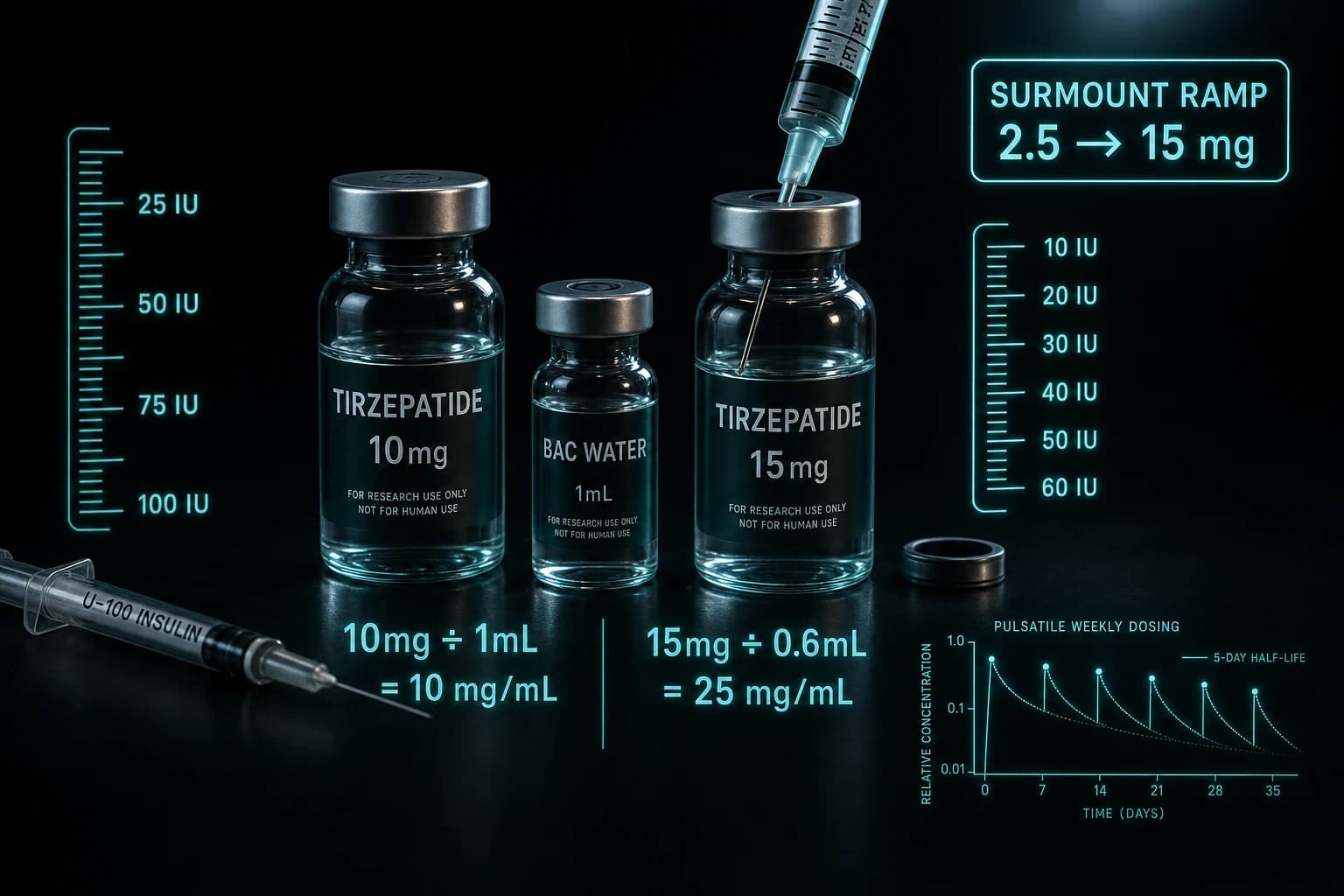
- 1 mL of BAC water in a 10mg tirzepatide vial yields 10 mg/mL. The full SURMOUNT ramp (2.5 to 10 mg) reads 25, 50, 75, 100 IU on a U-100 syringe
- 1.5 mL in a 15mg vial also yields 10 mg/mL. 12.5 mg = 125 IU and 15 mg = 150 IU require a split injection or a 1 mL barrel; 0.6 mL recon (25 mg/mL) keeps the full ramp under 100 IU
- Tirzepatide half-life is approximately 5 days with 80% subcutaneous bioavailability (Schneck et al. CPT PSP 2024, PMID 38356317)
- SURMOUNT-1 (Jastreboff et al. NEJM 2022, PMID 35658024) titrated 2.5 mg every 4 weeks; mean weight loss reached 22.5% at 15 mg over 72 weeks
- Reconstituted shelf life is approximately 21-28 days at 2-8°C with bacteriostatic water (0.9% benzyl alcohol)
- Standard FDA Mounjaro/Zepbound titration: 2.5 → 5 → 7.5 → 10 → 12.5 → 15 mg, increasing every 4 weeks
Short answer: for a 10mg tirzepatide vial, 1 mL of bacteriostatic water gives the cleanest dosing math (10 mg/mL, where every 10 IU on a U-100 insulin syringe equals exactly 1 mg). For a 15mg vial, 1.5 mL gives the same 10 mg/mL concentration, but the upper SURMOUNT doses (12.5 and 15 mg) exceed one 100-IU syringe and need either a split injection or a tighter 0.6 mL recon at 25 mg/mL.
This guide answers the specific reconstitution question for the two stock tirzepatide vial sizes that ship from research-peptide vendors. For the broader reconstitution mechanics, see the peptide reconstitution complete guide. For the parallel math on the semaglutide 5mg vial and the retatrutide 30mg vial, the prior reconstitution articles cover those compounds. For the SURMOUNT ramp this article references, the source is (Jastreboff et al. NEJM 2022, PMID 35658024).
TL;DR chart
For the standard FDA Mounjaro/Zepbound ramp (2.5 → 5 → 7.5 → 10 → 12.5 → 15 mg, increasing every 4 weeks):
10mg vial:
| BAC water | Concentration | 2.5 mg | 5 mg | 7.5 mg | 10 mg |
|---|---|---|---|---|---|
| 0.5 mL | 20 mg/mL | 12.5 IU | 25 IU | 37.5 IU | 50 IU |
| 1 mL | 10 mg/mL | 25 IU | 50 IU | 75 IU | 100 IU |
| 2 mL | 5 mg/mL | 50 IU | 100 IU | 150 IU (split) | 200 IU (split) |
15mg vial:
| BAC water | Concentration | 2.5 mg | 5 mg | 7.5 mg | 10 mg | 12.5 mg | 15 mg |
|---|---|---|---|---|---|---|---|
| 0.6 mL | 25 mg/mL | 10 IU | 20 IU | 30 IU | 40 IU | 50 IU | 60 IU |
| 1 mL | 15 mg/mL | 17 IU | 33 IU | 50 IU | 67 IU | 83 IU | 100 IU |
| 1.5 mL | 10 mg/mL | 25 IU | 50 IU | 75 IU | 100 IU | 125 IU (split) | 150 IU (split) |
| 3 mL | 5 mg/mL | 50 IU | 100 IU | 150 IU (split) | 200 IU (split) | 250 IU (split) | 300 IU (split) |
The bolded rows are the cleanest defaults. For the 10mg vial, 1 mL keeps every dose under 100 IU and reads as round numbers. For the 15mg vial, 0.6 mL is the only single-syringe option that covers the full 12.5 and 15 mg doses without needing a second injection or a 1 mL syringe barrel.
The math
Reconstitution formula:
- Vial mass = 10 mg or 15 mg (printed on the lyophilized tirzepatide vial)
- BAC water volume = your choice
- Target dose = your protocol target
Concentration = vial mass / BAC water volume. Volume per dose = target dose / concentration. Insulin units (U-100) = volume per dose × 100.
Worked example for a 10mg vial reconstituted with 1 mL and a 5 mg dose:
- Concentration = 10 mg / 1 mL = 10 mg/mL
- Volume per dose = 5 mg / 10 mg/mL = 0.5 mL
- Insulin units = 0.5 mL × 100 = 50 IU
Same calculator with the same inputs runs at /calculators/reconstitution; the live tool handles non-standard doses and odd vial sizes.
Why 10 mg/mL is the default
Researchers who standardize across compounds usually pick a 10 mg/mL working concentration because it makes mental math automatic: every 10 IU on a U-100 insulin syringe equals exactly 1 mg of tirzepatide. The trade-off is that the 12.5 and 15 mg maintenance doses exceed one 100-IU syringe, so high-dose weeks need a tighter recon or a split injection.
Tip: the 0.6 mL reconstitution on a 15mg vial is awkward to draw because the volume is small, but it produces 25 mg/mL and keeps the entire SURMOUNT ramp under 100 IU. A 1 mL or 0.5 mL syringe with finer markings makes the draw easier than a standard 1 mL BAC water draw.
Concentration cheat sheet
For the 10mg vial:
| BAC water added | Concentration | Notes |
|---|---|---|
| 0.5 mL | 20 mg/mL | Most compact. Fine resolution; cleanest at low doses (2.5 mg = 12.5 IU). Small volume to draw |
| 1 mL | 10 mg/mL | Recommended default. 1 mg = 10 IU. Full 2.5-10 mg range fits one syringe |
| 2 mL | 5 mg/mL | Larger injection volumes. 7.5 mg and 10 mg need split injection |
For the 15mg vial:
| BAC water added | Concentration | Notes |
|---|---|---|
| 0.6 mL | 25 mg/mL | Cleanest for 12.5 and 15 mg doses. Full ramp under 100 IU. Small volume to draw |
| 1 mL | 15 mg/mL | Compact, but doses fall on awkward IU readings (5 mg = 33 IU) |
| 1.5 mL | 10 mg/mL | Familiar 10 mg/mL math. 12.5 and 15 mg exceed one 100-IU syringe |
| 3 mL | 5 mg/mL | Large injection volume. Most doses above 5 mg need split |
SURMOUNT-1 dose ramp on the recommended recon
The SURMOUNT-1 trial titrated tirzepatide every 4 weeks across a 20-week ramp before the maintenance phase began (Jastreboff et al. NEJM 2022, PMID 35658024). The schedule, with insulin units on the recommended reconstitution for each vial size:
| Week | Weekly dose | 10mg vial @ 1 mL recon (10 mg/mL) | 15mg vial @ 0.6 mL recon (25 mg/mL) |
|---|---|---|---|
| 1-4 | 2.5 mg | 25 IU | 10 IU |
| 5-8 | 5 mg | 50 IU | 20 IU |
| 9-12 | 7.5 mg | 75 IU | 30 IU |
| 13-16 | 10 mg | 100 IU | 40 IU |
| 17-20 | 12.5 mg | n/a (vial empty after ~4 weeks of 10 mg) | 50 IU |
| 21+ | 15 mg (maintenance) | n/a | 60 IU |
A single 10mg vial covers the first ~12 weeks (4 weeks each at 2.5 and 5 mg, then 4 weeks at 7.5 mg consumes most of the vial) before the protocol moves to 15mg vials for the upper ramp. Researchers running the full ramp typically rotate from 10mg to 15mg vials around week 13.
Note: the FDA Mounjaro and Zepbound prescribing information uses the same titration schedule. Mounjaro is approved for type 2 diabetes; Zepbound for chronic weight management. Both products ship as pre-filled QuickPens at fixed doses (2.5, 5, 7.5, 10, 12.5, 15 mg). Multi-dose vials with bacteriostatic water reconstitution are a research-peptide format, not the FDA-approved presentation.
What the trials actually showed
SURMOUNT-1 randomized 2,539 adults with obesity (BMI ≥ 30, or ≥ 27 with a weight-related complication, no diabetes) to once-weekly tirzepatide 5 mg, 10 mg, 15 mg, or placebo for 72 weeks. Mean weight reductions were 16.0% on 5 mg, 21.4% on 10 mg, and 22.5% on 15 mg, against 2.4% on placebo (Jastreboff et al. NEJM 2022, PMID 35658024). At least 5% body weight reduction was achieved by 89%, 96%, and 96% of recipients across the three doses, against 28% on placebo.
SURMOUNT-2 ran the same compound in adults with obesity plus type 2 diabetes (n = 938, BMI ≥ 27, HbA1c 7-10%). Mean weight reductions were 13.4% on 10 mg and 15.7% on 15 mg over 72 weeks, against 3.3% on placebo (Garvey et al. Lancet 2023, PMID 37385275). Half (49%) of tirzepatide recipients reached an HbA1c below 5.7% with no severe hypoglycemia reported.
SURPASS-2 directly compared tirzepatide to semaglutide in 1,879 adults with type 2 diabetes over 40 weeks. HbA1c reductions were -2.01, -2.24, and -2.30 percentage points on 5, 10, and 15 mg of tirzepatide vs -1.86 on 1 mg semaglutide; tirzepatide was non-inferior at all three doses and superior on weight loss (Frias et al. NEJM 2021, PMID 34170647). For the head-to-head on weight outcomes, see the tirzepatide vs semaglutide comparison.
The molecule itself is a 39-residue peptide engineered from the native GIP sequence with a C20 fatty diacid for albumin binding, designed to activate both the GIP and GLP-1 receptors with biased signaling toward GLP-1 cAMP pathways (Coskun et al. Mol Metab 2018, PMID 30473097). The dual receptor activity is what differentiates tirzepatide from semaglutide (GLP-1 only) and retatrutide (which adds a glucagon receptor agonist arm).
Pharmacokinetics that affect dosing decisions
Population pharmacokinetic analysis across 19 pooled studies reported tirzepatide half-life at approximately 5 days (~120 hours) with 80% absolute bioavailability after subcutaneous injection. Median Tmax sits around 24 hours, with a range of 8 to 72 hours (Schneck et al. CPT PSP 2024, PMID 38356317).
Three practical implications:
- Once-weekly dosing produces stable steady-state levels after 4 weeks of constant dosing. Reaching steady state on a new dose is what the 4-week titration interval is designed to allow.
- Missed doses do not need to be made up if the next scheduled dose is more than 4 days away; the long half-life means a single missed dose minimally changes serum levels.
- Tirzepatide does not require refrigeration of the lyophilized vial during transit because the peptide backbone is stable at room temperature for several days, but reconstituted solution must be refrigerated.
Microdosing math
Some research protocols target sub-2.5 mg doses (e.g. 1 mg or 1.5 mg) for tolerability, dose-finding, or pharmacokinetic studies. The microdose math at common reconstitution volumes:
| Dose | 10mg @ 1 mL recon | 10mg @ 2 mL recon | 15mg @ 1.5 mL recon |
|---|---|---|---|
| 0.5 mg | 5 IU | 10 IU | 5 IU |
| 1 mg | 10 IU | 20 IU | 10 IU |
| 1.5 mg | 15 IU | 30 IU | 15 IU |
| 2 mg | 20 IU | 40 IU | 20 IU |
For sub-1 mg dosing, a 30-IU or 50-IU barrel U-100 syringe gives finer gradation than a 100-IU barrel. Below 0.5 mg, the 2 mL recon (5 mg/mL) gives the cleanest resolution because the IU reading is twice as high per mg.
Step-by-step reconstitution
- Materials. Tirzepatide vial (10mg or 15mg), BAC water (0.9% benzyl alcohol in sterile water), one U-100 insulin syringe to draw the BAC water, alcohol prep pads, sharps container.
- Sanitize stoppers. Wipe both rubber stoppers with an alcohol pad.
- Withdraw BAC water. Draw the chosen volume into the syringe. For a 0.6 mL recon, a 1 mL syringe with 0.01 mL graduations is more precise than a 100-IU insulin syringe. Tap out air bubbles.
- Inject slowly. Tilt the tirzepatide vial. Insert the needle through the stopper at an angle, let the BAC water run down the inside wall to avoid foaming.
- Dissolve gently. Swirl or roll the vial. Most tirzepatide lots dissolve within 30-60 seconds. Do not shake; aggressive agitation can fragment the lipidated peptide.
- Confirm clear solution. Reconstituted tirzepatide should be clear and colorless. Yellow tint, cloudiness, or visible particulates is a quality flag worth photographing and reporting to the vendor.
- Refrigerate. 2-8°C. Do not freeze.
Storage and stability
- Lyophilized vial: stable at -20°C long-term; 2-8°C for shorter periods. Room temperature transit is acceptable; avoid heat above 30°C.
- Reconstituted in BAC water: approximately 21-28 days at 2-8°C. The standard practice is to reconstitute one vial at a time and finish before opening the next.
- Reconstituted in plain sterile water (no preservative): approximately 24 hours; not recommended for multi-dose vials.
- Avoid freeze-thaw cycles on reconstituted solution.
For reference, one full SURMOUNT-1 monthly maintenance cycle (4 weekly injections at 15 mg = 60 mg) requires four 15mg vials, so most active researchers reconstitute one new 15mg vial every 7 days during maintenance dosing. A 10mg vial at the 5 mg dose lasts exactly 2 weeks.
Sourcing the 10mg or 15mg vial
The tirzepatide lab-tests page lists every vendor we track with public certificates of analysis. Ascension Peptides publishes a per-batch COA on every tirzepatide lot; code ENHANCED takes 50% off at checkout. For the broader sourcing rules (HPLC purity floor, COA recency, batch matching), the best peptide vendors 2026 review covers what to look for before buying.
Bottom line: for a 10mg vial, default to 1 mL of BAC water unless you need sub-1 mg microdose precision. For a 15mg vial, 1.5 mL is the most popular choice because it preserves the 10 mg/mL math, but the 0.6 mL option is the only single-syringe answer for 12.5 and 15 mg doses.
FAQ
How much bacteriostatic water do I add to a 10mg tirzepatide vial?
1 mL is the cleanest default because it produces a 10 mg/mL concentration where every 10 IU on a U-100 syringe equals exactly 1 mg. The full 2.5-10 mg SURMOUNT ramp (25, 50, 75, 100 IU) fits one syringe. 0.5 mL gives a more compact 20 mg/mL recon for low-dose precision; 2 mL gives 5 mg/mL for finer microdose resolution.
How much BAC water for a 15mg tirzepatide vial?
1.5 mL gives the same familiar 10 mg/mL math as a 10mg vial at 1 mL, but 12.5 mg = 125 IU and 15 mg = 150 IU exceed a single 100-IU insulin syringe. For the upper SURMOUNT doses on a single syringe, 0.6 mL gives 25 mg/mL where 15 mg = 60 IU.
How many IU is 5 mg of tirzepatide?
Depends on the reconstitution. With a 10mg vial at 1 mL (10 mg/mL), 5 mg = 50 IU. With a 15mg vial at 0.6 mL (25 mg/mL), 5 mg = 20 IU. With a 10mg vial at 0.5 mL (20 mg/mL), 5 mg = 25 IU.
How many IU is 15 mg (the SURMOUNT maintenance dose)?
With a 15mg vial reconstituted at 0.6 mL (25 mg/mL), 15 mg = 60 IU. With 1.5 mL (10 mg/mL), 15 mg = 150 IU and requires either a split injection or a 1 mL barrel syringe. With 1 mL (15 mg/mL), 15 mg = 100 IU exactly.
How long does reconstituted tirzepatide last?
Approximately 21-28 days at 2-8°C with bacteriostatic water (0.9% benzyl alcohol). Sterile water without preservative shortens shelf life to about 24 hours. Avoid freezing reconstituted solution; the lipidated peptide can fragment on freeze-thaw.
Do I need to titrate or can I start at a higher dose?
The SURMOUNT-1 protocol titrated specifically because GI tolerability is dose-dependent and improves with slow ramping (Jastreboff et al. NEJM 2022, PMID 35658024). Starting at 10 or 15 mg without ramping produces nausea, vomiting, and discontinuation rates substantially higher than what the trial reported. The 4-week dose interval also lets each new step reach steady state before the next escalation, which the 5-day half-life requires.
What syringe size do I use for tirzepatide?
A U-100 insulin syringe is standard. For early titration (2.5-5 mg) on a 10mg vial at 1 mL recon, a 30-IU or 50-IU barrel gives finer markings. For maintenance (10-15 mg) on a 15mg vial at 1.5 mL, a 100-IU barrel is necessary, and 12.5/15 mg need a split injection. A 1 mL syringe with 0.01 mL graduations is useful for the 0.6 mL recon math.
Can I use the same vial across multiple weeks?
Yes, that's the standard pattern. At maintenance (15 mg/week), a 15mg vial covers exactly one week; a 10mg vial covers two weeks at 5 mg/week or one week at 10 mg/week. Reconstitute the full vial at once, store at 2-8°C, and use within 28 days.
Does tirzepatide need refrigeration before reconstitution?
The lyophilized vial is stable at room temperature for several days during shipping but should be refrigerated at 2-8°C on arrival for long-term storage. Reconstituted solution must always be refrigerated. For the underlying pharmacokinetics that justify once-weekly dosing on a steady-state basis, see (Schneck et al. CPT PSP 2024, PMID 38356317).
Continue researching
For the full reconstitution mechanics across any peptide vial, the peptide reconstitution complete guide is the reference. For the parallel math on other GLP-1 vials, the semaglutide 5mg reconstitution chart and the retatrutide 30mg reconstitution guide cover those compounds. For the head-to-head efficacy data, the retatrutide vs tirzepatide vs semaglutide 2026 comparison walks through SURMOUNT, SURPASS, and TRIUMPH side by side. To preserve lean mass through the ramp, the GLP-1 muscle loss research covers what the published trials actually measured. The live reconstitution calculator handles non-standard math. To verify a specific tirzepatide vial before purchase, the tirzepatide lab-tests page lists every COA on file.
This article is for educational and research purposes only. Tirzepatide is FDA-approved as Mounjaro (type 2 diabetes) and Zepbound (chronic weight management); the doses, reconstitution math, and protocols discussed here reflect what the published clinical trials used and the standard research-peptide practice for vial reconstitution. Multi-dose vials with bacteriostatic water are a research format, not the FDA-approved pre-filled QuickPen presentation. Nothing in this article is medical advice. Off-label use, use outside the trial-defined inclusion criteria, and use without medical supervision are not supported by the data reviewed here. Consult a qualified clinician for individual medical questions.