At a glance
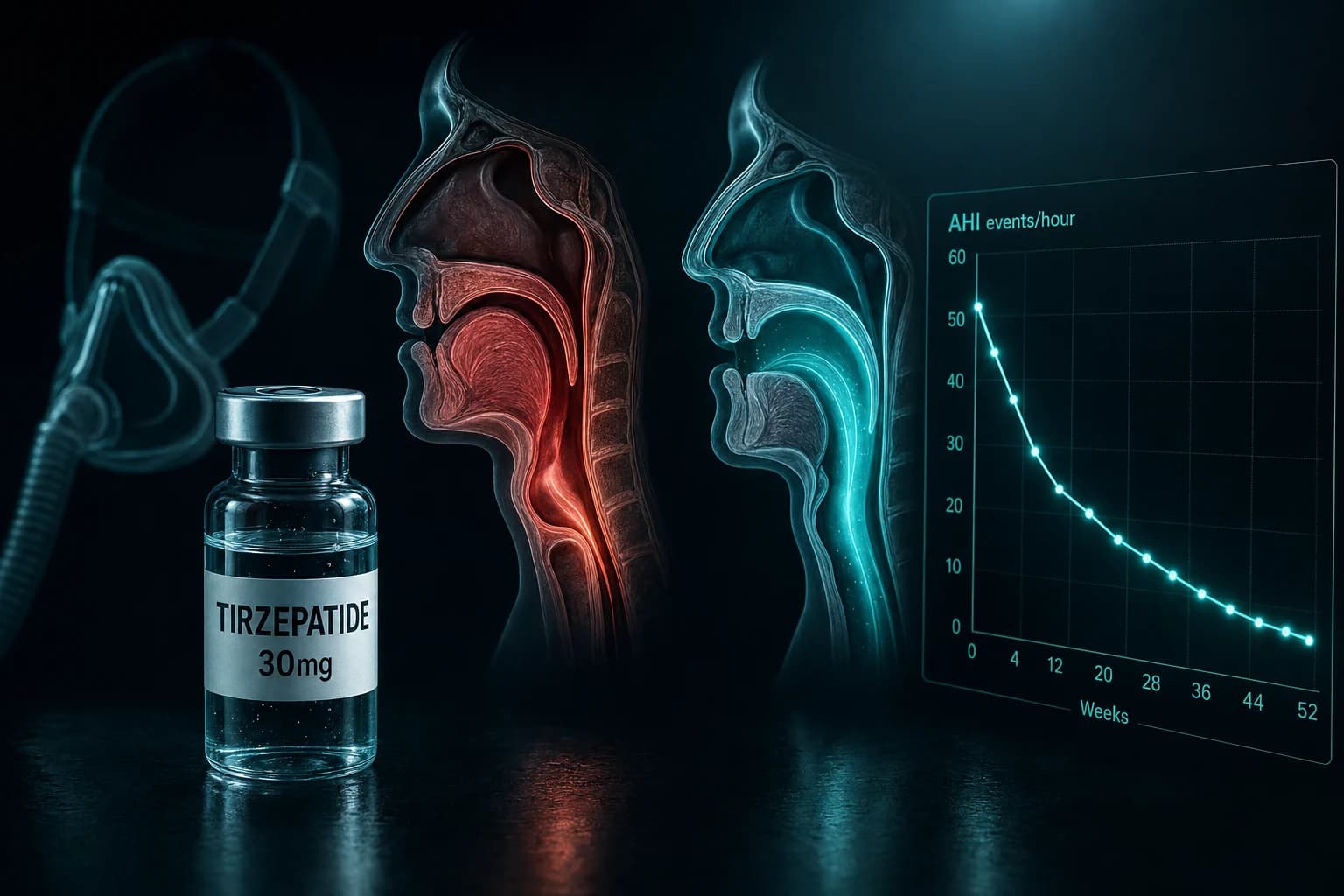
- Tirzepatide cut AHI by 25.3 events/h (Trial 1) and 29.3 events/h (Trial 2) vs placebo over 52 weeks (Malhotra et al. 2024)
- Up to 51.5% of participants met OSA disease resolution or downgrade to mild criteria at week 52
- FDA approved Zepbound for moderate-to-severe OSA in adults with obesity on December 20, 2024
- Body weight fell 18 to 20%, hsCRP fell about 35 to 50%, systolic BP fell roughly 7 to 9 mm Hg
- Approval is for OSA plus obesity (BMI 30+); no Phase 3 evidence in non-obese OSA
Why this trial was different
Most tirzepatide articles measure success in pounds. SURMOUNT-OSA measured it in apnea-hypopnea events per hour. The endpoint is colder and more clinical, and it is the one that produced the first prescription medication FDA approved for obstructive sleep apnea.
The Phase 3 result, published in Malhotra et al. NEJM 2024 (PMID 38912654), reported a placebo-adjusted AHI reduction of about 20 events per hour at 52 weeks across two parallel trials. The FDA approved Zepbound for moderate-to-severe OSA in adults with obesity on December 20, 2024 (the FDA press announcement is the cleanest source for the indication wording).
That distinction matters. Sleep apnea has been a weight-loss-adjacent topic for decades, with Sleep AHEAD (Foster et al. 2009, PMID 19786682) and the 10-year follow-up (PMID 32721163) showing intensive lifestyle intervention can lower AHI in obese type 2 diabetes patients. SURMOUNT-OSA is the first Phase 3 program where a pharmacologic agent earned a regulatory label that names OSA itself as the indication, separate from the obesity label.
What SURMOUNT-OSA actually tested
The protocol (Aronne et al. 2024, PMID 38547961) was two parallel 52-week, double-blind, placebo-controlled Phase 3 trials sharing one master design. Both enrolled adults with moderate-to-severe OSA (AHI of 15 events per hour or higher) and obesity (BMI 30 or higher) without type 2 diabetes.
- Trial 1: 234 participants who were unable or unwilling to use positive airway pressure therapy (PAP).
- Trial 2: 235 participants who had been on PAP for at least three consecutive months at baseline and continued PAP throughout.
Both trials randomized 1:1 to maximum tolerated tirzepatide (10 mg or 15 mg subcutaneously weekly) or placebo. Primary endpoint: change in AHI from baseline to week 52, measured by polysomnography. Key secondary endpoints, controlled for multiplicity, included percent change in AHI, body weight, hypoxic burden (sleep apnea-specific hypoxic burden, SASHB), high-sensitivity C-reactive protein, systolic blood pressure, and patient-reported outcomes via PROMIS sleep instruments.
The design is unusual in two ways worth noting. First, splitting CPAP-tolerant from CPAP-intolerant patients allowed the trial to address two separate clinical questions in one protocol. Second, the primary endpoint was an objective polysomnography measure rather than a symptom score, which is the harder bar.
The headline numbers
The placebo-adjusted reductions in AHI at 52 weeks were the largest ever reported for a pharmacologic agent in OSA. Below is the structured Phase 3 read.
| Endpoint at 52 weeks | Trial 1 (no PAP) | Trial 2 (on PAP) |
|---|---|---|
| Baseline AHI (events/h, mean) | ~51.5 | ~49.5 |
| AHI change, tirzepatide | -27.4 events/h | -30.4 events/h |
| AHI change, placebo | -4.8 events/h | -6.0 events/h |
| Placebo-adjusted AHI reduction | -25.3 events/h | -29.3 events/h |
| Percent AHI reduction, tirzepatide | -55.0% | -62.8% |
| Body weight change, tirzepatide | -18.1% | -20.1% |
| OSA disease resolution or downgrade to mild (%) | ~43% | ~51.5% |
| hsCRP percent change, tirzepatide | -36.1% | -44.7% |
| Systolic BP change, tirzepatide | -7.6 mm Hg | -9.6 mm Hg |
Numbers are drawn from the primary publication (Malhotra et al. NEJM 2024) and the secondary outcomes paper in Nature Medicine (PMID 41540105). Disease resolution was defined as AHI under 5 events/h or AHI 5 to 14 events/h without symptoms or impairment, which maps to the standard clinical definitions.
Two things stand out. The Trial 2 effect (CPAP-tolerant arm) was larger than the Trial 1 effect, which is the opposite of what some clinicians predicted. The mechanistic interpretation is that tirzepatide and PAP attack the upper airway through different routes and the combination clears more residual events than either alone. Second, the placebo arms also lost AHI events, which is consistent with the placebo lifestyle counseling baked into both trials. The treatment effect is the difference, not the absolute number.
Bottom line: In Trial 2, the average treated patient went from severe OSA at baseline (AHI ~49.5) to a borderline-mild reading at week 52 (placebo-adjusted -29.3 events/h). That is a magnitude of AHI change comparable to bariatric surgery in the OSA literature, achieved pharmacologically.
Was it the weight loss, or something more
This is the question the secondary outcomes paper (PMID 41540105) was designed to test. The authors ran a formal mediation analysis to separate the effect of weight loss from the effect of OSA-specific airway changes on each cardiometabolic endpoint.
The findings were specific:
- For systolic blood pressure, weight change explained most of the placebo-adjusted reduction. AHI change added little independent variance once weight was controlled for.
- For hsCRP, HOMA-IR (insulin resistance), and triglycerides, AHI change carried independent mediation effects beyond weight. In other words, fixing the apneas appears to do something distinct from losing weight on inflammatory and metabolic markers.
- Diastolic BP showed no significant mediation by either weight or AHI change, which is consistent with prior OSA pharmacology literature.
The cleanest reading is that tirzepatide acts on OSA primarily through weight loss, and that the downstream cardiometabolic improvements come partly from weight and partly from improved breathing during sleep. The Sleep AHEAD analyses (PMID 32721163) showed roughly 0.5 to 0.7 fewer AHI events per kilogram lost in their cohort, which lines up with the magnitude observed in SURMOUNT-OSA when you back-calculate from the weight loss.
This does not mean tirzepatide has a direct upper-airway action that is independent of body composition. It means the trial cannot separate them cleanly with mediation analysis alone. A trial that compared tirzepatide to a weight-matched lifestyle intervention would settle the question, and that trial does not exist.
Where this fits next to CPAP
CPAP remains the gold standard for moderate-to-severe OSA, and the SURMOUNT-OSA results do not change that. CPAP normalizes the AHI on the night it is worn. Tirzepatide reduces it on every night by changing the underlying anatomy and tone, but only after months of treatment. The two are not really competing on the same axis.
The stickier issue is adherence. The CPAP literature has converged on a flat curve: a systematic review of 82 papers across two decades reported a non-adherence rate of 34.1% on a 7-hour-per-night threshold, with no clinically meaningful improvement over time (Rotenberg et al. JOHNS 2016, PMID 27542595). Trial 1 of SURMOUNT-OSA was built around exactly this population.
| Treatment axis | CPAP | Tirzepatide (SURMOUNT-OSA) |
|---|---|---|
| Onset of effect | Same night | Gradual over 8 to 24 weeks |
| Effect on weight | Neutral | -18 to -20% body weight |
| Effect on AHI when used | Near-complete normalization | -25 to -29 events/h placebo-adjusted |
| Long-term adherence | 30 to 60% at 4-hour threshold | Limited Phase 3 data past 52 weeks |
| Effect on hsCRP and BP | Modest, mixed in literature | Clear reductions in SURMOUNT-OSA |
| Cost and access | Durable medical equipment, variable insurance | Brand drug, prior authorization typical |
| Discontinuation | AHI returns immediately | Likely AHI rebound with weight regain |
Trial 2 (the on-PAP arm) implies the most useful clinical reading: pharmacologic OSA therapy is an additive on top of CPAP for many patients, not a replacement. The PAP-tolerant participants who added tirzepatide produced the biggest absolute AHI reductions in the trial, suggesting the residual events that PAP misses (positional, REM-related, and arousal-driven) are responsive to weight loss in a way pressure alone is not.
Who the FDA label actually covers
The FDA-approved indication is narrow on purpose. Per the FDA announcement, Zepbound is approved for moderate-to-severe OSA in adults with obesity (BMI of 30 or higher), in combination with a reduced-calorie diet and increased physical activity. It is not approved for mild OSA, for OSA without obesity, or as monotherapy without lifestyle counseling.
That label is a direct readout of the trial inclusion criteria. There is no Phase 3 data on:
- AHI 5 to 14 (mild OSA), where weight loss generally has more variable effects
- BMI under 30, where the airway anatomy contribution from adiposity is smaller
- Type 2 diabetes patients, who were excluded from SURMOUNT-OSA
- Adolescent or pediatric OSA, which has different pathophysiology
- Pure central sleep apnea, where obstruction is not the issue
A research-grade reading of this is straightforward. The trial answered one question well. Extrapolating outside the inclusion frame is hypothesis, not data. For broader context on how GLP-1 and dual-agonist effects scale with adiposity, the GLP-1 muscle loss research and the Tirzepatide vs Semaglutide 2026 head-to-head cover the comparator field.
What the trial did not test
Several gaps deserve attention before generalizing the result.
- Cardiovascular event endpoints. SURMOUNT-OSA measured surrogates (BP, hsCRP, hypoxic burden), not MACE. The cardiovascular outcomes literature for tirzepatide in obesity is still pending the SURPASS-CVOT readout. SURMOUNT-OSA does not establish that treating OSA with tirzepatide reduces stroke or MI risk.
- Long-term durability. 52 weeks is the entire trial. There is no controlled data on what AHI does after weight regain, after dose reduction, or after discontinuation. Based on the Sleep AHEAD trajectory, regain is highly likely to undo most of the AHI improvement, but that has not been measured directly in this population.
- Non-CPAP comparators. The trial is tirzepatide vs placebo. There is no head-to-head against oral appliances, hypoglossal nerve stimulation (Inspire), positional therapy, or pharmacologic alternatives. Cross-trial comparison is risky given different inclusion criteria and definitions.
- Dose-response below 10 mg. Both arms were maximum-tolerated 10 mg or 15 mg weekly. There is no SURMOUNT-OSA data on whether 5 mg works for OSA. The smaller weight-loss effect at 5 mg in SURMOUNT-1 and SURMOUNT-2 makes a smaller AHI effect mechanically likely, but it has not been measured.
- Subgroup performance. Pre-specified subgroups by sex, age, and severity were directionally consistent, but the trials were not powered for definitive subgroup conclusions.
Note: SURMOUNT-OSA establishes that 52 weeks of high-dose tirzepatide reduces AHI in moderate-to-severe OSA with obesity. It does not establish OSA-specific cardiovascular benefit, durability past 52 weeks, or efficacy outside the inclusion criteria.
A candidate decision matrix for protocol research
For research planning purposes (not clinical care), the SURMOUNT-OSA inclusion criteria suggest a candidate scoring frame. None of this should be read as a substitute for medical evaluation.
| Factor | Stronger evidence base | Weaker evidence base |
|---|---|---|
| AHI severity | 15+ events/h moderate or severe | Under 15 (mild), no Phase 3 data |
| BMI | 30+ obesity | Under 30, no Phase 3 data |
| CPAP status | Either intolerant or compliant (both trials) | Hybrid use cases not directly tested |
| Diabetes | Non-diabetic (excluded from SURMOUNT-OSA) | T2D, evidence indirect (SURMOUNT-1/2) |
| Cardiovascular comorbidity | Stable, low-risk profile | Recent ACS or active heart failure (excluded) |
| Treatment duration plan | 52+ weeks at maintenance dose | Short courses, no AHI data |
| Concurrent therapy | Diet plus activity counseling (per label) | Monotherapy without lifestyle scaffolding |
The framework is built around what was actually tested. The further a candidate sits from the right column, the more aggressively the evidence has to be downgraded to extrapolation.
For dose-titration mechanics, the 12-week retatrutide titration protocol and the bioavailability comparison cover adjacent territory on how to think about dose ramp and route in incretin-class research.
Background context: why obesity drives OSA in the first place
The pathophysiology is mechanical. Adipose deposition in the lateral pharyngeal walls and tongue base narrows the upper airway. During sleep, when pharyngeal dilator muscle tone falls, the narrowed airway becomes prone to collapse on inspiration. Larger neck circumference, higher visceral adiposity, and increased airway compliance all contribute, which is why BMI is a strong predictor of AHI but not the only one.
The epidemiology has moved with the obesity curve. The Wisconsin Sleep Cohort update by Peppard et al. 2013 (PMID 23589584) reported that the prevalence of moderate-to-severe sleep-disordered breathing (AHI of 15 or higher) among adults aged 30 to 70 had climbed to 10% in men aged 30 to 49, 17% in men aged 50 to 70, 3% in women aged 30 to 49, and 9% in women aged 50 to 70. Those represent relative increases of 14% to 55% over the prior period, tracking the U.S. obesity trajectory.
That epidemiology is the reason a drug that produces sustained 18 to 20% body weight loss has plausible mechanism for OSA before any trial is run. Sleep AHEAD already showed lifestyle-driven weight loss reduces AHI, with approximately 0.5 to 0.7 events/h fewer per kilogram lost. SURMOUNT-OSA is the dose-up version of that observation: when you produce 23 kg of weight loss in 52 weeks instead of 7 kg, the AHI numbers move accordingly.
Practical considerations for protocol research
For research-grade protocol planning, three points are worth taking from the SURMOUNT-OSA design.
First, both arms used the maximum tolerated dose. The titration schedule mirrored SURMOUNT-1: 2.5 mg starting, escalating every four weeks to 10 mg or 15 mg by week 20. AHI assessments at week 52 measured the maintenance phase, not the titration phase. Interim improvements happen earlier (the time-course analysis, PMID 41135142 shows AHI trends parallel weight trends through the year), but the clean endpoint readout is at one year.
Second, dosing accuracy matters more here than in some other tirzepatide use cases. The Phase 3 weight-loss curve at 10 mg differs meaningfully from 15 mg, and OSA outcomes appear to track weight. Researchers running structured comparisons should pay attention to reconstitution math; the reconstitution calculator covers the standard volume work.
Third, the trial protocol included diet and activity counseling. Stripping that scaffold is not a faithful replication of SURMOUNT-OSA. The placebo arms in both trials lost about 1 to 2 percent body weight at week 52, which is not zero, and that small change probably accounts for the small placebo AHI improvements. Replicating the placebo-adjusted effect requires acknowledging the lifestyle component is not optional in the published data.
Sourcing for research-grade tirzepatide
For research applications, vial-grade tirzepatide and adjacent incretin compounds are available through Ascension Peptides with the ENHANCED code at 50% off. Reconstitution accuracy and storage drive whether the trial-grade weight-loss numbers (and therefore AHI numbers) are reproducible in a structured protocol. The reconstitution calculator and the bioavailability guide cover the back-of-envelope work.
For oral GLP-1 alternatives where injection is not the goal, Limitless Biotech ships oral and nasal options under code ENHANCED. Neither vendor is a substitute for FDA-approved branded therapy in patients with diagnosed OSA, where Zepbound under medical supervision is the labeled route.
Bottom line
Bottom line: SURMOUNT-OSA is the cleanest demonstration to date that a pharmacologic agent can drop AHI into the mild or normal range in moderate-to-severe OSA with obesity. The effect is large, the secondary endpoints all moved the right direction, and the FDA approval is narrow but real. The three things the data do not establish are durability past 52 weeks, efficacy outside the BMI 30+ frame, and cardiovascular event reduction.
The honest read is that a year of high-dose tirzepatide in the right patient produces an AHI reduction comparable to what bariatric surgery does, without the surgery. The honest caveat is that the trial does not tell us what happens in year three.
Related research on this site
- Tirzepatide vs Semaglutide: The 2026 Head-to-Head
- Retatrutide vs Tirzepatide vs Semaglutide: 2026 GLP-1 Comparison
- GLP-1 Muscle Loss: What the Research Shows in 2026
- Stopping GLP-1s: What the Withdrawal Trials Actually Show
- 12-Week Retatrutide Titration Protocol
- Tirzepatide research page
- Semaglutide research page
- Reconstitution Calculator
This article is for educational and research purposes only. It is not medical advice. Tirzepatide is FDA-approved as Zepbound for moderate-to-severe obstructive sleep apnea in adults with obesity (BMI 30+) and for chronic weight management, and as Mounjaro for type 2 diabetes. Off-label use, use outside the SURMOUNT-OSA inclusion criteria, and use without medical supervision are not supported by the data reviewed here. Polysomnography-confirmed OSA, prescription oversight, and continued PAP therapy where indicated remain the standard of care. The numbers reviewed here describe published trial outcomes; they do not establish that any specific individual will experience the same magnitude of effect.