At a glance
- A COA is the batch-specific lab report proving a vial's identity, purity, and safety.
- Gray-market semaglutide tested at 7.7% to 14.37% purity against a 99% label claim (JMIR 2024).
- Endotoxin appeared in every sample in that study; a clean COA reports it well under 0.5 EU/mg.
- The bar is above 98% purity by HPLC plus a mass-spec match to the correct molecular weight.
- A generic or lot-less COA is a red flag. The certificate must name the exact batch you received.
A vial can print "99% purity" on the label and hold 14% in the bottle. That is not a hypothetical. When researchers bought semaglutide from online sellers and sent it to a lab, measured purity came back between 7.7% and 14.37%, and every single sample carried detectable endotoxin (JMIR 2024).
The label is a marketing claim. The Certificate of Analysis is the receipt. Here is how to read one.
What a Certificate of Analysis actually is
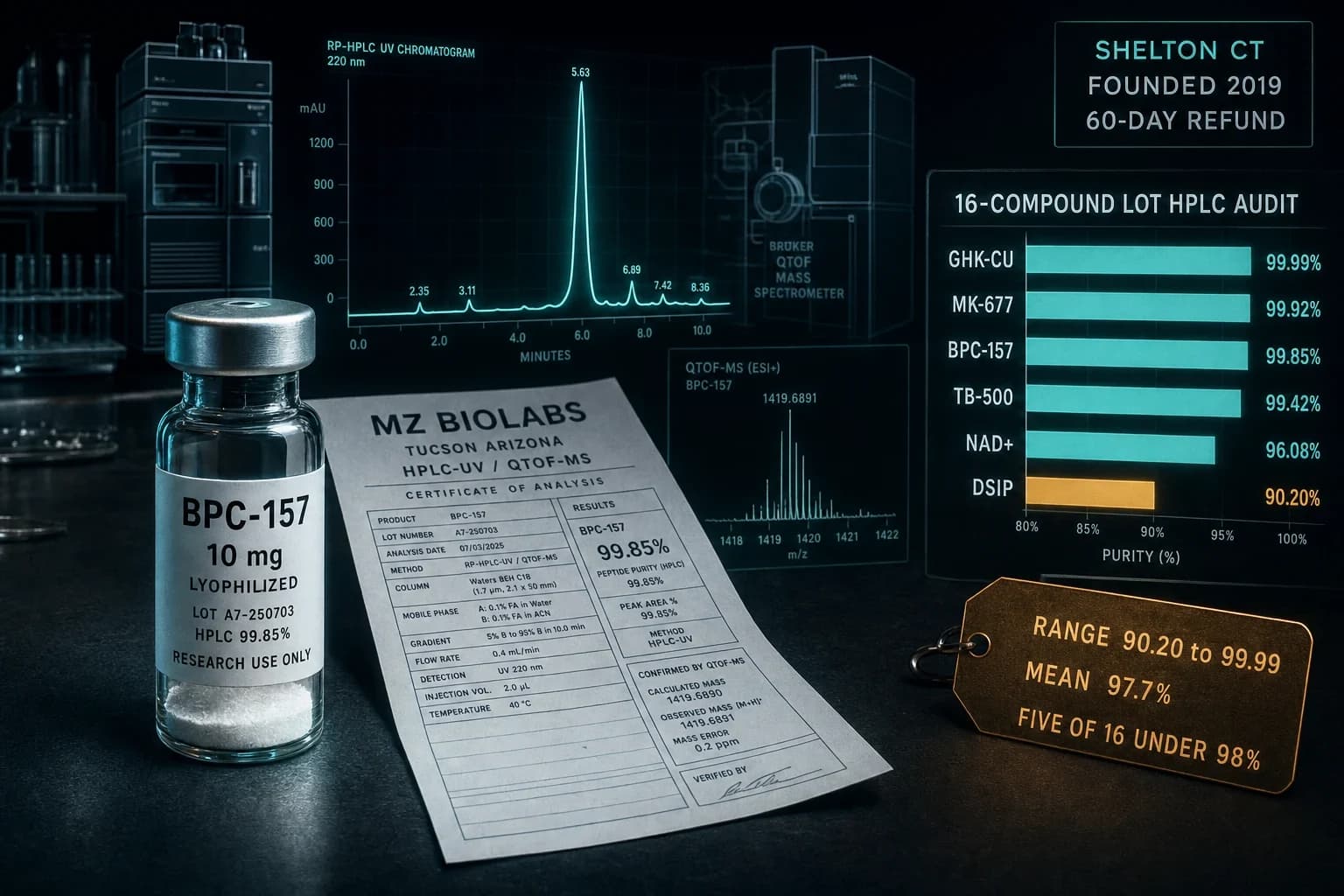
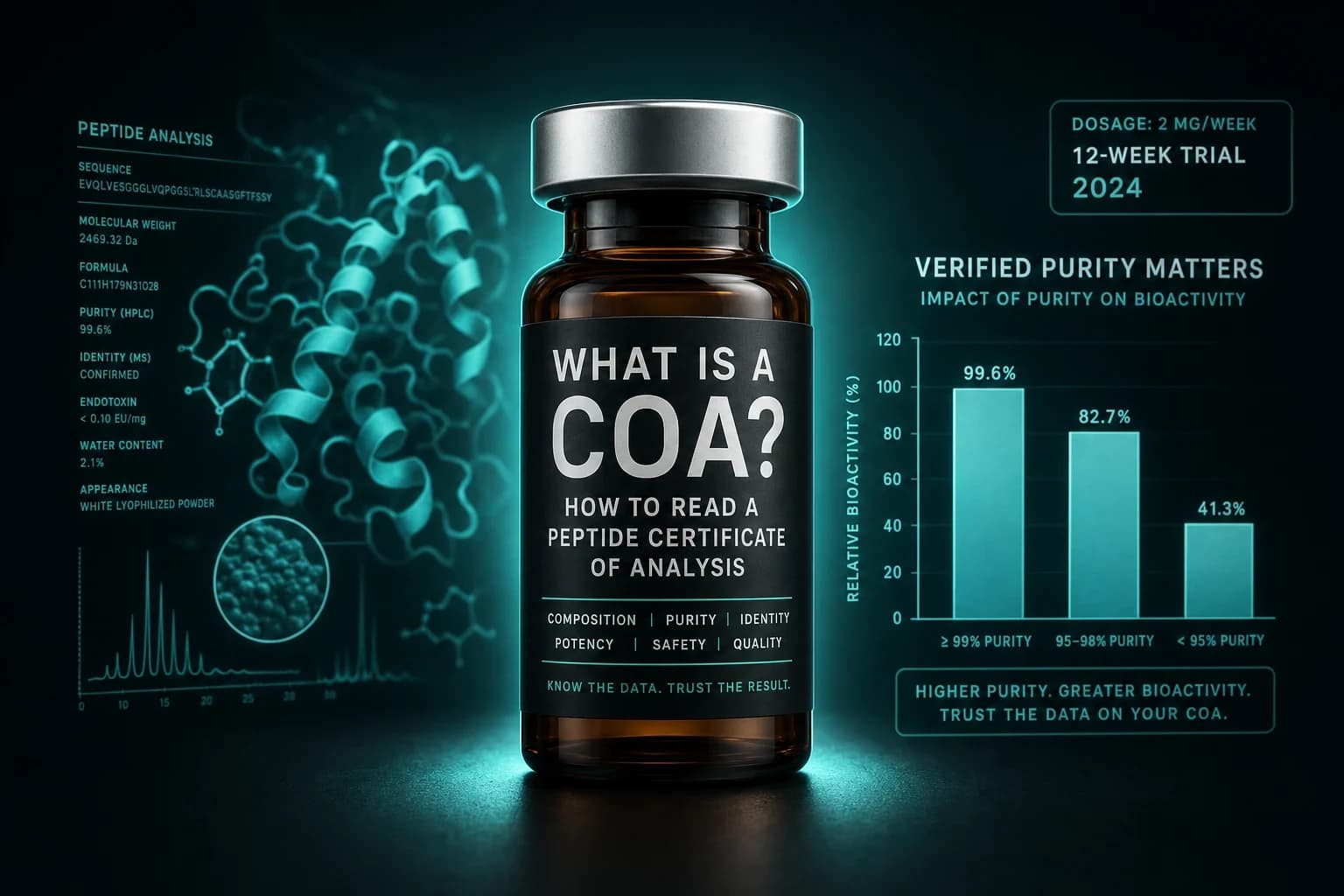
A COA is a lab report tied to one specific production batch. A real one names the compound, the lot number, the test date, the methods used, and the results for identity, purity, and contamination. It is not a logo, a "lab tested" badge, or a generic PDF that never changes between products.
The key word is batch-specific. Peptides are made in discrete synthesis runs, and quality varies run to run. A COA that does not carry the exact lot number printed on your vial tells you nothing about the vial in your hand.
Note: "Lab tested" on a product page is a claim. A downloadable, lot-matched COA is evidence. Only one of those survives scrutiny.
The four results that matter
Every peptide COA worth reading covers four things.
Identity (mass spectrometry). Mass spec confirms the sample is the molecule it claims to be by measuring its molecular weight. HPLC can show a sample is 99% one thing, but only mass spec confirms that one thing is the correct peptide and not a cheaper look-alike (Malgave et al. 2025).
Purity (HPLC). Reversed-phase high-performance liquid chromatography separates the sample into peaks and reports what percentage is your target peptide versus everything else. The research standard is at least 95%, and most legitimate batches clear 98%.
Endotoxin. Bacterial endotoxin is a contamination and sterility signal. It should be low, reported in EU/mg. In the gray-market semaglutide study, endotoxin ran from 2.16 to 8.95 EU/mg across every sample, which is exactly the kind of number a clean COA does not show.
Appearance and mass. Net peptide content and physical description confirm you received the quantity and form you paid for.
How to read each line
| COA line | What it means | What you want to see |
|---|---|---|
| Product + lot number | Ties the report to your exact batch | Matches the number on your vial |
| HPLC purity | Percent of sample that is the target peptide | ≥ 98% (95% floor) |
| Mass spec (MS) | Confirms molecular identity | Observed mass matches theoretical |
| Peptide content / net weight | Actual peptide mass in the vial | Close to labeled amount |
| Endotoxin | Bacterial contamination level | Low, reported in EU/mg |
| Test date + lab | When and who tested it | Recent, named third-party lab |
Green flags versus red flags
| Green flag | Red flag |
|---|---|
| Lot number matches your vial | Generic COA, no lot number |
| Third-party lab named on the report | "Tested in-house," no lab named |
| HPLC chromatogram image included | A single purity number with no chart |
| Mass spec identity confirmed | Purity shown but no identity test |
| Recent test date | Undated or years-old certificate |
If a seller cannot produce a lot-matched COA for the batch you are about to buy, that is your answer. The compounds are cheap to make and expensive to verify, which is exactly why verification is the part that gets skipped.
Why this is not paranoia
The market surveillance data is blunt. The JMIR 2024 analysis of no-prescription semaglutide found noncompliance on 59% to 63% of evaluated criteria, purity far below label, and endotoxin in all samples. Compounded tirzepatide has its own documented problem: a novel impurity forming when tirzepatide is combined with certain vitamin B12 analogs in mass-compounded products (Expert Opinion on Drug Safety 2026).
Purity also is not static. Semaglutide degrades measurably with heat and pH stress in HPLC studies (Malgave et al. 2025), so a COA tells you the batch was good when tested, and proper storage keeps it that way.
Warning: A COA verifies the batch, not the bottle you mishandled. Storage still matters after the certificate is issued.
How we handle this
We keep a self-hosted lab-test and COA library rather than linking to certificates that can be swapped out later. When you compare compounds in the peptide database or read a specific guide like semaglutide or BPC-157, the sourcing we point to routes to partners that publish batch-level COAs. For a worked example of a vendor that publishes lot-matched certificates, see our Ascension Peptides review. Our medical and editorial review process covers how we vet what we publish.
Bottom line: Read three lines before you buy anything: the lot number (does it match?), HPLC purity (is it above 98%?), and mass-spec identity (is it the right molecule?). Everything else is secondary. Ascension Peptides publishes batch COAs and ships COA-verified material with 50% off using code ENHANCED.
This article is for research and educational purposes only. It is not medical advice. Research compounds are not approved for human consumption. Always verify primary sources and applicable regulations before purchase.