GLOW BlendPre-mixed peptide stack
GHK-Cu + BPC-157 + TB-500 — the complete recovery, repair, and skin stack
Price
$160
Compounds
3 peptides
Category
Skin & Anti-Aging
Format
Pre-Mixed Injectable
Overview
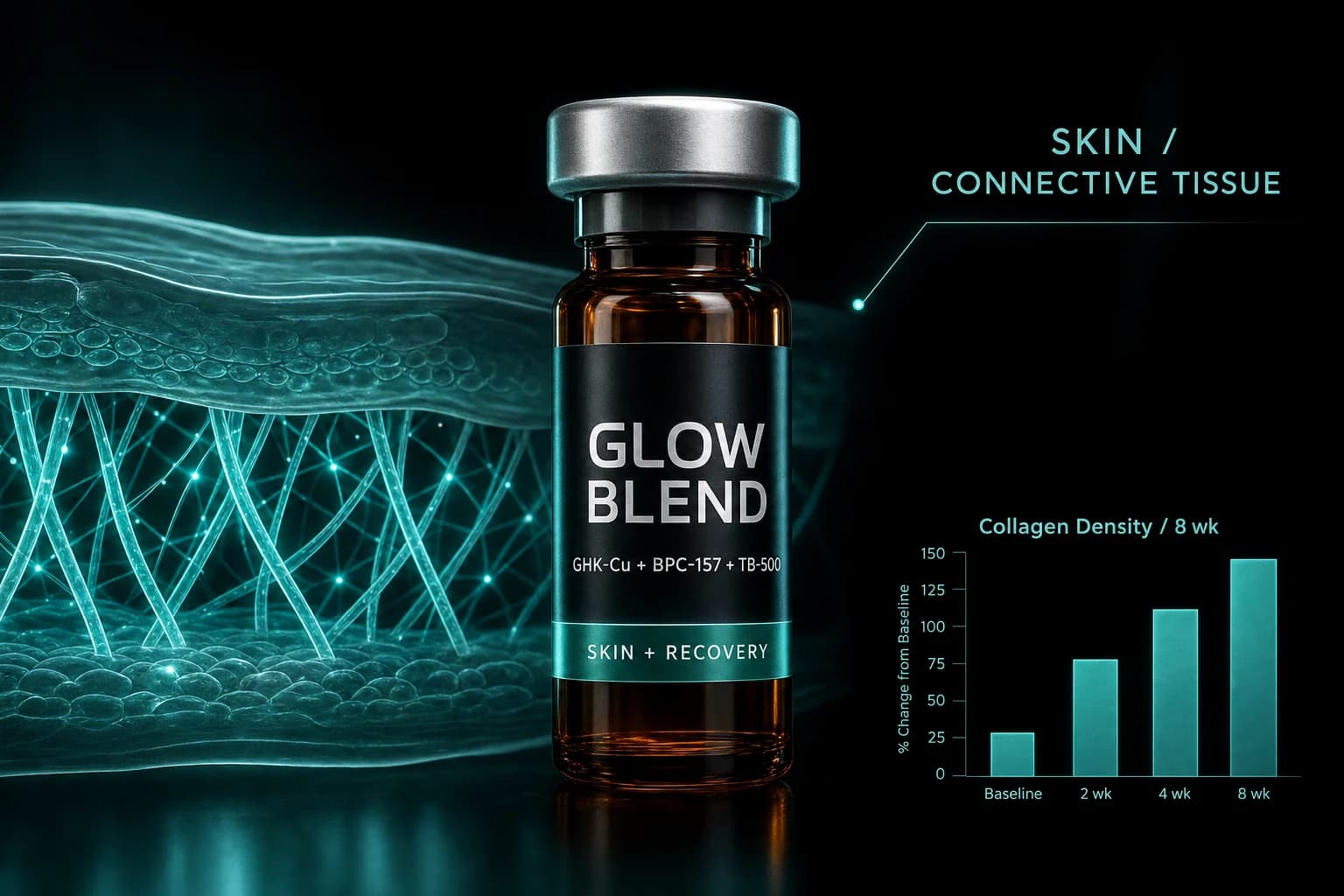
The GLOW Blend combines GHK-Cu, BPC-157, and TB-500 in a single pre-mixed vial. It takes the Wolverine Stack recovery foundation and adds the copper tripeptide GHK-Cu, which is the component doing the skin and collagen work. The formulation targets the overlap between tissue repair, systemic healing, and skin quality.
Names are worth clearing up first, because vendors use them loosely. GLOW almost always refers to this three-peptide combination: GHK-Cu, BPC-157, and TB-500. KLOW adds KPV, a fourth peptide, for gut and inflammatory research. Confusingly, some compounding pharmacies sell an unrelated "GLOW" injection built from glutathione and ascorbic acid with no BPC-157 or TB-500 in it at all. If a product page does not name all three peptides, it is not this blend.
GHK-Cu (glycyl-L-histidyl-L-lysine copper complex) is a naturally occurring tripeptide found in human plasma, and its concentration falls substantially between early adulthood and age 60. That decline is the reason it draws anti-aging interest. Pickart mapped its role in tissue remodeling, where it behaves less like a single-target drug and more like a reset signal, shifting gene expression toward repair and stimulating both collagen and decorin production [1]. It also upregulates antioxidant defenses and has been characterized in the context of degenerative conditions of aging [2].
The BPC-157 and TB-500 base is the same recovery pairing researchers already run for musculoskeletal work. BPC-157 accelerated tendon healing in rat models through tendon outgrowth, improved cell survival, and cell migration [3], and its wound-healing profile has been reviewed across a broad set of tissue types [4]. TB-500 is the synthetic actin-binding fragment of Thymosin Beta-4, part of the beta-thymosin family whose defining function is sequestering G-actin monomers to enable cell migration [5].
For anyone already running or considering the Wolverine Stack, GLOW adds the matrix and skin dimension without a second vial or a second reconstitution.
Why this combination works
The three compounds sit at different points in the repair cascade rather than stacking the same mechanism three times. BPC-157 works locally: it drives angiogenesis and growth factor upregulation at the site of interest, which is why the tendon and ligament literature is where its strongest data sits [3]. TB-500 works systemically: by binding G-actin it promotes cell migration and modulates inflammation body-wide, preparing tissue for repair rather than executing it at one location [5]. GHK-Cu works structurally: it upregulates collagen I and III synthesis, stimulates decorin, and shifts remodeling gene expression, which is the layer that determines whether repaired tissue ends up as organized matrix or disorganized scar [1]. That division is the actual argument for the blend. Local repair, systemic signaling, and matrix rebuilding are three separate jobs, and running one without the others leaves part of the cascade unaddressed. The copper component also carries a practical caution the other two do not: GHK-Cu delivers copper, so it is not a compound to stack casually alongside other copper sources.
What's inside
GHK-Cu
~2-3 hours half-lifeCopper tripeptide that drives collagen and elastin synthesis, wound healing, and extracellular matrix remodeling. The skin and anti-aging component of the stack.
BPC-157
~4 hours half-lifeLocal tissue repair through VEGF upregulation and angiogenesis. Proven in animal models for tendon, ligament, and gut healing.
TB-500
~2-3 hours half-lifeSystemic anti-inflammatory and cell-migration support via actin regulation. Provides body-wide healing context.
Researched benefits
- Three complementary peptides in one vial: local, systemic, and matrix-level repair
- GHK-Cu adds collagen synthesis and skin rejuvenation to the Wolverine base
- Researched for wound healing, scar remodeling, and skin elasticity
- Anti-aging potential: GHK-Cu declines with age and supplementation restores youthful signaling
- BPC-157 + TB-500 foundation for musculoskeletal recovery
- Single reconstitution for a three-compound protocol
Dosing & reconstitution
Research dosing
On the common 70mg 50/10/10 vial (GHK-Cu 50mg, BPC-157 10mg, TB-500 10mg), a daily subcutaneous draw sized to 2mg GHK-Cu delivers about 400mcg BPC-157 and 400mcg TB-500. That is not the standalone TB-500 loading dose of 2-2.5mg twice weekly. Exact per-compound amounts depend on the printed ratio, so read the label rather than assuming an even split. Cycles run 4-6 weeks on, then a multi-week off window. The GLOW peptide dosage chart has the week table and syringe math. Two timing details matter more here than in the two-peptide stacks. GHK-Cu can sting at the injection site more than BPC-157 or TB-500, so protocols often rotate sites rather than reusing one spot. And because the copper component is cumulative, extended continuous runs are less common than defined 4-6 week cycles with a break between them.
Reconstitution
For a 70mg 50/10/10 vial, add 3 mL of bacteriostatic water. That is about 23.3 mg/ml total. A 2mg GHK-Cu draw is 0.12ml, or 12 IU on a U-100 syringe, and it carries 400mcg BPC-157 and 400mcg TB-500 with it. Inject the water slowly along the vial wall rather than directly onto the powder, then swirl gently to dissolve. Do not shake. Use within 21-28 days once reconstituted. The reconstitution calculator handles the unit math if the vial size or water volume differs.
Open reconstitution calculatorFrequently asked
What does GHK-Cu add over the standard Wolverine Stack?
Extracellular matrix remodeling. The Wolverine Stack (BPC-157 plus TB-500) covers tissue repair and anti-inflammation. GHK-Cu adds collagen I and III synthesis, decorin stimulation, and the remodeling gene expression that determines whether repaired tissue organizes properly or scars.
Is GLOW only for skin research?
No. It is a full recovery stack with a skin and matrix layer on top. Anyone studying musculoskeletal healing, post-injury recovery, or gut repair still gets the complete BPC-157 and TB-500 foundation. The GHK-Cu extends the scope rather than replacing anything.
GLOW vs KLOW: what is the difference?
KLOW is GLOW plus KPV, a tripeptide fragment of alpha-MSH studied for gut and inflammatory research. If the interest is skin and structural repair, GLOW covers it. If gut inflammation is also in scope, KLOW adds that fourth pathway.
Why do some GLOW products contain glutathione instead of BPC-157?
Because two unrelated products share the name. Compounding pharmacies dispense a GLOW injection built from glutathione and ascorbic acid under 503A rules. The research-peptide GLOW blend is GHK-Cu, BPC-157, and TB-500. Check that all three peptides are named before assuming which one is on offer.
Can GHK-Cu be used topically instead of injected?
GHK-Cu has research supporting both topical and injectable routes, and topical formulations are common in cosmetic use. In this pre-mixed stack it is formulated for subcutaneous injection alongside BPC-157 and TB-500. For topical-only work, a standalone GHK-Cu product is the better fit.
Does the copper in GHK-Cu accumulate?
Copper is an essential trace mineral with a regulated absorption and excretion pathway, but GHK-Cu does deliver it directly. That is the reason protocols favor defined 4-8 week cycles with breaks rather than continuous year-round administration, and the reason stacking it alongside other copper-containing products warrants attention.
References
- [1]
Pickart L. (2008). The human tri-peptide GHK and tissue remodeling.
Journal of Biomaterials Science, Polymer Edition · PubMed 18644225
- [2]
Pickart L, Vasquez-Soltero JM, Margolina A. (2012). The human tripeptide GHK-Cu in prevention of oxidative stress and degenerative conditions of aging.
Oxidative Medicine and Cellular Longevity · PubMed 22666519
- [3]
Chang CH, Tsai WC, Lin MS, et al. (2011). The promoting effect of pentadecapeptide BPC 157 on tendon healing involves tendon outgrowth, cell survival, and cell migration.
Journal of Applied Physiology · PubMed 21030672
- [4]
Seiwerth S, Milavic M, Vukojevic J, et al. (2021). Stable Gastric Pentadecapeptide BPC 157 and Wound Healing.
Frontiers in Pharmacology · PubMed 34267654
- [5]
Hannappel E. (2007). beta-Thymosins.
Annals of the New York Academy of Sciences · PubMed 17468232
Ready to start your research
Get the GLOW Blend from Ascension Peptides
3 compounds, one vial, one reconstitution. COA-verified, US-based, discreet shipping. Use code ENHANCED for 50% off your entire order.
Buy GLOW Blend — $160