At a glance
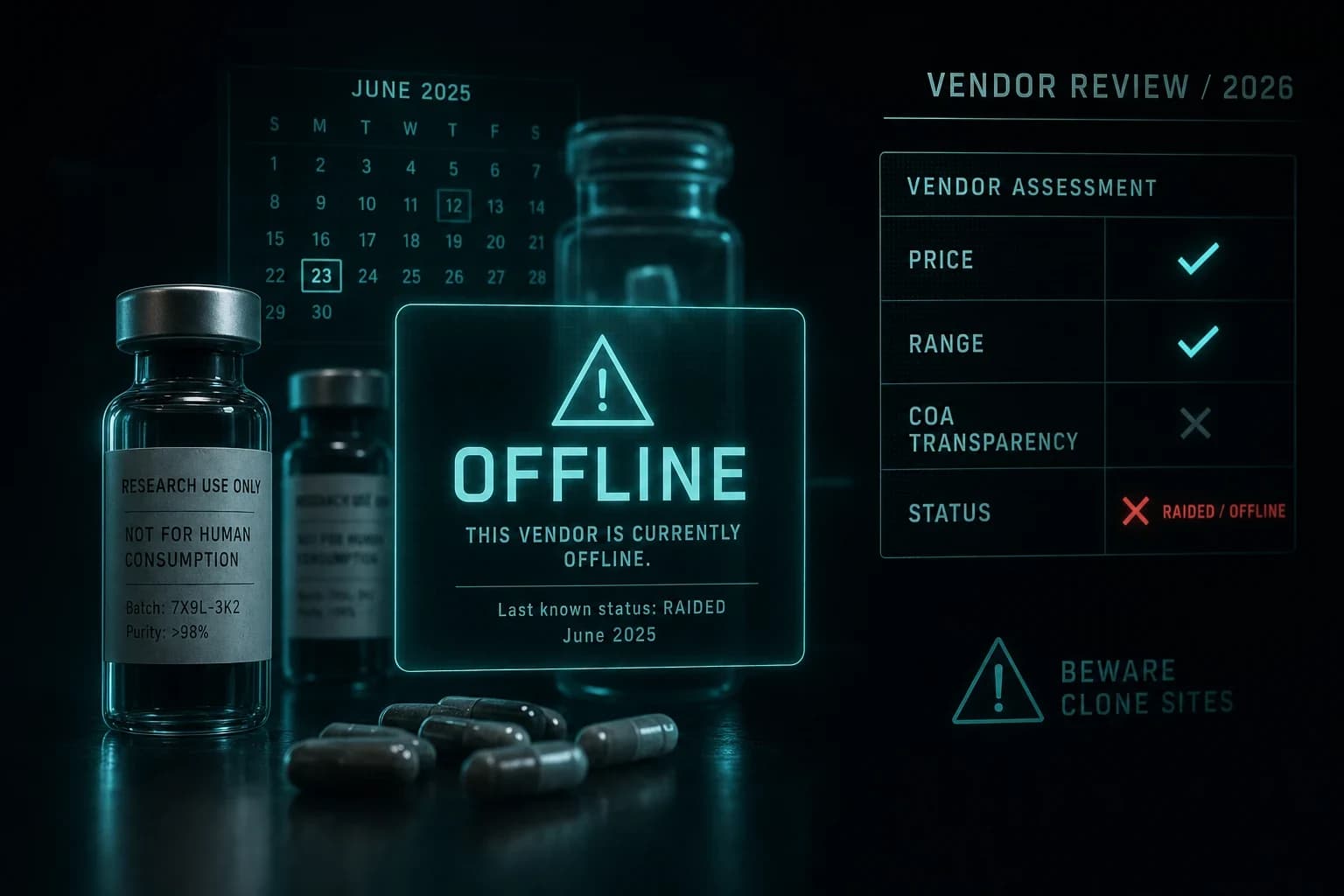
- The FDA raided Amino Asylum's warehouse in June 2025; the site has stayed offline since.
- Both founders reportedly pleaded guilty to federal charges in December 2025.
- Amino Asylum never published consistent per-batch third-party COAs for its peptides.
- Known for low prices and a huge SARMs and peptide range, not documented purity.
- In 2026 there is no reliable way to order from Amino Asylum.
- Format-matched replacement: Ascension Peptides for injectable vials (code ENHANCED, 50% off), Limitless Biotech for oral capsules and nasal sprays (code ENHANCED, 15% off).
If you are searching "is Amino Asylum legit" in 2026, the honest answer starts with a fact most vendor reviews bury: the site has been dark since federal agents raided its warehouse in June 2025. You cannot judge a checkout page that no longer loads. So this review does two things. It tells you what Amino Asylum actually was, based on years of public track record, and it tells you what changed, so you can decide where to send your money now.
We are affiliates of two surviving vendors: Ascension Peptides for injectables (code ENHANCED, 50% off) and Limitless Biotech for oral capsules and nasal sprays (code ENHANCED, 15% off). We are not affiliated with Amino Asylum in any way, and nothing below is a paid placement. The comparison is built on documentation, not loyalty. If Amino Asylum had a stronger public COA record than either partner, we would say so.
Note: Research peptides, SARMs, and research chemicals are sold for laboratory and research use only. They are not approved for human consumption. Nothing here is medical advice or an endorsement of ingesting anything.
What Amino Asylum was known for
Amino Asylum was one of the older names in the US research-chemical scene, run out of Memphis, Tennessee. It built its reputation on two things: breadth and price.
The catalog was enormous. Where a specialist peptide shop might stock 30 to 50 lyophilized vials, Amino Asylum carried peptides, a deep SARMs lineup, nootropics, and assorted research chemicals under one roll of the dice. If you wanted BPC-157, TB-500, MK-677, 5-Amino-1MQ, RAD-140, and a stack of odds and ends in a single order, it was a convenient one-stop cart.
Price was the other draw. Amino Asylum consistently undercut the field, and for a lot of buyers that was the entire pitch. On forums and Reddit threads (r/peptides, the moreplatesmoredates community), longtime customers often reported clean transactions, reasonable shipping times, and results they were happy with. That goodwill was real, and it is why the brand still pulls thousands of searches a month.
Here is the tension. A low price and a loyal following tell you a vendor is popular. They do not tell you what is in the vial.
The COA problem that predated the raid
The single most important question for any research-peptide vendor is simple: can you see a per-batch, third-party certificate of analysis tied to the exact lot you received? If you are new to the term, our explainer on what a peptide certificate of analysis actually proves walks through how to read one.
On this measure, Amino Asylum never scored well. Independent reviewers repeatedly noted the same gap: some in-house testing was referenced, but there was no consistent, publicly accessible library of third-party COAs matched to lot numbers. Purity claims existed. The documents backing them, per batch, largely did not.
That is not the same as saying the product was bad. Plenty of customers reported good experiences. But "some users report no problems" is a testimonial, not a test result. Without a lot-matched HPLC certificate from an independent lab, you are trusting the seller's word about identity, purity, and dose. For a category where mislabeling is the central risk, that is a structural weakness, and it existed long before any federal agent showed up. We cover why this gray-market sourcing model is so fragile in our piece on the truth about gray-market peptide sourcing.
What happened in 2025
In June 2025, according to multiple industry reports and community accounts, the FDA raided Amino Asylum's warehouse. The website went offline, payment processing was cut, and pending orders were frozen. Customers described server errors, removed checkout pages, and no communication.
It did not stop there. Reporting indicates the company's two founders pleaded guilty to federal charges in December 2025. The reported core of the case: products sold as SARMs that allegedly contained testosterone, which moves the conduct from regulatory gray area into unauthorized distribution of a controlled substance. Reports also cite ignored FDA warning letters and marketing that pushed products for human use rather than the "research only" framing that keeps a vendor on the safer side of the line.
We are attributing these specifics to reporting and public court records rather than stating them as our own findings. The observable, undisputed fact is this: as of mid-2026, the site remains offline, with no public statement and no sign of return.
Warning: Any site currently claiming to be "Amino Asylum" should be treated with heavy skepticism. After a shutdown of this kind, brand names get squatted, cloned, or revived under new operators with no connection to the original. Do not assume a familiar name means a familiar (or accountable) seller.
Amino Asylum assessment table
| Criteria | Amino Asylum | Our take |
|---|---|---|
| COA / testing | Referenced in-house testing; no consistent public per-batch third-party COAs | The core weakness, present before the raid |
| Product range | Very broad: peptides, SARMs, nootropics, research chemicals | A genuine strength while operating |
| Pricing | Consistently among the cheapest in the market | Real, and the main reason for its following |
| Shipping | Historically domestic US, generally reliable per user reports | Fine when the site was live; moot now |
| Reputation | Long-standing, mostly positive on forums, with contested purity concerns | Popularity is not the same as verification |
| Legit in 2026? | Site offline since June 2025 FDA raid; founders reportedly pleaded guilty | No reliable way to order today |
So, is Amino Asylum legit?
For most of its life, Amino Asylum was a real, operating vendor that shipped real orders and kept a loyal base happy on price and range. That is the fair version of the "legit" question, and the answer was a qualified yes with an asterisk on documentation.
In 2026, the practical answer is no. There is no dependable way to place an order, no customer support to stand behind a problem, and no third-party paper trail to verify what any revived storefront might send you. Even setting the legal outcome aside, the thing that made the brand risky (thin per-batch COA transparency) is exactly the thing that matters most. The shutdown removed the price advantage and left the weakness fully exposed.
Bottom line: Amino Asylum earned its following on price and selection, not on documented purity. After the June 2025 FDA raid and the reported founder guilty pleas, it is not a vendor you can safely buy from in 2026. The lesson is not "find a cheaper clone." It is "buy from a vendor whose quality you can independently verify."
Where informed buyers are going instead
The vendors surviving the 2025 to 2026 enforcement wave share one habit: they publish. If you want the full field, our best legit peptide vendors 2026 ranking sorts the market by exactly this criterion, per-batch third-party COAs, not marketing adjectives.
Amino Asylum's draw was its one-cart breadth: injectable peptides, oral capsules, nasal sprays, and SARMs under a single checkout. No single accountable vendor replaces that catalog, because format and documentation standards do not travel together. The honest replacement is format-matched: pick the vendor whose documentation model fits the format you are actually sourcing.
| What you were buying at Amino Asylum | Format-matched vendor | Documentation tier | ENHANCED discount |
|---|---|---|---|
| Injectable lyophilized vials (BPC-157, TB-500, GLP-1s, GHK-Cu, CJC-1295, Ipamorelin) | Ascension Peptides | Tier 1: public per-batch COA on every lot | 50% off (code ENHANCED) |
| Oral capsules (MK-677, 5-Amino-1MQ, oral BPC-157, KPV, tesofensine, SLU-PP-332) | Limitless Biotech | Tier 2: vendor-wide third-party testing claim (greater than or equal to 98% HPLC) | 15% off (code ENHANCED) |
| Nasal sprays (Selank, Semax, GHK-Cu, DSIP) | Limitless Biotech | Tier 2: vendor-wide third-party testing claim | 15% off (code ENHANCED) |
| SARMs and research chemicals (RAD-140, LGD-4033, Cardarine, etc.) | No partner we route to. The SARMs vertical is where enforcement is most active. We do not have a vendor on this site we are confident enough to point readers at. |
The vendor we cite first for injectables is Ascension Peptides. The reason is specific and checkable: they maintain a public library of per-batch COAs, each tied to a lot number, test date, HPLC purity figure, and the independent lab that ran it. We index a large slice of those certificates ourselves in our public lab-tests database so you can cross-check the vial in your hand against the document, which is the entire point of a COA. Our full Ascension Peptides review breaks down the catalog, shipping, and where they fall short.
For the oral and nasal catalog Amino Asylum covered, the vendor that fits is Limitless Biotech. Their documentation tier is one step lower (vendor-wide spec rather than per-batch certificates), but their format range is where they earn their slot: a Tier 1 injectable-only vendor is not a replacement if your research needs an oral capsule or a nasal spray in the first place. The full Limitless Biotech review covers the catalog audit, format fit, and the gap between the two documentation tiers.
That verification-first standard is what Amino Asylum lacked, and it is the difference that matters more than any coupon. You can browse the compound guides on our peptides directory and the protocol references in our dosage charts library to see which shops publish lot-matched data for the specific molecule you are researching. For reconstitution math once a vial is in hand, our peptide reconstitution calculator handles the IU conversions for any vial size.
If you decide Ascension fits your research, code ENHANCED takes 50% off the full catalog at checkout. If the oral or nasal route fits better, the same code takes 15% off at Limitless Biotech. We earn commission on either, disclosed plainly, and we would rather tell you why the documentation holds up than tell you it is simply the best.
The takeaway
Amino Asylum's story is a clean case study in why per-batch third-party COAs are non-negotiable. A vendor can be cheap, popular, and long-running, and still leave you unable to verify what is in the vial. When enforcement finally arrived, the customers with the least recourse were the ones who had only a price and a good feeling to go on.
Buy on evidence you can inspect. Do your own due diligence, confirm any vendor's current standing before ordering, and treat every "research chemical" as exactly that: for laboratory use only, not for human consumption.
Disclaimer: This article is for informational and research purposes only and is not medical advice. Research peptides, SARMs, and research chemicals are intended for laboratory use only and are not approved for human consumption. We are not affiliated with Amino Asylum. Details about legal proceedings are attributed to public reporting and court records; verify current facts independently before making any decision. We are affiliates of Ascension Peptides (injectables) and Limitless Biotech (oral capsules and nasal sprays); code ENHANCED earns us a commission at either partner, disclosed in full.