At a glance
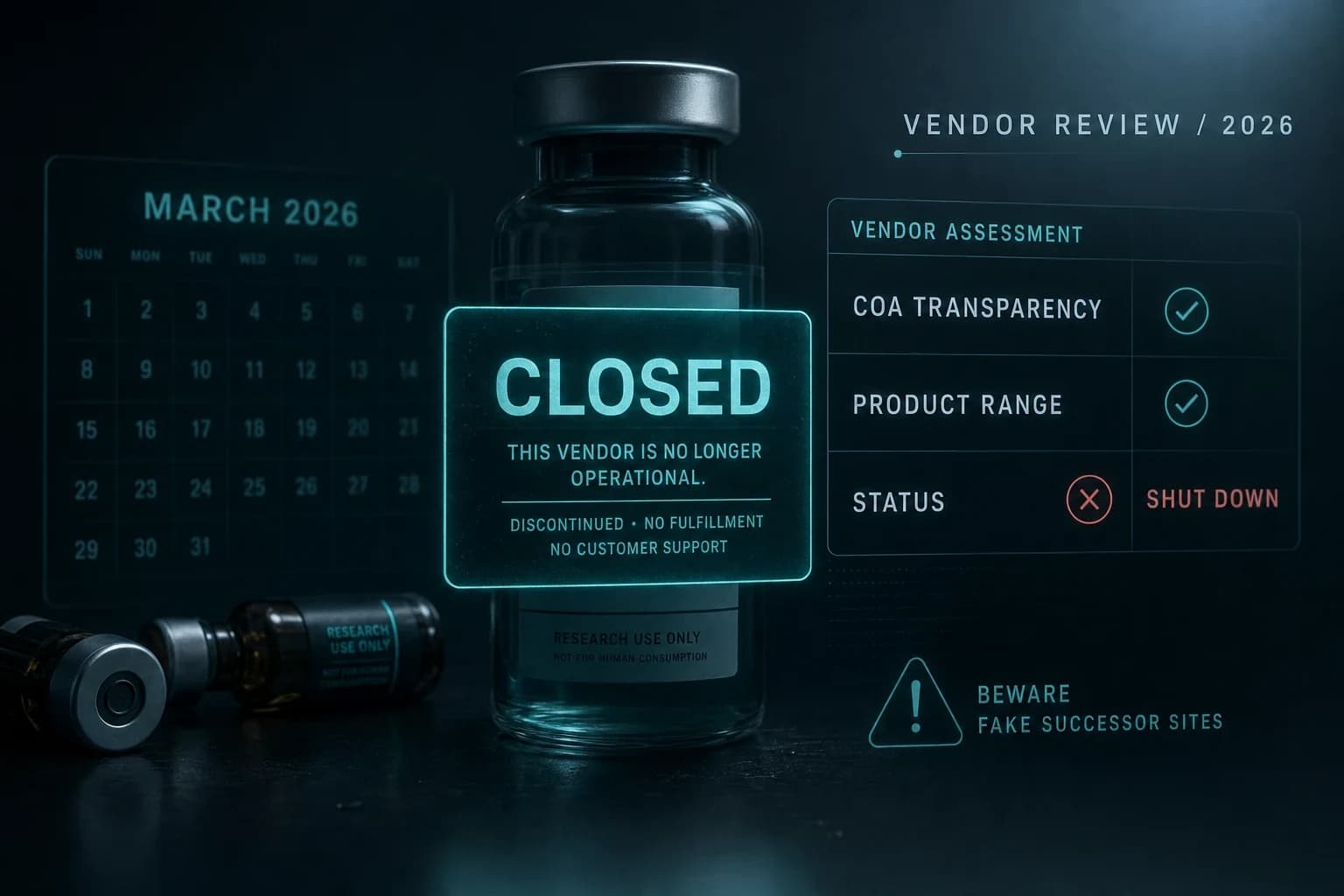
- Peptide Sciences voluntarily shut down on March 6, 2026, after a decade-plus online
- The official notice gave no reason; a 2025-2026 FDA/FTC enforcement wave is the backdrop
- Their site now warns that any 'successor' site claiming their name is fraudulent
- They provided COAs, but never a public per-batch third-party certificate library
- You cannot buy from them now; verify any alternative against published per-lot COAs
If you searched "is Peptide Sciences legit" expecting to place an order, here is the short version: as of March 2026, you cannot buy from them at all. Peptide Sciences, one of the longest-running and highest-volume research-peptide vendors in the United States, posted a shutdown notice on its own homepage and stopped selling. The company that a lot of people treated as the default name in this space is gone.
That changes the question. "Is Peptide Sciences legit" is now less useful than "what actually happened, and what do I do instead." This review answers both, sticks to what is verifiable, and flags the parts that are still rumor. We are an affiliate for a different vendor (more on that, transparently, at the end), so we are going to be careful to separate fact from sales pitch.
The headline: Peptide Sciences shut down in March 2026
On March 6, 2026, at roughly 2:00 PM Eastern, PeptideSciences.com replaced its storefront with a notice stating the company had voluntarily decided to shut down operations and discontinue the sale of all research products. There was no advance warning to customers, no published explanation beyond the word "voluntary," and no public detail about outstanding orders or refunds.
That much is confirmable: the notice is real, it is on their own domain, and multiple independent write-ups (including a law firm analysis) documented it within days. What is not confirmed is the reason. The company never issued an official statement explaining the decision, so anyone telling you exactly why Peptide Sciences closed is speculating.
Bottom line: The closure is verified. The motive is not. Treat any confident "here's the real reason they shut down" claim, including in this article, as informed context rather than established fact.
Why did Peptide Sciences shut down?
"Why did Peptide Sciences shut down" is one of the most-searched questions in this niche right now, which tells you how central the company was. Here is the honest answer: officially, nobody outside the company knows.
What we can describe is the environment they closed into. Through 2025 and into 2026, federal enforcement against gray-market research-peptide sellers escalated sharply. The FDA sent a wave of warning letters across the industry, and when the agency declared the semaglutide shortage resolved in early 2025, it removed the legal basis many vendors had leaned on to justify supplying GLP-1 compounds. Pharmaceutical litigation from the major GLP-1 makers added pressure on suppliers of those specific molecules. If you want the fuller picture of how this whole supply channel actually works and why it is fragile, we lay it out in the truth about gray-market peptide sourcing.
Against that backdrop, a large, highly visible vendor deciding to voluntarily wind down is at least consistent with reading the regulatory room. That is a reasonable inference. It is not a confession, and Peptide Sciences never framed it that way. We are not going to assert a cause they did not state.
What Peptide Sciences actually sold
For most of its run, Peptide Sciences operated as a broad-catalog research-chemical vendor shipping from within the US. The lineup covered the compounds you would expect: repair and recovery peptides like BPC-157 and TB-500, growth-hormone secretagogues, GHK-Cu, and, in the later years, the GLP-1 family (semaglutide, tirzepatide, and the newer triple agonist retatrutide) that drove so much of the recent demand. They sold single vials and blends, all under the standard "for laboratory research use only, not for human consumption" labeling that defines this market.
Their reputation, for years, was "big, established, and reliably in stock." That counts for something. Longevity in a market full of fly-by-night shops is a genuine signal, and plenty of buyers had uneventful experiences.
The testing question: COAs, but not the gold standard
Here is where an honest review has to get specific, because "they provide COAs" and "they publish independent per-batch COAs" are not the same claim, and the difference is the whole ballgame.
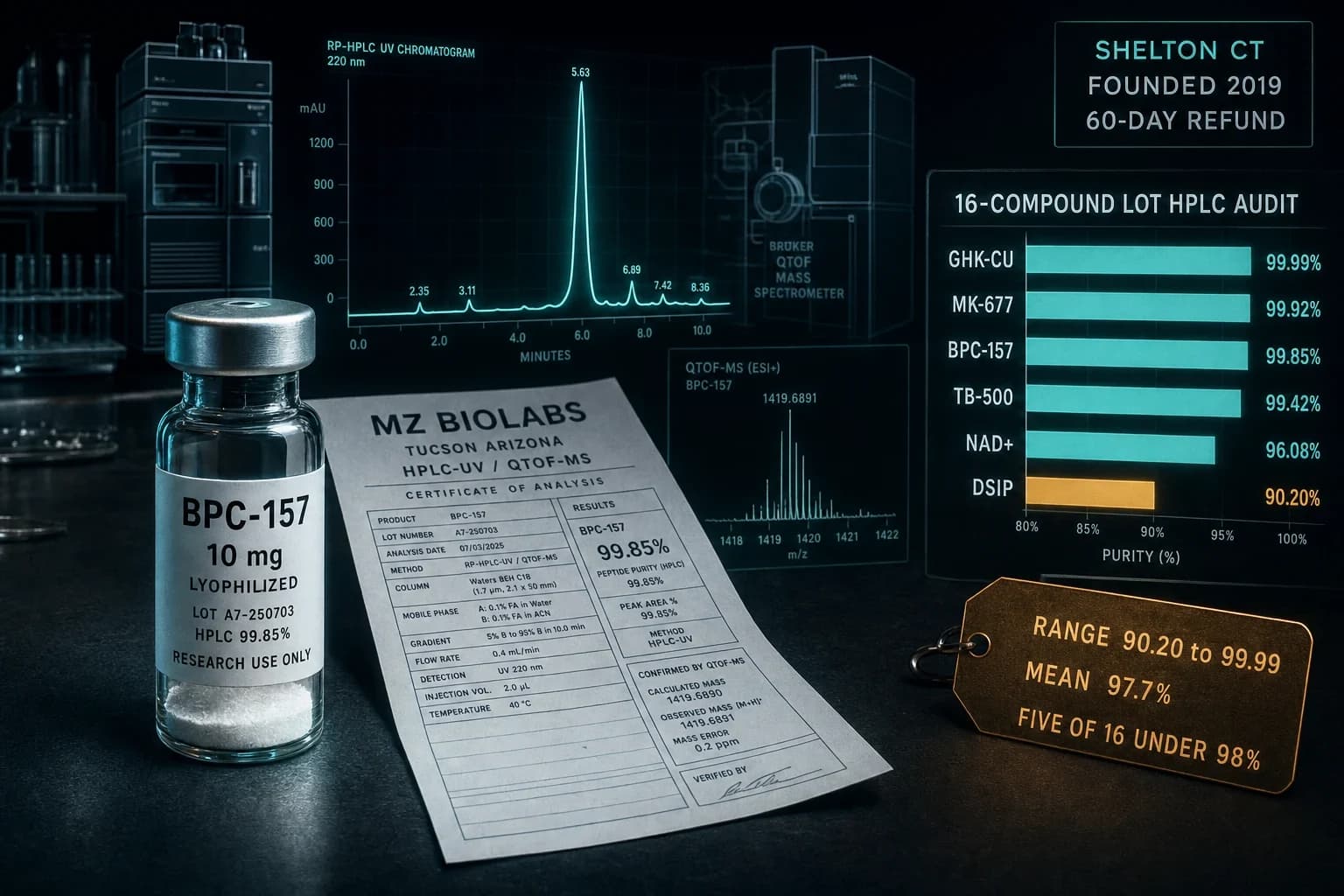
Peptide Sciences did provide Certificates of Analysis, typically including HPLC purity figures and mass-spec identity data. What they did not maintain, based on what was publicly available, was a public, per-lot certificate library tying the exact vial in your hand to an independent third-party lab report you could look up before opening it. Their documentation read more like internal quality paperwork than open third-party verification.
If you are fuzzy on why that distinction matters, our explainer on what a COA actually is walks through it. The short version: a purity number is only as trustworthy as the independence of the lab that produced it and your ability to match it to your specific batch. A generic "99% HPLC" banner on a product page is marketing. A named third-party lab report keyed to your lot number is evidence. Peptide Sciences sat closer to the former than the latter, which is the single biggest knock against them even before the closure.
Watch out for fake "Peptide Sciences is back" sites
This is the most important safety point in this whole review, so do not skim it.
Peptide Sciences' own shutdown notice includes a warning that any website, platform, entity, or individual claiming affiliation with the company, representing itself as a successor, or claiming to sell Peptide Sciences products is unauthorized, fraudulent, and has no connection to the original business. In plain terms: the real company told you, on its way out, that anyone using its name to sell you peptides now is not them.
That matters because a dormant, trusted brand name is exactly the kind of thing bad actors resurrect. If you see a site marketing itself as the "new" or "returning" Peptide Sciences, treat it as a red flag, not a homecoming. Buy on present-day, verifiable evidence, not on a name that used to mean something.
Assessment table
| Criterion | Peptide Sciences | Our take |
|---|---|---|
| COA / testing | Provided COAs with HPLC and mass-spec data, but no public per-batch third-party certificate library | Adequate on paper, below the current transparency bar |
| Product range | Broad: BPC-157, TB-500, GH secretagogues, GHK-Cu, GLP-1 family, blends | Strong while operating, now moot |
| Pricing | Mid-to-premium; rarely the cheapest | Fair, not a value leader |
| Shipping | US-based, generally reliable in-stock fulfillment historically | Was a real strength |
| Reputation | Long-running, high-volume, "default name" for years | Longevity was its best signal |
| Legit? | Was an established, real business; no longer operating as of March 2026 | Not a purchase option today |
So, is Peptide Sciences legit?
As a matter of history: yes, it was a real, decade-plus company with a large customer base, not a scam storefront. As a practical matter today: it does not matter, because you cannot legitimately buy from Peptide Sciences anymore. Any site currently selling under that name is one the real company disavowed in writing. The most legit thing you can do with the name "Peptide Sciences" in 2026 is stop typing it into a checkout page.
What we recommend instead
If you are a researcher who still needs a US source, the practical move is to pick a vendor whose quality you can verify right now, not one you are hoping is still trustworthy. Our full ranking of who is actually shipping and documenting their work is the best legit peptide vendors of 2026, and the standard we hold every vendor to is public, per-batch, third-party COAs, which you can audit yourself in our lab-tests database.
The vendor we cite first, and the one we have an affiliate relationship with, is Ascension Peptides. We disclose that plainly. The reason we can recommend them honestly is the exact thing Peptide Sciences lacked: a public per-lot certificate library where the vial's stamped lot number matches an independent third-party HPLC report you can pull up before you open it. That is documentation depth Peptide Sciences never published, and it is the concrete criterion, not the discount, that earns the recommendation. We audit their public certificates in our Ascension Peptides review, and you can browse the compounds they carry across our peptide database.
The commercial part, stated honestly: code ENHANCED takes 50% off the Ascension catalog, and we earn a commission if you use it. We think the per-batch COA transparency justifies the pick on the merits. If it did not, the discount would not save it.
Bottom line: Peptide Sciences is closed, its brand is being disavowed by its own founders, and the reason it shut is officially unexplained. Do not chase a name. Buy from a vendor whose per-batch, third-party COAs you can verify today, whoever that ends up being for you.
Disclaimer
Research peptides discussed here are sold for laboratory and research use only. They are not approved for human consumption, and nothing in this article is medical advice or an endorsement of self-administration. We are not affiliated with, endorsed by, or a successor to Peptide Sciences; every statement about their closure is drawn from their own public notice and independent reporting as of publication. We are an affiliate of Ascension Peptides and earn a commission on purchases made with code ENHANCED, which we disclose in the interest of transparency. Do your own due diligence, verify any vendor's current certificates yourself, and comply with the laws that apply to you.