At a glance
- The only published human safety trial dosed just two people intravenously.
- In rodents BPC-157 looks remarkably benign, with no lethal dose ever reached.
- Reported side effects are few, but that reflects thin data, not proven safety.
- Theoretical concerns center on angiogenesis, cancer risk, and blood pressure.
- The dominant real-world risk is unregulated grey-market purity, not the peptide.
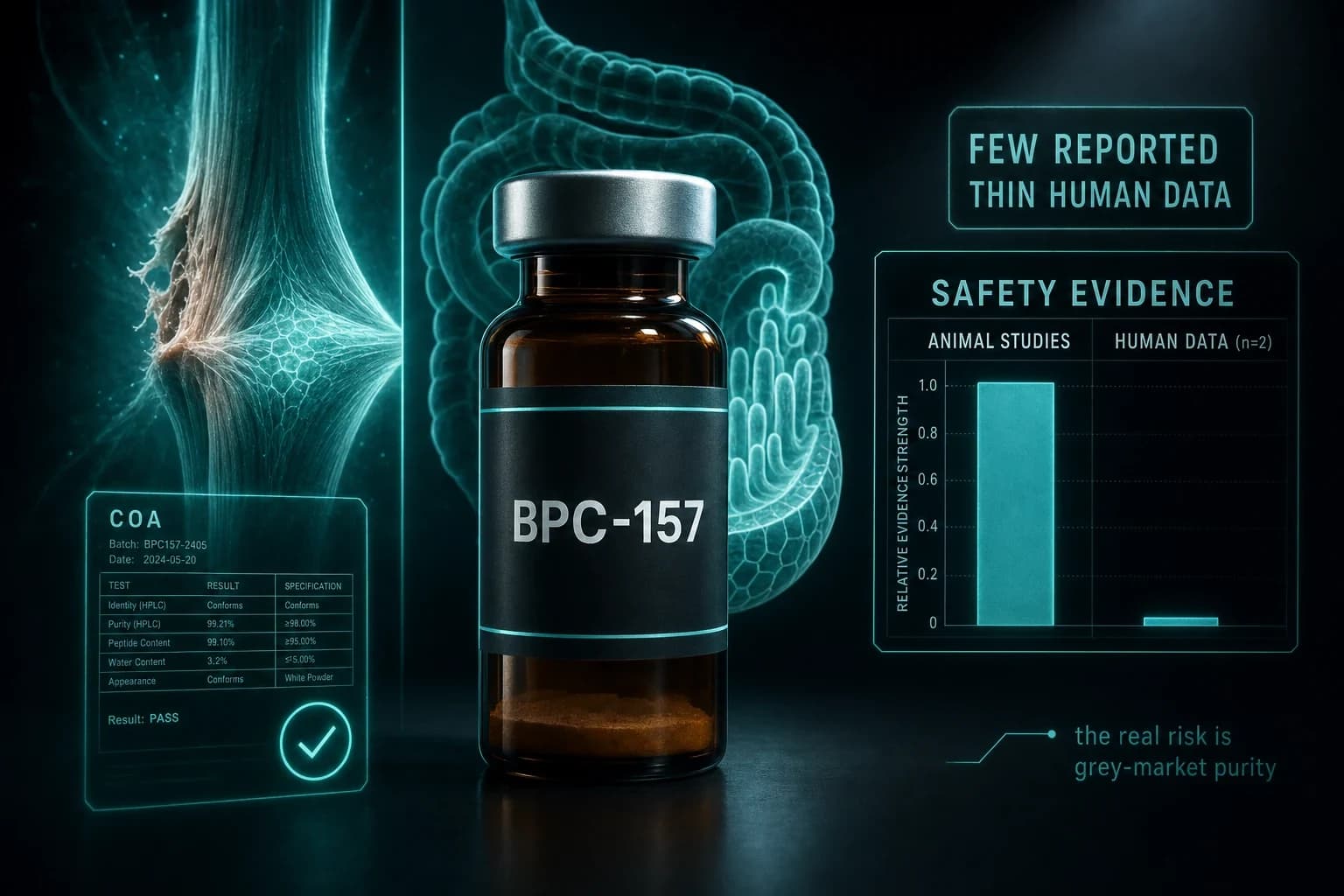
The entire published human safety record for BPC-157 rests on two people. In 2025, Edwin Lee and Kailynd Burgess ran the first documented human safety pilot, infusing up to 20 mg intravenously into two healthy adults and reporting no adverse effects and no measurable shift in cardiac, liver, kidney, thyroid, or glucose markers (Lee & Burgess (2025)). That is genuinely reassuring as far as it goes. It also tells you almost everything about the honest state of BPC-157 safety knowledge: the human dataset is a rounding error, and nearly everything else we "know" comes from rats.
This matters because the internet talks about BPC-157 as if its safety were settled. It is not settled. It is barely studied in humans. The accurate summary is not "BPC-157 has a long list of dangerous side effects" and it is not "BPC-157 is proven safe." The accurate summary is: few side effects have been reported, the animal data looks unusually clean, and the human evidence is too thin to draw strong conclusions either way. If you want the mechanism-first primer before the safety detail, start with what BPC-157 is and how it works.
What BPC-157 actually is
BPC-157 is a synthetic pentadecapeptide, a 15-amino-acid chain derived from a protein found in human gastric juice. It has been studied mostly for tendon, ligament, and gut healing, and for its effects on blood vessels. The tendon work is some of the more mechanistically detailed research: BPC-157 accelerates the outgrowth of tendon fibroblasts and improves their survival under oxidative stress through the FAK-paxillin pathway (Chang et al. (2011)). That healing signal is real in the preclinical literature. The safety picture attached to it is what gets oversold.
The animal safety data: clean, but from a narrow source
In rodents, BPC-157 looks remarkably benign. Across three decades of work, the peptide has shown a wide therapeutic window, and Predrag Sikiric's group reports that a lethal dose was never reached in their toxicity testing, describing high safety with "LD1 not achieved" (Sikiric et al. (2014)). Take that at face value and BPC-157 is one of the gentler compounds in the research-peptide space.
Now the caveat that most articles skip. The overwhelming majority of BPC-157 research, safety data included, traces back to a single research center. A 2025 literature and patent review noted that BPC-157 has not been approved by the FDA or other regulators because comprehensive human clinical studies simply do not exist, and that most records are linked to one group, with no meaningful data on what happens under higher, repeated, or long-term human exposure (Józwiak et al. (2025)). Concentration of evidence in one lab is not proof of a problem. It is a reason to hold the "no side effects" claim loosely until independent groups replicate it.
What users actually report
Anecdotally, the side effects people describe with subcutaneous BPC-157 are mild and mostly local: injection-site irritation, redness, or bruising, occasional lightheadedness or fatigue after dosing, transient headache, and some report short-lived nausea or changes in appetite. These reports are self-reported, uncontrolled, and unverifiable. They are also plausible for any injectable peptide and are not the same thing as documented drug effects. Treat them as informal signal, not evidence.
The more useful point: because the human data is so thin, the absence of reported serious side effects is weak evidence. You cannot detect a rare adverse event in a population that has never been formally studied. "Few side effects reported" and "safe" are not synonyms.
The theoretical concerns worth understanding
Two mechanistic questions deserve honest attention rather than dismissal.
The first is angiogenesis and cancer. BPC-157's healing effect is tied to its ability to promote new blood vessel growth, and researchers have linked that pro-angiogenic action to VEGFR2 activation and upregulation through the VEGFR2-Akt-eNOS pathway (Hsieh et al. (2017)). The same angiogenic machinery that helps a tendon heal is machinery that solid tumors exploit to build their own blood supply. There is no human evidence that BPC-157 causes or accelerates cancer. There is a reasonable theoretical basis for caution in anyone with an active or recent malignancy, and it is one reason blanket "totally safe" marketing is irresponsible.
The second is cardiovascular effects. BPC-157 interacts heavily with the nitric oxide system, which governs vascular tone and blood pressure (Sikiric et al. (2014)). In animal models this looks protective across a range of vascular insults, but NO-system activity cuts both ways, and its net effect on blood pressure in a healthy human taking grey-market material at an unverified dose has not been characterized.
What the evidence actually says, concern by concern
| Potential concern | What the evidence actually says | How strong |
|---|---|---|
| Acute toxicity | No lethal dose reached in rodent testing; wide therapeutic window (Sikiric et al. (2014)) | Moderate in animals, minimal in humans |
| Human short-term safety | 20 mg IV in two adults produced no adverse effects and no organ-marker changes (Lee & Burgess (2025)) | Very weak (n=2) |
| Injection-site and mild systemic effects | Anecdotally common, self-limited; no controlled human data | Anecdotal only |
| Cancer / tumor promotion | Pro-angiogenic via VEGFR2; theoretical concern, no human evidence of harm (Hsieh et al. (2017)) | Theoretical |
| Blood pressure / cardiovascular | Strong NO-system interaction; net human effect uncharacterized (Sikiric et al. (2014)) | Theoretical |
| Long-term / repeated exposure | No data of any kind in humans (Józwiak et al. (2025)) | Absent |
The honest read across this table: the strongest safety signals are in animals, the human evidence is a two-person pilot, and the biggest remaining unknowns are long-term and cardiovascular effects that nobody has properly measured.
The risk almost nobody talks about: what's actually in the vial
Here is the practical problem. Even if BPC-157 the molecule turns out to be as benign as the rodent data suggests, that says nothing about the specific vial in front of you. BPC-157 is not FDA-approved for human use, which means the grey market has no manufacturing oversight, no potency standards, and no requirement to disclose what a product contains. Independent testing of grey-market peptides routinely turns up underdosed, overdosed, mislabeled, and contaminated material. Your side-effect risk is driven less by the peptide's pharmacology and more by whether the powder is what the label claims.
Warning: The dominant real-world safety risk with BPC-157 is not the peptide, it is unregulated grey-market purity. BPC-157 is not FDA-approved for human use, and without third-party testing you have no way to know a vial's actual content, dose, or contaminants. Every batch you consider should carry a current, batch-matched Certificate of Analysis. If you cannot read the COA, assume you do not know what you are handling.
This is why sourcing and verification are the real safety conversation, not a footnote to it. A COA is a third-party lab's statement of identity, purity, and mass-spec confirmation for a specific batch. It is the single most useful document for reducing the largest quantifiable risk in this entire category. If you want to go deeper on independent verification, our overview of peptide lab testing walks through what to check and why.
Bottom line: Judge BPC-157 safety in two layers. Layer one is the pharmacology, which looks clean in animals and untested in humans. Layer two is the product, which is where the avoidable harm actually lives. You can control layer two completely by demanding a COA and refusing anything without one.
Reducing your risk if you research BPC-157
Nothing here is medical advice, and BPC-157 remains a research compound. That said, the risk-reduction logic is straightforward. Buy only batch-tested material with a readable COA. Reconstitute correctly so your actual dose matches your intended dose, since dosing errors magnify any effect, good or bad; our reconstitution calculator removes the arithmetic guesswork. Follow a conservative, documented protocol rather than improvising, using resources like the BPC-157 dosing protocol guide and the BPC-157 dosage chart. And be honest with yourself that you are operating ahead of the clinical evidence, which is a reason to be conservative, not adventurous.
The honest verdict
BPC-157's side-effect profile reads as unusually favorable, and that is a fair reflection of the animal literature. But favorable-looking is not the same as proven, and a two-person human pilot is not a safety database (Lee & Burgess (2025)). The reported side effects are few and mostly mild, the theoretical concerns around angiogenesis and cardiovascular effects are real but unquantified in humans, and the long-term picture is simply blank (Józwiak et al. (2025)). The one risk you can fully control is product quality, so control it.
If your research calls for BPC-157, source it accordingly. Ascension Peptides supplies research-grade, COA-verified BPC-157 for laboratory use only, with third-party testing on every batch, and code ENHANCED takes 50% off. Given that grey-market purity is the largest measurable risk in this entire discussion, verified sourcing is not an upsell here. It is the safety step.
Disclaimer: This article is for educational and informational purposes only and is not medical advice. BPC-157 is a research compound that is not approved by the FDA for human use or consumption. Nothing here is an endorsement to purchase, possess, or administer BPC-157. Products referenced are sold for laboratory and research use only. Consult a qualified healthcare professional before making any health decisions.