At a glance
- Copper peptides carry a single copper ion; GHK-Cu is the most-studied by decades.
- GHK-Cu shifted 31.2% of aged skin genes toward younger expression (Pickart 2018).
- Topical copper peptides have the strongest human cosmetic data; injectables are research-only.
- AHK-Cu is the copper peptide studied for hair; evidence is early and thin.
- Copper form and concentration decide whether a product does anything at all.
A single copper atom is doing most of the work in your favorite "anti-aging" serum, and almost nobody selling it can tell you which copper peptide is inside. That gap matters, because "copper peptides" is not one ingredient. It is a small family of molecules that each carry a copper ion, behave differently in skin versus hair, and sit at wildly different levels of evidence.
This is the category overview. If you already know you want GHK-Cu specifically, jump straight to our GHK-Cu compound guide and GHK-Cu dosage chart. If you want to understand what copper peptides are as a class, why GHK-Cu became the flagship, and where the honest limits are, keep reading.
What a copper peptide actually is
A copper peptide is a short chain of amino acids bound to a copper(II) ion. The peptide is the delivery vehicle. The copper is the payload. Copper is a required cofactor for enzymes that build and remodel your skin's structural proteins, including lysyl oxidase, which cross-links collagen and elastin. Free copper is reactive and poorly targeted. Bound to the right peptide, it gets shuttled where connective tissue is being rebuilt.
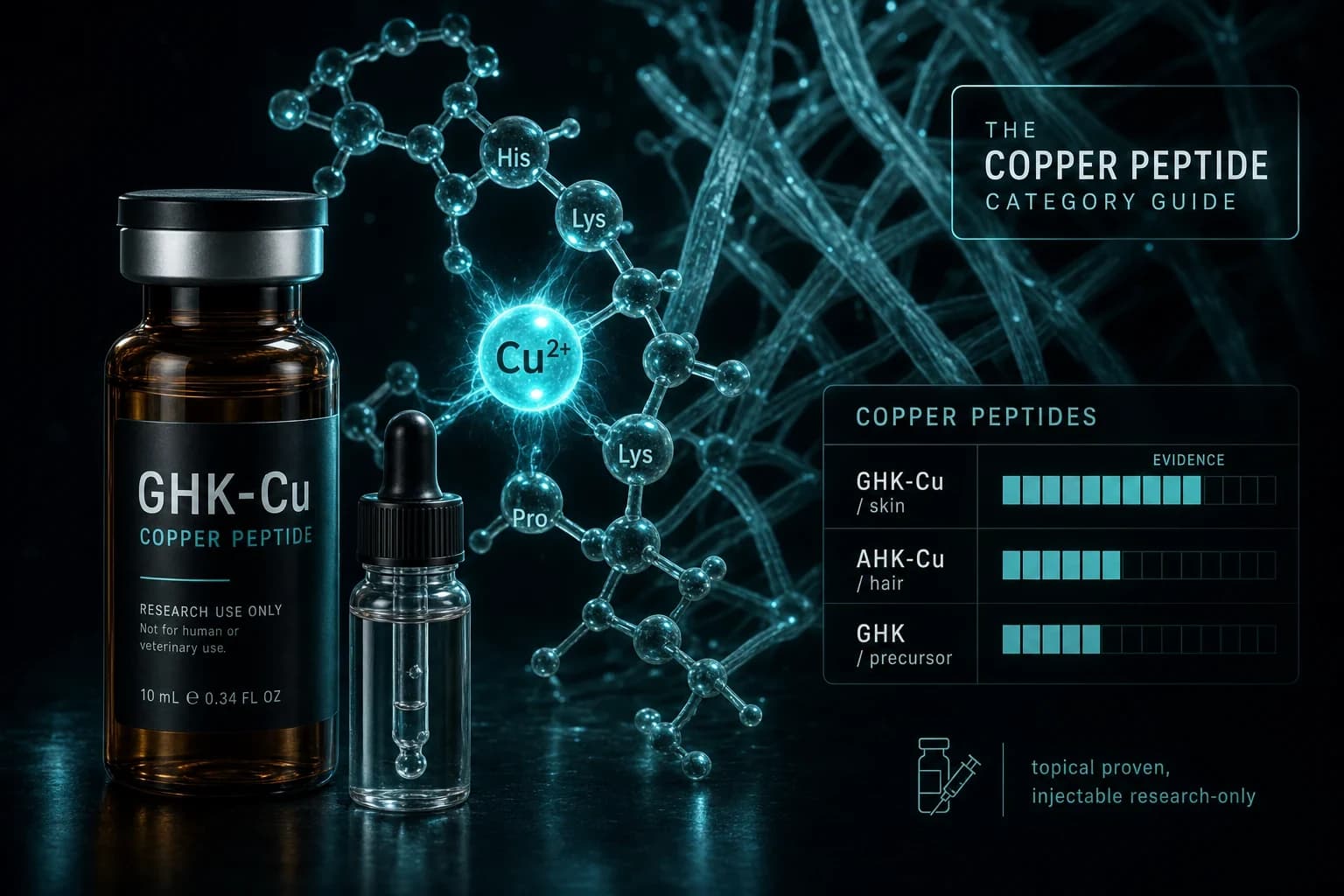
The family is small. GHK-Cu (glycyl-L-histidyl-L-lysine plus copper) is the original and the one with real research behind it. AHK-Cu (alanyl-L-histidyl-L-lysine plus copper) is the hair-focused cousin. A handful of others show up in cosmetic patents, but they rarely have published human data worth citing.
GHK itself is not exotic. It occurs naturally in human plasma, saliva, and urine, and its concentration in blood drops sharply with age, from roughly 200 ng/mL at age 20 to about 80 ng/mL by age 60 Pickart & Margolina (2018). That decline is part of why researchers got interested: it tracks with the slowdown in tissue repair we call aging.
GHK-Cu: the flagship, and why
GHK-Cu earns "flagship" status the boring way, through decades of published work. The foundational finding is old and specific. Maquart et al. (1988) showed that the GHK-copper complex stimulated collagen synthesis in fibroblast cultures and in wound models, establishing the peptide as a genuine driver of connective-tissue production rather than a passive moisturizer.
The mechanism widened over time. A gene-expression review by Pickart & Margolina (2018) reported that GHK influenced the expression of a large fraction of human genes, with roughly 31.2% of genes in an aged-skin dataset shifting toward a more youthful expression pattern after exposure. GHK-Cu also functions as an antioxidant and anti-inflammatory agent, and it activates wound-repair programs including angiogenesis and the recruitment of repair cells.
For a plain-language walk through skin regeneration and the remodeling story, Pickart (2015) is the review to read. It ties the collagen, elastin, and antioxidant threads into one coherent picture of why a copper-carrying tripeptide keeps showing up in serious dermatology research.
We cover the visible results, the timelines, and what "before and after" realistically looks like in our GHK-Cu before and after breakdown. This guide will not duplicate that.
Bottom line: When someone says "copper peptides," they almost always mean GHK-Cu. It is the only member of the family with a multi-decade evidence base, so treat it as the default and treat everything else as promising but unproven.
How copper peptides work
Three mechanisms carry most of the story, and they overlap.
Collagen and elastin. This is the headline effect. GHK-Cu stimulates fibroblasts to produce collagen and supports the enzymes that cross-link it into durable structure Maquart et al. (1988). More organized collagen and elastin translate, in cosmetic terms, to firmer skin with better bounce.
Antioxidant and anti-inflammatory action. Copper peptides help quench reactive oxygen species and dial down inflammatory signaling. That matters because chronic low-grade inflammation and oxidative damage are two of the main engines of visible skin aging Pickart (2015).
Wound and tissue repair. The same programs that heal a wound, angiogenesis, repair-cell recruitment, and controlled remodeling, are what GHK-Cu switches on. That is why the peptide sits in both the "skincare" and "healing" conversations at once.
The practical point: copper peptides do not just sit on the surface. They signal cells to behave the way younger, healthier tissue behaves. Whether that signal reaches the right cells depends entirely on how you apply it.
Topical vs injectable: the honest split
This is where most buyers get misled, so read it twice.
Topical is where the human cosmetic evidence lives. Copper peptide creams and serums have been studied in actual human skin for wrinkles, firmness, and photodamage. A review of topical peptides in aesthetics by Wang et al. (2021) places copper peptides among the ingredients with meaningful cosmetic support for skin appearance. If your goal is skin, topical is the route with the best-documented risk-to-reward.
The catch with topical is penetration. GHK-Cu is water-soluble and charged, which makes it hard to cross the skin barrier on its own. Delivery methods matter. Li et al. (2015) demonstrated that microneedle-based delivery improved transdermal transport of a copper peptide, which is why microneedling plus copper peptide shows up in clinical and at-home protocols.
Injectable copper peptides are research-only. There is no approved injectable GHK-Cu product for cosmetic or medical use, and human injectable data is essentially absent. People do use reconstituted GHK-Cu in research settings, but that is an unapproved, self-directed use with no regulatory backing and no established safety profile at scale.
Warning: Injectable copper peptides are unapproved research compounds, not medicines. And copper form and concentration are not a detail. Too little copper and the product is inert; a poorly formulated or over-concentrated copper complex can irritate or, in theory, oxidize. Buy from a source that publishes what is actually in the vial, and never assume "copper peptide" on a label means a correctly built GHK-Cu complex.
Skin uses vs hair uses
The two big use cases pull on different molecules.
Skin is GHK-Cu's home turf: fine lines, firmness, elasticity, wound and scar remodeling, and post-procedure recovery. This is the deepest evidence and the most common reason people buy copper peptides.
Hair is where AHK-Cu enters. AHK-Cu is the copper peptide marketed for follicle stimulation and hair density, with a proposed mechanism involving VEGF-driven support of the follicle's blood supply. Be honest about the state of the evidence: it is early, mostly preclinical or small, and nowhere near the depth of the GHK-Cu skin literature. GHK-Cu itself also gets studied for hair, and we lay out what the research actually supports in our GHK-Cu hair loss research protocol.
If you are stacking copper peptides against known hair actives, treat AHK-Cu as an experimental add-on, not a replacement for evidence-backed options.
Copper peptide comparison table
| Copper peptide | Main use | Evidence level | Best-supported route |
|---|---|---|---|
| GHK-Cu | Skin firmness, collagen, wound and scar repair | Strong (decades of studies, some human) | Topical for cosmetics; injectable is research-only |
| AHK-Cu | Hair density and follicle support | Early / limited | Topical |
| GHK (copper-free) | Signaling precursor, formulation base | Moderate mechanistic data | Topical |
The table hides one truth worth stating plainly: only the first row has enough human cosmetic data to make confident claims. The rest are hypotheses with promising mechanisms.
Honest evidence limits
Copper peptides are real and the mechanisms are well characterized, but the marketing runs far ahead of the data. Three limits to hold onto:
- Most quantified effects come from cell cultures and animal models, not large human trials. The human evidence that exists is strongest for topical skin cosmetics and thin everywhere else.
- Effect sizes for cosmetics are meaningful but not dramatic. Copper peptides improve skin quality; they do not resurface your face. Anyone promising injectable-filler results from a serum is selling hype.
- Formulation is destiny. Two products both labeled "copper peptide" can differ enormously in the amount and form of copper, and therefore in whether they do anything. This is why sourcing and testing matter more here than in almost any other category.
If you want to verify what is actually in a vial or serum before you commit, our lab testing guide walks through third-party purity and identity testing so you are not trusting a label alone.
Where copper peptides fit
Reach for copper peptides when your goal is skin quality, post-procedure recovery, or an evidence-informed experiment with collagen support, and you are willing to be patient across weeks, not days. Start topical if your target is cosmetic. Understand that anything injectable is research territory with no approval behind it.
If GHK-Cu is where you have landed, the next steps are dosing and sourcing. Our GHK-Cu dosage chart covers research concentrations and reconstitution, and our where to buy GHK-Cu in 2026 guide covers what a trustworthy source looks like and how to avoid underdosed copper complexes.
Sourcing research-grade GHK-Cu
For research-grade GHK-Cu, Ascension Peptides is our recommended source, with code ENHANCED taking 50% off, and our where to buy GHK-Cu guide covers how to verify it. Their copper peptides are supplied for laboratory research use only, with published identity and purity documentation, which is exactly the transparency this category demands. Given how much copper form and concentration decide the outcome, a source that shows its testing is not a nice-to-have here. It is the whole game.
Disclaimer: This article is for educational and informational purposes only and describes research findings. Copper peptides discussed here, including any injectable form, are sold for laboratory and research use only and are not approved to diagnose, treat, cure, or prevent any disease. Nothing here is medical advice. Consult a qualified healthcare professional before making decisions about any compound or protocol.