At a glance
- Women made up two-thirds of the STEP 1 semaglutide trial: 14.9% average weight loss at 68 weeks.
- PT-141 (Vyleesi) is FDA-approved specifically for premenopausal women with low libido.
- Tirzepatide averaged 20.9% weight loss in SURMOUNT-1, the highest of any approved GLP-1.
- GHK-Cu remodels aging skin and stimulates collagen; strongest topical anti-aging peptide data.
- GLP-1 peptides are contraindicated in pregnancy and breastfeeding, full stop.
Search "peptides for women" and you get two kinds of results: recycled listicles that could have been written about anyone, and supplement ads. Neither tells you what actually changes when the body taking the peptide is female.
That distinction matters more than the marketing admits. Some of the strongest peptide evidence we have is female-specific by design. The pivotal weight-loss trials enrolled majority-women cohorts. One libido peptide is FDA-approved for women and only women. And a few compounds people casually recommend to everyone were studied almost entirely in men, which is worth knowing before you build a protocol around them.
Here is what the research supports, sorted by the goal you actually came here for.
How to read this guide
Peptides are not interchangeable. A weight-loss GLP-1 and a skin-remodeling copper peptide share a category label and nothing else. So this is organized by outcome, with a route for each: which are FDA-approved prescription medications you get through a licensed telehealth clinic, and which are research or cosmetic compounds you source differently.
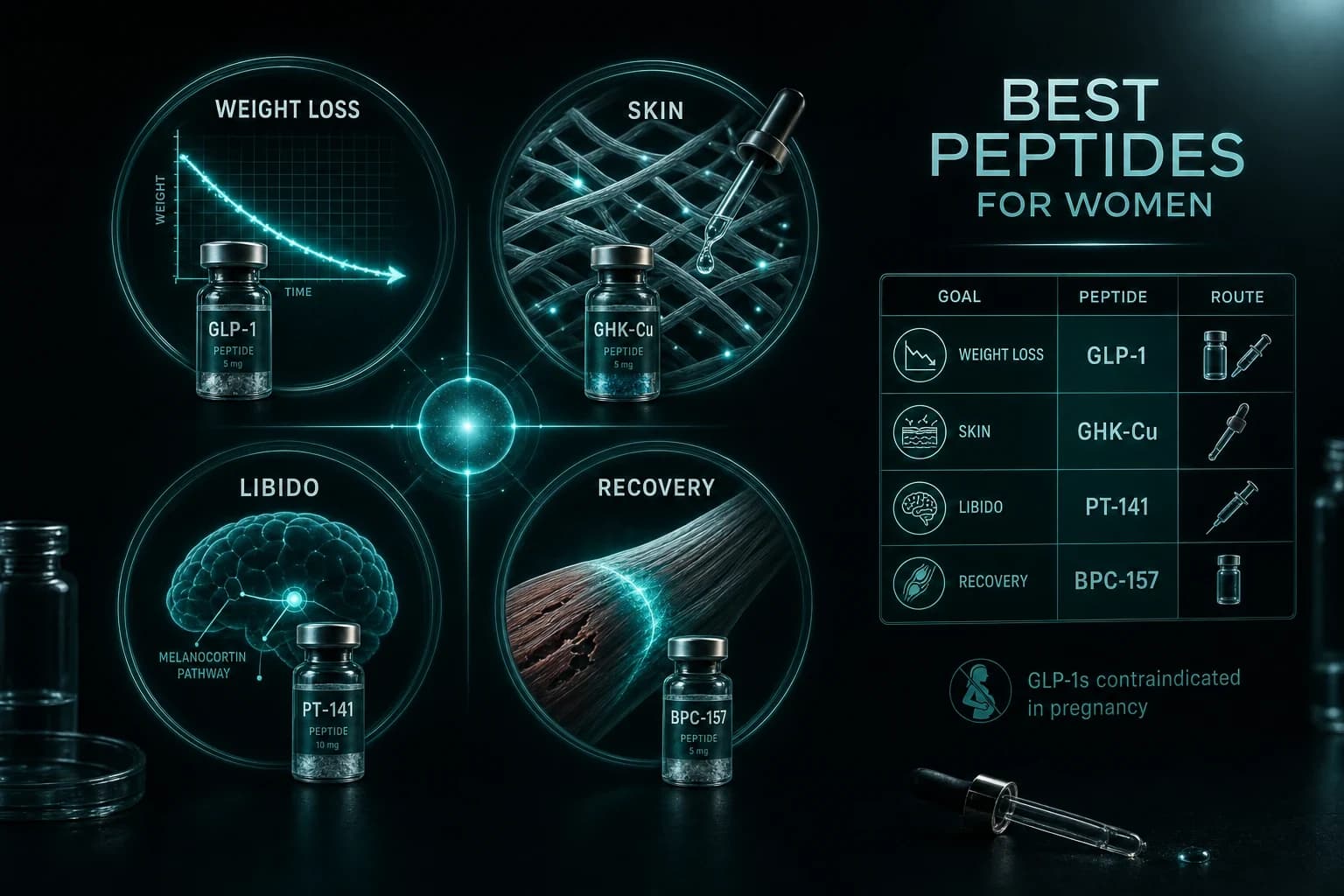
| Goal | Top peptide | Evidence in women | How to access |
|---|---|---|---|
| Weight loss | Semaglutide / Tirzepatide | STEP 1 and SURMOUNT-1, majority-female cohorts | Prescription via supervised telehealth |
| Skin & anti-aging | GHK-Cu | Collagen synthesis, skin remodeling (Pickart 2015) | Topical / research compound |
| Libido (low desire) | PT-141 (bremelanotide) | FDA-approved for premenopausal women | Prescription (Vyleesi) |
| Recovery & tissue repair | BPC-157 / TB-500 | Animal tendon and muscle models | Research compound |
| Hair | GHK-Cu, thymosin beta-4 | Follicle and dermal signaling (early) | Topical / research compound |
Weight loss: the GLP-1 peptides, and why the data is genuinely female-heavy
This is the category with the best evidence and, conveniently, the best evidence in women specifically. The large GLP-1 trials did not just include women. They were built on them.
In STEP 1, the pivotal trial for weight-management semaglutide, participants on 2.4 mg weekly lost an average of 14.9% of body weight over 68 weeks versus 2.4% on placebo (Wilding et al. (2021)). Roughly three-quarters of that cohort were women. When people say semaglutide "works for women," this is the trial they are unknowingly quoting.
Tirzepatide raised the ceiling. In SURMOUNT-1, the highest dose produced an average 20.9% body-weight reduction at 72 weeks, again in a predominantly female population (Jastreboff et al. (2022)). It hits two receptors, GIP and GLP-1, which is the leading theory for why the numbers run higher than semaglutide alone.
A detail the listicles skip: GLP-1 weight loss in women is not purely cosmetic. Excess weight drives PCOS symptoms, insulin resistance, and fertility complications, so the metabolic shift often does more than change a dress size. That is also exactly why the pregnancy warning below is non-negotiable.
Warning: GLP-1 peptides (semaglutide, tirzepatide) are contraindicated in pregnancy and while breastfeeding. Animal data show fetal risk, and the drugs are designed to restrict caloric intake at a time when the opposite is required. If you could become pregnant, you need reliable contraception on these, and most protocols advise stopping well before trying to conceive. This is a conversation for your prescriber, not a forum.
If weight loss is your goal, do not order raw peptide and freelance it. These are prescription medications, and the dose titration is where people either succeed or quit from nausea. A supervised program handles the ramp for you.
Bottom line: For weight loss, work with a licensed clinic. Yucca Health runs supervised compounded GLP-1 programs, and our cheapest GLP-1 breakdown compares what you will actually pay. Start with semaglutide if you want the longest safety record, or read the best peptides for weight loss for the full comparison.
Skin and anti-aging: GHK-Cu is the one with real data
If you have bought a "peptide serum" in the last five years, there is a decent chance it contained GHK-Cu, or wanted you to think it did. Unlike most cosmetic peptide claims, this one has decades of mechanistic work behind it.
GHK-Cu is a copper-binding tripeptide the body produces naturally, and its levels fall with age. It stimulates collagen and elastin synthesis, supports skin remodeling, and shows antioxidant and wound-signaling activity across a large body of research (Pickart et al. (2015)). In practical terms, that maps to the outcomes women actually want from an anti-aging product: firmer texture, better tone, less crepey thinning.
It is applied topically or used as a research compound rather than injected for cosmetic purposes, which makes it one of the more accessible entries here. The tradeoff is patience. Collagen remodeling is a months-long process, not a weekend glow.
Tip: GHK-Cu and vitamin C compete for the same skin chemistry and can destabilize each other. Use them at different times of day, copper peptide at night, ascorbic acid in the morning, rather than layering them wet-on-wet.
Want to see what realistic timelines look like before you spend money? Our GHK-Cu before and after breakdown walks through what changes at 4, 8, and 12 weeks, and the GHK-Cu compound page covers concentrations and formats.
Libido and sexual health: the one peptide approved for women only
Here is the fact that reframes this entire category. PT-141, generic name bremelanotide, sold as Vyleesi, is FDA-approved for one indication: acquired, generalized hypoactive sexual desire disorder (HSDD) in premenopausal women. Not men. Women.
It works upstream of the plumbing. Most sexual-health drugs target blood flow. PT-141 activates melanocortin receptors in the brain, acting on desire itself, which is why it was developed for low libido rather than mechanical dysfunction. In the RECONNECT program, the Phase 3 trials behind approval, bremelanotide produced statistically significant improvements in sexual desire and reductions in distress versus placebo in premenopausal women with HSDD (Kingsberg et al. (2019)).
Low desire in women is routinely dismissed or blamed on stress and relationships. Sometimes that is the cause. But HSDD is a recognized clinical diagnosis with an approved pharmacological treatment, and that is worth knowing if you have been told to just relax about it.
The honest caveat: nausea is the most common side effect, and it is dosed on-demand ahead of activity rather than daily. If this is your goal, the PT-141 compound page covers timing and what to expect, and the prescription version is something to raise with a licensed provider.
Recovery and tissue repair: promising, but read the fine print
BPC-157 and TB-500 (a thymosin beta-4 fragment) dominate the recovery conversation. They show genuinely interesting effects on tendon, ligament, and muscle healing, plus angiogenesis, in animal models. For active women dealing with a nagging tendon or a slow-healing injury, the appeal is obvious.
The fine print: the strong data is preclinical. These are rat and cell studies, not randomized human trials, and they were not designed around female physiology or anyone's physiology in a clinical sense. That does not make them useless. It makes them research compounds you evaluate honestly, not proven therapeutics. Anyone selling them as a sure thing is overselling.
They are sourced and dosed differently from the prescription peptides above, and reconstitution is where people make expensive mistakes. If you go this route, run your vial math through the reconstitution calculator so 250 mcg is actually 250 mcg.
Hair: thin data, but a real mechanism
Female hair thinning is common, under-discussed, and mostly served by products designed for male-pattern loss. The peptide angle is early but not baseless.
GHK-Cu appears again here. The same copper-peptide signaling that remodels skin also influences the dermal environment around hair follicles, and it shows up in a growing number of scalp formulations. Thymosin beta-4 has follicle-signaling activity in preclinical work as well. Neither has the trial weight of a GLP-1, and honest framing matters: this is a reasonable adjunct to evidence-based treatments, not a replacement for a dermatologist if you are shedding noticeably.
A caution about "peptides studied in men"
One more thing the generic guides get wrong. Growth-hormone secretagogues like sermorelin and CJC-1295/ipamorelin get recommended to women for body composition and lean mass. But much of the frequently cited lean-mass and body-composition data on GH-axis peptides came from male-only or male-dominant cohorts. Hormonal context differs meaningfully between sexes, so extrapolating those specific numbers to women is a guess, not a finding. Treat lean-mass claims for these compounds as unproven in women until the trials exist.
So which peptide is right for you
Match the compound to the goal, then match the route to the compound.
- Weight loss is the highest-evidence use, and it runs through a prescriber. GLP-1s like semaglutide and tirzepatide have the female-heavy trial data to back them.
- Skin and anti-aging point to GHK-Cu, the one cosmetic peptide with decades of mechanism behind it.
- Low libido has a genuinely female-specific, FDA-approved option in PT-141.
- Recovery and hair are the "promising but early" tier: worth exploring with clear eyes, not the sure things weight loss has become.
Bottom line: If weight loss is the goal, go supervised: compare programs on our cheapest GLP-1 page and get titrated by a licensed clinic rather than guessing. For skin, recovery, and research compounds, Ascension Peptides carries GHK-Cu and repair peptides at 50% off with code ENHANCED.
Disclaimer
This article is for educational purposes and is not medical advice. GLP-1 medications (semaglutide, tirzepatide) and bremelanotide (PT-141/Vyleesi) are prescription drugs that require evaluation and supervision by a licensed clinician; do not obtain or dose them without one. GLP-1 peptides are contraindicated in pregnancy and breastfeeding. Research peptides such as BPC-157 and TB-500 are laboratory-use compounds that are not approved for human use and have not been established as safe or effective in clinical trials. Talk to a qualified healthcare provider before starting any peptide, especially if you are pregnant, trying to conceive, breastfeeding, or managing a medical condition.