At a glance
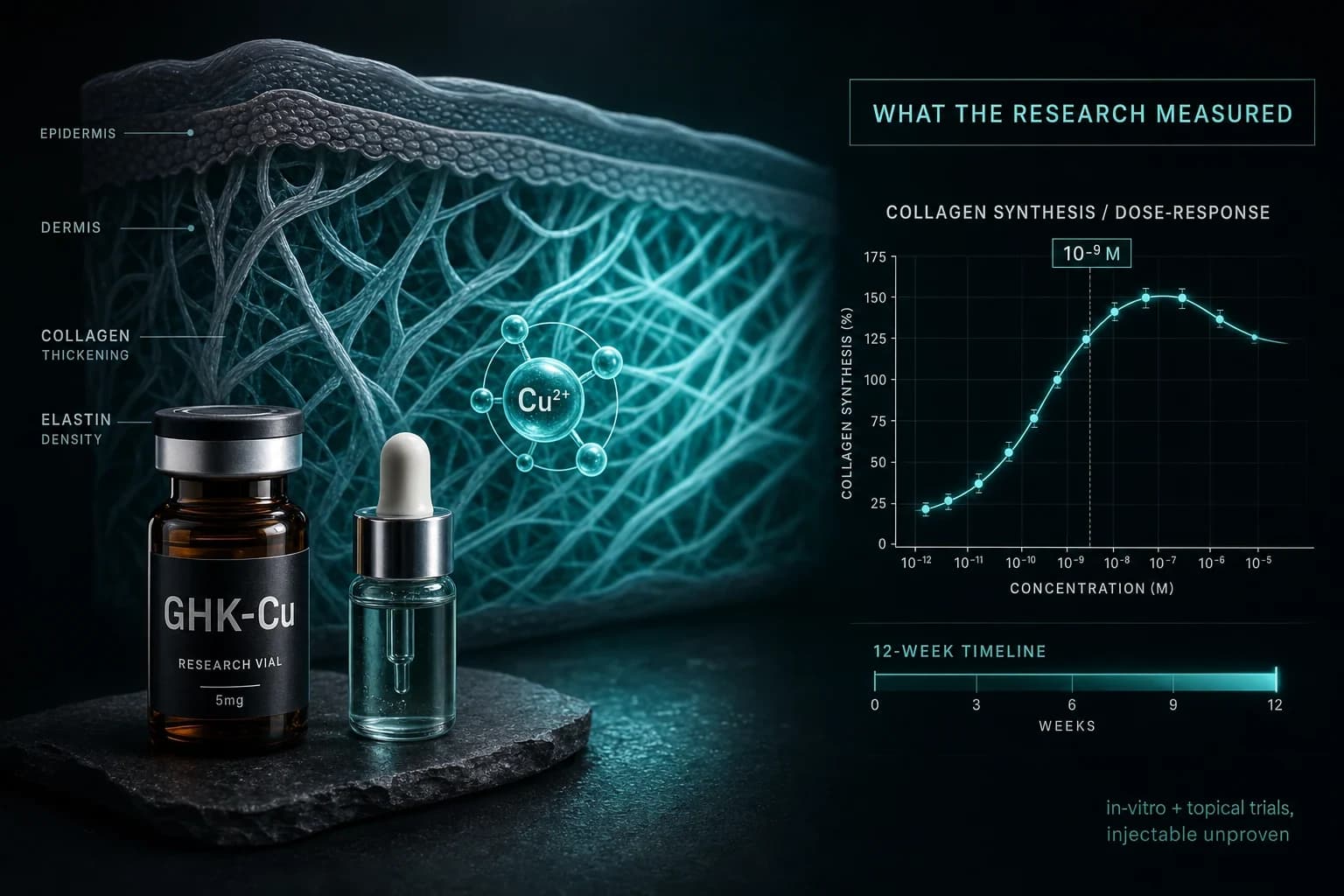
- GHK-Cu raised fibroblast collagen synthesis starting near 10^-12 M, peaking at 10^-9 M (Maquart 1988).
- In diabetic mice, copper-peptide scaffolds sped wound closure and collagen deposition (Yang 2022).
- Pickart's review reports GHK can modulate at least 4,000 human genes.
- Cosmetic topical trials tracked firmness and wrinkle changes over roughly 12 weeks.
- Injectable GHK-Cu is an unapproved research compound, not a proven human treatment.
In 1988, a team led by Maquart and Pickart added the copper tripeptide GHK-Cu to fibroblast cultures and watched collagen synthesis climb, with the effect starting between 10^-12 and 10^-11 M and peaking at 10^-9 M (Maquart et al. (1988)). That single dose-response curve is the honest starting point for any "GHK-Cu before and after" conversation. The interesting numbers are real, but they come from cell cultures, animal wounds, and small cosmetic trials, not from dramatic personal transformations.
If you searched for before-and-after photos, here is the reframe worth making. Most of what you find online is marketing. What follows is what published research actually measured: which parameter moved, in what model, over what timeframe, and how it was quantified. GHK-Cu (glycyl-L-histidyl-L-lysine bound to copper 2+) is a naturally occurring human tripeptide that declines with age, and it has one of the deeper research files among cosmetic peptides. For the compound-level primer, see the GHK-Cu peptide overview.
Bottom line: The strongest GHK-Cu evidence is for collagen stimulation in vitro, wound repair in animals, and modest skin-parameter changes in topical cosmetic trials. There is no published data showing injectable GHK-Cu delivers cosmetic "before and after" outcomes in humans.
What "before and after" means in the research
In a study, a before-and-after is a measured delta: collagen output before exposure versus after, wound area on day 0 versus day 14, a cutometer elasticity reading at baseline versus week 12. Those deltas are what let us talk about GHK-Cu without inventing outcomes.
The distinction that matters most is delivery route. Topical GHK-Cu has the better human evidence base, because copper peptides have been studied in cosmetic formulations for decades (Wang et al. (2021)). Injectable GHK-Cu, the version sold as research vials, has essentially no controlled human cosmetic data behind it. Treating the two as interchangeable is the single biggest error in this niche.
The evidence timeline
| What changed | Study | Model and timeframe | How it was measured |
|---|---|---|---|
| Collagen synthesis rose | Maquart et al. (1988) | Human fibroblast cultures, in vitro | Radiolabeled collagen output across a dose curve |
| Wound closure and collagen deposition accelerated | Yang et al. (2022) | Healthy and diabetic mice, days to full closure | Wound-area imaging plus histology |
| Firmness, elasticity, wrinkle depth improved | Pickart et al. (2015) | Human topical cosmetic products, ~12 weeks | Instrument readings and clinical grading |
| Broad gene expression shifted | Pickart & Margolina (2018) | Cell cultures, single exposure | Microarray gene profiling |
| Anti-oxidant and repair pathways engaged | Pickart et al. (2012) | In vitro and biochemical assays | Pathway and marker analysis |
Read that table left to right and the pattern is clear. The mechanistic work is strong and reproducible. The human cosmetic work is real but modest and topical. The injectable cosmetic work does not exist in the peer-reviewed record.
Collagen: the most reproducible signal
The collagen finding is the one that keeps showing up. In the original fibroblast work, GHK-Cu stimulated collagen synthesis independent of any change in cell number, meaning the cells were not just multiplying, they were each producing more matrix (Maquart et al. (1988)). A later review documented that GHK also drives synthesis of elastin, glycosaminoglycans, dermatan sulfate, and the small proteoglycan decorin, while modulating both matrix metalloproteinases and their inhibitors (Pickart et al. (2015)).
Two caveats keep this honest. First, this is cultured-cell and review data, not a controlled trial showing thicker dermal collagen in living people. Second, GHK stimulates both the synthesis and the breakdown of collagen, which is how healthy tissue remodels rather than simply piling on matrix. The "before and after" here is a biochemistry readout, not a skin biopsy from a cosmetic user.
Wound healing: strong in animals
GHK-Cu earned its reputation in wound research. In a 2022 study, copper-peptide-functionalized scaffolds significantly accelerated wound closure, collagen deposition, and tissue remodeling in both healthy and diabetic mice, with upregulated eNOS and CD31 pointing to improved blood-vessel formation (Yang et al. (2022)). Better vascularization is a plausible mechanism for faster repair, since new tissue needs a blood supply.
The timeframe in wound models is days to a couple of weeks for full closure, which is much faster than the 8-to-12-week horizon typical of cosmetic skin studies. Do not transplant a mouse wound-closure timeline onto expectations for human skin quality. Different tissue state, different endpoint, different species.
Skin firmness and elasticity: the human topical data
This is where cosmetic buyers actually live. Reviews of copper-peptide cosmetic products report that topical GHK has been found to tighten loose skin and improve elasticity, skin density, and firmness, reduce fine lines and wrinkles, reduce photodamage and hyperpigmentation, and increase keratinocyte proliferation (Pickart et al. (2015)). An esthetics-focused review similarly places tripeptide and hexapeptide topicals among the peptides with a plausible evidence trail for skin appearance (Wang et al. (2021)).
The realistic read: these are modest, instrument-measured improvements over roughly 12 weeks of consistent topical use, not overnight resurfacing. The cosmetic-trial literature is smaller and less rigorous than pharmaceutical trials, often industry-run, and short. Genuine, but modest, is the accurate framing.
The gene-expression story
Part of why GHK generates so much interest is its breadth of action. Pickart's review reports the peptide is capable of up- and down-regulating at least 4,000 human genes, described as resetting expression toward a healthier state (Pickart et al. (2015)). A later analysis in light of newer gene data found GHK modulated expression of roughly 31.2% of the genes it profiled, spanning tissue-repair, anti-inflammatory, and anti-oxidant pathways (Pickart & Margolina (2018)). Earlier work tied GHK to oxidative-stress defense and repair mechanisms relevant to aging (Pickart et al. (2012)).
That scope is genuinely striking, and it is also why caution is warranted. A molecule that touches a third of the transcriptome in a dish is a molecule whose full effects in an injected human are not characterized. Breadth of action is not the same as a proven benefit.
Delivery is the whole game
Copper peptides are hydrophilic and do not cross the skin barrier freely. Researchers have used microneedle systems specifically to push copper peptide through skin because passive penetration is limited (Li et al. (2015)). That fact cuts both ways. It means topical formulation quality matters enormously, and it is part of why people experiment with injectable forms, chasing systemic delivery the research has not validated for cosmetic use.
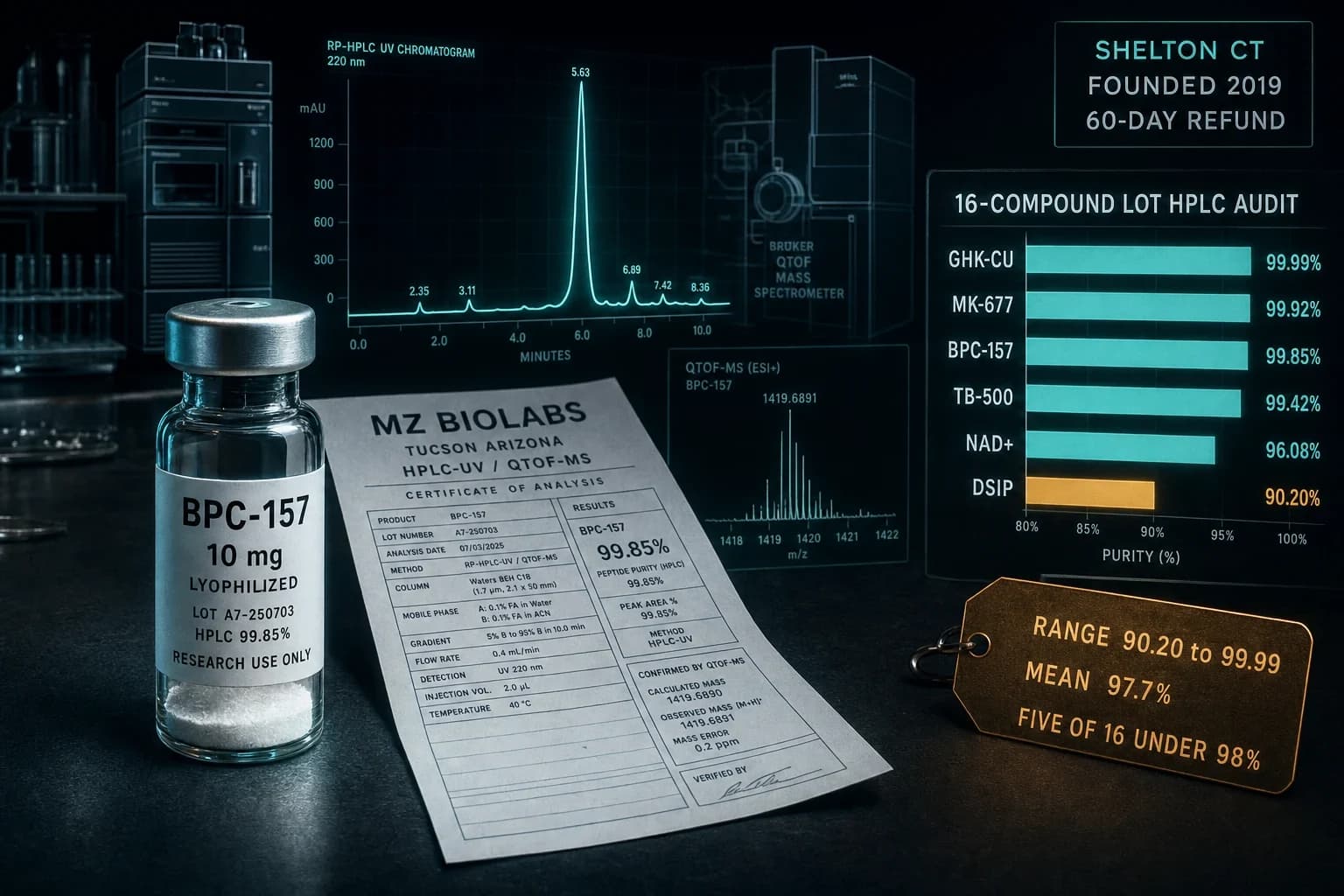
If you are comparing product routes and sourcing, the where to buy GHK-Cu in 2026 guide breaks down formats and vendor verification, and anyone running a research protocol should confirm purity through third-party lab tests rather than trusting a label.
Hair: an emerging, thinner file
GHK-Cu also shows up in hair research, since the same wound-healing and matrix pathways operate around the follicle, and the skin-regeneration review notes wound-healing effects extending to hair follicles (Pickart et al. (2015)). The evidence here is thinner than the skin data. If that is your goal, read the dedicated GHK-Cu hair-loss research protocol rather than extrapolating from wound-closure studies.
Warning: Almost all GHK-Cu data is in-vitro, animal, or small topical cosmetic trials. Injectable GHK-Cu is a research compound, not approved for human use, and copper compounds can carry skin-toxicity signals depending on the form and concentration (Li et al. (2016)). No published human trial supports injecting GHK-Cu for cosmetic before-and-after results.
Setting honest expectations
If you internalize one thing, make it this: the research documents mechanisms and modest topical changes, not the dramatic transformations that before-and-after galleries imply. The collagen biochemistry is solid. The animal wound data is encouraging. The human topical skin data is real but modest and slow, measured over months. The injectable cosmetic case is unproven.
For anyone handling research-grade material, dosing accuracy is non-negotiable. Work from a documented GHK-Cu dosage chart and use a reconstitution calculator so concentrations are precise rather than guessed.
Where to get research-grade GHK-Cu
For lab-use-only research, Ascension Peptides supplies GHK-Cu in injectable and topical research formats, with third-party testing and code ENHANCED for 50% off, and our where to buy GHK-Cu guide covers how to verify it. This is sold strictly for laboratory and research use, not for human administration, and nothing here is medical advice or an endorsement of self-experimentation.
Disclaimer: This article is for educational and informational purposes only. GHK-Cu, particularly in injectable form, is a research compound and is not approved by the FDA for human use. Nothing here is medical advice, a treatment recommendation, or a claim of cosmetic or therapeutic benefit. The studies cited measured outcomes in cell cultures, animals, or topical cosmetic products, and those results do not predict outcomes in any individual. Consult a qualified healthcare professional before using any peptide.