At a glance
- 'No subscription' is really four separate asks: no membership fee, no auto-renewal, month-to-month billing, or a one-time fill without re-enrollment.
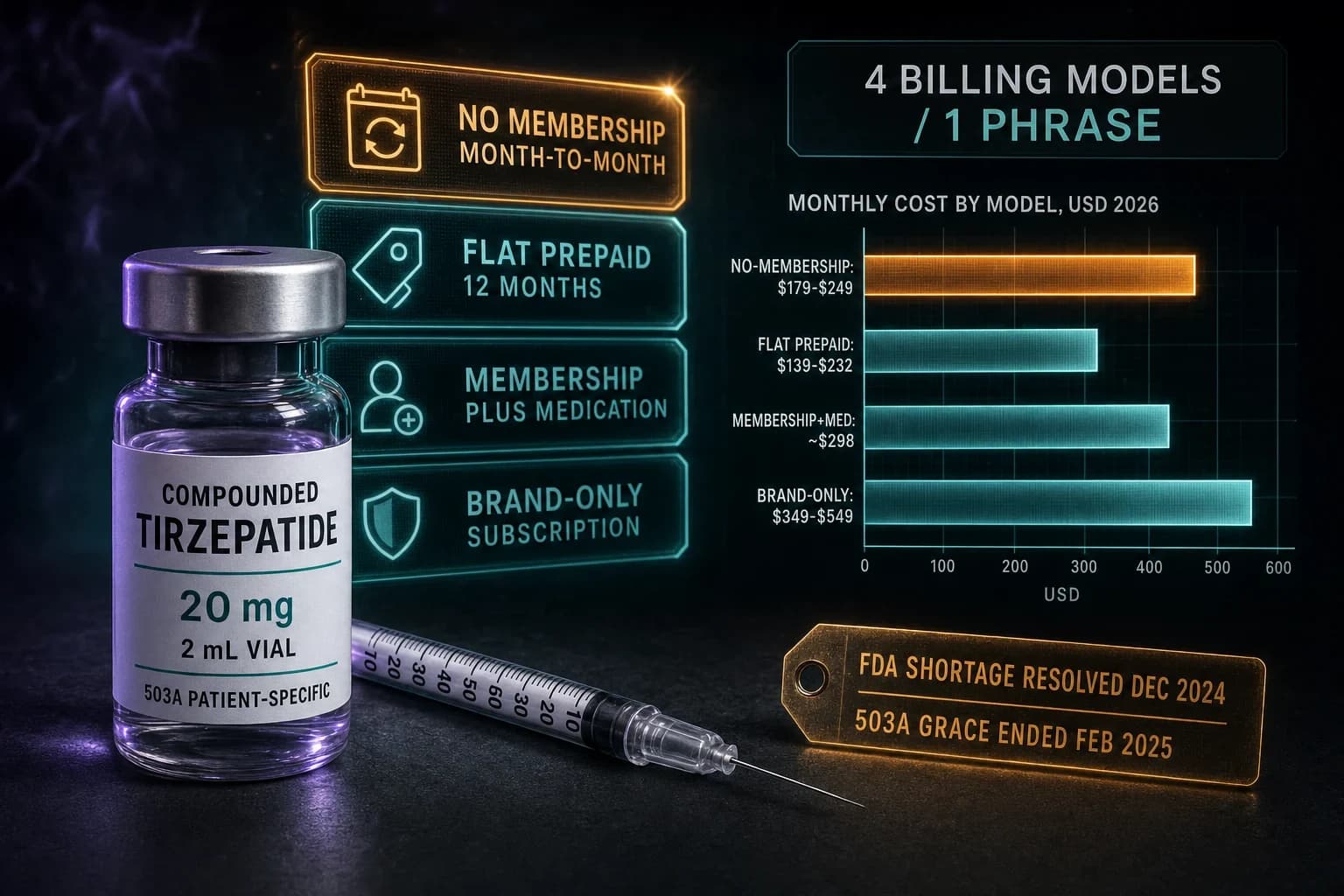
- Compounded tirzepatide left the FDA shortage list in late 2024; the 503A grace period ended February 2025 and most surviving access is patient-specific.
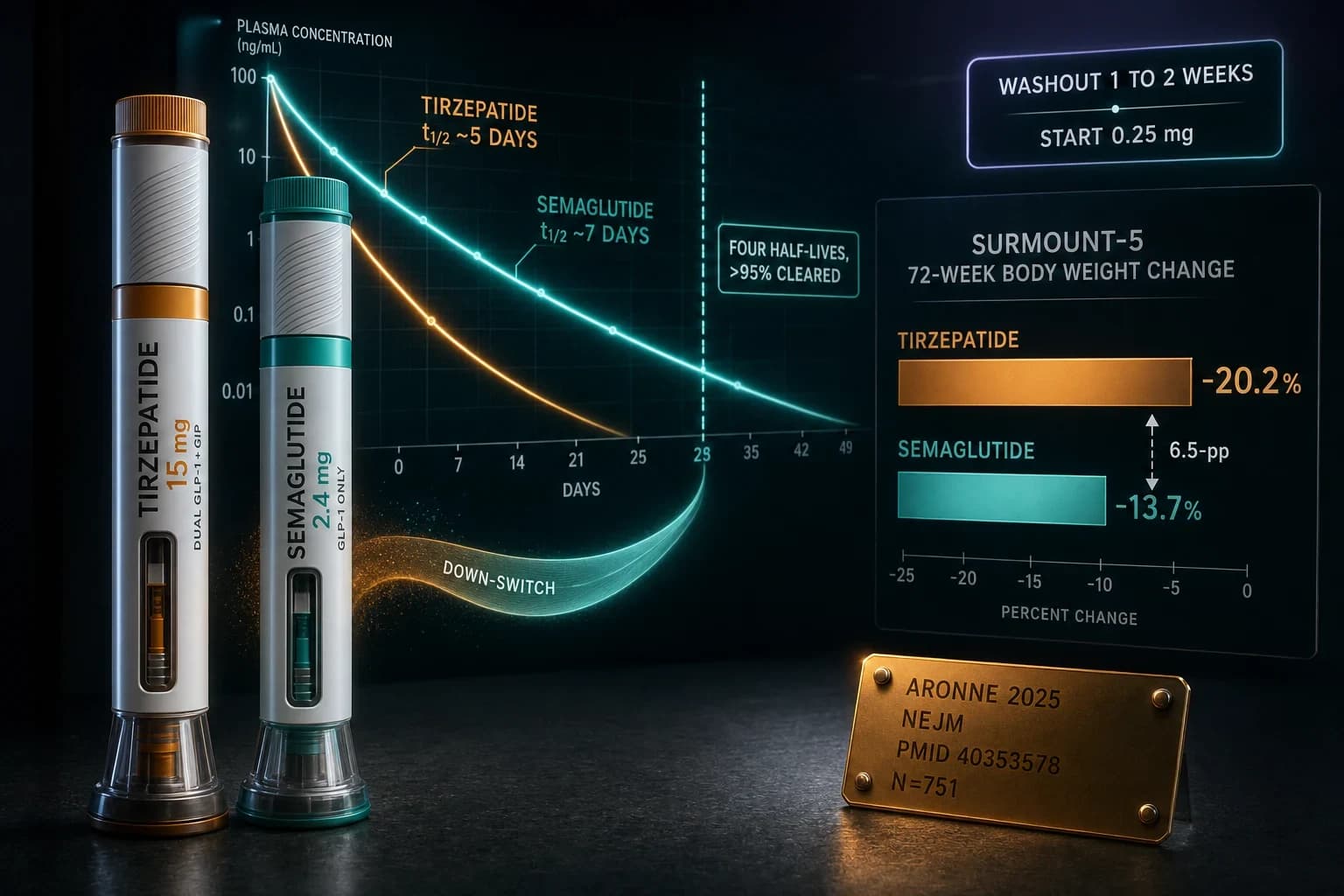
- SURMOUNT-5 (Aronne 2025, NEJM, PMID 40353578) measured 20.2% weight loss on tirzepatide versus 13.7% on semaglutide at 72 weeks.
- Compounded tirzepatide ships as a multidose vial with no standard concentration, raising dosing-error risk the Zepbound pen does not carry.
- Membership-free compounded tirzepatide in 2026 runs roughly $179 to $249 month-to-month, with $139 to $179 effective rates on 12-month prepay.
"No subscription" is one of the most-searched promises in compounded GLP-1 marketing and one of the least precise. Shoppers mean at least four different things by it, and most telehealth programs quietly meet only one or two of them. The honest answer in late 2026 depends on three regulatory shifts and one fact about how compounded tirzepatide gets delivered that landing pages almost never explain.
Type "tirzepatide online no subscription" into Bing today and you get a stack of vendor pages and affiliate rankings that treat the phrase as a yes-or-no feature flag. It is not. It is a composite ask hiding four separate questions, and ignoring the ambiguity is how buyers end up locked into a 12-month prepay they thought they could cancel.
What "no subscription" actually means
The phrase bundles four distinct things buyers care about:
- No membership fee on top of the medication cost. A monthly add-on charge that gets you access to the clinic without covering any dose.
- No auto-renewal. The clinic does not charge your card again when the shipment runs out.
- True month-to-month billing. You pay for one month and can walk after one month, with no multi-month prepay required.
- One-time fill without re-enrollment. You buy a single vial, use it, and are done. No further prescriber relationship, no refills.
Only one of these is a "no subscription" in the strict sense. The other three are variations of a subscription with a looser exit. Marketing copy equivocates between them because the first three are easy to deliver and the fourth is incompatible with how 503A compounding works in 2026.
The clearest signal that the market is using the phrase loosely: Weight Loss Rankings and ConsumerAffairs both describe Bodybuilding Health+ as having "no membership fee" (true: there is no separate access charge on top of the medication) while the same provider's cheapest advertised rate requires a prepaid six or twelve-month term. That is "no membership" and simultaneously "yes subscription" by the stricter definition. Both statements can be accurate on the same landing page.
Note: The ambiguity is partly regulatory. 503A patient-specific compounding requires a valid prescription at the time of each fill. A clinic that commits to zero re-enrollment cost cannot also commit to zero clinician relationship. "One-time fill, no re-enrollment" is therefore structurally rare in US-licensed telehealth today.
The post-shortage regulatory shift
The buying rules changed in late 2024 and early 2025, and most SERPs still reflect the older ones. Three dates matter:
- October 2024. FDA removed tirzepatide from the drug shortage list. The removal was reconsidered and reaffirmed in a December 2024 declaratory order.
- February 18, 2025. End of enforcement discretion for 503A state-licensed pharmacies compounding tirzepatide for the general population. 503A pharmacies may still compound patient-specific prescriptions, but only when a prescriber documents a clinical need not met by the FDA-approved product (allergy, dose, delivery form).
- March 19, 2025. End of enforcement discretion for 503B outsourcing facilities compounding tirzepatide at scale.
In late 2026 the compounded tirzepatide market is smaller and narrower than it was two years ago. The providers who survived are 503A pharmacies working through telehealth clinics on patient-specific prescriptions. Most of them require a brief clinician visit (telehealth video or asynchronous intake) that pattern-matches to the FDA's clinical-need requirement. That visit is not a subscription in the ordinary sense, but it is also not a one-click vial purchase.
Our compounded tirzepatide legal access guide walks the regulatory shift and what each pharmacy class may still do. Our cheapest tirzepatide access guide ranks the surviving options by cash price per milligram.
Four billing models, four different "no subscription" promises
Here is how the current market maps to the four asks:
| Billing model | How it bills | Membership fee? | Prepay required? | Cancel at any point? | Representative monthly cost (2026) |
|---|---|---|---|---|---|
| No-membership month-to-month | One monthly charge covers everything | No | No | Yes | $179 to $249 |
| Prepaid flat multi-month | One upfront charge for 3, 6, or 12 months | No | Yes | Not after medication ships (no refunds) | $139 to $232 effective |
| Membership plus medication | Separate monthly access fee plus the drug | Yes, roughly $99 | No | Yes | ~$298 all-in |
| Brand-name subscription | FDA-approved Zepbound with a program fee | Varies | No | Yes | $349 to $549 |
Our hands-on review of Bodybuilding Health+ documents a no-membership model where the cheapest advertised monthly rate requires a multi-month prepay, so the "no subscription" claim is accurate only in model one of the table and marketing-accurate in model two.
Several providers who used to sit in model two have narrowed their offer. Policy Lab reported Bodybuilding Health+ at $159 to $209 per month across six and twelve month terms, with roughly $2,385 billed upfront for the twelve-month plan and no refunds after shipment. If "subscription" means "monthly auto-renewal", the twelve-month plan is subscription-free. If it means "cancel without losing money", it is not.
Model three has mostly left the market. Policy Lab's 2026 ranking lists a handful of clinics that still charge a membership fee on top of the medication, including Eden at roughly $99 per month plus medication (total around $298). Readers searching for "no subscription" are usually trying to exit this exact model.
Model four is the FDA-approved product. Ro and Hims largely withdrew from compounded tirzepatide after the shortage resolution and now sell Zepbound with a program fee. Our how much is tirzepatide on Ro and Hers tirzepatide cost breakdowns detail those specific programs. Our compounded tirzepatide vs Zepbound comparison runs the honest side-by-side on cost per milligram.
Where the "no monthly plan" promise usually breaks
Three failure modes recur across the SERP:
Prepay-plus-no-refund. The twelve-month plan ships you a bulk order upfront, usually in 3 to 4 shipments, and is non-refundable after the first shipment lands. You can "cancel at any time" in the sense that your card is not re-charged, but you cannot get the remaining prepaid balance back. If you tolerate the medication badly or your weight response plateaus, you own the remaining doses.
Bundled clinician visit on refill. Many 503A clinics require a short re-engagement every 90 days to document continuing clinical justification. That is a soft subscription even when the billing is month-to-month, because skipping the visit cancels your eligibility.
Advertised monthly rate assumes the longest term. Policy Lab's $159 per month figure for one provider was its twelve-month rate. The actual one-month purchase price was higher. Pay attention to the small text under the price on the landing page.
Warning: No-refund after shipment is standard in the compounded GLP-1 market in 2026 and is not a sign of a bad clinic. It is how 503A pharmacies protect against drug diversion. Plan to use what you buy, not to walk away from it.
What the clinical evidence actually supports
The reason "no subscription" matters at all is that tirzepatide earns its demand on real evidence. The data below is why buyers tolerate the regulatory complexity in the first place.
SURMOUNT-1 (Jastreboff et al. 2022, NEJM, PMID 35658024) randomized 2,539 adults with obesity or overweight plus a weight-related complication, without type 2 diabetes, to tirzepatide 5, 10, or 15 mg weekly or placebo for 72 weeks. Mean body weight change at the 15 mg dose reached roughly -22.5%. In the placebo arm, 3% of participants reached a 5% or greater weight reduction (versus 85% to 91% across the tirzepatide doses).
SURMOUNT-2 (Garvey et al. 2023, Lancet, PMID 37385275) ran the same template in 938 adults with obesity and type 2 diabetes. Mean weight loss at 72 weeks was 12.8% on the 10 mg dose and 14.7% on 15 mg. Diabetes damps weight response in GLP-1 trials, so the roughly 7-percentage-point gap below SURMOUNT-1 is expected rather than a quality problem.
SURMOUNT-4 (Aronne et al. 2024, JAMA, PMID 38078870) is the discontinuation trial most buyers underweight. After a 36-week open-label lead-in on tirzepatide, participants were randomized to continue the drug or switch to placebo for 52 more weeks. The continuation group lost another 6.7%, reaching about 26% total loss over 88 weeks. The placebo group regained 14.8% of their stabilized body weight. Stopping the medication did not preserve the loss.
SURMOUNT-5 (Aronne et al. 2025, NEJM, PMID 40353578) is the head-to-head against semaglutide. In 751 adults without diabetes over 72 weeks, tirzepatide produced 20.2% mean weight loss versus 13.7% on semaglutide, a 6.5-percentage-point gap at each drug's maximum tolerated dose. Discontinuation for gastrointestinal reasons was slightly lower on tirzepatide (2.7% versus 5.6%). Our SURMOUNT-5 evidence review has the full breakdown.
SURPASS-2 (Frías et al. 2021, NEJM, PMID 34170647) is the diabetes-indication head-to-head. Tirzepatide 15 mg lowered HbA1c 2.46 percentage points versus 1.86 on semaglutide 1 mg at 40 weeks.
Pharmacokinetics explain why these trials used once-weekly subcutaneous dosing. The population PK model from Schneck and Urva (2024, CPT Pharmacometrics, PMID 38356317) places tirzepatide's half-life near 5 days with mean subcutaneous bioavailability around 80% (per the Zepbound label). Steady state arrives after roughly four weekly doses. See our tirzepatide dosage chart for the standard titration ladder and our tirzepatide compound page for mechanism and indications.
The one risk a subscription-free vial introduces
Membership-free compounded tirzepatide usually ships as a multidose vial, not as the fixed-dose pen Zepbound uses. That design choice solves a cost problem and introduces a dosing-error problem.
Approved Zepbound comes as a single-use autoinjector pre-set to one of six doses. Compounded tirzepatide is almost always a vial of concentrated solution (commonly 10, 15, 20, or 25 mg per vial at variable concentrations) with an accompanying insulin syringe. The pharmacy sets the concentration; the patient draws the volume. There is no standard mg-per-mL across the market.
The FDA has flagged this as a safety issue. As of May 2026 the agency reportedly held about 730 adverse event reports tied to compounded tirzepatide, with dosing errors a recurring category. A 2024 FDA letter described prescribers starting patients at two to four times the recommended starting dose and titrating every one to two weeks instead of every four. The National Association of Boards of Pharmacy published a 2026 attachment showing how a 17 mg/mL multidose vial can lead a patient to discard most of the vial's contents when the written milligram dose does not match the vial's concentration.
Three practical safeguards:
- Confirm the concentration on the label, not just the total milligrams. The same written dose (for example "2.5 mg") requires different volumes at 10 mg/mL versus 15 mg/mL.
- Use the pharmacy's own dose chart, not a generic Zepbound titration schedule. The volume math does not transfer.
- Keep the vial refrigerated (2 to 8 C) between doses. Most compounded formulations have beyond-use dates of 28 to 42 days once accessed. The reconstitution and sterility fundamentals are covered in our reconstitution calculator and the broader peptide reconstitution guide.
Our best tirzepatide compounding pharmacy comparison ranks the surviving 503A providers on concentration disclosure and labeling quality.
Tip: Before your first self-injection, verify three numbers on the label: total milligrams in the vial, total milliliters in the vial, and milligrams per milliliter. If any of them is missing, call the pharmacy before drawing. A reputable 503A clinic will send dose instructions in writing with each shipment.
A decision tree for buying without a plan lock
Match the ask to the actual billing model:
If "no subscription" means "no membership fee": Choose a model-one provider that bundles everything into one monthly charge. Bodybuilding Health+ sits here with month-to-month pricing around $179 to $249.
If it means "I only want one or two months": Month-to-month at a model-one clinic is the right path. Expect to pay a per-month premium compared with the twelve-month rate. The premium is the price of optionality, and it is usually $30 to $70 per month.
If it means "I will take twelve months but no card on auto-renewal": A prepaid flat multi-month plan is fine, but accept the no-refund risk. Confirm the first shipment's refund window in writing before you pay.
If it means "one vial, no clinician relationship": This is the hardest ask to meet in 2026. US-licensed compounded tirzepatide requires an active prescriber relationship under 503A rules. The only alternative is a research-use-only peptide market that is legally and operationally different, with no US clinician in the loop and no clinical supervision. For a GLP-1 molecule used chronically, that path trades a small saving for a large unknown.
Our cheapest tirzepatide hub carries the live cash-price ranking across the surviving providers.
What you give up with no program behind you
Membership-based programs charge a fee because they are selling continuity. Dropping the fee drops some of what the fee bought:
- Dose titration decisions are usually the patient's call rather than a prescriber's. The clinic will fill the prescription at the dose on file.
- Side-effect management happens through asynchronous messaging rather than scheduled follow-ups. Response times are slower.
- Weight-plateau conversations are harder to have. Model-one clinics are set up to fill, not to coach.
- Supply gaps are more frequent. A no-membership clinic has lower carrying costs and sometimes thinner inventory.
None of these are deal-breakers for an informed buyer who has read the SURMOUNT trials and knows the titration ladder. They are deal-breakers for someone looking for a program that will tell them what to do each month. If that is you, pay the membership fee; it is cheap for what it buys.
Brand-name Zepbound as the no-compound alternative
If "no subscription" is really a proxy for "no compounded uncertainty", the honest answer is to pay for brand-name Zepbound. Lilly's own LillyDirect program sells single-dose vials under the Zepbound Self Pay program at roughly $349 for the 2.5 mg vial and $499 for the 5 mg vial as of mid-2026 cash pricing. There is no monthly program fee and no re-enrollment per fill, so from the buyer's perspective it is the closest the market gets to a true "no subscription" option. The tradeoff is a materially higher price per milligram than compounded.
Our tirzepatide without insurance breakdown runs the LillyDirect math against compounded alternatives.
Honest cost table (2026)
| Path | Who | Monthly cost | Subscription in the strict sense? | Refund after ship? |
|---|---|---|---|---|
| No-membership month-to-month compounded | Bodybuilding Health+ | $179 to $249 | No | Monthly, so n/a |
| Prepaid 12-month compounded | Bodybuilding Health+, Yucca Health | $139 to $179 effective | No | No |
| Brand Zepbound via LillyDirect | Lilly | $349 to $499 per vial | No | Per vial |
| Legacy brand subscription | Ro, Hers | $349 to $549 | Yes | Depends |
The row buyers usually want is row one. Our tirzepatide access guide walks the clinic intake process end-to-end, and the broader telehealth hub covers eligibility checks across the surviving providers.
Bottom line
Bottom line: "Tirzepatide online no subscription" is really four questions wearing one hat. In 2026 the honest answer for most buyers is a model-one no-membership month-to-month compounded program at $179 to $249 per month, with the understanding that cheap multi-month rates still require upfront commitment and that compounded vials carry a dosing-error risk fixed-dose pens do not. Decide which of the four asks you actually have before shopping; the market is pricing them differently.
Research use only. This article summarizes the published clinical evidence and current public reporting on compounded and brand-name tirzepatide. Tirzepatide is an FDA-approved prescription medication. Compounded formulations are not FDA-approved for safety or effectiveness. Nothing above constitutes medical advice. Consult a US-licensed clinician before starting, stopping, or changing any GLP-1 therapy. Prices, programs, and regulatory status change; verify current terms directly with the provider before buying.