At a glance
- Sermorelin is GHRH(1-29); HGH is the hormone itself.
- No adult head-to-head trial of sermorelin vs HGH exists.
- Rudman 1990: HGH 0.03 mg/kg, 3x weekly for 6 months in 12 men aged 61-81.
- Khorram 1997: GHRH analog IGF-I rise faded by week 16; lean mass rose in men only.
- Sermorelin needs a working pituitary; HGH does not.
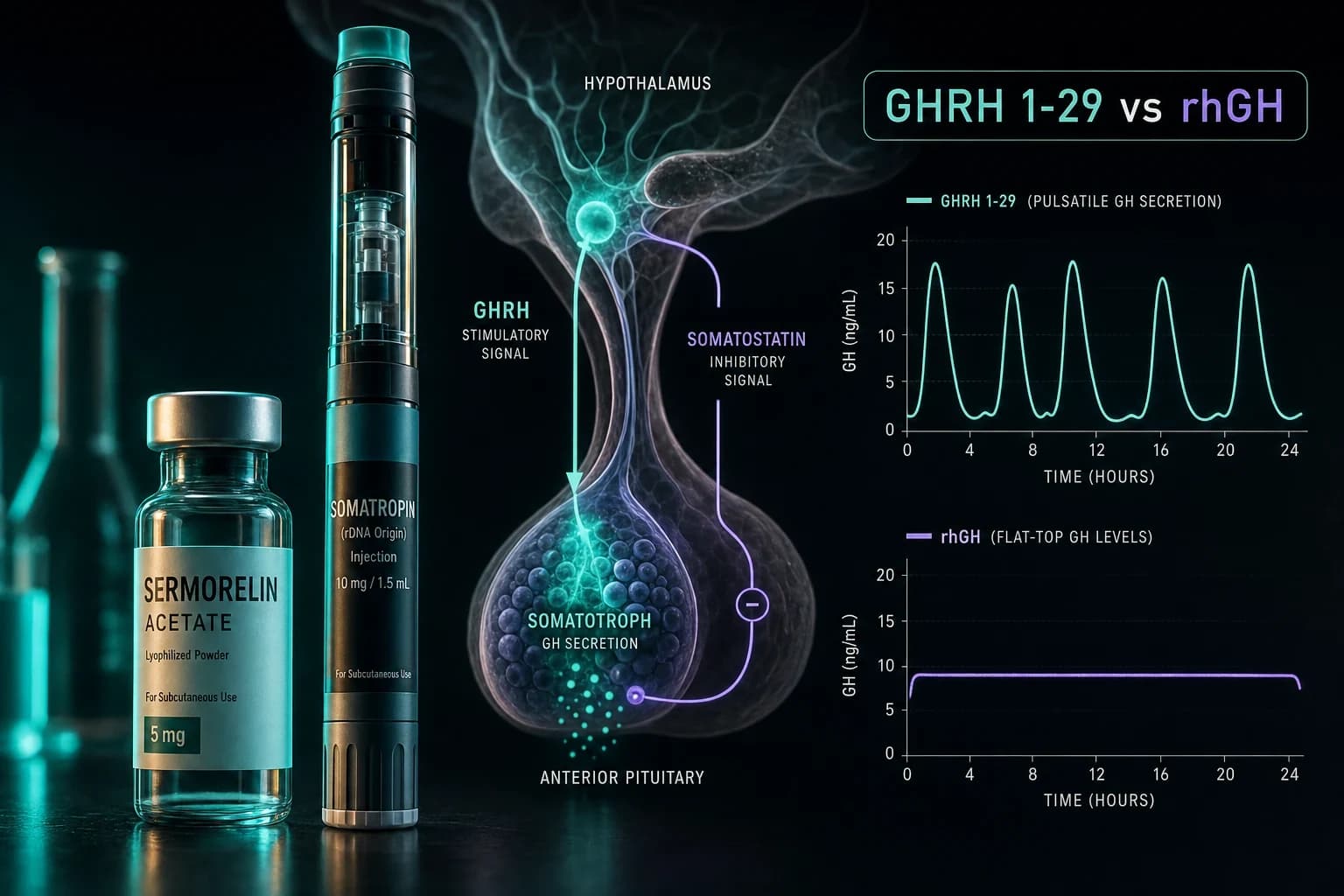
Sermorelin and HGH both raise growth hormone, but only one of them is growth hormone. Sermorelin is GHRH(1-29), the first 29 amino acids of the hormone your hypothalamus uses to tell the pituitary to release GH. HGH (somatropin) is the finished hormone, injected directly. That single difference drives almost everything else you will read about the two: the feedback control, the side-effect profile, the price, and the fact that one is a prescription-only pharmaceutical with decades of adult data while the other has a small, mostly older evidence base.
This guide compares them on the evidence, and it is blunt about where the evidence runs out.
Bottom line: Sermorelin works one step upstream and needs a functioning pituitary. HGH replaces the hormone outright. No head-to-head trial in adults exists, and the one direct pediatric comparison covered only 6 months. Anyone telling you one is simply "better" is extrapolating.
Sermorelin vs HGH at a glance
| Sermorelin (GHRH 1-29) | HGH (somatropin) | |
|---|---|---|
| What it is | Releasing-hormone fragment | The growth hormone itself |
| Where it acts | Pituitary GHRH receptors | GH receptors throughout the body |
| Needs a working pituitary | Yes | No |
| GH release pattern | Pulsatile, still gated by somatostatin | Whatever the injection delivers |
| Best-documented use | Pediatric GH deficiency, pituitary testing | GH deficiency in children and adults |
| Adult long-term trials | Small, short, mostly 1990s | Larger, longer, but mostly in deficiency |
| Typical dosing frequency | Daily, usually at night | Daily or (long-acting forms) weekly |
How each one works
Your hypothalamus releases GHRH in bursts. The pituitary answers with a pulse of GH. A second hormone, somatostatin, acts as the brake. Sermorelin plugs into the first step. Because the brake is still connected, the pituitary can only release what it is physiologically willing to release. The same logic explains the limit: if the pituitary is damaged, sermorelin has nothing to stimulate. A study of 41 short children on GHRH in the assessment and long-term treatment of GH deficiency found that the GH response to GHRH was similar in normal adults and short-stature children but significantly lower in the GH-deficient children, which is why sermorelin was first used as a diagnostic test of pituitary reserve.
Injected HGH skips all of that. It does not depend on the pituitary or on somatostatin tone, which is exactly why it is the standard treatment when the gland itself is the problem, and why dose control is the whole game.
What the evidence shows in children
This is the only setting with a direct comparison, and it is thin.
A randomized study of 43 prepubertal children with hypothalamic GH deficiency compared low and high doses of GHRH(1-29)-NH2 with GH at 0.1 IU/kg/day over 6 months (PubMed 8329826). The abstract confirms the design; the outcome figures are not something this article will quote secondhand.
The Prakash and Goa review of sermorelin in idiopathic GH deficiency is clearer about the limits. It states that the effect of long-term sermorelin at 30 mcg/kg per day on final adult height is yet to be determined, and that the recommended dose has not been directly compared with somatropin. Its conclusion is modest: limited data suggest sermorelin promotes growth in some prepubertal children with idiopathic GH deficiency.
A small 1995 study in children with idiopathic short stature treated seven children with GHRH at 30 mcg/kg/day, with five continuing for 24 months. The authors concluded that some of these children grow well during the first 2 years. Seven children is a case series, not a verdict.
What the evidence shows in adults
HGH in older men. Rudman et al. (1990) gave about 0.03 mg/kg of biosynthetic HGH three times a week for six months to 12 men aged 61 to 81 with low IGF-I, with 9 untreated men as controls. It is the paper behind the anti-aging reputation of HGH. Later reviews report that several follow-up studies could not consistently reproduce its outcomes, and that evidence for improved muscle strength in older men is weak.
Sermorelin and GHRH analogs in older adults. Corpas et al. (1992) tested GHRH(1-29) twice daily in older men, as its title puts it, to reverse the age-related decline in GH and IGF-I. Vittone et al. (1997) had 11 healthy men aged 64 to 76 with low baseline IGF-I self-inject GHRH nightly for 6 weeks, then measured GH secretion, muscle strength, body composition, and muscle metabolism. Khorram et al. (1997) used a modified analog, [Nle27]GHRH(1-29)-NH2, in age-advanced men and women. IGF-I and IGFBP-3 rose within 2 weeks, then drifted back toward baseline by 16 weeks. Lean body mass increased in men only, skin thickness increased in both sexes, and no other body composition or bone density changes appeared.
The Khorram result is the most useful of the three because it reports outcomes. The IGF-I response faded toward baseline by week 16 while dosing continued, and the body composition payoff was narrow. It also tested an analog, not plain sermorelin, so it informs the class rather than the exact molecule.
HGH for performance. A systematic review of growth hormone and athletic performance (Liu et al., 2008) looked at the claim that HGH improves physical performance in healthy people. Its conclusion, in short, is that the claim is not well supported by the published trials.
Evidence-strength map
| Question | Sermorelin | HGH |
|---|---|---|
| Raises GH and IGF-I in adults | Yes (small trials) | Yes |
| Improves body composition in healthy older adults | Narrow, men only in the best-documented analog trial | Some changes, inconsistent across trials |
| Improves strength or performance | Not shown | Not shown |
| Final adult height in children | Not determined | Established standard of care |
| Long-term safety in healthy users | Little data | Limited in healthy users; well-studied in deficiency |
The safety logic, and its limits
The mechanistic argument for sermorelin is real: because somatostatin feedback stays intact, it is harder to push GH and IGF-I far above physiologic range. That is an inference from how the system works, not a head-to-head safety result. The Khorram data show IGF-I plateauing and falling back, which fits the idea, but one trial of an analog does not settle it.
For the numbers that exist, see our dedicated sermorelin side effects breakdown, which covers the FDA Geref file. The short version is that injection site reactions dominate on the sermorelin side, while edema, joint pain, and glucose effects are the classic concerns with supraphysiologic HGH.
Warning: Neither compound is appropriate with active malignancy or during pregnancy, and anyone with diabetes or a pituitary condition needs a physician, not a forum. This is research information, not a protocol.
Which one fits which situation
| Situation | What the evidence supports |
|---|---|
| Diagnosed GH deficiency from pituitary damage | HGH. Sermorelin cannot work without a responsive pituitary. |
| Childhood growth disorder | Physician-directed therapy; HGH has the established record |
| Researching age-related GH decline with an intact pituitary | Sermorelin and related GHRH analogs are the studied approach |
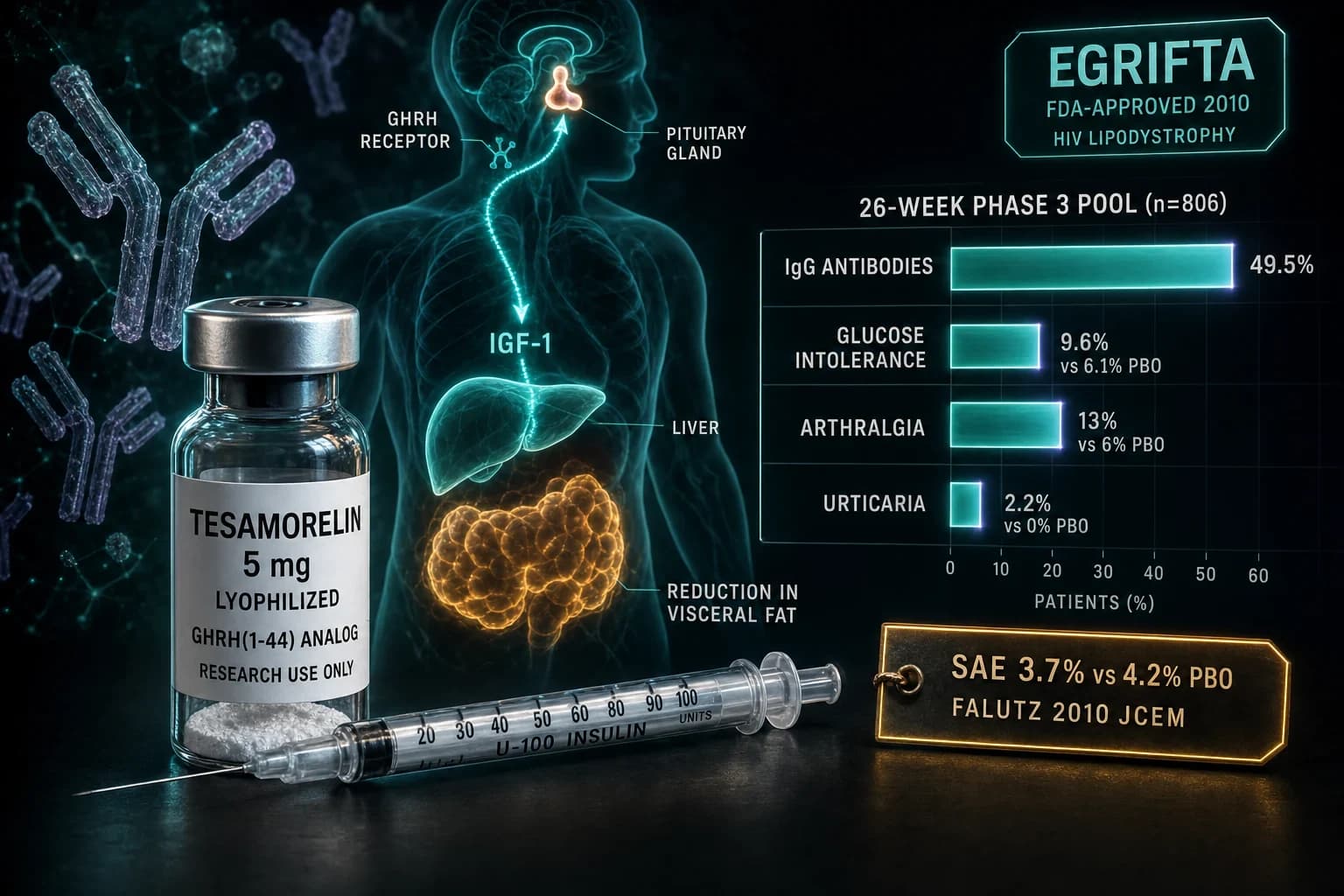
| Wanting more potent or longer-acting GHRH signaling | See sermorelin vs tesamorelin and the three-way GHRH comparison |
| Chasing performance or aesthetics | Neither has trial support for this |
How to read a sermorelin or HGH claim
Four checks cut through most of the marketing.
- Who was studied? Children with diagnosed deficiency, older men with low IGF-I, and healthy adults are three different populations. Results do not transfer between them.
- Which molecule? Plain GHRH(1-29), a modified analog such as the Khorram compound, and recombinant HGH are not interchangeable in a citation.
- What was measured? A higher IGF-I number is a hormone readout. Strength, bone density, and height are outcomes. Many trials only deliver the first.
- How long did it run? Six weeks, 16 weeks, and 24 months answer different questions, and the Khorram IGF-I drift shows why duration matters.
Cost and access
Figures from clinic marketing pages are unverified, so treat cost claims as vendor claims. What can be said structurally: HGH is a regulated prescription biologic, and sermorelin as a pharmaceutical (Geref) was discontinued by its manufacturer, which is why it now circulates mainly as a compounded or research-grade peptide. That makes sourcing quality the main risk on the sermorelin side. A vial is only as good as its certificate of analysis, so read the explainer on what a COA actually tells you and browse the COA library before buying anything.
For research-grade sermorelin, Ascension Peptides is the vendor we have audited in detail (see the Ascension Peptides review). Sermorelin 10mg is in their catalog, and code ENHANCED takes 50% off. Dosing context lives on the sermorelin dosage chart, and the reconstitution calculator handles the unit math. The compound overview is at /peptides/sermorelin.
If the real question is whether a fragment of HGH could be the better tool, that is a separate topic covered in what "HGH 191AA" means.
What to take away
The honest comparison is between a hormone and a signal. HGH is the established treatment for confirmed deficiency. Sermorelin is a physiologic stimulator with a small, aging evidence base and no adult head-to-head against HGH. If a source gives you a confident winner, ask which trial it came from.
This article is for research and educational purposes only. It is not medical advice, and none of the compounds discussed are approved for the uses described. Consult a licensed physician before making any health decision.